Quick answer: Explain SEO progress before rankings move by showing evidence the client can check: the work log against the plan, technical fixes confirmed in Search Console, rising impressions and new queries, non-branded growth, Business Profile actions, tracked leads, and dated milestones. Google’s Maile Ohye said SEO can take four months to a year.
Key takeaways
- SEO progress before rankings move is the set of leading indicators that change in months 1 to 3, while keyword rankings and leads still lag.
- Rankings move late: Google’s Maile Ohye said SEOs need four months to a year, and Ahrefs found only 6.11% of new pages reached the top 10 within a year.
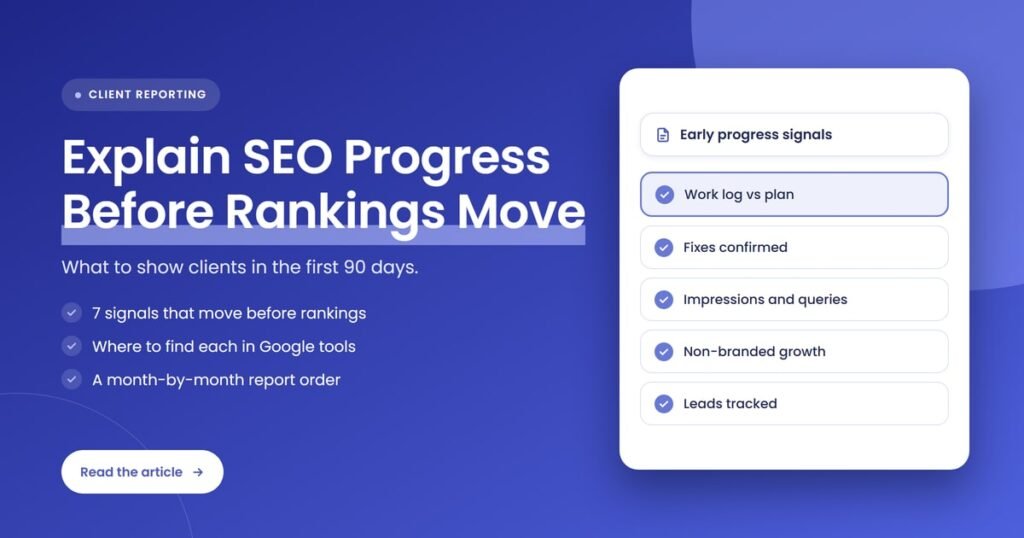
- The 7 ways to explain early SEO progress are the work log, the Page indexing report, impressions and new queries, non-branded queries, Business Profile actions, key events and dated milestones.
- An early progress report should lead with work and fixes in month 1, visibility in month 2 and the first demand signals in month 3.
- After month 6, outcome metrics such as leads and non-branded clicks should replace most early signals.
What is SEO progress before rankings move?
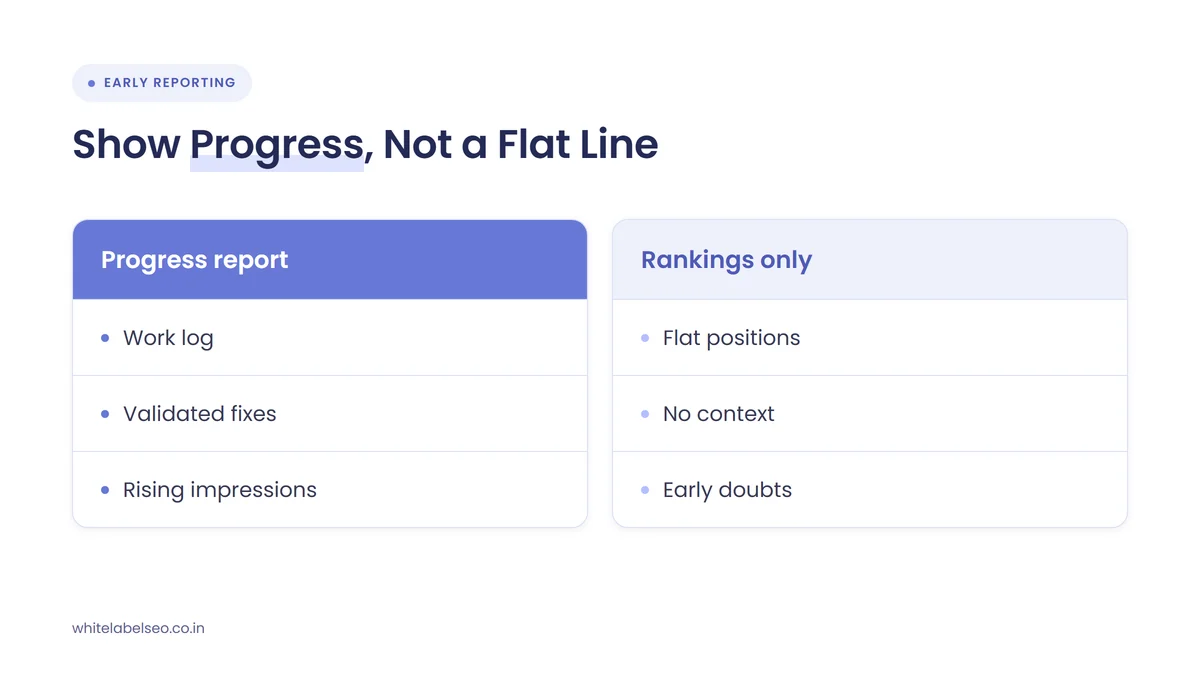
SEO progress before rankings move is measurable change that happens ahead of keyword rankings: completed work, fixed technical issues, more impressions, new search queries and tracked leads. These leading indicators show that the site is being crawled, indexed and shown more often, even while the rankings a client watches have not changed yet.
The difference between leading and lagging signals is the whole point of an early progress report. Rankings, organic clicks and leads are lagging signals: they move last. Impressions, query count and indexed pages are leading signals: they move first and explain why the lagging signals will follow. Agencies that resell white label SEO services need both kinds in the report, because the client pays every month and sees the agency’s logo, not the partner’s, on every update.
Why does SEO progress show up before rankings move?
SEO progress shows up before rankings move because Google needs months to crawl, index, test and trust changes, while impressions and indexing respond in weeks. In most cases, SEOs need four months to a year to implement improvements and then see benefit, according to Google’s Maile Ohye in the 2017 “How to hire an SEO” video reported by Search Engine Roundtable.
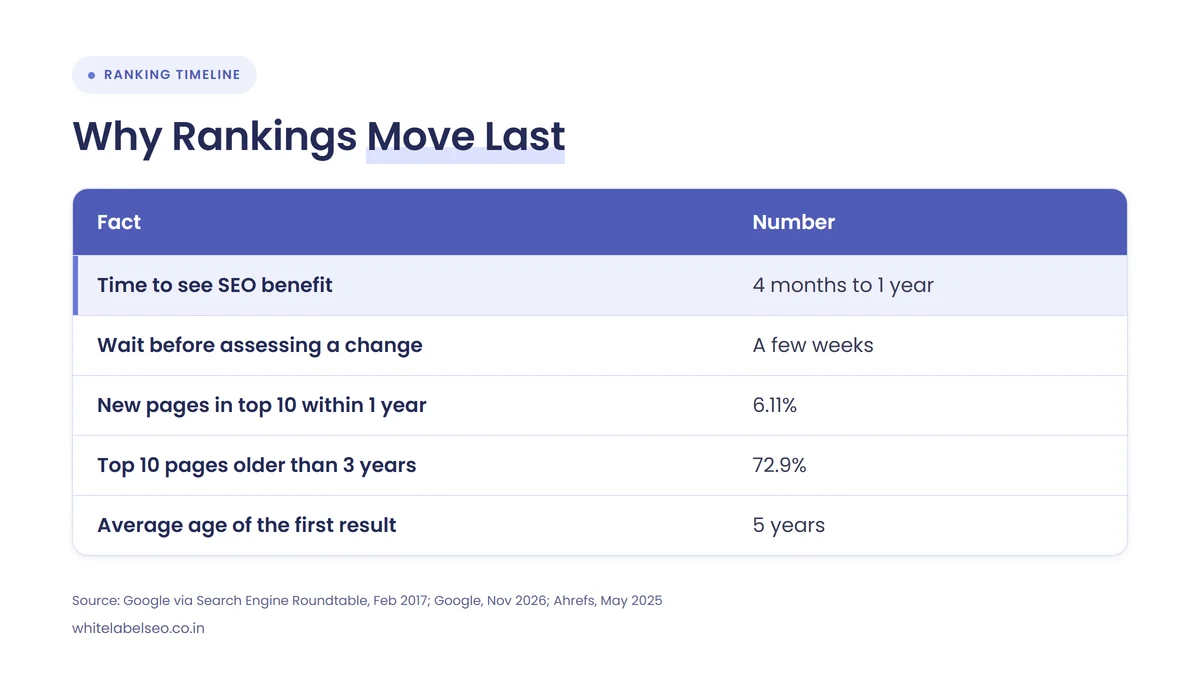
Google Search Central’s SEO Starter Guide gives the shorter part of the timeline: some changes take effect in a few hours, others take months, and you should wait a few weeks to assess whether a change worked. Google’s “Do you need an SEO?” page tells business owners to ask an SEO what results to expect, in what timeframe, and how success is measured. That question is the opening for an early progress report, and it belongs in the onboarding call too, as covered in our guide on how to set SEO expectations with a new client.
The ranking timeline facts an agency can share with clients are listed in the table below.
| Fact | Number | Source |
|---|---|---|
| Time SEOs need to implement improvements and see benefit | 4 months to 1 year | Maile Ohye, Google, via Search Engine Roundtable, Feb 2017 |
| Time for a change to take effect in Google Search | A few hours to months | Google SEO Starter Guide, Nov 2026 |
| Wait before assessing a change | A few weeks | Google SEO Starter Guide, Nov 2026 |
| New pages reaching the top 10 within 1 year | 6.11% of 2 million pages | Ahrefs, May 2025 |
| Top 10 pages older than 3 years | 72.9% | Ahrefs, May 2025 |
| Average age of the page ranking first | 5 years | Ahrefs, May 2025 |
The table shows that a page ranking in its first year is the exception, not the rule. Ahrefs’ study of 2 million filtered English URLs, published by Patrick Stox on May 15, 2025, found 6.11% reached the top 10 within a year, and only 1.74% of a 1 million URL random sample did. A client in month 2 is therefore not behind schedule; the client simply needs evidence that matches the stage of the work.
What are the 7 ways to explain SEO progress to clients before rankings move?
The 7 ways to explain SEO progress to clients before rankings move are a work log, confirmed fixes, impressions and queries, non-branded growth, Business Profile actions, tracked leads and dated milestones. Each one uses data the client can open in Google Search Console, Google Business Profile or Google Analytics, so the progress report does not rest on the agency’s word.
1. Compare the work log with the agreed plan
Compare the work log with the agreed plan to show SEO progress from week 1, because completed deliverables are the first thing a client can verify. List each task promised for the month, its status, the URL it changed and the date it went live, in the same order as the proposal or onboarding plan.
A work log turns “we’re working on it” into a dated record. It also protects the agency when rankings are flat, because the client can see that the plan was delivered on time. Keep the log in the client’s own words: “12 service pages rewritten” is clearer than “on-page optimization.” Before you send it, check the report against these 10 red flags in a white label SEO report, such as tasks with no URL or vague activity lines.
2. Prove technical fixes in the Page indexing report
Prove technical fixes in the Page indexing report in Google Search Console, which shows which pages Google has indexed and why other pages are not indexed. When a fix is made, start validation in the report: Search Console Help says validation typically takes up to about two weeks, and the result is a dated, Google-issued confirmation the client can see.
Explain the indexed page count as a leading indicator: a page Google has not indexed cannot rank. Note the limits too. Example URL lists in the report are capped at 1,000 rows, and Google says the report is probably unnecessary for sites with fewer than 500 pages. For new sites, add context from Google’s John Mueller, covered in our post on why new sites need time to show their value.
3. Report impressions and new queries in Search Console
Report impressions and new queries in Search Console because impressions usually rise before clicks and rankings. Search Console Help defines impressions as how many times your site appeared in search results, and average position as the average position of the topmost result from your site, so rising impressions mean Google is testing the site for more searches.
Show 2 numbers from the Performance report: total impressions, and the count of distinct queries that earned at least 1 impression, each compared with the baseline month. The Performance report shows the past 3 months by default, and its newest data can be preliminary, so compare full months only. A growing query count is the clearest sign that new pages and rewritten pages are being matched to new searches before they rank on page 1.
4. Separate non-branded queries from brand demand
Separate non-branded queries from brand demand so that SEO progress is not hidden by, or confused with, people who already know the client’s name. Google added a branded queries filter to the Search Console Performance report on November 20, 2025, made it available to all eligible sites on March 11, 2026, and added it to the Search Analytics API on November 16, 2026.
Google classifies branded queries with an internal, AI-assisted system, and the filter works only for top-level (domain) properties with enough queries and impressions. Non-branded impressions are the leading indicator that matters most for SEO progress, because they come from people searching for the service, not the brand. For what the new API data means in client reports, read our news post on how Search Console’s API now splits branded and non-branded queries.
5. Show Business Profile actions for local clients
Show Business Profile actions for local clients, because calls, direction requests and website clicks from Google Business Profile can rise before the website ranks. Google Business Profile Help counts calls as the number of times a customer clicked the call button on the profile, and directions as how many people asked for directions to the business.
Report the 3 Business Profile actions side by side with the month the profile work was done: categories, services, photos, posts and review replies. Google counts only taps on the call button, so calls dialed by hand are missing from the number; say so in the report. Profile work is one of the local SEO tasks an agency can white label, and it gives local clients the earliest visible return.
6. Track leads as key events in Google Analytics
Track leads as key events in Google Analytics in month 1, so that the first organic lead is counted the day it arrives. Google Analytics Help defines a key event as an event that measures an action that’s particularly important to the success of your business, such as a form submission, a call click or a booking.
The tracking setup is itself SEO progress worth reporting: “form, call and booking key events are live and tested on 3 devices” is a deliverable. Filter key events to the Organic Search channel, record the month 1 baseline even if it is zero, and show the trend from month 2. A client who sees a working measurement plan trusts the later lead numbers.
7. Set dated milestones for when rankings should move
Set dated milestones for when rankings should move, so the client knows what to expect at day 30, day 60 and day 90 and when rankings are realistically due. Use Google’s four months to a year as the outer range, and tie each milestone to a signal from items 1 to 6, not to a single keyword position.
Dated milestones work best as 3 short statements per review, for example: by day 30, the plan is delivered and fixes are validated; by day 60, impressions and the query count are above the baseline; by day 90, non-branded impressions and the first organic key events are tracked. Google Search Central suggests checking Search Console about once a month, which matches a monthly milestone review.
How should an SEO progress report change from month 1 to month 3?
An SEO progress report should change from work in month 1, to visibility in month 2, to the first demand signals in month 3, following the order in which each signal can move. The order keeps every report honest: it never claims a result before the work could have produced it.
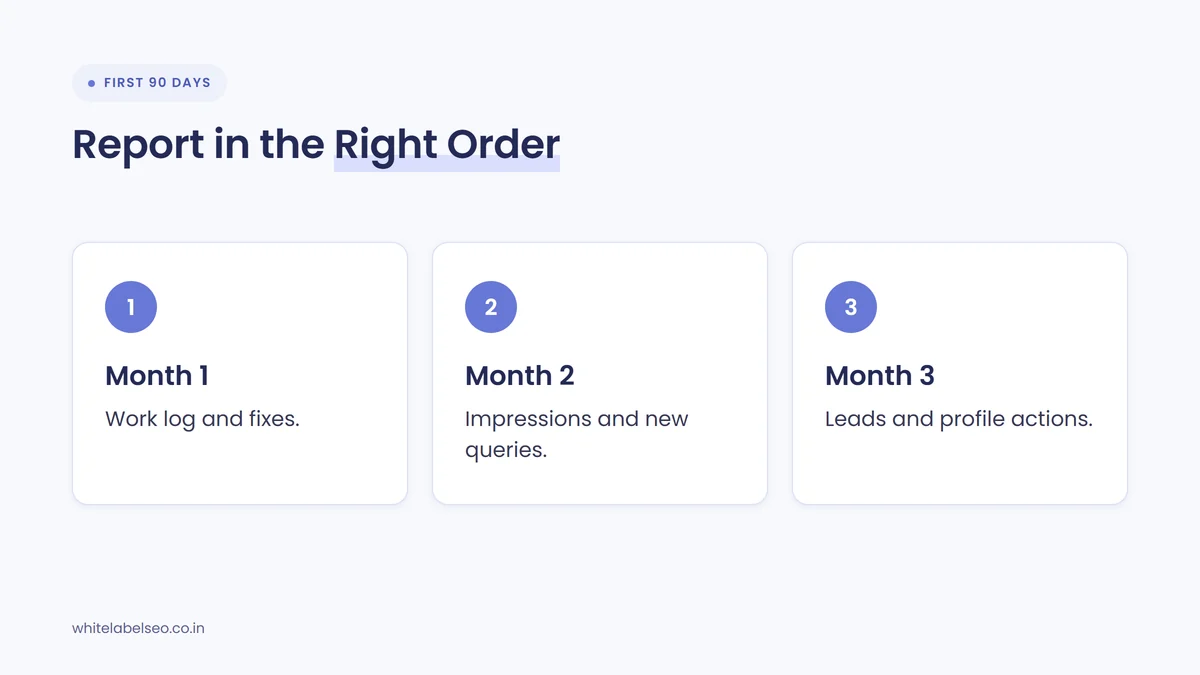
The report focus for each of the first 90 days is listed below.
- Month 1, work and fixes: the work log against the plan, technical fixes in validation, the baseline for impressions, queries and key events.
- Month 2, visibility: impressions and the distinct query count against the baseline, indexed pages, and non-branded impressions where the filter is available.
- Month 3, first demand signals: Business Profile actions, organic key events, and pages starting to earn clicks, plus the dated milestones for months 4 to 6.
Sitechecker’s 2026 SEO agency growth report, a survey of 73 agencies published on March 11, 2026, found that 93.2% use Google Search Console and 17.8% name client churn as a growth constraint. The first 90 days are where that churn starts, which is why our guide to reduce SEO client churn in the first six months uses the same month-by-month review.
Which metrics should replace early SEO progress signals after month 6?
Outcome metrics should replace early SEO progress signals after month 6: organic leads as key events, non-branded clicks, Business Profile actions and AI search visibility. Leading indicators explain the first months; by month 6, the client expects the lagging results they pay for, and the report order should flip to put outcomes first.
Keep 1 or 2 leading indicators in the later report, such as the distinct query count, as an early warning for drops. The full list for a mature monthly report is in our guide to the 9 metrics agencies should report to SEO clients.
Frequently asked questions
How long before a client sees SEO results?
A client usually sees SEO results in rankings and leads after 4 months to a year, the range Google’s Maile Ohye gave in 2017. Leading indicators such as indexed pages and impressions can move within weeks, which is why early reports should show those first.
Should you report keyword rankings in the first 3 months?
Yes, you can report keyword rankings in the first 3 months, but as a baseline, not as the headline. Put rankings below the work log, fixes and impressions, and explain that Ahrefs found only 6.11% of new pages reach the top 10 within a year.
What if impressions fall in the first months?
If impressions fall in the first months, check the cause before the report goes out: removed or redirected pages, a Google update, a tracking change or seasonality. Explain the cause in one sentence, show the fix and the date it was made, and track the next full month.
Can a white label SEO partner supply SEO progress evidence?
Yes, a white label SEO partner can supply SEO progress evidence, including the work log, validated fixes and Search Console data, in a report your agency brands as its own. Agree the report order and the baseline month with the partner before the first client month starts.
Is it normal to see no new leads in month 1?
Yes, it is normal to see no new leads from SEO in month 1, because Google’s SEO Starter Guide says changes can take months to show an effect. Report the key event setup and the baseline instead, so the first organic lead is measured when it arrives.
What SEO progress evidence should you send clients this month?
Send clients the evidence that matches their month: the work log and fixes in month 1, impressions and new queries in month 2, and non-branded growth, Business Profile actions and key events in month 3, each with a dated milestone for when rankings should move. Every item in that list is something the client can open and check, which is what keeps the retainer safe while rankings catch up.
At White Label SEO, our white label SEO services include monthly reports in this order, ready to send under your agency’s brand.
Need progress reports your clients can check?
We deliver white-label SEO under your agency’s brand, with a work log, validated fixes and Search Console data in every monthly report. Talk to us about the first 90 days for your next client.
Sources
- Search Engine Roundtable, “Google: Give SEOs 4-12 Months To See Positive Ranking Benefits”, February 16, 2017. https://www.seroundtable.com/google-give-seos-4-12-months-23419.html
- Google Search Central, “SEO Starter Guide”, accessed November 18, 2026. https://developers.google.com/search/docs/fundamentals/seo-starter-guide
- Google Search Central, “Do you need an SEO?”, updated June 5, 2026. https://developers.google.com/search/docs/fundamentals/do-i-need-seo
- Ahrefs (Patrick Stox), “How Long Does It Take to Rank in Google?”, May 15, 2025. https://ahrefs.com/blog/how-long-does-it-take-to-rank/
- Search Console Help, “Page indexing report”, accessed November 18, 2026. https://support.google.com/webmasters/answer/7440203
- Search Console Help, “Performance report (Search results): Overview and basic setup”, accessed November 18, 2026. https://support.google.com/webmasters/answer/7576553
- Google Search Central Blog, “Introducing the branded queries filter in Search Console”, November 20, 2025 (updated March 11, 2026). https://developers.google.com/search/blog/2025/11/search-console-branded-filter
- Google Search Central Blog, “New filtering and reporting capabilities in the Search Analytics API”, November 16, 2026. https://developers.google.com/search/blog/2026/11/search-analytics-api-update
- Google Business Profile Help, “Understand your Business Profile performance & insights”, accessed November 18, 2026. https://support.google.com/business/answer/9918094
- Google Analytics Help, “About key events”, accessed November 18, 2026. https://support.google.com/analytics/answer/9267568
- Google Search Central, “Get started with Search Console”, accessed November 18, 2026. https://developers.google.com/search/docs/monitor-debug/search-console-start
- Sitechecker (Ivan Palii), “The 2026 SEO agency growth report”, March 11, 2026. https://sitechecker.pro/seo-agency-growth-data-study-2026/