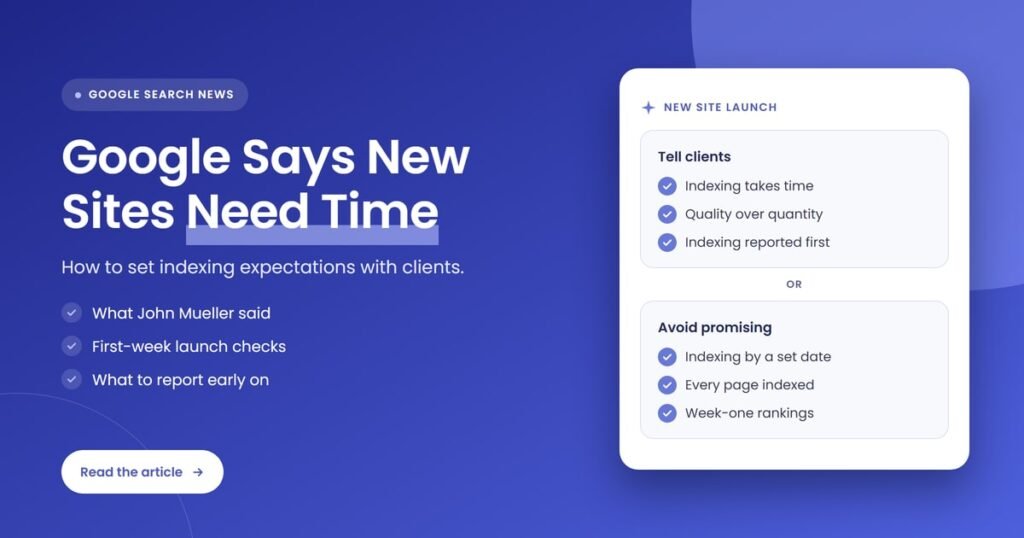
Quick answer: Google’s John Mueller says it can take time for Google’s systems to understand the unique value of a new site, so not every page gets indexed or ranks straight away. Agencies should tell clients this before launch, focus on crawlable, high-quality pages and a sitemap, and report indexing progress before rankings or leads.
Key takeaways
- In a Bluesky reply reported by Search Engine Roundtable on November 10, 2026, John Mueller said “it can take time for the systems to understand the unique value” of a new site.
- Mueller advised making the site “really top notch (quality over quantity)” and recommended focusing on normal crawling and indexing rather than the Request Indexing button.
- Google’s own documentation says crawling can take a few days to a few weeks, and that not every page will be indexed.
- Agencies should set expectations before launch, check crawlability and the sitemap in the first weeks, and report indexing coverage before rankings.
- The November 2026 core update began rolling out on November 10, so early data for any site launched now may be noisier than usual.
What did John Mueller say about new sites?
John Mueller of Google said a new site can take time to be understood. Replying on Bluesky to a site owner whose Search Console indexing requests kept failing, he said “it can take time for the systems to understand the unique value of it all,” and suggested making the site “really top notch (quality over quantity).”
The question came from the owner of a fairly new site. They said every “Request indexing” attempt in Google Search Console failed with an error message, even the first attempt of the day, while their sitemap of 644 URLs had been discovered without problems and there were no manual actions. Search Engine Roundtable covered the exchange on November 10, 2026.
Mueller said he would pass the error on. His wider advice was the part that matters for agencies:
- Normal crawling first: “I’d recommend focusing on normal crawling and indexing,” rather than relying on manual indexing requests.
- Time is part of the process: he described the site as fairly new and busy with content, and said the systems need time to understand its unique value.
- Quality over quantity: his advice was to make sure the content is “really top notch,” not to publish more of it.
None of this is new policy. It matches what Google’s documentation has said for years, which is exactly why it is useful: it is a fresh, on-the-record statement agencies can point to when a client asks why their new site isn’t showing up yet.
What does it mean for Google to understand a new site’s unique value?
It means Google has to crawl the pages, process what they contain and decide whether they add something its index doesn’t already have. Google says indexing depends on the content of the page and its metadata, and that not every page it processes will be indexed. For a new site with no history, that judgment takes time.
Three terms are worth defining for clients, because they often get used as if they mean the same thing:
- Crawling: Google’s crawler finds and downloads pages. Google discovers new URLs by following links from pages it already knows and from sitemaps the site owner submits.
- Indexing: Google analyzes a crawled page and may store it in its index. Google’s guide states plainly that not every page it processes will be indexed.
- Ranking (serving): when someone searches, Google chooses which indexed pages to show and in what order. Being indexed is a requirement, not a promise of visibility.
“Unique value” is Mueller’s phrase, not a named Google system. We read it as a plain description of the question every new page has to answer: why should this page be in the index next to the pages already there? A new site that publishes many similar pages quickly gives Google more to process and less reason to index all of it.
Why can a new website take time to get indexed and rank?
A new website has few links pointing to it, no track record and often many pages arriving at once. Google says crawling alone can take a few days to a few weeks, and that it makes no promise to crawl, index or serve any page. Ranking comes after all of that, and Google publishes no timeline for it.
Each stage has its own reasons for delay, and each one needs a different answer for the client:
| Stage | What Google’s documentation says | What the agency can do | What to tell the client |
|---|---|---|---|
| Discovery | New URLs are found through links from known pages and through sitemaps | Submit an XML sitemap and link every key page from the site’s own navigation | “Google needs to find each page first, and we’ve made that easy.” |
| Crawling | Crawling can take anywhere from a few days to a few weeks | Check robots.txt, noindex tags and server errors in the first week | “A wait of days or weeks is normal and not a sign of a problem.” |
| Indexing | Not every page Google processes will be indexed | Review the Page indexing report and improve thin or duplicate pages | “Not every URL will be indexed, and that can be fine.” |
| Ranking | No timeline is given, and no one can promise a ranking | Build useful content and earn genuine links and mentions over time | “Rankings follow indexing, and we’ll report them once there is data.” |
The Search Console Help page for the Page indexing report is direct on this point: “Don’t expect every URL on your site to be indexed.” It says only canonical pages should be expected in the index, and that a status such as “Crawled – currently not indexed” doesn’t necessarily indicate an issue that needs attention. That is a helpful line to quote to a worried client.
Does the Request Indexing button speed things up?
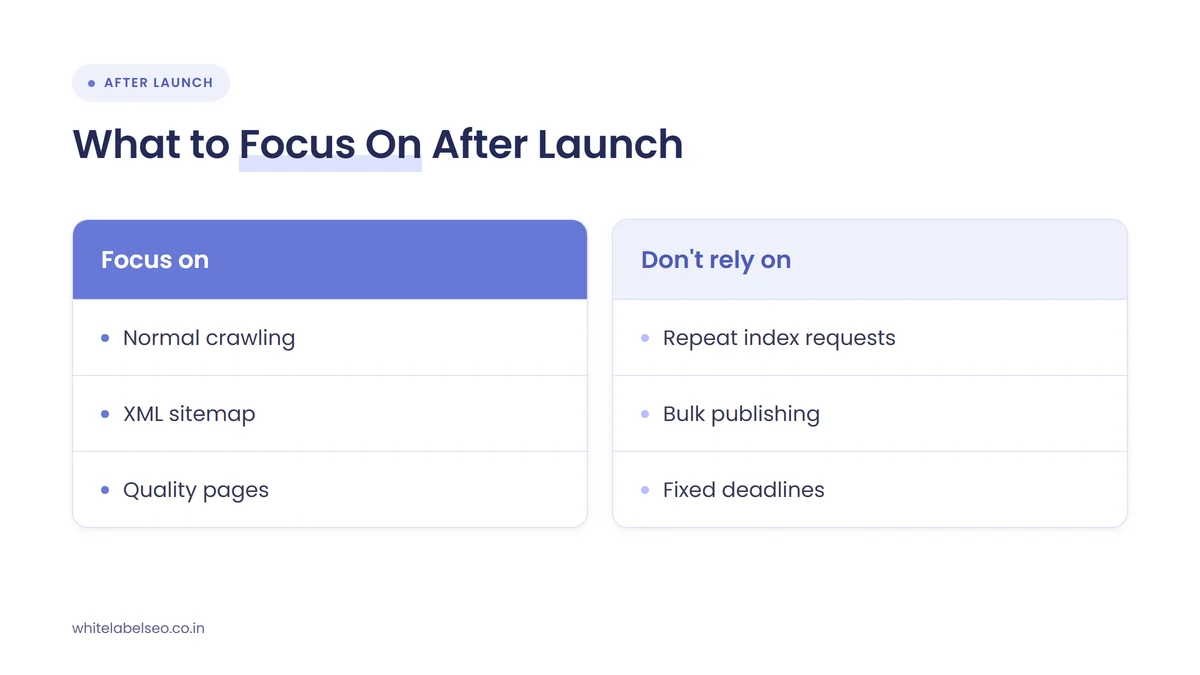
Not in any reliable way. Google says requesting a recrawl multiple times for the same URL won’t get it crawled any faster, and that a crawl request may not lead to inclusion in search results quickly, or at all. Mueller’s advice was to focus on normal crawling and indexing instead of manual requests.
Request Indexing, found in the URL Inspection tool in Search Console, has a quota for individual URLs. It is useful for a handful of important pages, such as a homepage after a fix. For a launch with dozens or hundreds of pages, Google’s documentation says to submit a sitemap instead.
This matters for agencies because clients often see the button as a way to “force” Google. If a client or a junior team member spends launch week clicking it on every page, the agency should redirect that effort to the things Google says it uses: internal links, a clean sitemap and pages worth indexing. Search Engine Roundtable notes Google has discouraged using the feature to force indexing before.
What should agencies tell clients launching a new site?
Tell clients before launch that indexing and rankings take time, that Google doesn’t promise to index every page, and that the first weeks are about getting pages crawled, not about traffic. Then explain what the agency will check, what it will report and when, so the waiting period has a visible plan behind it.
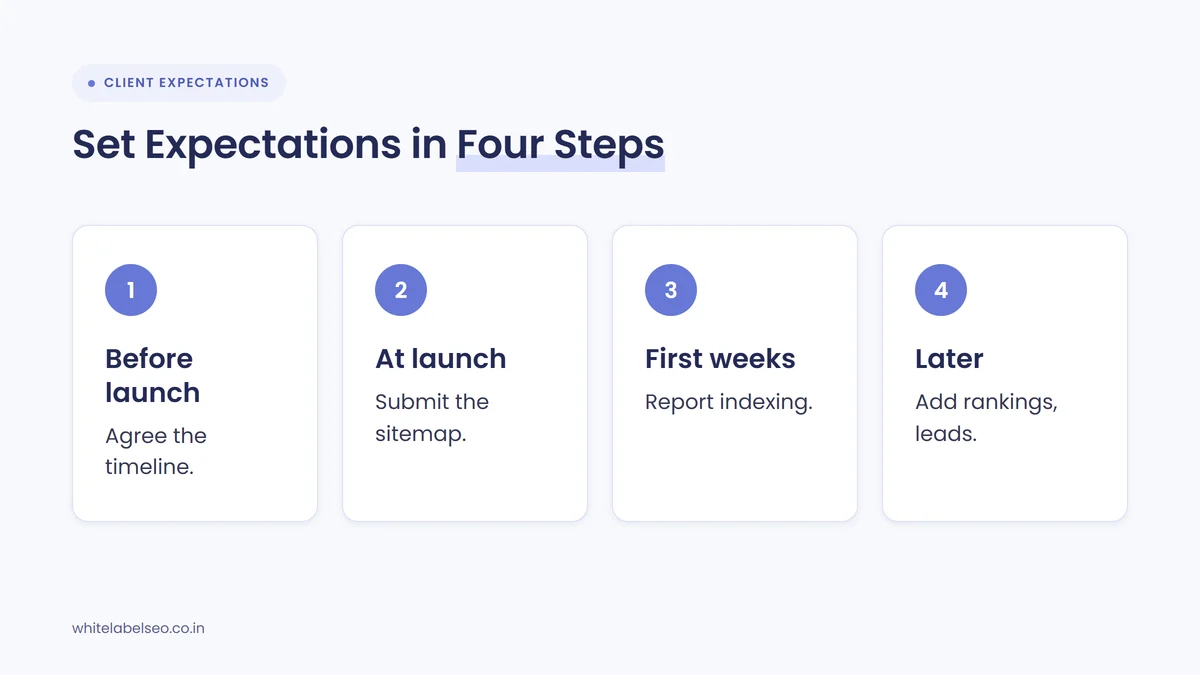
- Before launch: set the timeline in writing. Say that crawling can take a few days to a few weeks, according to Google, and that rankings come after indexing with no published timeline. Put it in the proposal or onboarding note, not just on a call. Our guide on how to set SEO expectations with new clients covers the wording for that first conversation.
- At launch: explain what you submitted. Tell the client the sitemap is in Search Console, which pages matter most and how they are linked from the site’s navigation.
- In the first weeks: share indexing progress. Show how many key pages are indexed, which are discovered but not yet crawled, and what you are doing about any errors.
- After the first months: move to rankings and leads. Once the important pages are indexed and collecting impressions, shift the report toward queries, rankings and enquiries.
A short client message for launch week could read: “Your new site is live and we’ve submitted it to Google. Google says crawling can take a few days to a few weeks, and it doesn’t index every page on every site. Our focus now is making sure your most important pages are found and indexed. We’ll share an indexing update in two weeks and start reporting rankings once there is enough data.”
Web design agencies hear this question most, because the launch is where their project ends and the SEO work begins. If that is your agency, our post on turning website launches into SEO retainers shows how to sell the months after launch as their own phase.
What should agencies do in the first weeks after a new site launches?
In the first weeks, check that Google can reach and read every important page, submit a sitemap, link key pages from the navigation and fix anything blocking indexing. Then focus on the quality of the core pages rather than publishing more. That follows both Google’s documentation and Mueller’s quality-over-quantity advice.
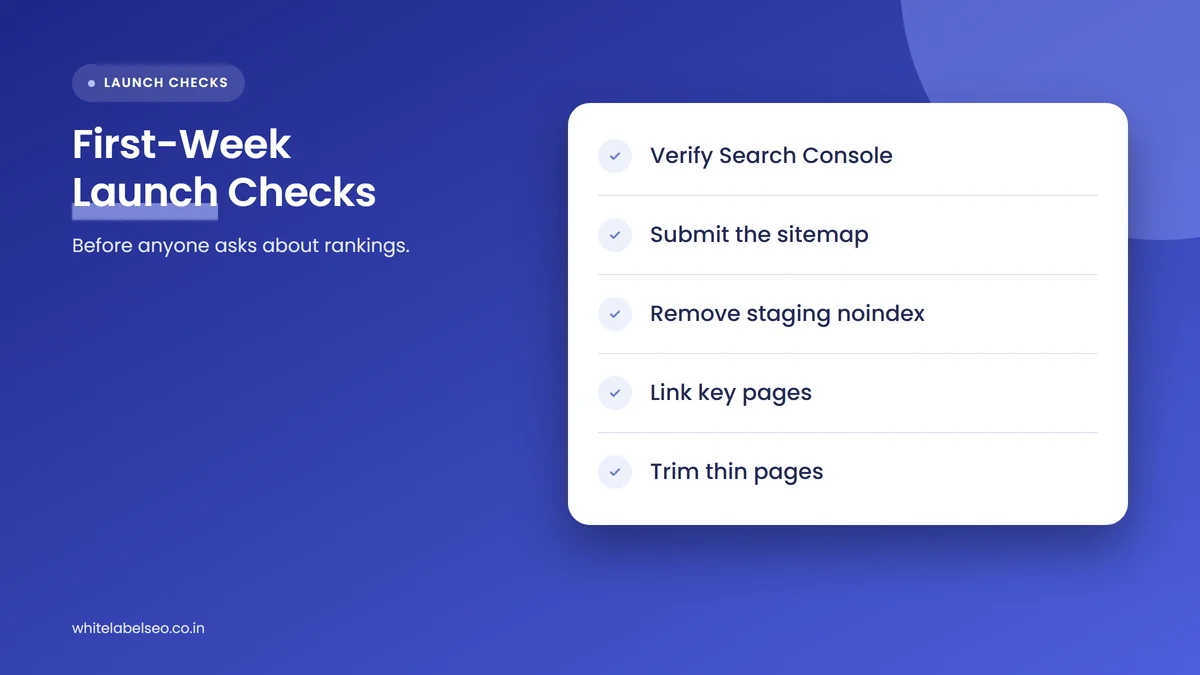
- Verify the site in Search Console on launch day, so data starts collecting from the beginning.
- Submit an XML sitemap listing only the canonical pages you want indexed. Google’s sitemap guide says a sitemap helps when a site is new and has few external links, but that it can’t ensure every item in it will be crawled and indexed.
- Check for leftover staging settings. A noindex tag or a blocking robots.txt rule left over from the development site can keep a new site out of the index entirely.
- Link every important page internally. Google discovers pages by following links from pages it already knows, so orphaned pages are slower to find.
- Inspect a few key URLs. Use the URL Inspection tool on the homepage and main service pages to confirm Google can fetch them, and request indexing only for those.
- Trim thin or near-duplicate pages. If the site launched with many pages that say almost the same thing, consolidating them gives Google a clearer picture of the site’s value.
The last point is where Mueller’s comment is most practical. A site that launches with a few strong pages and adds more steadily is easier to explain, easier to maintain and closer to what he described than a site that publishes hundreds of thin pages in its first week.
What should agencies report in the first months?
Report indexing first, then impressions, then rankings and leads. In the early weeks, the honest numbers are how many key pages are indexed, which pages are excluded and why, and whether impressions are starting to appear in Search Console. Rankings and traffic for a new site usually need more time before they mean much.
A simple order for early reports:
- Indexing coverage: indexed pages from the Page indexing report, with the main reasons for any excluded pages explained in plain English.
- Technical fixes: what was found and fixed, such as a stray noindex tag or a broken sitemap entry.
- Early impressions: which pages and queries are starting to show in the Search Console Performance report.
- Content work: which core pages were improved, and what is planned next.
- Rankings and leads: introduced once there is enough data to show a trend, not reported as zero in week one.
Our list of metrics agencies should report to SEO clients shows how these early numbers fit into a full monthly report later on.
How does the November 2026 core update affect a new site’s early data?
Google released the November 2026 core update on November 10, 2026, and says it applies globally and to all languages, with a rollout that could take up to two weeks. Rankings across many sites can move during that period, so a site launching now may see more early movement than usual.
For clients launching this month, say so directly: some ups and downs in the first weeks may reflect the core update rollout rather than anything about their new site. Avoid drawing conclusions from day-to-day changes until the rollout is complete. If an established client sees a drop during the same period, our guide on handling a ranking drop after a core update covers that separate conversation.
Does the same apply when a client moves to a new domain?
Partly. A domain move is not the same as a brand-new site, because Google already knows the old pages. Google’s site move guide says a small to medium-sized site can take a few weeks for most pages to move, larger sites take longer, and visibility may fluctuate temporarily during the move.
The client message is similar, with two additions. First, the redirects from old URLs to new ones carry the history across, and Google recommends keeping them for as long as possible, generally at least a year. Second, some fluctuation during the move is expected and documented, so it should be in the plan before the switch, not explained after a client notices it.
What should agencies avoid saying about new site indexing?
Avoid promising a date for indexing or rankings, promising that every page will be indexed, or suggesting that a tool or a button can force Google to index a site. Each of these goes further than Google’s own documentation, and each one becomes a problem if the client remembers it.
- “Google will index the site within a week.” Google says crawling can take a few days to a few weeks and that not every page will be indexed.
- “Every page will be in Google.” Google says not to expect every URL to be indexed.
- “We’ll submit every page manually to speed it up.” Google says repeated requests won’t make crawling faster, and Mueller recommended normal crawling instead.
- “More pages will help Google notice the site.” Mueller’s advice was quality over quantity.
Clients who push for a firm date are usually worried about the return on their spend. Our post on proving SEO ROI to clients when results take months covers how to show progress while they wait.
Frequently asked questions
How long does it take Google to index a new website?
Google doesn’t give a fixed time. Its documentation says crawling can take anywhere from a few days to a few weeks, and that not every page will be indexed. John Mueller said in November 2026 that it can take time for Google’s systems to understand the unique value of a new site.
Why are some pages on a new site not indexed?
Google doesn’t index every page it finds. Its Page indexing report help says not to expect every URL to be indexed, only canonical pages. Pages may be waiting to be crawled, may be technically blocked, or may be too similar to other pages to add new value.
Should you use Request Indexing for every page on a new site?
No. Google says requesting a recrawl multiple times won’t make it faster, and there is a quota for individual URLs. Submit a sitemap for the full site, use Request Indexing only for a few key pages, and focus on normal crawling and indexing as John Mueller recommended.
Does a sitemap get a new site indexed?
A sitemap helps Google discover pages, especially on a new site with few external links, but Google says it can’t ensure that every page in it will be crawled and indexed. It is one part of the setup, alongside internal links and pages worth indexing.
What should an agency report to a client with a new website?
Start with indexing coverage, technical fixes and early impressions from Search Console. Add rankings, traffic and leads once there is enough data to show a trend. Reporting zero rankings in week one makes normal progress look like failure.
What should you do next?
Add a short indexing note to every new site proposal and launch plan, using Google’s own wording on crawling time and indexing. Run the first-week checks, report indexing before rankings, and flag the November 2026 core update to any client launching this month. If you want a partner to handle launch SEO and reporting under your agency’s brand, see our white-label SEO services at White Label SEO.
Want new client sites handled from launch day?
At White Label SEO, we handle launch checks, indexing reviews and monthly reporting under your agency’s brand, with every figure labeled by its source so you can explain the early weeks to clients clearly. Tell us about your next launch, and we’ll show you how we’d support it.
Sources
- Search Engine Roundtable (Barry Schwartz), “Google: It Can Take Time To Understand The Unique Value Of New Websites”, November 10, 2026. https://www.seroundtable.com/google-new-sites-time-value-42489.html
- John Mueller (@johnmu.com) on Bluesky, reply on new site indexing, November 9, 2026. https://bsky.app/profile/johnmu.com/post/3mzu7fu2xbc2f
- Google Search Central, “In-Depth Guide to How Google Search Works”, accessed November 11, 2026. https://developers.google.com/search/docs/fundamentals/how-search-works
- Google Search Central, “Ask Google to recrawl your URLs”, accessed November 11, 2026. https://developers.google.com/search/docs/crawling-indexing/ask-google-to-recrawl
- Google Search Central, “What Is a Sitemap”, accessed November 11, 2026. https://developers.google.com/search/docs/crawling-indexing/sitemaps/overview
- Search Console Help, “Page indexing report”, accessed November 11, 2026. https://support.google.com/webmasters/answer/7440203
- Google Search Central, “How to move a site”, accessed November 11, 2026. https://developers.google.com/search/docs/crawling-indexing/site-move-with-url-changes
- Google Search Status Dashboard, “November 2026 core update”, November 10, 2026. https://status.search.google.com/incidents/WLxcJyC6jMWMfryxsKMc