Quick answer: In the first 30 days, tell a new SEO client what you will fix first, when they will see each kind of progress, which numbers you will report, and what nobody can promise. Explain that rankings and leads build over months, that AI answers now reduce clicks, and that the day-30 review checks the work, not the final results.
Key takeaways
- Early churn often starts with a gap between what the client expected and what month one looks like. Close that gap in writing during the first week.
- Give the client a phase-by-phase view of progress: work completed first, then early visibility signals, then leads. Google itself says some changes take hours and others take several months.
- Agree on three to five numbers you will report, where each one comes from, and how often it arrives, before the first report goes out.
- Explain AI search early. Studies from Pew and Ahrefs show fewer clicks when an AI Overview appears, and Search Console’s AI reports show impressions only.
- Book a day-30 review on day one. It turns the first month into a shared checkpoint instead of a test the client grades alone.
What does setting SEO expectations mean?
Setting SEO expectations means agreeing with a new client, in plain language and in writing, on what work happens when, what progress each month should look like, how it will be measured and what is outside anyone’s control. It is the bridge between the proposal the client signed and the first report they read.
The proposal sells the plan. Expectation setting happens after the signature, when the client starts asking “so what happens now?” If you want the pre-sale side, our guide to writing an SEO proposal that wins retainers covers scope, pricing and the AI search paragraph that belongs in the document. This post picks up on day one.
Why do new SEO clients leave in the first few months?
New SEO clients usually leave early because month one does not look like what they pictured. They expected rankings or calls, and they got an audit, technical fixes and a report full of unfamiliar terms. Nobody told them that this is what a healthy first month looks like, so the silence reads as failure.
The patterns repeat across agencies of every size:
- The sales call promised speed. A rushed “you’ll see results quickly” becomes the yardstick for every report that follows.
- The client measures traffic only. With AI answers taking some clicks, a traffic-only client can see good work as a decline.
- Nobody explained the order of work. Clients don’t know that technical fixes and page updates come before ranking movement.
- The first report arrives with no context. A dashboard of impressions and positions means little to a business owner who wanted phone calls.
- The client’s own tasks stall. Missing logins, slow content approvals and no access to the website delay the plan, and the client blames the agency.
Clients also want to see a link to money. In the AgencyAnalytics 2026 Marketing Agency Benchmarks Report, based on 494 agency responses, 55% of agencies said the question they hear most from clients is whether marketing performance can be connected to revenue. If you don’t set up that connection in month one, the client will ask about it in month three, usually in a less friendly tone.
What should you tell a new SEO client in the first 30 days?
Tell a new SEO client four things in the first 30 days: what you found and what you will fix first, when each type of progress usually shows up, which numbers you will report and where they come from, and what no one can promise. Say it on a kickoff call, then send it as a short written summary.
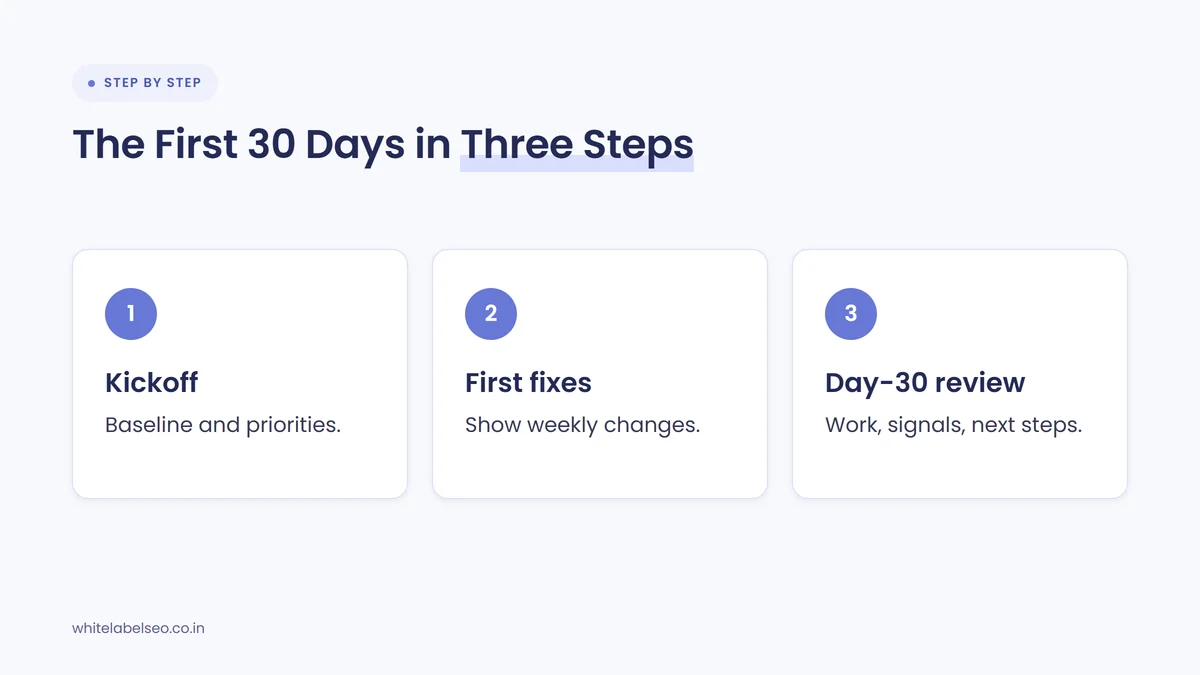
Here is how we split the first month. Adjust the timing to your own onboarding, but keep the order.
| When | What the team does | What you tell the client |
|---|---|---|
| Days 1 to 3 | Kickoff call, access to Search Console, analytics, the website and Google Business Profile, baseline snapshot | “Here is where you stand today. Every future report compares against this.” |
| Week 1 | Technical and content audit, priority list, agreed list of target pages and search terms | “These are the three to five issues that matter most, in the order we will fix them.” |
| Weeks 2 to 3 | First fixes: indexing problems, page titles, key service pages, profile updates, conversion tracking | “Here is what we changed this week. Google needs time to recrawl and reassess these pages.” |
| Week 4 | First report and day-30 review call | “This is the work completed, the early signals and the plan for months two and three.” |
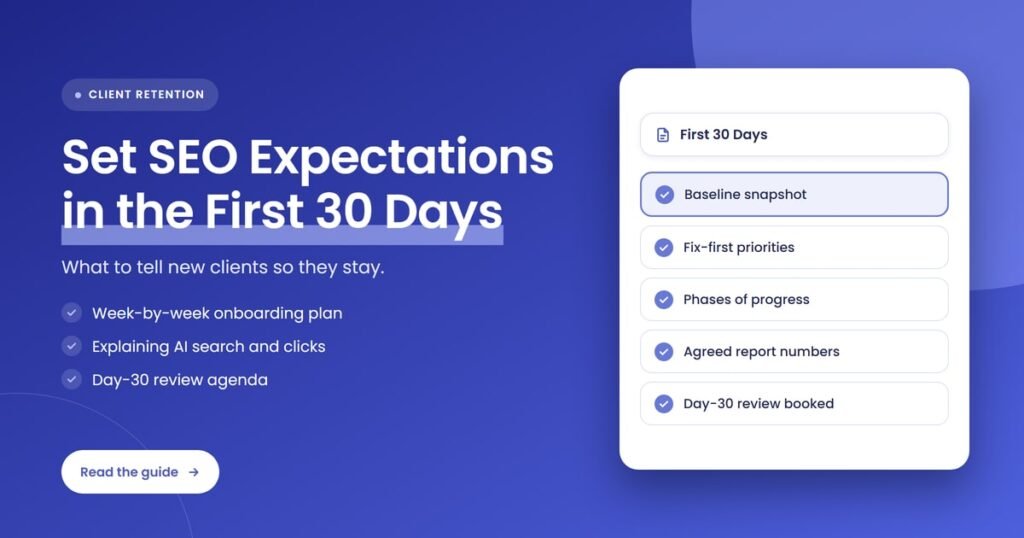
Put the summary in an email after the kickoff call. A written version protects both sides: the client has something to forward to their business partner, and your team has a record of what was agreed. Keep it to one page:
- Starting point: the baseline numbers and the main problems found.
- First priorities: what gets fixed in month one, and why it comes first.
- What progress looks like: the phases in the next section, in your own words.
- What we will report: the agreed metrics, the source of each one and the reporting date.
- What we need from you: logins, approvals and a named contact, with dates.
- What no one can promise: a set ranking position, a traffic number or a place in any AI answer.
How long should you tell a client SEO will take?
Tell a client that SEO progress arrives in phases rather than on one date. Google’s SEO Starter Guide says some changes take effect in a few hours and others take several months, and suggests waiting a few weeks before judging a change. Explain which signals come first and which take longer, and avoid naming a fixed month for results.
Google doesn’t publish a standard SEO timeline. Its “Do you need an SEO?” page instead tells business owners to ask an SEO what results to expect and in what timeframe, and how success is measured. Your clients may have read that page. Have an answer ready that is honest about phases and specific about measurement.
We explain it to clients as three kinds of progress, each with its own evidence:
| Phase | What changes | How the client can see it |
|---|---|---|
| Work completed | Fixes, new and updated pages, profile improvements, tracking set up | A dated list of deliverables in every report |
| Early visibility signals | Pages indexed, impressions rising, more search terms showing the site, movement on priority terms | Search Console trends compared with the baseline |
| Business results | More calls, form fills, bookings or sales from organic search | Conversion tracking in analytics, call tracking or the client’s CRM |
How fast each phase arrives depends on the site’s history, the competition, the budget and how quickly the client approves work. Say that plainly. A client who understands why the timeline varies will accept “it’s moving in the right direction” far more easily than one who was given a date.
How do you explain AI search and lower clicks to a new client?
Explain AI search by telling the client that Google now answers some questions directly with AI Overviews and AI Mode, so a page can be seen without being clicked. Then show which reports capture that visibility and how leads are tracked. Saying this in month one stops a flat traffic line from looking like failure later.
The research is consistent enough to share:
- Pew Research Center tracked 68,879 Google searches by 900 US adults in March 2025. People clicked a traditional result in 8% of visits when an AI summary appeared, compared with 15% when none did.
- Ahrefs reported in February 2026 that an AI Overview correlates with a 58% lower average clickthrough rate for the top-ranking page, comparing 300,000 keywords between December 2023 and December 2025.
Search Console now gives you something to show. Google introduced generative AI performance reports in June 2026 and rolled them out to all websites worldwide by August 31, 2026. They show how often a site’s URLs appeared in AI Overviews, AI Mode and generative AI features in Discover. The announcement describes impressions, not clicks, which is why our post on what to tell clients about the missing click data matters for month-one conversations.
Tell clients the reporting itself will change too. In September 2026, Google’s John Mueller said position and impression tracking for AI features would evolve over time and acknowledged edge cases in how they are counted, as Search Engine Roundtable reported. That is a good reason to agree on business outcomes as the main measure from day one.
Clients will also ask what extra work AI search needs. Google’s documentation says there are no additional requirements to appear in AI Overviews or AI Mode. The same fundamentals apply, which keeps the plan you just explained intact.
What should the day-30 review cover?
The day-30 review should cover the work completed against the plan, the early signals compared with the baseline, anything blocking progress on either side, and the priorities for months two and three. It is a checkpoint on the plan, not a verdict on results, and the client should hear that before the call starts.
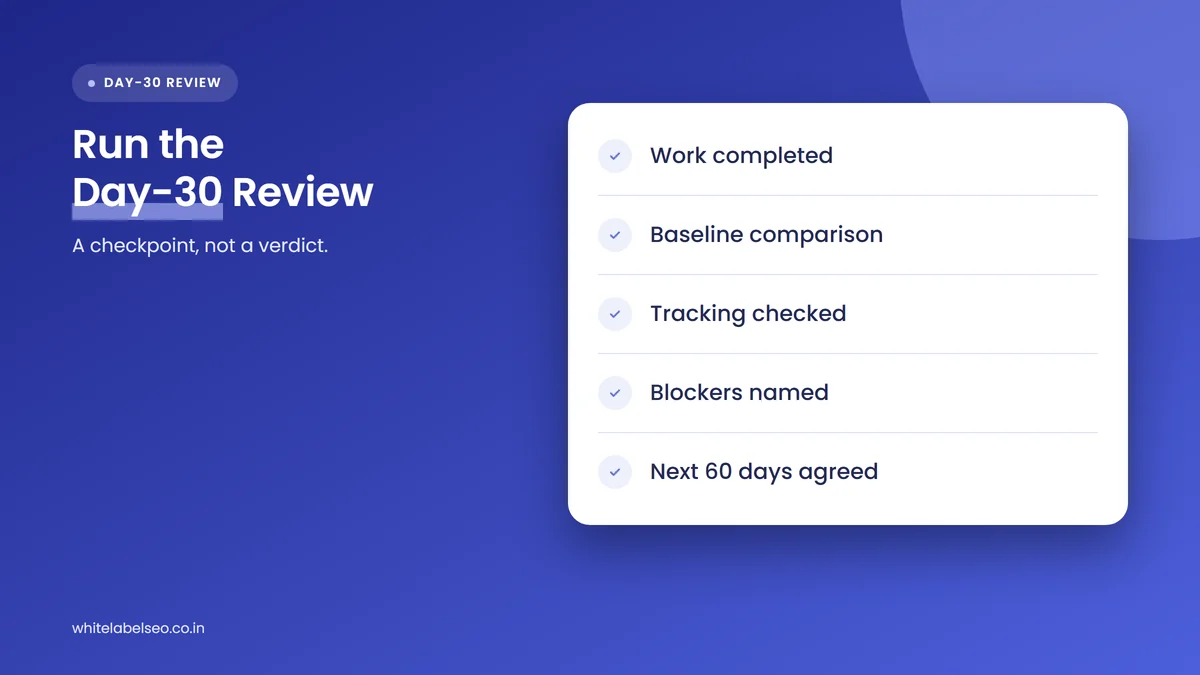
A simple agenda keeps the call to 30 minutes:
- Recap the goal. One sentence on what the client wants from search, in their words.
- Show the work. Every deliverable from the scope, with dates and links to the changed pages.
- Compare with the baseline. Indexing, impressions and priority terms, including AI feature impressions where Search Console shows them.
- Check the tracking. Confirm that calls, forms or sales from organic search are being recorded correctly.
- Name the blockers. Late approvals, missing access or website limits, on either side.
- Agree on the next 60 days. The priorities, and what the month-two report will show.
Keep the report that goes with it short and readable. If a report needs a glossary, the client won’t read it. Our list of red flags in a white-label SEO report is a good check before you send the first one.
What should you never say to a new SEO client?
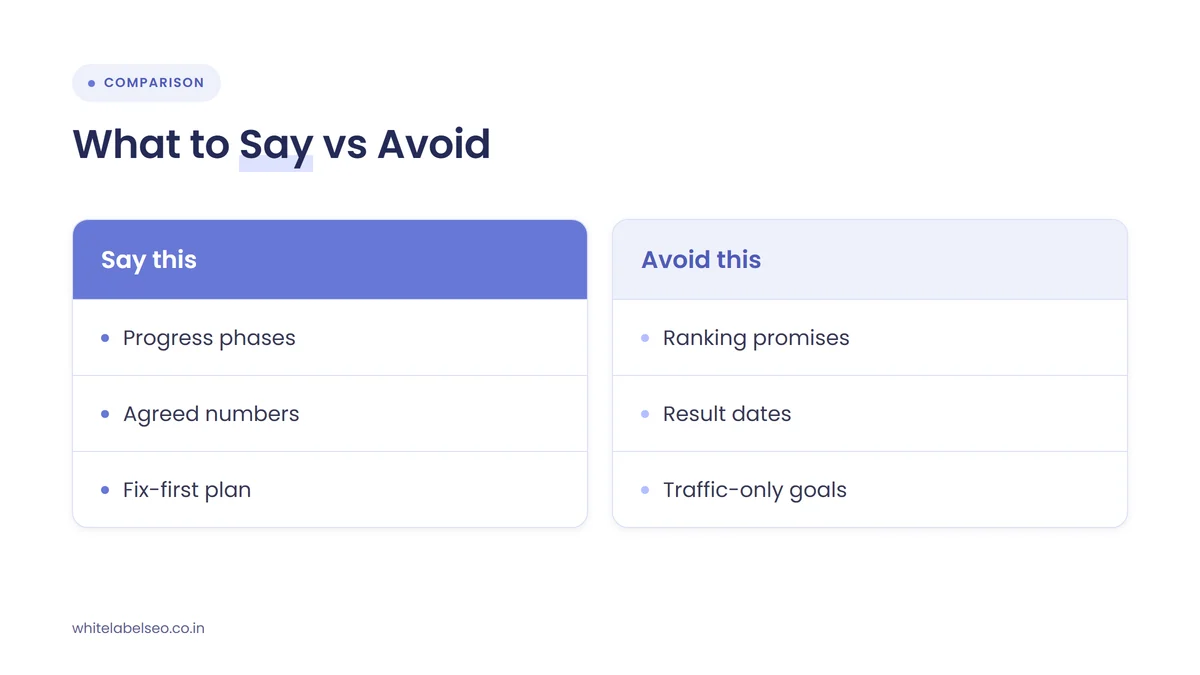
Never promise a ranking position, a traffic figure, a date for results or a spot in an AI answer. Avoid jargon without explanation, and never blame Google for slow progress before you have checked your own work. Each of these feels reassuring in week one and becomes a reason to cancel by month three.
Google is direct about this. Its “Do you need an SEO?” page tells business owners that no one can promise a top ranking, and that they should look elsewhere if an SEO promises first place. Repeating that point to your client builds trust, because it shows you are working to Google’s own guidance. If a client pushes, our guide on how to answer clients who push for ranking promises has the wording.
Some phrases to swap out:
| Instead of | Say |
|---|---|
| “You’ll be on page one in 90 days.” | “Here’s what we’ll fix first and the signals we’ll watch each month.” |
| “Traffic will double.” | “We’ll track visibility in Google and AI answers, plus the calls and forms it brings.” |
| “Google’s algorithm is unpredictable.” | “Here’s what changed, what we checked and what we’re doing about it.” |
| “We’ll get you into AI Overviews.” | “We’ll do the work that makes the site a strong candidate, and report when it appears.” |
The same rule applies when rankings move in month one for reasons outside your work. Our post on what to tell clients when rankings swing without a confirmed update covers that conversation.
How does white-label fulfillment change expectation setting?
With white-label fulfillment, your agency still owns the client conversation, so the timeline you promise must match what your partner can deliver. Agree on onboarding steps, turnaround times and the first report date with the partner before the kickoff call, so nothing you tell the client depends on a guess.
In practice, that means three checks before you speak to the client:
- Onboarding dates: when the partner’s audit and first fixes will be ready, so your week-by-week plan is real.
- Report format and date: what the branded report includes and when you receive it, leaving time to review it before the client sees it.
- What the partner needs: the access and approvals that, if late, will push the plan back.
Your partner’s monthly rhythm shapes the expectations you can set. Our breakdown of what a white-label SEO partner does each month shows the deliverables you can describe to clients with confidence.
Frequently asked questions
When should you first talk to a client about SEO expectations?
Start in the sales conversation, then repeat it in detail on the kickoff call and in a written summary during the first week. The proposal sets the frame, but clients only pay full attention once the work begins. A written version gives them something to refer back to when they get impatient.
What should the first SEO report show a new client?
The first report should show the work completed, the baseline numbers, any early changes in indexing, impressions or priority terms, and the plan for the next month. It should explain each number in a sentence. It should not present early movement as a final result.
How do you handle a client who expects results in the first month?
Go back to the written summary and the phases you agreed on. Show the work completed and any early signals against the baseline. Then explain what the next 60 days will add. If the expectation came from the sales process, correct it openly rather than letting it build.
Should you tell clients that AI Overviews reduce clicks?
Yes. Studies from Pew Research Center and Ahrefs show fewer clicks when an AI Overview appears. Telling the client early, and showing them Search Console’s AI impression reports alongside lead tracking, stops a flat traffic line from being read as failure later.
What numbers should you agree to report?
Agree on three to five numbers that connect to the client’s goal. A common set is work completed, impressions and priority search terms from Search Console, AI feature impressions where available, and calls, forms or sales from organic search. Name the source of each number before the first report.
What should you do this week?
Take your newest client, or the next one you sign, and write the one-page expectations summary described above: starting point, first priorities, phases of progress, agreed numbers, client tasks and what no one can promise. Book the day-30 review now. Then check that your fulfillment timeline supports every date in the summary. To see the delivery we put behind conversations like this, read about our white-label SEO services at White Label SEO.
Want onboarding your clients can follow week by week?
At White Label SEO, we deliver SEO under your agency’s brand, with clear onboarding steps, fixed report dates and branded reports you can put in front of clients from the first month. Tell us about your client mix, and we’ll map a first-30-days plan you can share with confidence.
Sources
- Google Search Central, “Do you need an SEO?”, accessed November 5, 2026. https://developers.google.com/search/docs/fundamentals/do-i-need-seo
- Google Search Central, “SEO Starter Guide: The Basics”, accessed November 5, 2026. https://developers.google.com/search/docs/fundamentals/seo-starter-guide
- Google Search Central, “AI features and your website”, accessed November 5, 2026. https://developers.google.com/search/docs/appearance/ai-features
- Google Search Central Blog, “Introducing Search Generative AI performance reports in Search Console”, June 3, 2026, updated August 31, 2026. https://developers.google.com/search/blog/2026/06/gen-ai-performance-reports
- Search Engine Roundtable, “Google: Google Search Console AI Position Reporting Will Evolve Over Time”, September 16, 2026. https://www.seroundtable.com/google-search-console-ai-position-reporting-change-42099.html
- Pew Research Center, “Google users are less likely to click on links when an AI summary appears in the results”, July 22, 2025. https://www.pewresearch.org/short-reads/2025/07/22/google-users-are-less-likely-to-click-on-links-when-an-ai-summary-appears-in-the-results/
- Ahrefs, “Update: AI Overviews Reduce Clicks by 58%”, February 4, 2026. https://ahrefs.com/blog/ai-overviews-reduce-clicks-update/
- AgencyAnalytics, “AgencyAnalytics releases 2026 Marketing Agency Benchmarks Report”, June 30, 2026. https://agencyanalytics.com/company/newsroom/press-release-agency-benchmarks-report-2026