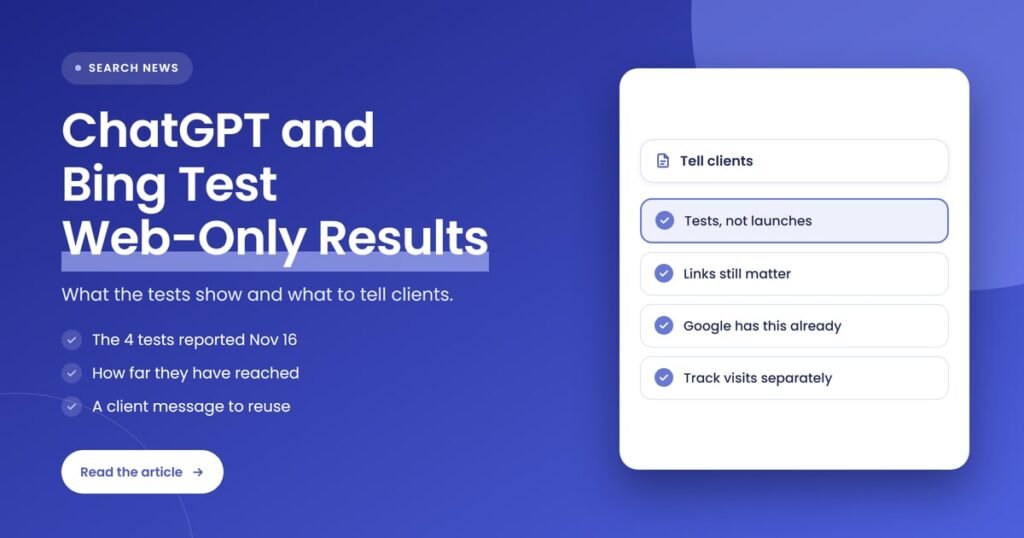
Quick answer: OpenAI is testing 3 web-only results formats in ChatGPT, and Microsoft is testing 1 Web Mode tab in Bing, Search Engine Roundtable reported on November 16, 2026. Neither company has confirmed a rollout. Tell clients that classic web links are not going away, then add ChatGPT and Bing checks to client reporting.
Key takeaways
- ChatGPT is being tested with 3 formats that put web links back in view: web-only results, web results first and an AI answer with a “See more” button.
- Bing is testing a Web Mode tab that shows only web page results, without AI Overviews or Copilot answers, and Barry Schwartz does not think it is fully live.
- Both items are tests spotted by users, with no statement from OpenAI or Microsoft, so agencies should call them tests, not launches.
- Google already offers the same idea: it launched a Web filter for text-based links on May 14, 2024.
- The client message is short: rankings and well-built pages still matter, and a reader who wants links can now ask for links.
- The reporting task is to record ChatGPT and Bing referral traffic as its own line, because web-only results could change how much of it clicks through.
What did ChatGPT and Bing test with web-only results in November 2026?
ChatGPT and Bing were both spotted testing web-only results in November 2026: OpenAI with 3 result formats in ChatGPT, and Microsoft with 1 Web Mode tab in Bing. Search Engine Roundtable reported both tests on November 16, 2026, and included both in its November 20, 2026 video recap.
The 4 tests, as reported by Barry Schwartz of Search Engine Roundtable, are listed below in the order he covered them.
- ChatGPT web-only results: ChatGPT shows web links without the AI answer, spotted by Joe Youngblood on X.
- ChatGPT web results first: ChatGPT shows web links first and the normal AI results after them, spotted by Juozas Kaziukėnas on X.
- ChatGPT answer with a “See more” button: ChatGPT shows an AI answer with a “See more” button, followed by web results, spotted by Fernando on X.
- Bing Web Mode tab: Bing shows only web page results in a separate tab, first flagged by Khushal Bherwani on X.
Neither article includes a statement from OpenAI or Microsoft, and Schwartz wrote that he could not replicate the ChatGPT findings himself. For agencies that sell white label SEO services, that status decides the tone of the client message: these are tests worth watching, not changes to act on today.
What are web-only results in ChatGPT and Bing?
Web-only results are search results that show ranked web page links without an AI-written answer. In ChatGPT, that means a list of web links where the chat answer would normally sit. In Bing, it means a tab that filters the page down to web pages alone.
ChatGPT search normally answers a question in conversation and adds links to sources. OpenAI’s “Introducing ChatGPT search” post, published on October 31, 2024, describes answers “with links to relevant web sources”, and a Sources button below a response opens a sidebar with the references. Web-only results change that order: the links come first, or alone, and the answer is optional. The result looks closer to the classic blue links of a search engine than to a chat reply.
How do the 3 ChatGPT tests show web-only results?
The 3 ChatGPT tests show web-only results in 3 different positions relative to the AI answer: instead of it, before it, or after a short version of it. Each test was posted on X by a different user, and Search Engine Roundtable published a screenshot of each.
The 3 ChatGPT formats are listed below, from least AI to most AI.
- Web-only results: only web links, with no AI answer. Schwartz wrote that he had seen this before, took it for a bug and did not cover it at the time.
- Web results first: web links at the top, then the normal ChatGPT AI results below them.
- AI answer with “See more”: a short AI answer with a “See more” button, then web results. Schwartz noted that this resembles Google’s AI Overviews.
The third format is the one that tells agencies the most. A “See more” button means the AI answer can be short and the links do the rest of the work, which is the layout clients already know from Google Search.
How does Bing’s Web Mode tab show web-only results?
Bing’s Web Mode tab shows only web page results. According to Search Engine Roundtable, choosing it removes AI Overviews, Copilot answers and every other feature, and leaves the ranked web pages.
Khushal Bherwani flagged the tab first on X. A commenter named John had spotted an earlier version about a month before the article, labeled “Web” instead of “Web Mode”. Schwartz could reproduce Web Mode in some browsers, does not think it is fully live and doubts many people see or use it. Microsoft has made no statement about it. Because it is a tab, a Bing user chooses it on purpose, which makes it a different kind of test from ChatGPT’s formats, where OpenAI picks what the user sees.
Is Bing’s Web Mode the same as Google’s Web filter?
Yes, Bing’s Web Mode works like Google’s Web filter in what it shows. Google announced the Web filter on May 14, 2024 with the statement “We’ve launched a new Web filter that shows only text-based links”, and it hides features such as AI Overviews, knowledge panels, featured snippets and shopping results.
Schwartz made the same comparison, pointing to the May 2024 launch. The difference is timing: Google’s filter has been live for more than 2 years, while Bing’s tab and ChatGPT’s formats are still tests.
How far have the web-only results tests reached?
The web-only results tests have reached a small, unconfirmed group of users. Schwartz could not replicate the ChatGPT findings, could reproduce Bing Web Mode only in some browsers, and found no statement from OpenAI or Microsoft. The table below lists each test, what it shows, who spotted it and when it was reported.
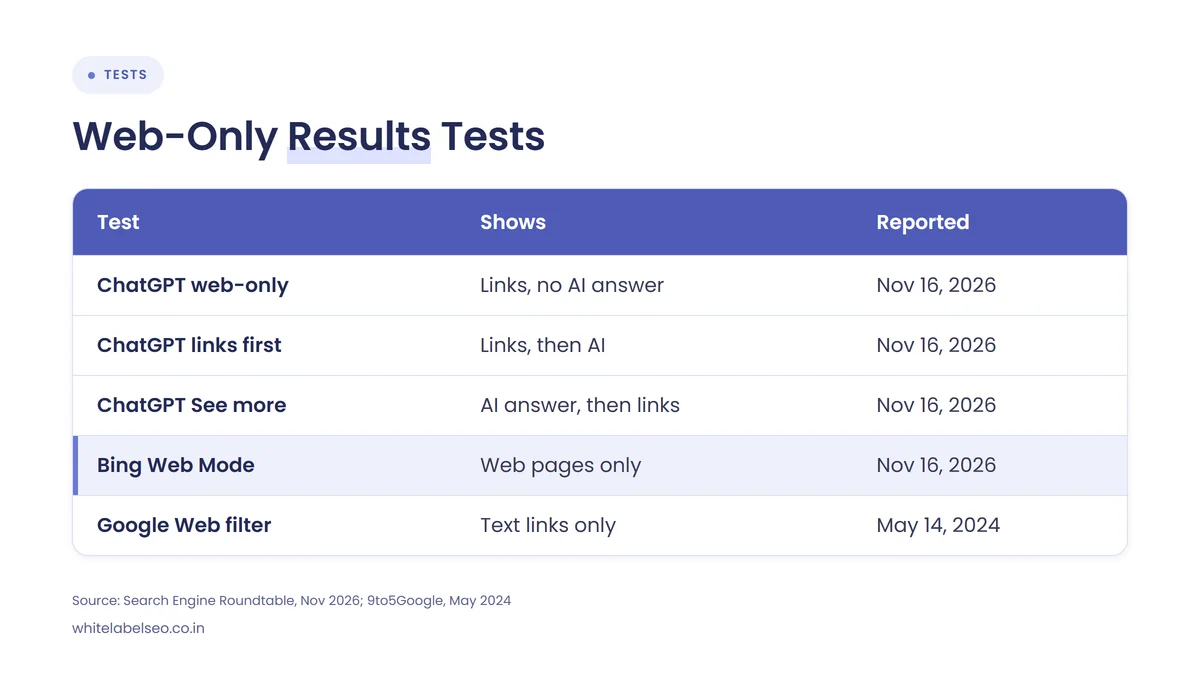
The 3 ChatGPT tests, the Bing test and Google’s Web filter are compared in the table below.
| Test | What users see | Spotted by | Reported | Status |
|---|---|---|---|---|
| ChatGPT web-only results | Web links, no AI answer | Joe Youngblood on X | Nov 16, 2026 | Test, not replicated |
| ChatGPT web results first | Web links, then the normal AI results | Juozas Kaziukėnas on X | Nov 16, 2026 | Test, not replicated |
| ChatGPT “See more” | AI answer with a “See more” button, then web results | Fernando on X | Nov 16, 2026 | Test, not replicated |
| Bing Web Mode tab | Web pages only, no AI Overviews or Copilot answers | Khushal Bherwani on X | Nov 16, 2026 | Test, not fully live |
| Google Web filter | Text-based links only | Announced by Google | May 14, 2024 | Live |
The table shows that all 4 November 2026 items are tests, while Google’s Web filter is the only one of the 5 that is live today.
Scale gives a second reason for caution. In a November 3, 2026 interview reported by Search Engine Journal, Adam Fry of OpenAI said ChatGPT gets about one-fifth as many search-like queries as Google, and ChatGPT’s weekly users grew 20%, from 1 billion to 1.2 billion, in 2 months. Ahrefs data in the same report put ChatGPT at 0.36% of tracked referral traffic in October 2026, against 24.74% for Google, across 118,671 sites. A format change in ChatGPT would touch a much smaller share of client traffic than the same change in Google Search.
Who is affected by the web-only results tests?
The web-only results tests affect agencies that report on AI search visibility and clients that already get visits from ChatGPT or Bing. Clients that only see Google traffic notice nothing today.
The 4 groups the tests touch most are listed below.
- Agencies selling AI search visibility: if ChatGPT shows links first, the clicks from ChatGPT may rise, and reports that treat ChatGPT only as a mention counter will miss it.
- Publishers and content clients: pages that rank well on Bing and are cited in ChatGPT are the pages a web-only view would list.
- Clients that worry about zero-click search: a “See more” button and a Web Mode tab both suggest that users still want links, a point that sits next to our look at the open web traffic decline.
- Clients with Bing visibility: Bing Web Mode shows only ranked pages, so Bing rankings matter in that tab and AI answer placement does not.
What should agencies tell clients about web-only results?
Agencies should tell clients that web-only results are tests, not launches, and that they show people still want links to real pages. The practical message is calm: keep earning rankings and citations, and watch ChatGPT and Bing referral traffic as a separate line.
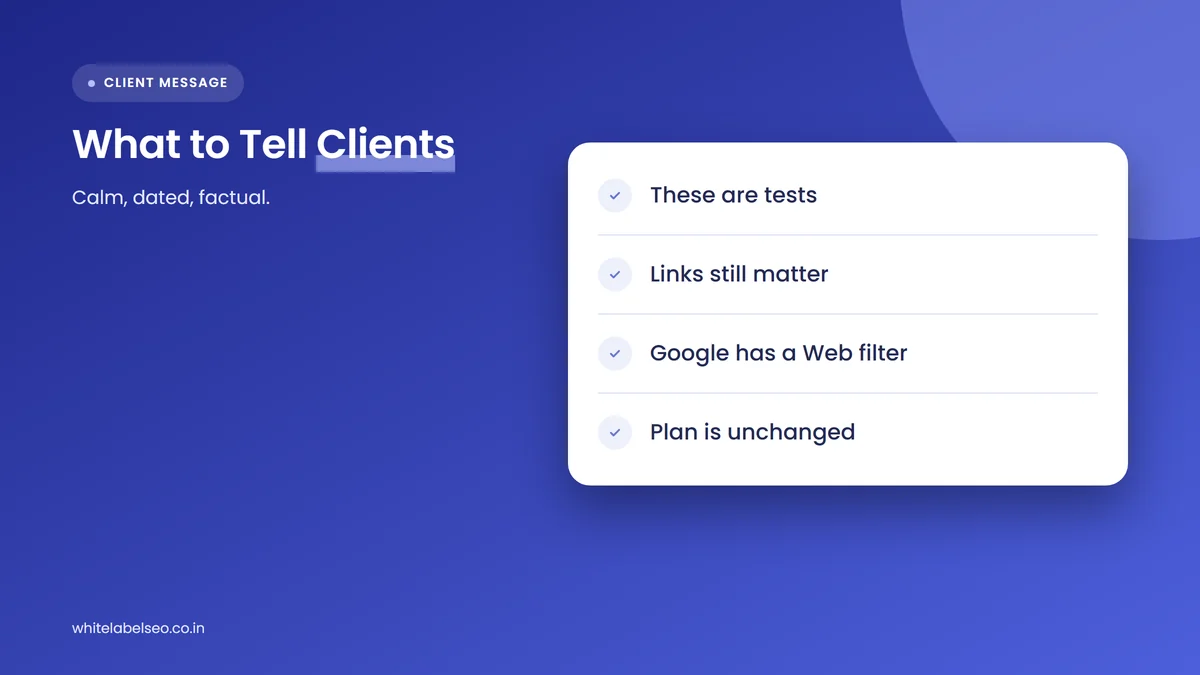
The 4 talking points we suggest for client conversations about web-only results are listed below.
- Say these are tests: Search Engine Roundtable reported the ChatGPT formats and Bing Web Mode as spotted tests, and neither OpenAI nor Microsoft has announced them.
- Say links still matter: 2 of the 3 ChatGPT formats and Bing Web Mode put web links in front of readers, which supports ranking and citation work.
- Say Google already has this: Google’s Web filter has shown text-based links since May 14, 2024, so web-only results are not a new idea.
- Say nothing changes in the plan yet: keep the current SEO work, and report ChatGPT and Bing visits as their own line so any change shows up in the data.
Avoid two things in that conversation. Do not promise that links in ChatGPT will bring traffic, because no test has shown a result, and do not tell a client that AI answers are fading, because 2 of the 3 ChatGPT formats still include an AI answer. Our list of 9 metrics agencies should report to SEO clients is the right place to add the new line.
How should agencies report on web-only results?
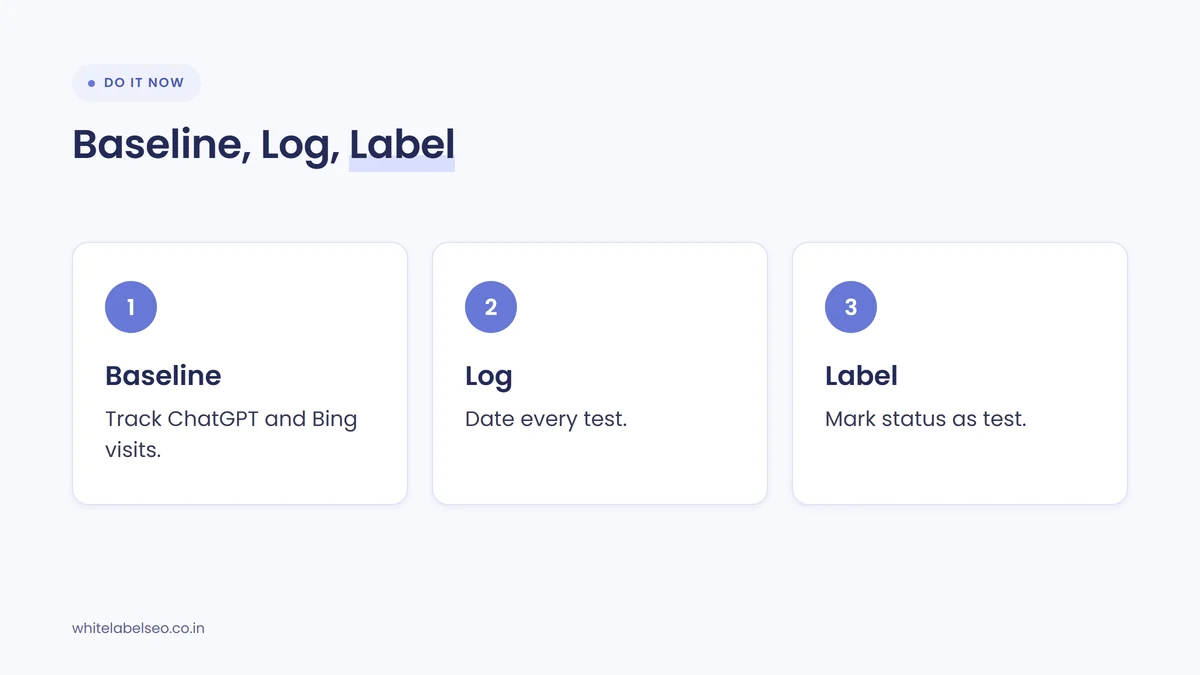
Agencies should report on web-only results by tracking ChatGPT and Bing visits as separate lines and noting any test they spot, with a date. The tests are too small to show up in a monthly trend, so the first goal is a clean baseline, not a conclusion.
The 5 steps to prepare client reporting for web-only results are listed below.
- Create a ChatGPT referral line in each client’s analytics, so ChatGPT visits are not buried in a general referral or direct group.
- Create a Bing organic line next to Google organic traffic, so a Web Mode change can be seen against a baseline.
- Record a 3-month baseline of ChatGPT and Bing visits before comparing anything, since a test affecting a small group moves the numbers only slightly.
- Log every test with a date, using Search Engine Roundtable’s report date, so a change in the data can be matched to the test later.
- Label the status in the report as “test, not confirmed” until OpenAI or Microsoft publishes a statement.
Our guide to ChatGPT business analytics and what to tell clients covers the reporting side of ChatGPT data in more depth, and this post stops at the contextual border of the tests themselves.
How should you report AI search visibility next to web-only results?
You should report AI search visibility as a separate section from web-only results and classic rankings: mentions and citations in AI answers in one place, ranked links and clicks in another. The two behave differently, and the web-only results tests show that the same engine may switch between them.
A client can be mentioned in a ChatGPT answer and still get no visit, or appear in a link list and get a click without any mention. Reporting both lets the client see which one the work is moving. The wider reporting changes are covered in our post on AI Overviews and zero-click search: what white-label SEO partners must report differently.
Frequently asked questions
Is ChatGPT adding blue links to its search results?
Not confirmed. Search Engine Roundtable reported 3 ChatGPT test formats on November 16, 2026 that show web links alone, first or after an AI answer, but OpenAI has made no statement and Barry Schwartz could not replicate them.
Is Bing Web Mode live for everyone?
No, Bing Web Mode is not fully live. Barry Schwartz could reproduce it in some browsers on November 16, 2026, but he does not think it has rolled out fully, and Microsoft has not commented.
Does Bing Web Mode remove AI answers?
Yes, Bing Web Mode removes AI answers in that tab. Search Engine Roundtable reports that selecting it hides AI Overviews, Copilot answers and every other feature, leaving only web page results.
Do web-only results change how pages rank?
No evidence shows that web-only results change how pages rank. They change what is shown around the ranked links, so keep ranking and citation work as it is and watch referral traffic.
How much traffic does ChatGPT send compared with Google?
ChatGPT sent far less. Ahrefs data reported by Search Engine Journal on November 3, 2026 put ChatGPT at 0.36% of tracked referral traffic in October 2026 and Google at 24.74%, across 118,671 sites.
What should agencies do next about web-only results?
Tell clients these are tests, set up separate ChatGPT and Bing traffic lines now, and record a baseline before any rollout. Save the dated log of tests, because it will explain any shift in ChatGPT or Bing visits later.
If you want a partner that handles this reporting under your brand, see how our white label SEO services work for agencies at White Label SEO.
Want client reports that track ChatGPT and Bing separately?
At White Label SEO, we build AI search and classic search lines into the reports we deliver under your agency’s name, with each test dated and its status explained. Tell us how your client reports are built today, and we’ll show you what we would change.
Sources
- Search Engine Roundtable (Barry Schwartz), “ChatGPT Tests Web Results, See More & Other Search Results Formats”, November 16, 2026. https://www.seroundtable.com/chatgpt-search-result-tests-42537.html
- Search Engine Roundtable (Barry Schwartz), “Bing Tests Web Mode Tab To Show Only Web Page Results”, November 16, 2026. https://www.seroundtable.com/bing-web-mode-42535.html
- Search Engine Roundtable (Barry Schwartz), video recap, November 20, 2026. https://www.seroundtable.com/video-11-20-2026-42577.html
- OpenAI, “Introducing ChatGPT search”, October 31, 2024. https://openai.com/index/introducing-chatgpt-search/
- 9to5Google, “Google Search Web filter”, May 14, 2024. https://9to5google.com/2024/05/14/google-search-web-filter/
- Search Engine Journal, “Google’s Search Volume Is About 5x ChatGPT’s, OpenAI Says”, November 3, 2026. https://www.searchenginejournal.com/googles-search-volume-is-about-5x-chatgpts-openai-says/595817/