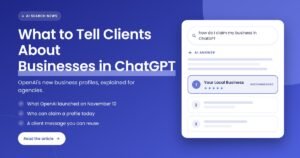
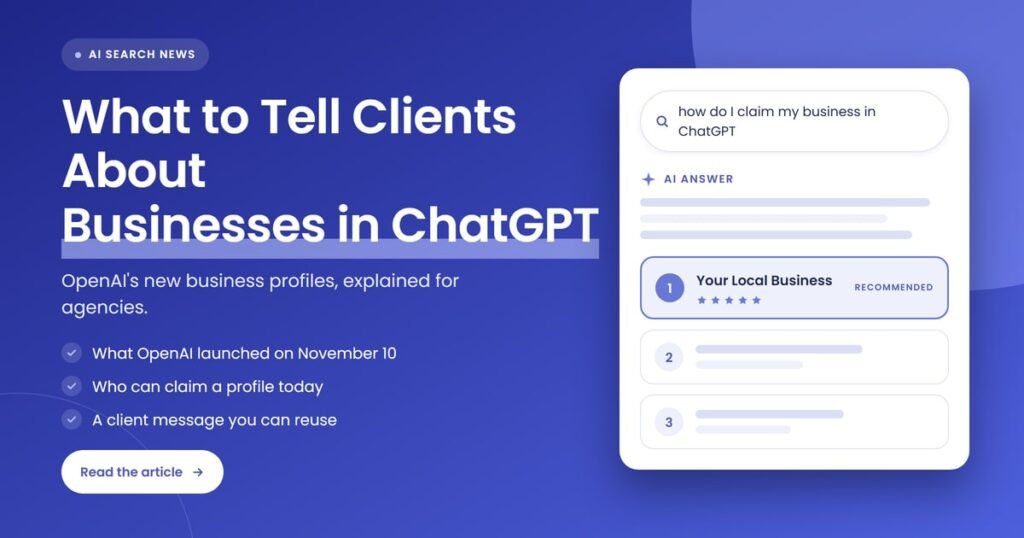
Quick answer: On November 10, 2026, OpenAI launched Businesses in ChatGPT in beta, with a Business Hub where eligible businesses claim a profile, update details and see aggregate mentions and website clicks. Agencies should tell local clients to claim only after checking OpenAI’s Help Center eligibility rules, and report the new numbers separately from Google.
Key takeaways
- OpenAI launched Businesses in ChatGPT in beta on November 10, 2026, with a Business Hub for claiming and managing a business profile.
- Business Hub shows 3 aggregate measures over the past 28 days: mentions, website clicks and discovery topics.
- Eligibility depends on location and business type. Local stores and restaurants can currently claim only an existing U.S. listing.
- Claiming takes 2 gates: OpenAI approves the claim, then Persona identity verification unlocks edits, product feeds and insights.
- Tell local clients it is a beta profile to manage and measure. OpenAI does not say claiming raises how often ChatGPT recommends a business.
- Do 6 things now: sort clients by eligibility, check each listing, pick a verification method, get the identity check done, match the profile to the website and record a 28-day baseline.
What changed with Businesses in ChatGPT?
OpenAI launched Businesses in ChatGPT in beta on November 10, 2026, adding a Business Hub where eligible businesses claim, manage and track their business profile inside ChatGPT. OpenAI’s announcement says ChatGPT reaches 1.2 billion people each week. Once a business is verified, Business Hub lets it update key details, add self-service product feeds with pricing and availability, and view aggregated insights.
A business profile appears when a business shows up in a ChatGPT answer. Users can open the profile and, if the business has built a Business Agent, start a conversation with it. For agencies that resell SEO through our white-label SEO services, Businesses in ChatGPT is a new profile to set up and report on for clients, next to the profiles they already manage.
The product is in beta. OpenAI says it plans to add more markets and business categories but gives no timeline. This post is dated November 24, 2026, so check OpenAI’s pages again before you send any client message, because beta rules change.
What does Business Hub show in Businesses in ChatGPT?
Business Hub shows 3 aggregate measures over the past 28 days, mentions, website clicks and discovery topics, and it lets a verified business edit its profile details and product feed. Businesses do not see individual prompts or customer conversations, including chats with their own agents.
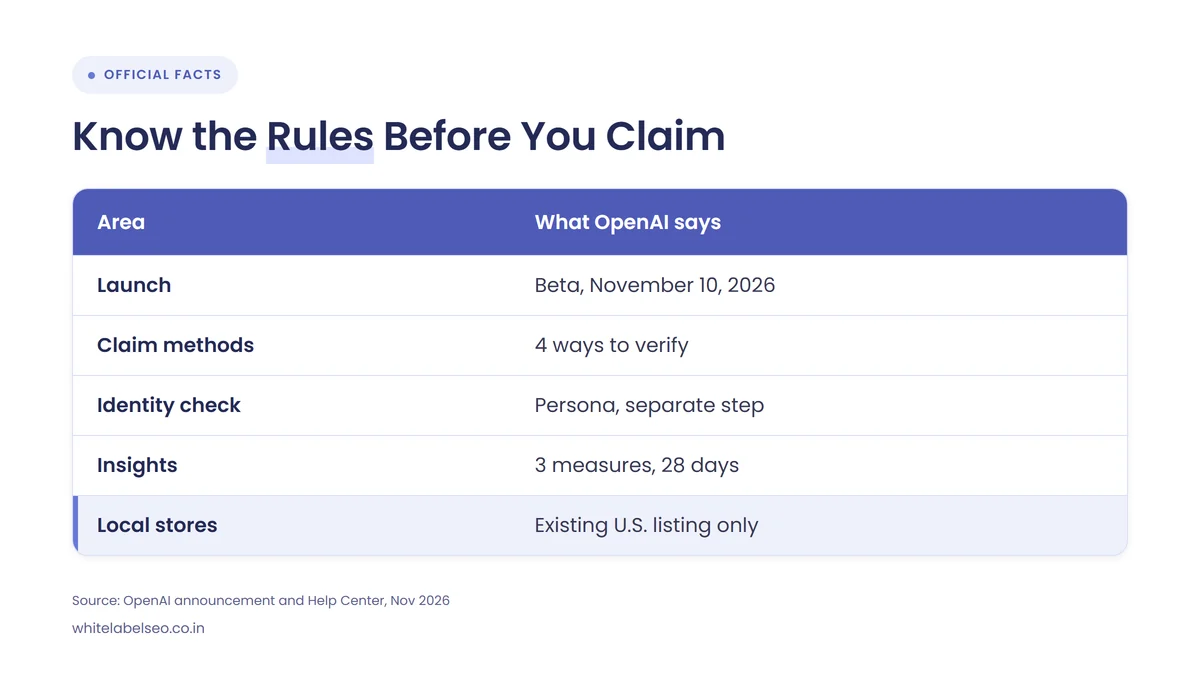
The table below lists the 6 facts agencies need first, in the order a client meets them.
| Area | What OpenAI says | Source |
|---|---|---|
| Launch | Beta since November 10, 2026; ChatGPT reaches 1.2 billion people each week | OpenAI announcement |
| Claim verification | 4 methods: business phone, business email, website domain or Shopify | OpenAI Help Center |
| Identity check | Persona identity verification is a separate step after claim approval | OpenAI Help Center |
| Insights | 3 measures, aggregate, past 28 days | OpenAI Help Center |
| Local stores and restaurants | Existing U.S. listing only, for now | OpenAI Help Center |
| Business Agents | Eligible ecommerce and online service businesses in the U.S. | OpenAI announcement |
The table shows that Businesses in ChatGPT has 2 approval gates before a client sees any data, and that location and business type decide how much of the product a client can use.
The Help Center defines the 3 insight measures this way. A mention for an online business means ChatGPT referenced the business website, not only its name. A mention for a local business means ChatGPT showed a result for that location. Website clicks count how often people click through to the site. Discovery topics are common themes in answers that mentioned or cited the business. OpenAI says insights appear only when conversation or interaction thresholds are met, and a blank metric may mean incomplete data, not zero activity.
A verified business can also edit its website, business description, category, logo, delivery policy, return policy and cover photo, and OpenAI reviews changes before it publishes them. Business Hub insights are the tool that earlier reports called ChatGPT business analytics.
Who can use Businesses in ChatGPT today?
Anyone who owns a business, or is authorized to represent it, can start to claim your business in ChatGPT, but eligibility depends on the business’s location and type. OpenAI’s Help Center says eligible businesses can claim an existing listing or add a new one where ChatGPT is available and the required verification is supported. It does not list countries.
Coverage of the launch reads the rules differently, so the Help Center is the rule to follow. SmartCompany reported on November 11, 2026 that Australian businesses can claim in Business Hub, reading the feature as open in regions where ChatGPT is available. BrightLocal reported the same day that online businesses can claim wherever ChatGPT is available, while the Help Center says: “Local stores and restaurants can currently claim only an existing U.S. listing.”
Three separate layers decide what a client can do, and coverage often mixes them up.
- Claim layer: an eligible business, or a listing OpenAI already holds, can be claimed by an authorized person. No Ads account or ChatGPT Enterprise agreement is needed.
- Local listing layer: local stores and restaurants are limited to an existing U.S. listing.
- Business Agents layer: agents are for eligible ecommerce and online service businesses in the U.S. that meet the Business Agents Policy, and a verified profile alone does not qualify a business.
OpenAI reviews each claim and emails a decision or a request for more information. The claim does not grant access to the profile on its own, and the verified badge appears only after Persona approval.
The 4 claim verification methods OpenAI lists are shown below, and the methods available vary by listing.
- Business phone: a code sent by text message or automated call to the business phone number.
- Business email: a code sent to the business email address.
- Website domain: a TXT record added to the domain’s DNS settings, followed by selecting Verify domain.
- Shopify store: a store connection made from the Shopify admin or from Business Hub.
Persona identity verification is a separate step. The Help Center says it may ask for a government-issued ID, business registration information and proof of authorization, and the legal name and address must match official registration records.
Who is affected by Businesses in ChatGPT?
Online service and ecommerce clients can use the full feature set today, while local stores and restaurants outside the U.S. have no claim route described in the Help Center. The four client types below are affected differently, so agencies should sort clients before sending one message to all.
- Ecommerce clients: can claim a business profile, add product feeds with pricing and availability, and may qualify for a Business Agent in the U.S. Shopify merchants can connect a store to streamline verification.
- Online service clients: can claim a business profile, and may qualify for a Business Agent in the U.S. if they meet the Business Agents Policy.
- Local stores and restaurants in the U.S.: can claim an existing U.S. listing in Business Hub.
- Service-area and non-U.S. local clients: BrightLocal’s November 11, 2026 guide gives no details for service-area businesses, so check each listing in Business Hub before promising anything.
The claimant also matters. Persona may need a government-issued ID and registration details, so the client’s authorized person should complete the check and the agency should not collect the client’s ID. Agencies running white label local SEO for multi-location clients should expect to repeat each step for every location a client wants to claim.
What should agencies tell local clients about Businesses in ChatGPT?
Agencies should tell local clients that Businesses in ChatGPT is a new beta business profile from OpenAI, and that claiming it lets a business manage and measure its profile, not buy or control ChatGPT’s recommendations. In the pages we read, OpenAI describes claiming as managing information and viewing insights. Neither the announcement nor the Help Center says claiming raises how often ChatGPT recommends a business.
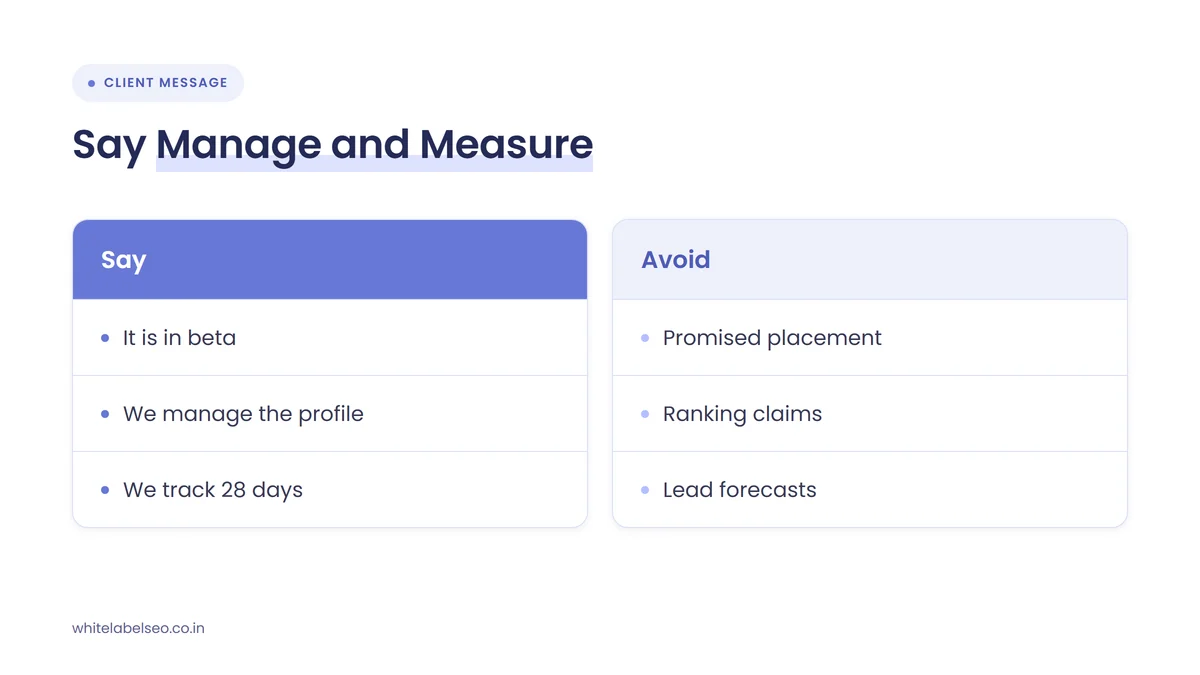
Here is what to tell clients, in 4 sentences you can reuse in an email or a call.
“OpenAI has launched a beta business profile in ChatGPT, called Business Hub. If your business is eligible, we can claim it, check the details match your website and Google Business Profile, and track mentions and website clicks over 28 days. The claim needs someone authorized to represent your business, and an identity check you complete yourself. It manages what ChatGPT shows about you; it does not decide whether ChatGPT recommends you.”
Agencies should avoid promising placement, rankings or leads from a claimed profile, because no source in OpenAI’s launch pages supports it. Keep the numbers in context too: Business Hub insights are aggregate, appear only above thresholds and cover 28 days. Add them to client reports as their own line, using the same plain approach as the metrics agencies should report to SEO clients.
What should agencies do now about Businesses in ChatGPT?
Agencies should do 6 things now: sort clients by eligibility, check each listing in Business Hub, pick a verification method, get the identity check completed, match the profile to the website and record a 28-day baseline.
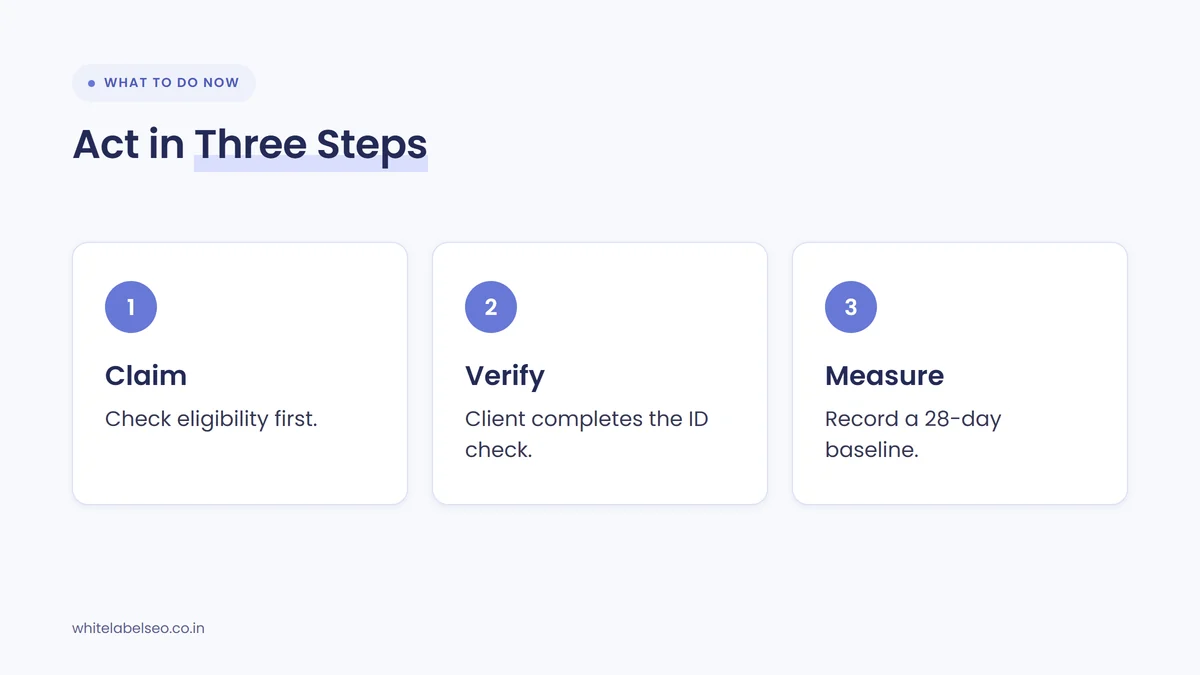
The 6 steps below are in the order they should happen.
- Sort clients by eligibility. Group clients into ecommerce, online service, U.S. local stores and restaurants, and everyone else, using the Help Center rules above.
- Search each client in Business Hub. Check whether a listing exists, whether someone has already claimed it and which verification methods the listing offers.
- Confirm who is authorized. Ask the client who may represent the business, then pick one claim method: business phone, business email, website domain or Shopify.
- Arrange the identity check. Ask the client’s authorized person to complete Persona identity verification with a legal name and address that match official records.
- Match the business profile to the website. Align the description, category, logo and policies with the client’s site and Google Business Profile, then wait for OpenAI to review and publish the changes.
- Record a 28-day baseline. After approval, note mentions, website clicks and discovery topics, and treat blank metrics as incomplete data, not zero activity.
This is a small task for each client, and it is the kind of profile work agencies can hand to a partner as part of white-label AI search optimization. Start with the clients that can use the full feature set.
How is Businesses in ChatGPT different from Google Business Profile?
Businesses in ChatGPT is OpenAI’s business profile inside ChatGPT, while Google Business Profile is the profile Google uses in Search and Maps, so a client manages each one separately. BrightLocal’s November 11, 2026 guide calls Business Hub the counterpart to Google Business Profile with Search Console-style reporting, and notes that ChatGPT is the first AI platform to share click data.
OpenAI does not say Business Hub replaces anything a client already does. Keep the Google Business Profile work going, and keep names, phone numbers, hours and categories identical in both places. For how Google is changing that side, see our post on Gemini Business Profile tools reaching Workspace accounts.
Frequently asked questions
Is Businesses in ChatGPT available to every business?
No, it is a beta and eligibility depends on location and business type. OpenAI says it will expand to more markets and categories but gives no timeline, and local stores and restaurants can currently claim only an existing U.S. listing.
Do you need to pay or advertise to claim a business in ChatGPT?
No, the Help Center says you do not need an Ads account or a ChatGPT Enterprise agreement to claim an eligible business. Enterprise customers and advertisers can also claim through their OpenAI representative. The Help Center does not list a fee, so check Business Hub for current terms.
Will claiming a business profile make ChatGPT recommend it more?
No, OpenAI does not say that. In the announcement and Help Center, claiming is described as managing profile information, adding feeds and viewing insights. Agencies should not promise recommendations to clients.
Can an agency claim a client’s business in ChatGPT?
Yes, if the agency is authorized to represent the client, but the identity check may need government-issued ID, business registration information and proof of authorization. Let the client’s authorized person complete that step.
Can a Business Agent book appointments or take orders?
No, the Help Center says agents can explain products and policies and link to the business website, but they cannot complete purchases, make bookings or check order status. Customers can chat only with a published agent.
What should you do next?
Run the 6 steps above for your clients that can claim today, send the 4-sentence message to the rest, and review OpenAI’s Help Center again in a few weeks, because the beta will change.
Agencies that resell SEO can hand the profile set-up and the 28-day reporting to a partner: see how our white-label SEO services work at White Label SEO.
Need help claiming and reporting on client business profiles?
At White Label SEO, we set up and track business profiles for your clients under your brand, and you stay in control of every client relationship. Tell us how many clients you want to check first, and we’ll scope it with you.
Sources
- OpenAI, “Introducing Businesses in ChatGPT”, November 10, 2026. https://openai.com/index/introducing-businesses-chatgpt/
- OpenAI Help Center, “Setting up your business on ChatGPT”, read November 24, 2026. https://help.openai.com/en/articles/20001635-setting-up-your-business-on-chatgpt
- BrightLocal (Mike Hawkes), “ChatGPT Business Hub”, November 11, 2026. https://www.brightlocal.com/learn/chatgpt-business-hub/
- SmartCompany (Eloise Keating), “Australian businesses can now claim themselves in ChatGPT”, November 11, 2026. https://www.smartcompany.com.au/artificial-intelligence/australian-businesses-can-now-claim-themselves-in-chatgpt/