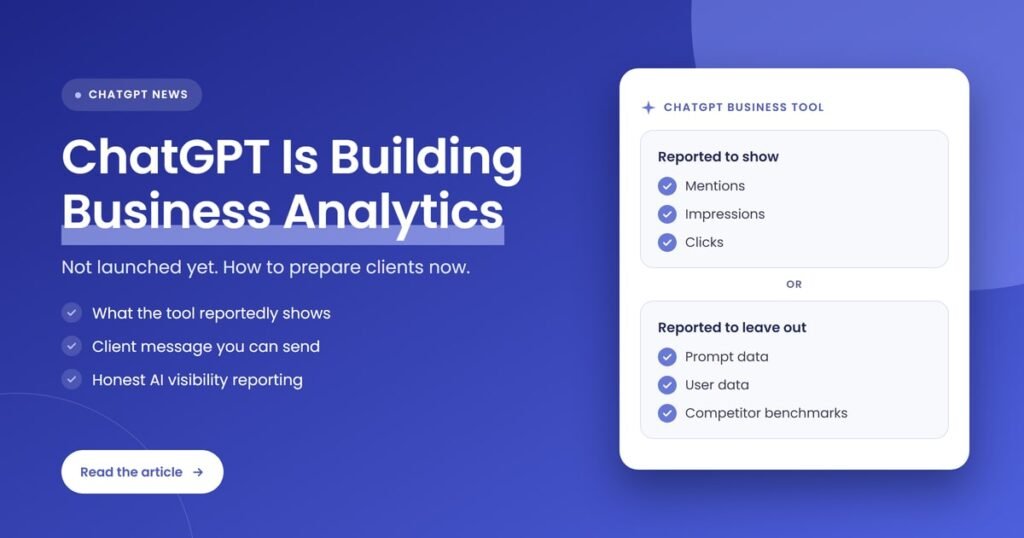
Quick answer: OpenAI is reportedly building a Search Console-style tool for businesses that verify ownership in ChatGPT. It is reported to show how often a business is mentioned, impressions in responses and clicks to the website, but no prompts, user data or competitor benchmarks. Tell clients it is unreleased, prepare their ownership details now, and keep reporting honest.
Key takeaways
- On November 6, 2026, Search Engine Roundtable reported that OpenAI is working on a “Claim your business in ChatGPT” feature with visibility tracking, based on a finding shared by Juozas Kaziukėnas on LinkedIn.
- The reported analytics show mentions, impressions and clicks to the website, tracked daily in a chart. It is part of a wider Business Hub and is only for businesses that verify ownership, for example by connecting a Shopify store.
- It reportedly includes no prompt data, no user data and no competitor benchmarks, so it will not explain why numbers rise or fall.
- It is a work in progress with no launch date, and it appears separate from ChatGPT ads. Do not promise clients features or timing.
- Agencies can act now: sort out who owns each client’s accounts, keep business details consistent, check OpenAI’s crawler access and track ChatGPT referrals in analytics.
What did OpenAI reportedly start building for businesses?
OpenAI is reportedly building a dashboard where businesses can claim their presence in ChatGPT, keep their details up to date and see how often ChatGPT mentions them. Search Engine Roundtable compared it to Google Search Console and Bing Webmaster Tools. OpenAI has not announced it, and the details come from screenshots of an unreleased feature.
Barry Schwartz covered the story at Search Engine Roundtable on November 6, 2026. The finding came from Juozas Kaziukėnas, who posted on LinkedIn that ChatGPT is building an analytics tool to track how often a business is mentioned in ChatGPT conversations. According to the report, the feature sits behind a “Claim your business in ChatGPT” prompt and covers three jobs:
- Visibility tracking: how often the business is mentioned in ChatGPT conversations.
- Business information: adding products and keeping business details current.
- Customer questions: a business agent that answers customer questions using context the business controls.
Kaziukėnas described it as a work in progress. He said he first saw early signs in August and that a banner he saw suggests it is getting closer to launch. The article includes no statement from OpenAI, so everything here should be read as reported, not confirmed.
What is “Claim your business in ChatGPT”?
“Claim your business in ChatGPT” is the reported entry point to an OpenAI Business Hub where a verified business owner could manage how the business appears in ChatGPT. Think of it as a mix of a Google Business Profile style listing and a Search Console style report, built for answers inside ChatGPT rather than search results.
Two definitions help when you explain this to clients:
- Search Console-style analytics: first-party data from the platform itself about how often a site or business was shown and clicked. Google Search Console does this for Google Search, and the reported ChatGPT tool would do something similar for ChatGPT responses.
- Ownership verification: proof that the person claiming the business controls it. The report gives connecting a Shopify store as one example. Other methods have not been described publicly.
OpenAI does already run a separate merchant program. Its “Power product discovery in ChatGPT” page lets merchants apply to share product data for shopping in ChatGPT, and says Shopify merchants are already integrated. We found no official OpenAI page about claiming a business or the analytics dashboard, so treat any guide that claims to explain the setup steps with caution.
What will the ChatGPT business analytics tool show?
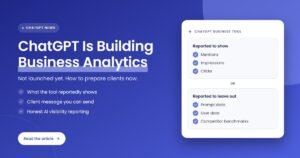
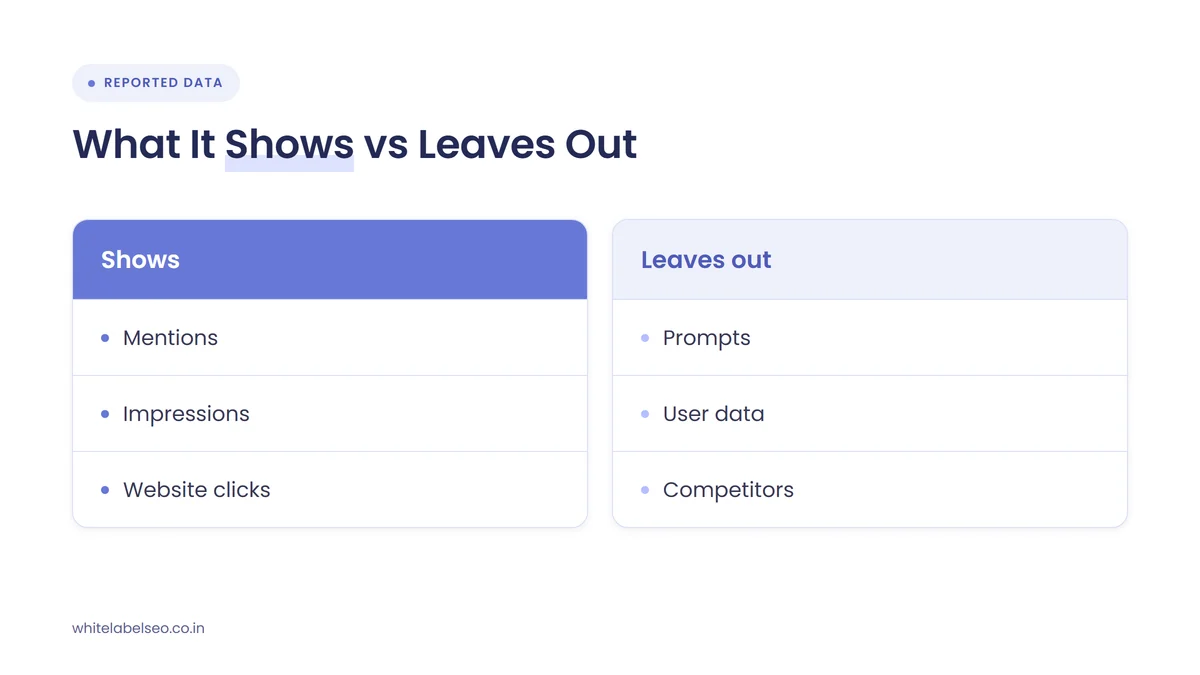
Based on the reporting, the tool will show how many times a business appeared in ChatGPT responses, how many clicks went to its website and how often it was mentioned in conversations, tracked daily in a chart. It will not show which prompts triggered the mention, who asked or how the business compares with competitors.
| Data point | Reported in the tool? | What it means for client reports |
|---|---|---|
| Mentions in ChatGPT conversations | Yes | A first-party measure of how often ChatGPT talks about the business |
| Impressions in responses | Yes | The closest thing to a ChatGPT visibility number |
| Clicks to the website | Yes | Traffic ChatGPT sent, as counted by OpenAI |
| Daily trend chart | Yes | Lets you line up changes with work you shipped |
| Prompt data | No | You cannot see which questions led to a mention |
| User data | No | No audience detail, so no demographics or locations |
| Competitor benchmarks or rankings | No | No share of voice, so comparisons still need other tools |
Kaziukėnas pointed out the main limit himself: without prompt data, the tool will not tell you why mentions or clicks went up or down. He also suggested that pairing it with external prompt-tracking tools could give first-party evidence of whether GEO and AEO work is paying off. That is the reporting model we recommend below.
How is it different from Search Console and ChatGPT ads?
The reported ChatGPT tool covers organic ChatGPT answers, while Google’s generative AI report in Search Console covers AI Overviews and AI Mode on Google. Unlike Google’s AI report, the ChatGPT tool is reported to include clicks. It is also separate from ChatGPT ads, which are a paid product with their own reporting.
Clients will see all of these labels in the news, so it helps to put them side by side:
| Data source | Covers | Clicks? | Prompts or queries? | Status |
|---|---|---|---|---|
| Reported ChatGPT business analytics | Organic ChatGPT responses | Yes, reported | No | Unreleased, work in progress |
| Search Console generative AI report | Google AI Overviews and AI Mode | No, counted in the main Performance report | No | Live |
| Analytics referrals from ChatGPT | Visits that arrive from ChatGPT links | Yes, as sessions | No | Live, using utm_source=chatgpt.com |
| Third-party prompt trackers | A chosen sample of prompts | No | Yes, only the ones you track | Live, varies by tool |
OpenAI’s Publishers and Developers FAQ says ChatGPT adds utm_source=chatgpt.com to referral URLs, so analytics tools can already count visits from ChatGPT today. We covered the Google side, and why its AI report has no clicks, in our post on what to tell clients about Search Console’s AI report.
Who is affected by ChatGPT business analytics?
Any business that wants to know how ChatGPT talks about it is affected, and so is every agency that reports AI visibility to clients. Ecommerce clients on Shopify may get access first, given the verification example in the report. Agencies selling AI search work will face the most questions once clients see the feature.
Three groups should pay attention now:
- Agencies selling AI visibility or GEO. If you report ChatGPT presence from a third-party tracker, the client will soon have a first-party number to compare it with, and the two will not match.
- Resellers who manage client accounts. Verification will need someone with access to the client’s store or accounts. If that access is unclear, setup will stall.
- Local and service businesses. They depend on consistent names, addresses and details across the web. A business listing inside ChatGPT adds one more place where that information must match.
What should agencies tell clients about ChatGPT analytics now?
Tell clients that OpenAI is reportedly building a dashboard for businesses, that it is not live yet and has no announced date, and that you will help them claim it when it arrives. Explain that it will show how often they appear and get clicks, but not why, so it will add to your reporting rather than replace it.
Here is a short message you can adapt and send under your own brand:
- What is happening: “OpenAI is reportedly building a tool that lets businesses claim their profile in ChatGPT and see how often ChatGPT mentions them.”
- What it is expected to show: “Early reports say it will show mentions, appearances in answers and clicks to your website.”
- What it will not show: “It reportedly will not show the questions people asked or how you compare with competitors.”
- What we are doing: “We are making sure your business details and account access are ready, so we can claim it quickly once it opens.”
- What will not change: “We will keep judging progress on visibility, traffic and leads together, and we will label every number by its source.”
Sending this before the client reads about it protects trust. If a client hears about ChatGPT analytics from a news headline first, the next question is usually why their agency did not mention it.
How should agencies prepare clients before it launches?
Prepare clients by confirming who owns and can access their store and business accounts, making business information consistent everywhere, checking that OpenAI’s search crawler is not blocked and setting up ChatGPT referral tracking in analytics. None of these steps depend on the tool launching, and each one is useful today.
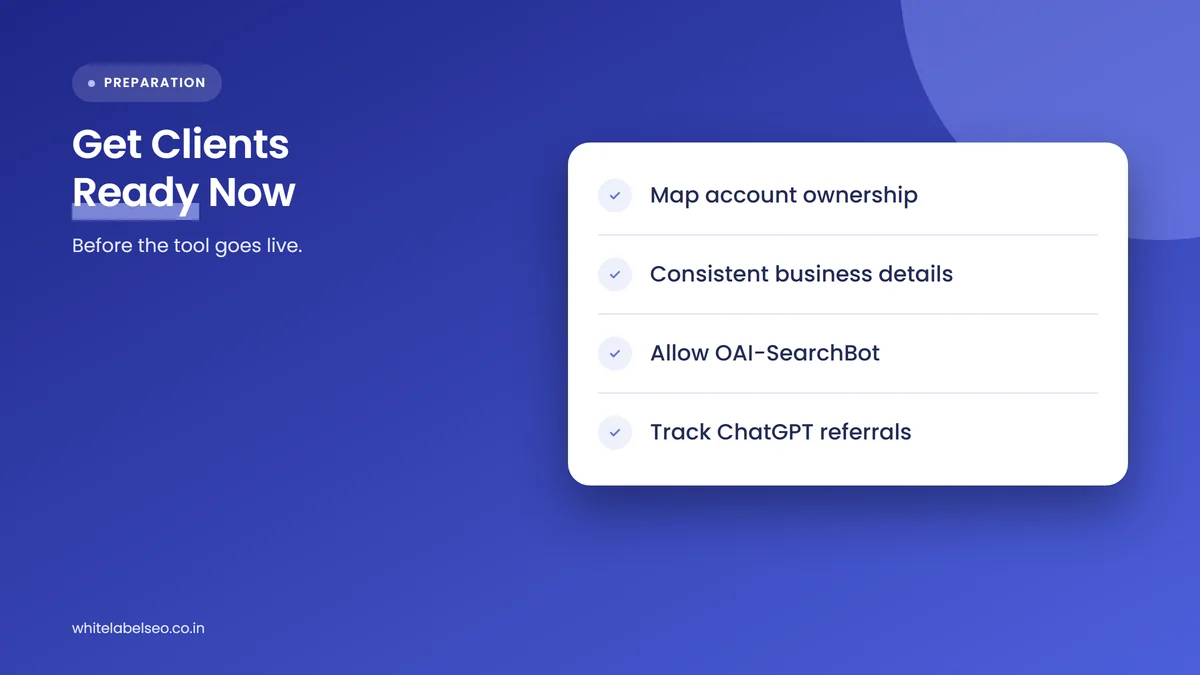
- Map account ownership. List who owns each client’s ecommerce store, domain, Google Business Profile and analytics. The client should own them, with your team added as a user. Verification will be slow if a former vendor holds the keys.
- Make business details consistent. Check the name, address, phone, hours, services and product names on the website, Google Business Profile and main directories. A ChatGPT business profile should match all of them.
- Check crawler access. OpenAI’s crawler documentation says sites that opt out of OAI-SearchBot will not be shown in ChatGPT search answers. Review each client’s robots.txt and firewall rules so the search crawler is not blocked by accident.
- Track ChatGPT referrals. Set up a segment or report in analytics for sessions with utm_source=chatgpt.com, so you have a baseline before any first-party data arrives.
- Review the merchant route for store clients. For ecommerce clients, read OpenAI’s merchant page and confirm whether their platform already shares product data with ChatGPT.
How should agencies report ChatGPT visibility honestly?
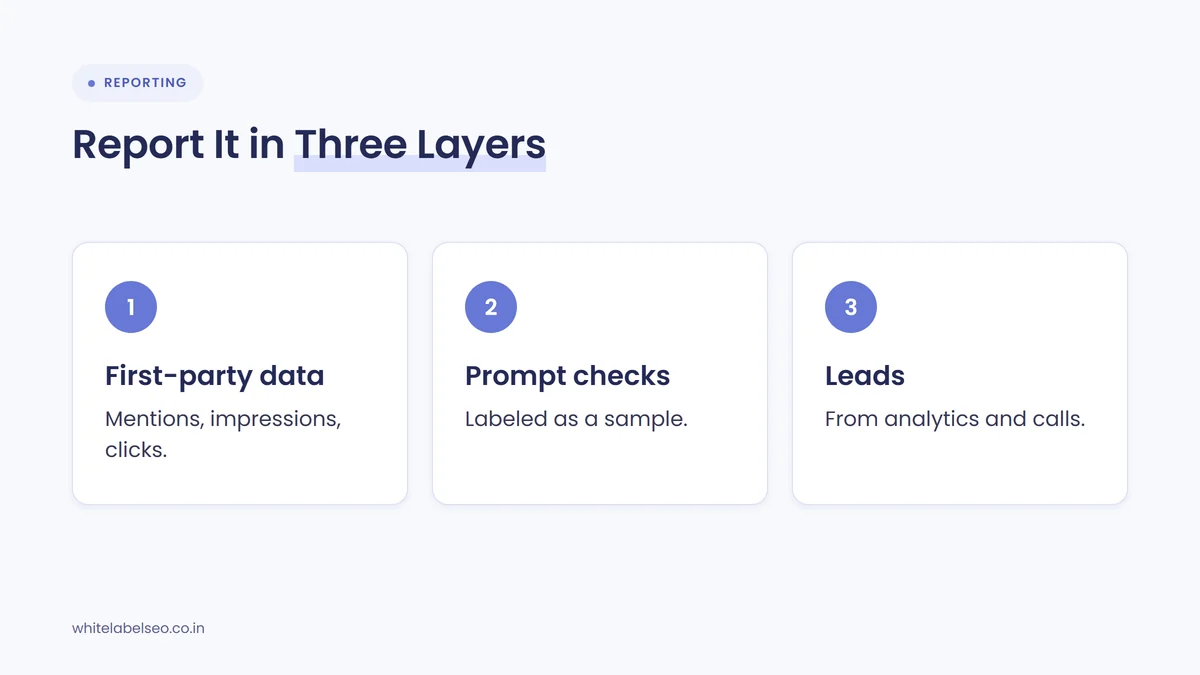
Report ChatGPT visibility in three layers: first-party data from OpenAI once it exists, prompt checks from a third-party tracker labeled as a sample, and leads from analytics and call tracking. Show where every number came from, and never present a tracker’s estimate as if it were OpenAI’s own data.
| Report layer | Source | Answers the question | How to label it |
|---|---|---|---|
| ChatGPT visibility | OpenAI business analytics, once launched | How often were we shown and clicked? | OpenAI data |
| ChatGPT visits | Analytics, utm_source=chatgpt.com | How many visits arrived from ChatGPT? | Site analytics |
| Prompt checks | Third-party tracker or manual checks | Which questions do we appear for? | Sample, not a full picture |
| Business results | Analytics, call tracking, CRM | Did it bring leads or sales? | Client data |
| Commentary | Your team | What changed and what is next? | Opinion and plan |
Expect OpenAI’s click count and your analytics sessions to differ. Platforms count clicks, analytics tools count sessions, and some visits lose their tracking along the way. Say this in the report notes before the client spots the gap. Our list of red flags in a white label SEO report covers other ways unlabeled numbers damage trust.
What should agencies avoid while the tool is unreleased?
Avoid promising a launch date, selling “ChatGPT analytics setup” as a paid deliverable before anyone can access it, or treating screenshots as confirmed features. Also avoid claiming that a third-party prompt tracker shows the same thing OpenAI will. Unreleased tools change, and promises made now become awkward client conversations later.
- Launch promises. The tool is reported as a work in progress. No date has been announced.
- Feature promises. Metrics, verification methods and eligibility could all change before release.
- Third-party profile offers. Some services already invite businesses to “claim” an AI profile. Make sure clients know those are not OpenAI products.
- Mixing paid and organic. The analytics are reported as separate from ChatGPT ads. Keep paid and organic ChatGPT results in separate report sections.
- Explaining why without data. With no prompt data, any reason you give for a change in mentions is your view. Present it as such.
How do we handle this with partner agencies?
We already include AI search visibility in the standard monthly reports we deliver under partner agencies’ brands, with every figure labeled by its source. When OpenAI’s tool opens, we plan to add its data as a new row in the same report, so agencies do not have to rebuild their reporting or re-explain it to clients.
Until then, our onboarding checklist covers the preparation steps above: account ownership, consistent business details, crawler access and ChatGPT referral tracking. We also agree a tracked prompt list with each partner agency, so the prompt checks reflect questions the client’s buyers actually ask. If you are still deciding how to price this work, our post on why AI search visibility is becoming a core white label deliverable covers the packaging side.
What is likely to happen next?
This section is our opinion, not an OpenAI statement. We expect the tool to launch in stages, possibly starting with merchants whose stores already connect to ChatGPT, and to stay light on detail at first. Agencies should plan for first-party impressions and clicks with no prompt data, and treat anything more as a bonus.
Our reasoning is simple. The verification example in the report is a Shopify connection, and OpenAI’s merchant program already integrates Shopify catalogs. Google launched its own AI report with impressions only and has not added clicks or queries. If OpenAI ships mentions, impressions and clicks, it will give businesses something Google has not, but the missing prompt data means agencies will still need their own tracking to explain the numbers.
Frequently asked questions
Is ChatGPT business analytics available now?
No. Search Engine Roundtable reported it on November 6, 2026 as a work in progress based on screenshots shared by Juozas Kaziukėnas. OpenAI has not announced it or given a launch date, so agencies should prepare clients without promising when it will arrive.
What data will ChatGPT business analytics show?
According to the report, it will show how often a business is mentioned in ChatGPT conversations, impressions in ChatGPT responses and clicks to the business website, tracked daily in a chart. It reportedly will not show prompt data, user data or competitor benchmarks.
How will a business verify ownership in ChatGPT?
The report says the tool is only available to businesses that verify ownership, with connecting a Shopify store given as one example. Other verification methods have not been described publicly, so make sure each client controls its own store and business accounts.
Is ChatGPT business analytics the same as ChatGPT ads?
No. Search Engine Roundtable says the tool appears separate from ChatGPT ads and is focused on organic ChatGPT responses. Keep paid and organic ChatGPT performance in separate sections of client reports.
Can agencies track ChatGPT traffic before the tool launches?
Yes. OpenAI says ChatGPT adds utm_source=chatgpt.com to referral URLs, so analytics tools can count visits from ChatGPT today. Third-party prompt trackers can add context on which questions a client appears for, as long as you label them as samples.
What should you do next?
Send clients a short note about the reported tool this month, then work through the preparation checklist: account ownership, consistent business details, crawler access and ChatGPT referral tracking. Add a source label to every AI visibility number you report. If a new client still expects AI search results on a fixed timeline, our guide to setting SEO expectations with new clients helps you reset that conversation. To see the reporting we deliver behind partner agencies, read about our white-label SEO services at White Label SEO.
Want client reports ready for ChatGPT analytics?
At White Label SEO, we deliver SEO fulfillment and monthly reporting under your agency’s brand, with AI visibility, traffic and leads shown side by side and every number clearly sourced. Talk to us about adding it to your client reports.
Sources
- Search Engine Roundtable, “OpenAI Working On ChatGPT Tools For Business For Analytics & Citations”, November 6, 2026. https://www.seroundtable.com/chatgpt-tools-for-business-42476.html
- Juozas Kaziukėnas on LinkedIn, “ChatGPT is building an analytics tool”, 2026. https://www.linkedin.com/posts/juozas_chatgpt-is-building-an-analytics-tool-to-share-7524436371613118464-E3Zf/
- OpenAI Help Center, “Publishers and Developers – FAQ”, accessed November 9, 2026. https://help.openai.com/en/articles/12627856
- OpenAI, “Overview of OpenAI Crawlers”, accessed November 9, 2026. https://developers.openai.com/api/docs/bots
- OpenAI, “Power product discovery in ChatGPT”, accessed November 9, 2026. https://chatgpt.com/merchants
- Search Engine Roundtable, “Gary Illyes Implies Click Data Not Coming To Google Search Console AI Reporting”, November 2, 2026. https://www.seroundtable.com/click-data-search-console-ai-reporting-42437.html
- Google Search Console Help, “Generative AI performance report (Search)”, accessed November 9, 2026. https://support.google.com/webmasters/answer/16984139