
Quick answer: White label content writing works in 6 steps: you send a content brief, a partner researches, writes and edits the draft, you fact-check it and apply the client’s brand voice, and the client approves it under your name. Keep 5 quality control gates in your own hands, because Google judges the page, not who wrote it.
Key takeaways
- White label content writing means a partner writes the content and your agency delivers it to the client under your own brand.
- The work runs in 6 steps, from your content brief to client approval and publishing.
- A content brief with the keyword, intent, audience, brand voice and sources is the biggest input you control.
- 5 quality control gates keep content high quality: fact-check, originality, people-first review, brand voice and metadata.
- A human draft takes about 3 hours 20 minutes on average, so fast, cheap drafts need a closer editorial review.
- Put ownership, revision rounds and AI use in writing, then scale only after each gate passes on one client.
What is white label content writing?
White label content writing is an arrangement in which a partner writes blog posts, service pages and other SEO content that your agency delivers to its client under your own name. The client sees your brand on the content and the invoice, while a white label writer does the research, drafting and first edit in the background.
The agency keeps strategy and accountability, and the partner takes the production work. That split suits SEO retainers, where a client expects steady publishing but your team can’t write every page. It is one of the services we cover in our white label SEO services, next to technical audits, local SEO and link building.
White label content writing is not the same as buying articles from a marketplace. A marketplace sells a finished text. A white label content writing partner works to your brief, your style guide and your review process, so the output fits the client’s site and your quality bar.
How does white label content writing work?
White label content writing works as a 6-step handoff between your agency and the partner, with 3 review stages: a provider quality check, your agency review and client approval. DashClicks describes the same 3 review stages in its September 2025 guide to briefs and review cycles for white label SEO partners.
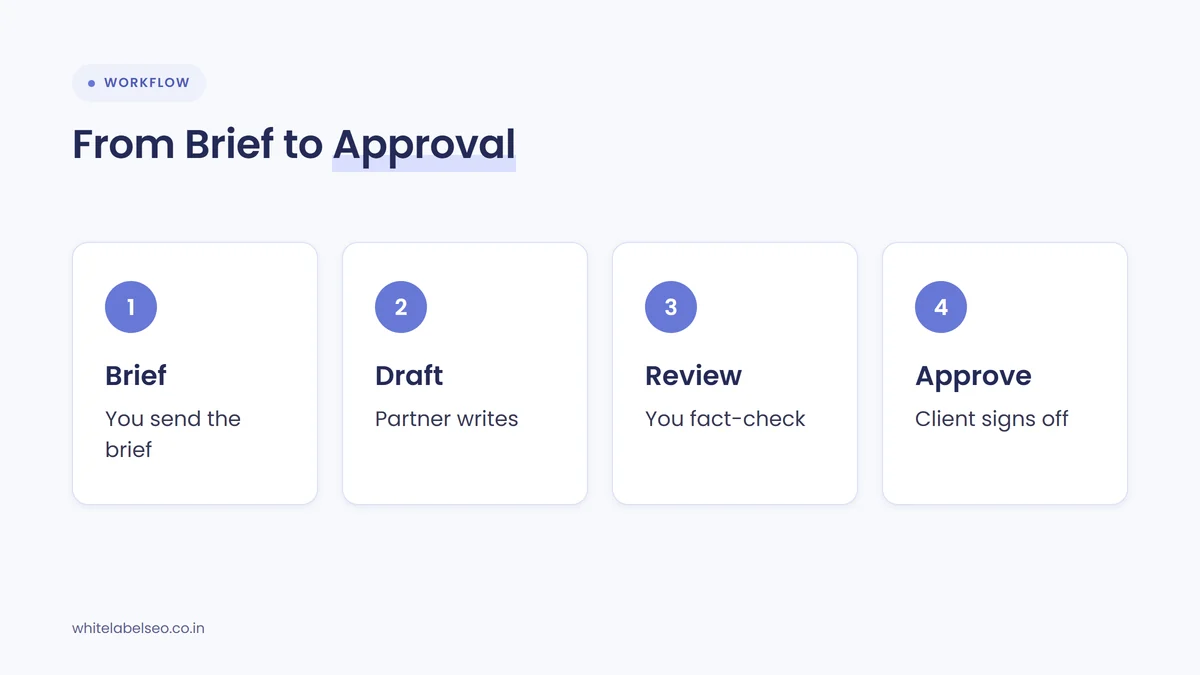
The 6 steps of white label content writing are listed below, in the order the work moves.
- Send the content brief. Give the white label writer the keyword, search intent, audience, outline, sources and brand voice for each piece.
- Agree the deadline and revision rounds. Set the delivery date and the number of revision rounds in writing before the writer starts.
- Receive the draft and the provider check. The partner’s own editor reads the draft first, so you don’t get a first pass full of basic errors.
- Run your agency review. Fact-check the claims, match the brand voice and check the on-page SEO before anything reaches the client.
- Collect client approval. Send the content under your brand, take the client’s comments and pass any changes back to the writer.
- Publish and record the result. Publish through your own CMS access, then log the page in Google Search Console and your reporting so you can judge it on results later.
Each step has an owner. The partner owns steps 2 and 3, and your agency owns steps 1, 4, 5 and 6, which is why white label content writing keeps the client relationship with you.
What should a content brief for a white label writer include?
A content brief for a white label writer should include 7 items: the target keyword, the search intent, the audience, the outline, the sources, the brand voice and the on-page requirements. The more specific the content brief, the fewer revision rounds the writer needs, because the writer isn’t guessing what the client wants.
The 7 items a white label content writing brief should contain are listed below.
- Target keyword and variants. The main phrase, plus the 2 or 3 close variants the page should also use.
- Search intent. Whether the reader wants to learn, compare or buy, so the content brief sets the right page type.
- Audience. The client’s customer, their level of knowledge and the words they use.
- Outline. The headings in order, with the question each section answers.
- Sources and facts. The named sources the writer may cite, and the client facts that must be stated exactly.
- Brand voice. A style guide with tone, spelling, words to avoid and one approved sample.
- On-page requirements. Title, meta description, internal links, image alt text and calls to action.
Keep each brief to one page. A short, specific content brief gets followed, and a long one gets skimmed. If you are unsure what the rest of the partner’s monthly work looks like, compare it with what a white label SEO partner does each month, so the writing fits the wider plan.
How do agencies keep white label content writing quality high?
Agencies keep white label content writing quality high with 5 quality control gates that every piece passes before the client sees it: fact-check, originality, people-first review, brand voice and metadata. The gates sit with your agency, not the partner, because the client holds you responsible for what is published.
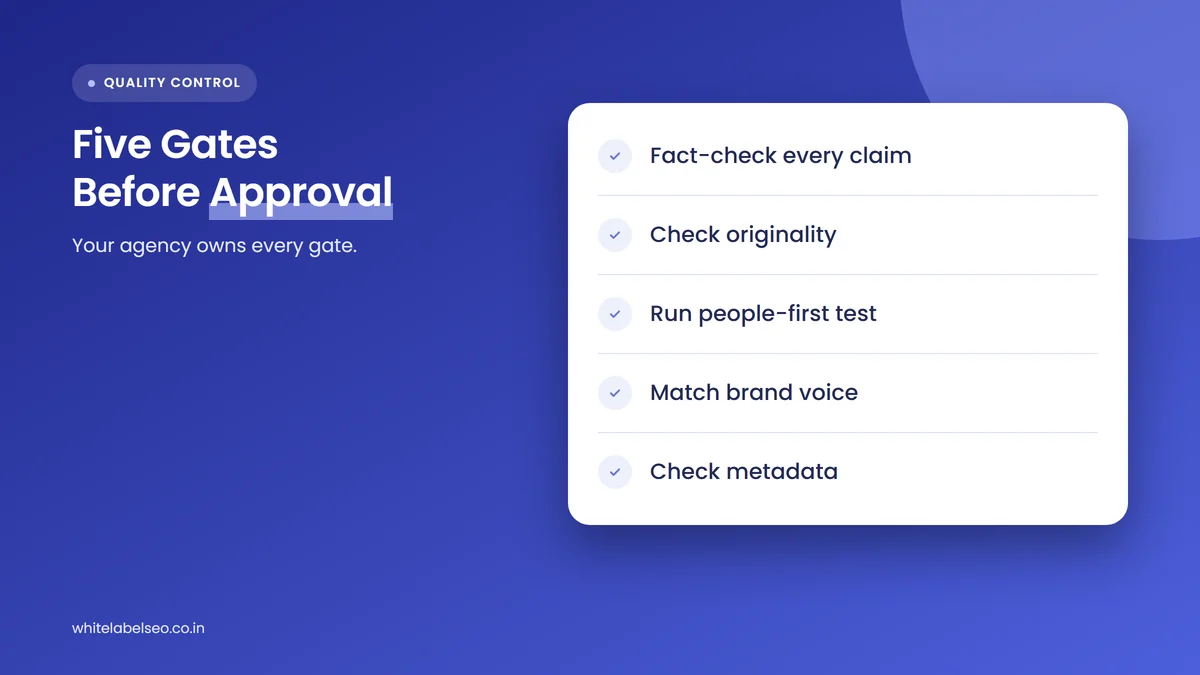
The 5 quality control gates for white label content writing are listed below.
- Fact-check every claim. Google’s people-first content guidance says informational pages should be factually accurate, so open each source and confirm each number, date and quote.
- Check originality and page value. Google Search Essentials includes spam policies that define scaled content abuse as many pages generated for the primary purpose of manipulating search rankings, so reject near-identical pages with swapped city or product names.
- Apply the people-first content test. Google’s guidance asks Who wrote it, How it was created and Why it exists, so make sure each page has a clear author or brand, an honest process and a purpose beyond ranking.
- Match the brand voice. Read the draft against the client’s style guide and approved sample, and rewrite any sentence that sounds like the writer rather than the client.
- Check titles, descriptions and alt text. Google says its review advice also applies to metadata such as title elements, meta descriptions, structured data and image alt text.
Run the gates in this order, because a fact error found at gate 1 can change the rest of the draft. For a quick test of the partner’s overall output, use the 10 red flags in a white label SEO report alongside this list.
Can a white label writer use AI?
Yes, a white label writer can use AI, but every piece needs human review before it is published. Google’s guidance on generative AI content says it is critical to manually fact-check and review all AI-generated content for accuracy and trustworthiness, and that using AI to generate many pages without adding value for users may violate its spam policy.
Ask your partner in writing whether AI is used, at which step, and who reviews the result. A partner that cannot answer in 2 sentences has no process for manual oversight. Our guide to AI content governance for white label SEO partnerships covers the policy side in full.
How long does white label content writing take?
White label content writing takes about 3 hours 20 minutes of writing time per blog post on average, according to Orbit Media’s 2026 blogging survey of 1,042 content marketers, plus your review time on top. The same survey puts the average post at 1,312 words, so a partner that delivers a 1,300-word post in minutes needs a closer look.
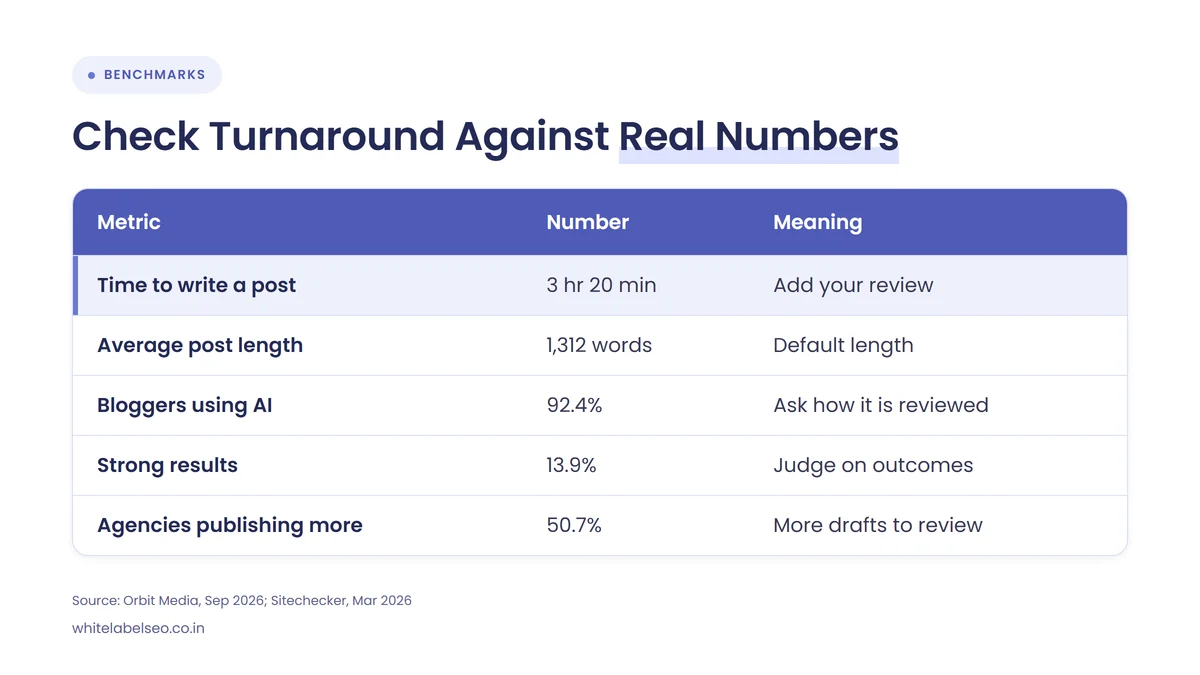
The table below lists 6 benchmarks for white label content writing, with what each number means for your agency.
| Metric | Number | What it means for you | Source |
|---|---|---|---|
| Average time to write a post | 3 hours 20 minutes (peak 4 hours 10 minutes in 2022) | Judge a partner’s turnaround against a human draft time, then add your review hours | Orbit Media, September 2026 |
| Average post length | 1,312 words | Use it as the default length unless the search intent needs more | Orbit Media, September 2026 |
| Bloggers using AI | 92.4% of 1,042 | Assume AI may touch a draft, and ask your partner how it is reviewed | Orbit Media, September 2026 |
| Bloggers reporting strong results | 13.9%, an all-time low | Judge content on results after publishing, not on volume delivered | Orbit Media, September 2026 |
| Agencies publishing more content overall | 50.7% of 73 agencies | More volume means more drafts for your editorial review | Sitechecker, March 2026 |
| Agencies building automations to cut delivery cost | 60.3% of 73 agencies | Cheaper delivery makes quality control gates more important | Sitechecker, March 2026 |
The table shows that writing a post takes hours of human work, and that most agencies are publishing more while cutting delivery cost, so review time is the part of the budget that protects quality.
Ask the partner for a turnaround time per piece in writing, and build your own review time into the client schedule. A common mistake is promising the client a date before the review stages are counted.
Who owns white label content writing once it is delivered?
Your agency, or your client, should own white label content writing once it is delivered and paid for, and the agreement should say so in writing. Without a clear clause, a partner could reuse text, claim credit or resell the same piece to someone else.
The ownership terms to agree before the first brief are listed below.
- Assignment of rights. The partner assigns all rights in the delivered content to your agency or your client on payment.
- No credit and no reuse. The partner does not sign, promote or resell the white label content.
- Original work. The partner confirms in writing that each piece is original and not copied from other pages.
- Removal of access. Any login the partner holds is removed when the work ends.
Have a lawyer check the final wording, because rules differ between countries. For the money side of the same agreement, see how much white label SEO costs, so content fees sit inside a margin that works.
How do you scale white label content writing across more clients?
You scale white label content writing across more clients by adding one client at a time and running the same 5 quality control gates on each. A process that works for one client’s 4 posts a month can fail at 20 clients if the content brief and the review step are skipped to save time.
Start with 1 client, keep your review hours as a benchmark, then add 2 or 3 more once the first client’s content passes all 5 gates without rework. Keep a style guide per client so the brand voice never mixes. The full approach to volume, author signals and expert input is in our guide to producing E-E-A-T content at scale with a white label SEO partner.
Frequently asked questions
Do clients know a white label writer wrote their content?
No, clients do not have to know, because white label content writing is delivered under your brand. What matters is that your agency stays accountable for accuracy and quality. Some agencies tell clients they work with specialist writers without naming them, which is honest and still protects the partner relationship.
How many revision rounds should white label content writing include?
Two revision rounds per piece is a sensible starting point, and you should agree the number in writing before work starts. One round fixes the agency’s comments and one handles the client’s changes. A clear content brief usually removes the need for more.
Can a white label writer match a client’s brand voice?
Yes, a white label writer can match a client’s brand voice if you supply a style guide and one approved sample. Without them, the writer falls back on a generic tone. Review the first 2 pieces closely and send the writer your edits so the next drafts need fewer changes.
What should you do if a white label draft fails the quality gates?
Send it back with the gate it failed and the exact lines that need to change, inside the agreed revision rounds. If the same gate fails twice, pause the order, review the content brief and consider whether the partner fits that content type.
Is white label content writing worth it for a small agency?
Yes, white label content writing is worth it for a small agency when writing is the bottleneck, because it frees your team to run strategy, reviews and client calls. It is not worth it if you skip the review, since one inaccurate post under your brand costs more than the saved writing hours.
What should you do next?
Write a one-page content brief template with the 7 items above, add your 5 quality control gates as a checklist, and send both to your partner with a 2-piece test order. Then score the first 2 drafts on facts and brand voice before you add more clients.
If you want a partner that works to your brief and your review process, see how our white label SEO services support agencies at White Label SEO.
Want content written to your brief and your brand voice?
At White Label SEO, we write to your content brief, hand the draft back for your review and keep your brand on every page. Tell us about the client and the content you need, and we’ll scope a small first order with you.
Sources
- Google Search Central, “Creating helpful, reliable, people-first content”, accessed November 23, 2026. https://developers.google.com/search/docs/fundamentals/creating-helpful-content
- Google Search Central, “Using generative AI content on your website”, accessed November 23, 2026. https://developers.google.com/search/docs/fundamentals/using-gen-ai-content
- Google Search Central, “Spam policies for Google web search”, accessed November 23, 2026. https://developers.google.com/search/docs/essentials/spam-policies
- Orbit Media, “Blogging Statistics 2026: What 1,042 Content Marketers Told Us About What Works”, September 2026. https://www.orbitmedia.com/blog/blogging-statistics/
- Sitechecker, “The 2026 SEO agency growth report”, March 11, 2026. https://sitechecker.pro/seo-agency-growth-data-study-2026/
- DashClicks, “Coordinate content briefs and review cycles with a white label SEO partner”, September 2, 2025. https://www.dashclicks.com/blog/coordinate-content-briefs-review-cycles-with-white-label-seo-partner