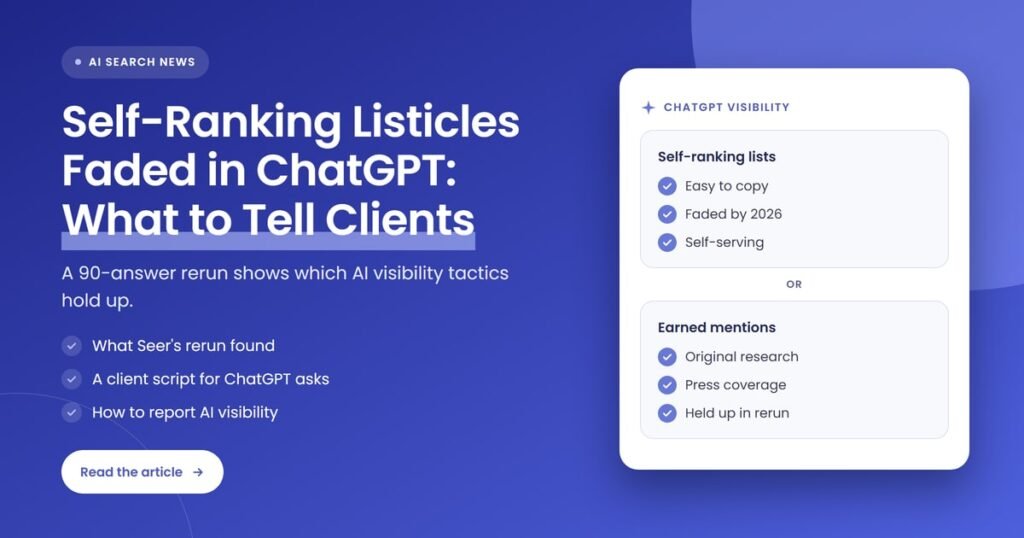
Quick answer: Seer Interactive reran three ChatGPT prompts in November 2026 and found that none of the 21 agencies ChatGPT named in February 2025, mostly via self-ranking “best agency” listicles, still appear reliably. Agencies should tell clients that quick listicle tactics fade, measure AI visibility across many runs, and sell earned mentions, original data and clear entity information instead.
Key takeaways
- In February 2025, ChatGPT named 21 agencies for three prompts, and many of the pages behind those answers were agency-published “best SEO companies” lists that ranked the publisher first.
- In a November 2026 rerun of 90 answers, none of the 21 appeared reliably: 4 appeared sometimes, 8 rarely and 9 never.
- Seer, which never published a self-ranking list, went from zero mentions to 58 of 90 runs, and credits research, press coverage, speaking and social, while saying it cannot prove the cause.
- Google has said it knows about low-quality listicle content, and Anthropic’s usage policy, effective November 12, 2026, bars using Claude to seed AI answer sources with content that misrepresents where it came from.
- One screenshot proves nothing about AI visibility. Report results from repeated runs of a fixed prompt set, and sell work that earns mentions from other people.
What did Seer Interactive find about self-ranking listicles?
Seer Interactive found that agencies ChatGPT recommended in early 2025 through self-ranking listicles have mostly faded. Wil Reynolds reran his February 2025 prompts in November 2026: none of the 21 agencies named back then appeared reliably, 9 never appeared at all, and Seer, which used no listicle tactic, appeared in 58 of 90 answers.
Wil Reynolds, CEO of Seer Interactive, published the findings on November 12, 2026. In February 2025 he ran three prompts in ChatGPT that he expected to name Seer, such as “What are the best data driven SEO companies”. ChatGPT named 21 agencies, and Seer was not one of them. When he clicked through to the pages ChatGPT was reading, he kept finding the same pattern: an agency publishes a “best SEO companies” page, puts itself at or near the top, and fills the rest with other agencies.
Twenty-one months later, the same prompts told a different story. The bottom 17 agencies had 540 chances to be named across the rerun and were named 27 times, about 5%. Seer was named in 58 of 90 answers, or 64.4%.
What is a self-ranking listicle?
A self-ranking listicle is a “best companies” or “top tools” article published by one of the companies on the list, which places itself first or near the top. The tactic aims to give search engines and AI assistants a page they can pull from when someone asks for recommendations, with the publisher’s name already in the top spot.
AI visibility, in this post, means how often an AI assistant such as ChatGPT names a brand when someone asks a question the brand should answer. It is not a ranking position. The same prompt can produce different answers each time, which is why the way you measure it matters as much as the number itself.
How did Seer run the 2026 test, and what were the results?
Seer ran the same three prompts 10 times each on three current ChatGPT models through the API, with web search on and no memory or personalization, for 90 answers. Each of the 21 agencies was counted only on the prompt that named it in 2025, giving each agency 30 chances to appear.
Reynolds defined “reliably” as two in three answers or more and “rarely” as fewer than one in three. Here is how the 21 agencies and Seer landed:
| Group | 2025 result | November 2026 result |
|---|---|---|
| Agencies appearing reliably (2 in 3 or more) | All 21 named in a single run | 0 |
| Agencies appearing sometimes | Named | 4 |
| Agencies appearing rarely (under 1 in 3) | Named | 8 |
| Agencies never appearing | Named | 9, across 270 tries |
| Seer Interactive | Not named | 58 of 90 answers (64.4%) |
Seer’s result was not even across prompts. It appeared in 25 of 30 answers for the PPC and SEO prompt and 28 of 30 for the data-driven prompt, but only 5 of 30 for the “innovative SEO agency” prompt, where another agency, iPullRank, appeared in 23 of 30. That detail is useful for client conversations: AI visibility is prompt by prompt, not a single score.
What are the limits of Seer’s study?
Seer’s study is a useful signal, not proof. Reynolds lists the limits himself: the 2025 baseline was a single run in logged-in ChatGPT on GPT-4o, the 2026 setup used different models through the API, and he cannot link any specific talk, study or post to ChatGPT naming Seer. The prompts were also chosen as ones Seer should win.
Those caveats matter when you pass the study on to clients:
- One baseline run. Some of the 21 agencies may have come and gone between answers in 2025 too. A single run can’t show how often they appeared.
- Different setups. Logged-in ChatGPT and API calls with no memory are not the same environment, and the models changed.
- No isolated cause. Reynolds credits Seer’s human-focused work but says he can’t draw a line from any one activity to the result.
- Prompts that favor Seer. Reynolds picked prompts he expected Seer to fit, so Seer’s 64.4% says more about those prompts than about the market.
So don’t tell clients “listicles stopped working.” Tell them that in one well-documented test, the agencies that leaned on that pattern did not hold their place, and the agency that built a reputation elsewhere did.
Who is affected by the fade of listicle tactics?
Any client that bought, or is asking for, quick “get us into ChatGPT” tactics is affected. That includes brands publishing their own “best of” lists, brands paying for placement on thin listicles, and agencies whose AI visibility reports rest on one screenshot from a single good answer.
The risk is highest for clients in crowded recommendation categories, such as agencies, software, local services and professional services, where “best X” prompts are common and many competitors have published the same kind of page. It is also a reporting risk for your agency: if a client saw their name in ChatGPT once and later can’t find it, the account manager has to explain a result that was never stable.
Why are Google and Anthropic pushing back on listicle tactics?
Google and Anthropic are both signaling that manufactured sources for AI answers are a target. Google told The Verge, as reported by Search Engine Roundtable in April 2026, that it knows about low-quality listicle content. Anthropic’s usage policy, effective November 12, 2026, bars using Claude to seed answer sources with content that misrepresents its origin.
The two moves are different and worth explaining accurately:
- Google. In April 2026, Search Engine Roundtable reported a Google statement, first given to The Verge, that it applies protections against common forms of manipulation in Search and Gemini and is working to combat low-quality listicle content. Google’s own documentation also says there are no special optimizations needed to appear in AI Overviews or AI Mode.
- Anthropic. Anthropic’s updated usage policy, released October 8 and effective November 12, 2026, adds a section on deceptive campaigns. It bars using Claude to manipulate the sources search engines or AI systems draw answers from with content that “misrepresents its origin, authorship, or independence,” giving networks of sites posing as unaffiliated sources as the example.
Anthropic’s rule covers how people use Claude, not how ChatGPT ranks pages, and an honest comparison page is not the same as a fake network. Still, the direction is clear. Tactics that dress up self-promotion as independent opinion are getting harder to defend to clients and to platforms.
What should agencies tell clients who ask to “get us into ChatGPT”?
Tell clients the truth in three parts: no one controls which brands an AI assistant names, shortcuts like self-ranking listicles have faded in the best public test so far, and the brands that hold up are the ones other people write about. Then offer a measurable plan, not a promise of placement.
A short script your account managers can adapt:
- Acknowledge the goal. “Being named when buyers ask ChatGPT for recommendations is a fair goal, and we can track it.”
- Set the expectation. “AI answers change from run to run, and no one can promise a spot. The quick tactic many agencies sold, publishing your own ‘best of’ list, did not hold up in a 90-answer test published this month.”
- Offer the plan. “We’ll pick the prompts that matter to your sales, measure how often you’re named across repeated runs, and build the mentions and information that give AI tools a reason to name you.”
- Agree what success looks like. “We’ll report your mention rate on agreed prompts each month, next to the leads and sales search brings in.”
Keep AI visibility in proportion, too. Over nearly two years, AI assistants sent 0.3% of Seer’s sessions, while organic search sent 45.7%. Your clients’ mix will differ, so check their own analytics before agreeing how much budget AI visibility deserves. For more on framing outcomes early, see our guide to setting SEO expectations with a new client.
How should agencies report AI visibility to clients?
Report AI visibility as a mention rate from repeated runs, not a screenshot. Fix a set of prompts tied to the client’s sales, run each one several times across the assistants that matter, log whether the brand is named and which sources are cited, and track the rate month over month next to leads.
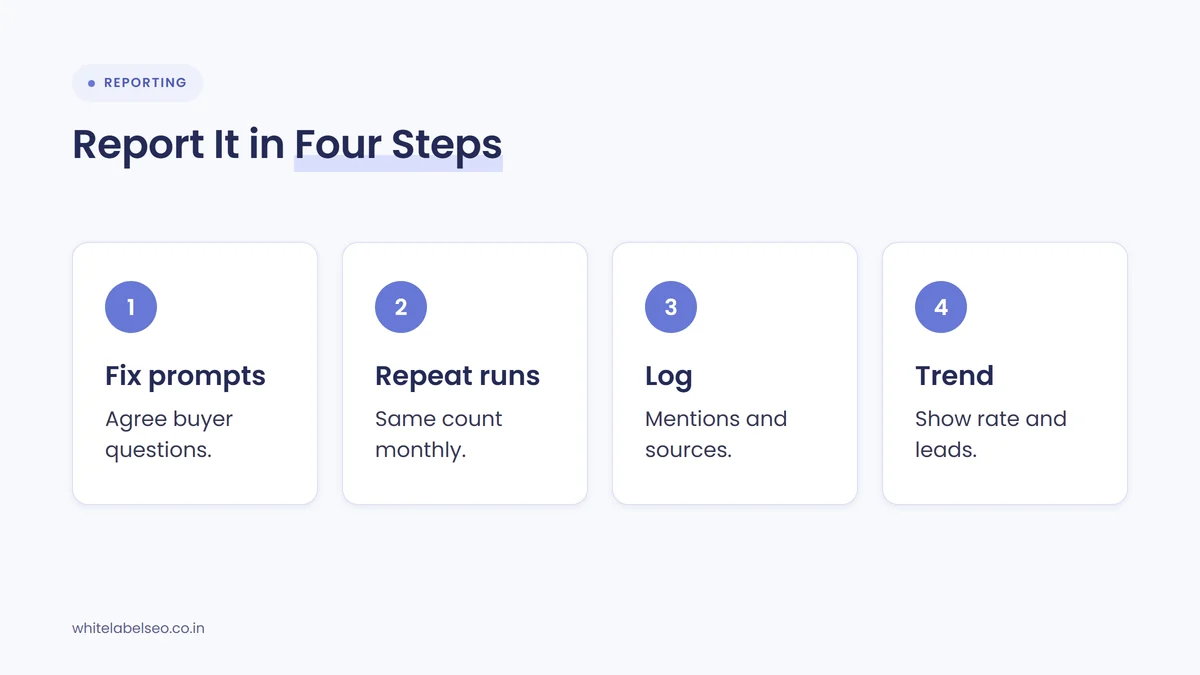
- Fix the prompt set. Agree 10 to 20 prompts with the client that a real buyer would ask, including category, comparison and problem-led questions. Keep the wording stable from month to month.
- Run each prompt several times. Seer used 10 runs per prompt per model. Whatever number you choose, use the same one every month and note the models and settings.
- Log mentions and sources. Record whether the client is named, which competitors are named, and which pages the answer cites. The cited pages show where mentions need to be earned.
- Report the trend with context. Show the mention rate per prompt, the change from last month, and the leads and sales organic search delivered, so AI visibility sits beside business results.
This method also protects your agency. When a client sends a screenshot of a competitor in ChatGPT, you can show how often that competitor actually appears across runs. If clients ask about native analytics from AI platforms, our post on ChatGPT’s business analytics plans covers what to say.
What AI visibility work should agencies sell instead?
Sell work that earns mentions from other people and makes the client easy for AI tools to describe: original research and data that publications pick up, digital PR and expert commentary, steady reviews, and clear, consistent entity information across the client’s site and profiles. These take longer, but they don’t depend on a loophole staying open.
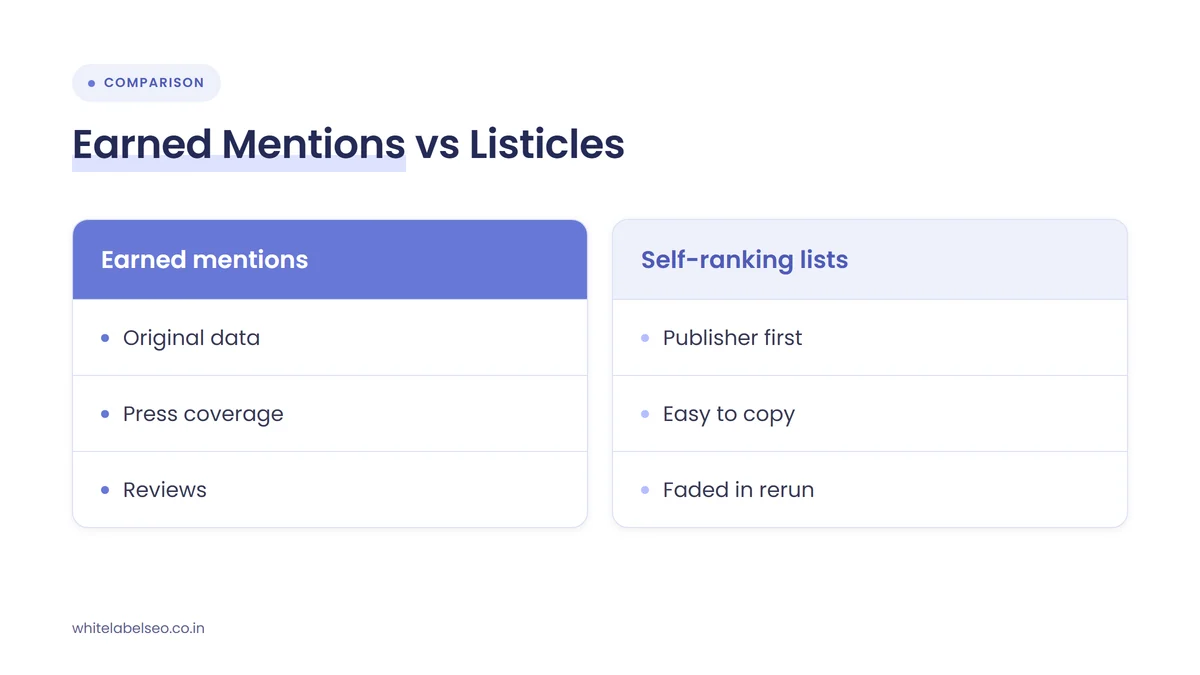
Seer’s own example points the same way. Reynolds says 10 Seer researchers had work picked up by 19 publications in 12 months, and Seer tracked 958 mentions from outlets citing its studies or views between August 2025 and August 2026. Seer’s own site was cited in 21 of the 58 answers that named it.
| Work to sell | What it involves | Why it helps AI visibility | What to report |
|---|---|---|---|
| Original data and research | Surveys, benchmarks or analysis of the client’s own data, published as a citable page | Gives journalists and other sites a reason to mention the brand | Mentions and links earned, pages cited in AI answers |
| Digital PR and expert commentary | Pitching the research, offering expert quotes, speaking and podcasts | Puts the brand on independent sites AI tools already read | Coverage won, prompts where the brand now appears |
| Reviews | A steady process for asking happy customers to review the business | Adds third-party evidence about the brand | Review count, rating and recency |
| Clear entity information | Consistent name, services, locations and people across the site, schema and profiles | Makes it easier for AI tools to describe the brand correctly | Accuracy of how AI answers describe the client |
| Answer-first site content | Service and guide pages that answer buyer questions directly | Gives assistants a clear page to cite | Citations of client pages, organic leads |
Most of this already fits inside an SEO retainer. Our post on white-label digital PR and brand mentions for AI search visibility goes deeper on scoping the PR side, and why AI search visibility is becoming a core deliverable covers how to package it.
What should agencies do about existing self-ranking listicles?
Review any self-ranking listicles you have published for clients and decide whether each one is honest and useful. Pages that rank the client first without stated criteria or fair limits should be rewritten as genuine comparisons, merged into a stronger page, or retired, with the client told why.
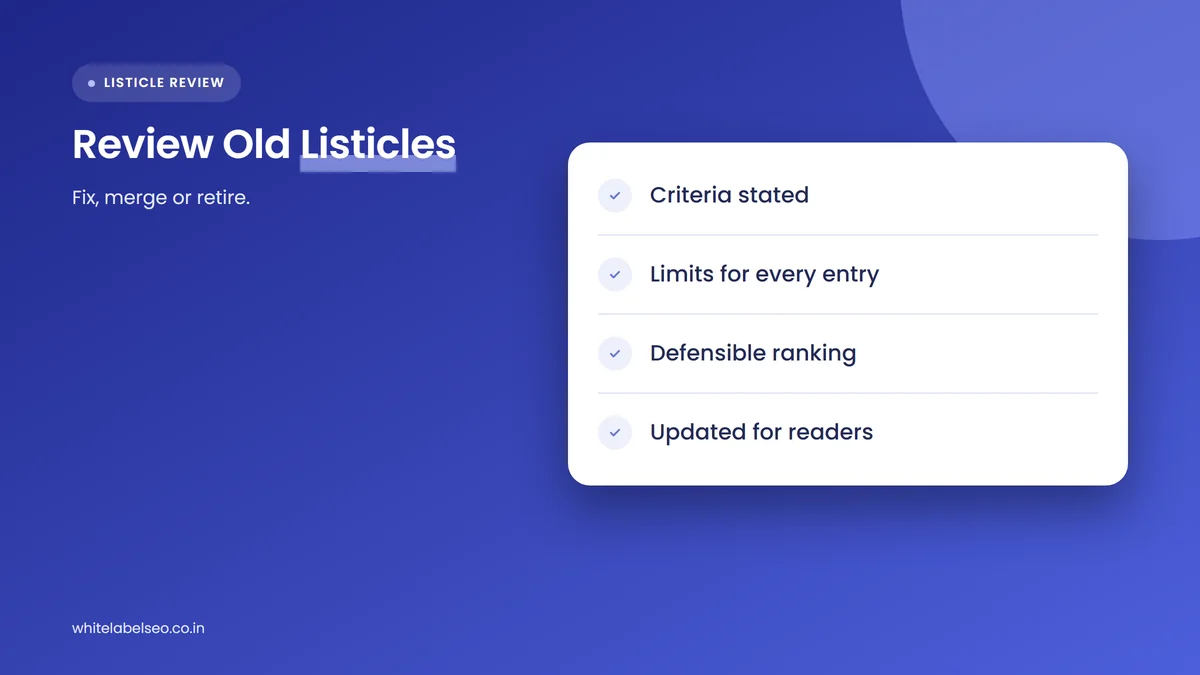
A practical review covers four questions for each page:
- Are the selection criteria stated? A reader should see how the list was built.
- Does every entry, including the client, show limits? A list where only competitors have weaknesses reads as an advert.
- Is the client’s ranking defensible? If the client would not come first on the stated criteria, the page should say so.
- Is the page updated for readers, or only to look fresh? Reynolds noted that the four agency listicles cited in Seer’s answers all ranked the publisher first and had been updated in recent months.
What is our view, and what is likely next?
Our view, which is opinion rather than data, is that AI visibility will keep rewarding brands that other people talk about, and keep punishing shortcuts once enough people copy them. Agencies that sell earned mentions and honest measurement now will have an easier time explaining results to clients as AI tools change.
We expect more public reruns like Seer’s, because the method is simple to copy, and more clients asking for prompt-level reporting. We also expect platforms to keep tightening their rules on manufactured sources, as Anthropic did this month. None of this is certain, and AI answers can shift quickly, which is the strongest argument for measuring often and promising little.
Frequently asked questions
Did self-ranking listicles stop working in ChatGPT?
One public test suggests they lost their effect. In Seer Interactive’s November 2026 rerun, none of the 21 agencies ChatGPT named in 2025, largely through self-ranking listicles, appeared reliably across 90 answers. The study has limits, including a single 2025 baseline run, so treat it as a strong signal rather than proof.
Can an agency promise a client a spot in ChatGPT answers?
No. No one controls which brands an AI assistant names, and answers change from run to run. An agency can promise the work, a fixed prompt set, repeated measurement and honest monthly reporting of how often the client is named, alongside leads and sales from search.
How many times should you run a prompt to measure AI visibility?
Run each prompt several times per assistant and keep the number the same every month. Seer used 10 runs per prompt on each of three models. The exact number matters less than consistency, stable prompt wording and a note of the models and settings used.
Does Anthropic’s new usage policy ban listicles?
No. Anthropic’s usage policy, effective November 12, 2026, bars using Claude to seed the sources AI systems draw answers from with content that misrepresents its origin, authorship or independence, such as networks of sites posing as unaffiliated sources. An honest comparison page is a different thing.
How much traffic do AI assistants send compared with search?
It varies by business, so check each client’s analytics. For Seer Interactive, AI assistants sent 0.3% of sessions from November 2024 to October 2026, while organic search sent 45.7%. That is one company’s data, but it is a useful reminder to keep AI visibility in proportion.
What should agencies do next?
Pick your three clients most likely to ask about ChatGPT and get ahead of the conversation. Agree a fixed prompt set with each, run a baseline across several runs, review any self-ranking listicles you have published for them, and add earned-mention work to next quarter’s plan. If you need a team to deliver that behind your brand, see our white-label SEO services at White Label SEO.
Want AI visibility reporting you can stand behind?
At White Label SEO, we deliver white-label SEO under your agency’s brand, including prompt-based AI visibility tracking, earned-mention work and monthly reports your account managers can explain with confidence.
Sources
- Seer Interactive (Wil Reynolds), “2025 – ChatGPT named 21 competitors & us 0 times 2026 – Them 0, us 65%”, November 12, 2026. https://www.seerinteractive.com/insights/chatgpt-named-21-competitors-in-2025-and-us-0-today-many-are-at-0-we-are-at-65-percent
- Anthropic, “Usage Policy”, effective November 12, 2026. https://www.anthropic.com/legal/aup
- Search Engine Journal (Matt G. Southern), “Claude’s New Rules Target Fake Sources Built To Sway AI Answers”, October 9, 2026. https://www.searchenginejournal.com/claude-rules-fake-sources-ai-answers/592456/
- Search Engine Roundtable (Mordy Oberstein), “Google Is Aware Of And Warns Against Self-Serving Listicles”, April 14, 2026. https://www.seroundtable.com/google-warns-against-trying-to-manipulate-llms-41156.html
- Google Search Central, “AI features and your website”, last updated December 10, 2025. https://developers.google.com/search/docs/appearance/ai-features