

Quick answer: Charge a setup fee when the first month of an SEO retainer needs real one-time work: an audit, tracking and access setup, technical fixes and a keyword and content plan. Waive it only when that work is already done or the client commits to a longer term. Explain it as a separate, itemized line with clear deliverables.
Key takeaways
- A setup fee pays for the heavy one-time work at the start of a retainer, so the monthly fee can reflect steady ongoing work.
- Charge it when onboarding is substantial, waive it when the work already exists, and fold it into a higher first month when the client needs one simple number.
- The fee reduces early churn risk mostly by funding a proper first 90 days and filtering out clients who are not ready to commit.
- Word it as a list of deliverables with dates, never as “admin” or “account activation”.
- If a white-label partner does your fulfillment, its onboarding scope and any fee it charges set the floor for what you charge.
What is an SEO setup fee?
An SEO setup fee is a one-time charge, billed at the start of a retainer, that covers the work needed before ongoing SEO can run: auditing the site, connecting tracking, getting access to the client’s accounts, fixing blocking technical issues and building the first keyword and content plan. It is separate from the recurring monthly fee.
A retainer is a recurring monthly fee for an agreed scope of ongoing work. It is the standard way SEO is sold: Ahrefs found that 78.2% of the SEO providers it surveyed charge a monthly retainer. The setup fee answers a simple problem with that model. Month one costs far more to deliver than month six, and a flat monthly price hides that.
You will also see it called an onboarding fee, a launch fee or a foundation fee. The name matters less than the scope. What the client needs to see is exactly what the money buys and when it will be done.
What onboarding work does a setup fee pay for?
A setup fee pays for the work that happens once, at the start: a technical and content audit, analytics and conversion tracking, access to Search Console and Google Business Profile, fixes for issues that block progress, and a keyword and content plan. Together these turn a new account into one your team can work on every month.
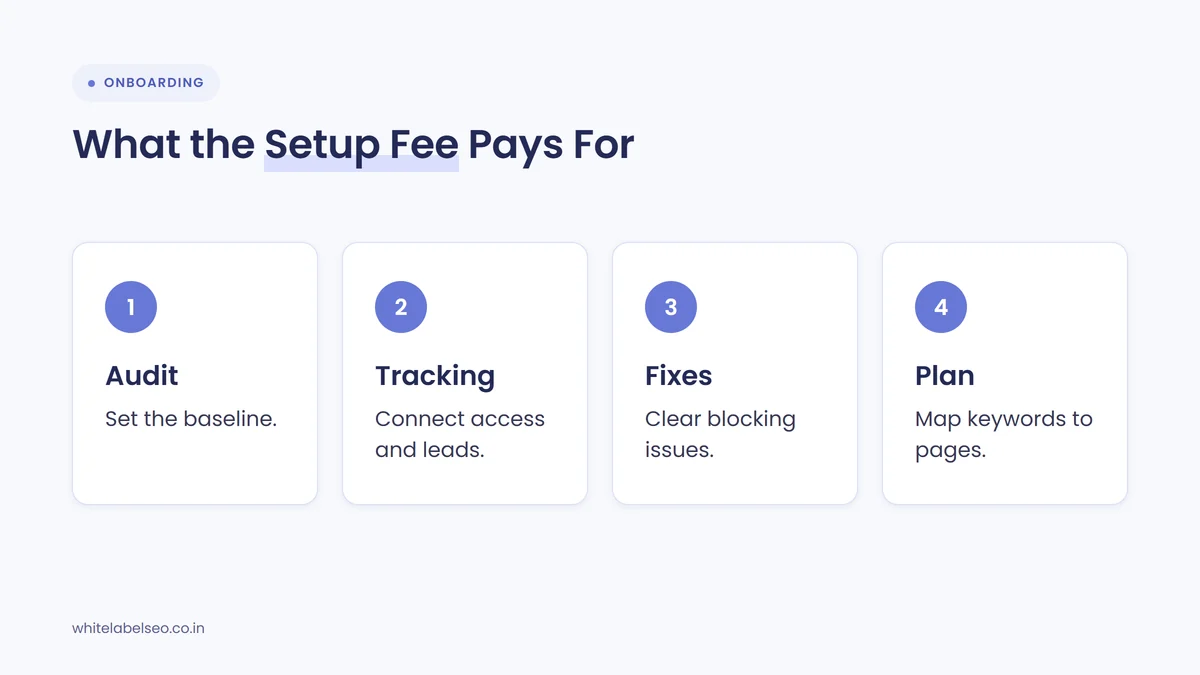
Here is what usually sits inside a setup fee, and why each item is one-time work rather than monthly work:
- Audit. A technical crawl, an on-page and content review, a backlink check and a look at the main competitors. It sets the baseline you will report against for the rest of the engagement.
- Tracking setup. Analytics, conversion events for calls and forms, and a reporting dashboard. Without this, you cannot show the client that SEO produced leads, only that rankings moved.
- Search Console and Google Business Profile access. Getting the right permission level often takes more back-and-forth than agencies expect. In Search Console, only owners can add or remove users, so the client or their developer has to grant access. In Google Business Profile, newly added owners and managers must wait 7 days before they can manage some features, such as removing other users.
- AI search tracking. Since August 2026, Search Console’s generative AI performance reports cover all websites worldwide, showing impressions from AI Overviews and AI Mode by page. Setting a baseline for those reports at the start gives you a fair comparison later.
- Technical fixes. Indexing problems, broken redirects, duplicate pages, slow templates and missing schema. These are the issues that hold back everything else, so they need to be cleared first.
- Keyword and content plan. Keyword research mapped to pages, a list of pages to create or improve, and the order you will tackle them in. This becomes the roadmap that each monthly retainer works through.
Not every client needs all six. A site that already has clean tracking and a recent audit needs far less setup than a site migrated last year with no analytics. That difference is the main reason to decide case by case rather than charging the same setup fee to everyone.
When should you charge a setup fee, waive it, or fold it into the first month?
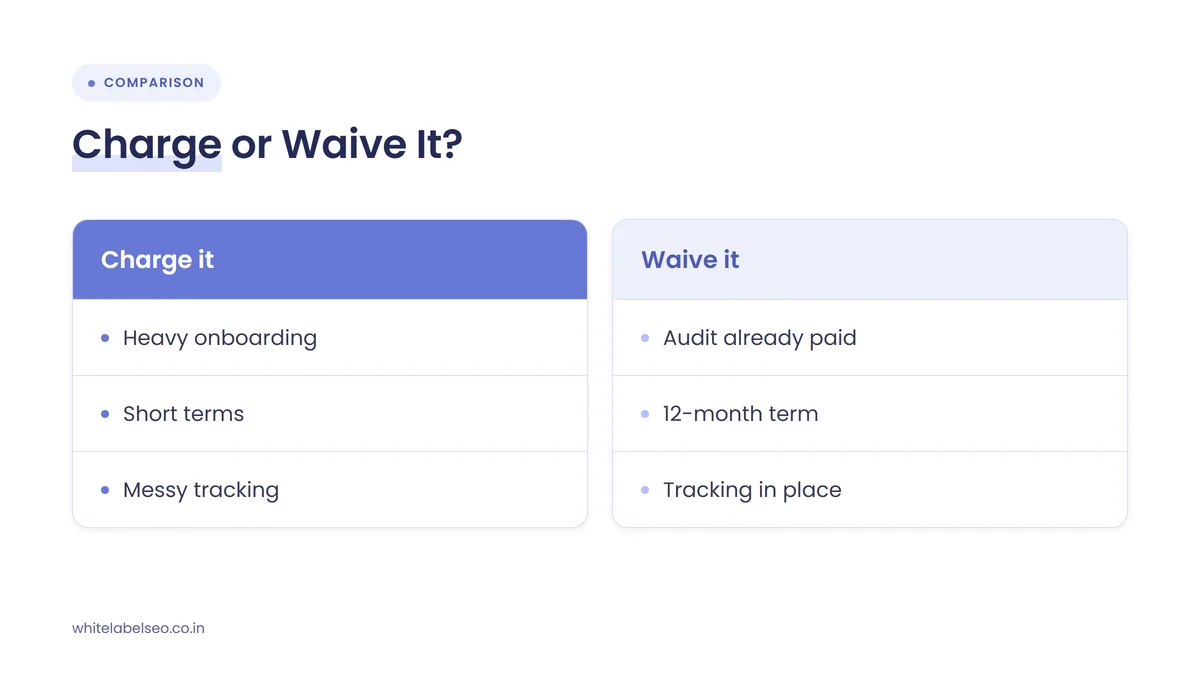
Charge a separate setup fee when onboarding is heavy and you want the monthly price to stay comparable with competitors. Waive it when the setup work already exists or the client commits to a longer term. Fold it into a higher first month when the client wants one simple number and onboarding is moderate.
When does charging a separate setup fee make sense?
A separate setup fee makes sense when the site needs a full audit, new tracking, access untangling and technical fixes before ongoing work can start. It also suits clients who compare monthly prices across agencies, because it keeps your recurring fee honest and stops one-time costs from inflating every month of the contract.
It fits best for sites with a history of migrations, multiple locations, messy analytics or a previous agency that left without handing over access. It also protects you on short terms: if a client leaves after three months, you have still been paid for the most expensive month of work.
When should you waive the setup fee?
Waive the setup fee when the onboarding work is genuinely light or already paid for. That includes clients who bought a paid audit from you first, existing web design clients whose tracking you built, and clients who sign a longer minimum term, where the extra committed months cover the setup cost over time.
A waived fee can also be a deliberate trade. Offering to waive it in exchange for a 12-month term or an upfront quarterly payment gives the client a reason to commit, and it gives you the time SEO needs to show results. Show the full fee in the proposal and mark it as waived, so the client sees the value they are receiving.
When is a higher first month the better option?
A higher first month works when the client’s finance team prefers simple invoices, or when a separate “setup” line would trigger extra approval steps. You price month one at the retainer plus the onboarding work, then drop to the standard retainer from month two. The work is the same; only the presentation changes.
The risk is that clients remember the first invoice as “the price”. Spell out in the proposal that month one is higher because it includes the audit, tracking and plan, and list the standard monthly fee next to it.
How do the setup fee pricing models compare?
There are four common ways to handle onboarding costs on an SEO retainer: a separate setup fee, a waived fee tied to a longer term, a higher first month, and onboarding spread across the retainer. Each one trades simplicity, cash flow and churn protection differently, so the right choice depends on the client and the site.
| Model | How it works | Best for | Main risk |
|---|---|---|---|
| Separate setup fee | One-time fee for listed onboarding deliverables, then the monthly retainer | Heavy onboarding, clients who compare monthly prices | Feels like a hidden charge if the deliverables are vague |
| Waived fee with a longer term | Fee shown in the proposal and waived in exchange for a 12-month term or upfront payment | Clients ready to commit, light or moderate onboarding | You absorb the cost if the client exits early without a clear term |
| Higher first month | Month one priced at retainer plus onboarding, then the standard fee | Clients who want simple invoices or one approval | Client anchors on the first invoice as the regular price |
| Spread across the retainer | No setup line; onboarding cost built into a slightly higher monthly fee | Long contracts, accounts with little setup work | Monthly price looks high next to competitors, and early exits lose you money |
| Paid audit first | Audit sold as its own project, with the fee credited if the client signs a retainer | Prospects not ready to commit to a monthly fee | Client takes the audit to a cheaper provider |
We looked for a reliable, recent public benchmark on how much agencies charge for SEO setup and did not find one. The ranges that circulate come from individual agencies’ own pricing pages, so we have left figures out. Price your setup fee from your own cost to deliver the onboarding work, plus your normal margin. Our guide to what white-label SEO costs shows how wholesale fees feed into that calculation.
How does a setup fee reduce early churn risk?
A setup fee reduces early churn risk in two ways. It funds a structured first 90 days, so the client sees a plan, a baseline and early progress instead of silence. It also filters out prospects who were never ready to commit, because a client who pays for onboarding has decided to see the work through.
Early churn is where agencies lose the most. In a September 2026 Search Engine Journal article, Sophie Brannon of StudioHawk cites a 2026 agency churn analysis from Focus Digital, which found that the first 90 days are the peak churn risk across every agency model it studied, and that agencies running formal 30, 60 and 90 day check-ins had consistently lower first-year churn. Her recommended plan puts the welcome email, access requests, kickoff, benchmarking report and prioritized roadmap in the first two weeks.
That is exactly the work a setup fee pays for. When onboarding is unfunded, it tends to get squeezed into the gaps between paying clients’ work, and the new client waits weeks to see anything. When onboarding is funded and listed in the proposal, your team has the time to deliver it on schedule. Our post on reducing SEO client churn in the first six months covers the rest of that retention plan.
Be careful with the filtering argument, though. A setup fee does not make a poor-fit client a good one. It works alongside honest expectations, not in place of them. Our guide on setting SEO expectations with a new client covers what to say before the contract is signed.
How should you word a setup fee in an SEO proposal?
Word a setup fee as a named, one-time line with a short list of deliverables, a delivery window and the monthly fee that follows. Explain why it exists in one sentence: the first month needs work that later months do not. Avoid vague labels like “admin” or “activation”, which read as padding.
Use these steps to write the setup section of your proposal:
- Name it plainly. “SEO setup and onboarding (one-time)” tells the client what it is. Put it on its own line in the pricing table, directly above the monthly retainer.
- List the deliverables. Audit, tracking setup, account access, priority technical fixes, keyword and content plan. Add a delivery window, such as “within the first 30 days”.
- Explain the reason in one sentence. For example: “The first month includes one-time setup work, so we bill it separately to keep your monthly fee focused on ongoing results.”
- State what happens if the work already exists. If the client has a recent audit or working tracking, say you will review it and reduce the fee.
- Show any waiver clearly. If you waive the fee for a longer term, list the full amount and the waiver condition so the trade is visible.
- Connect it to the first report. Tell the client the audit and baseline will appear in their first monthly report, so they can see the setup work was done.
Sample wording you can adapt: “SEO setup (one-time, billed with month one): full site audit, analytics and conversion tracking, Search Console and Google Business Profile access, priority technical fixes and a six-month keyword and content plan, delivered within 30 days. Your monthly retainer begins in month two.” For where this sits in the wider document, see our guide to writing an SEO proposal that wins retainers.
How do white-label partner onboarding costs affect your setup fee?
If a white-label partner fulfills your SEO, its onboarding scope and any setup fee it charges become a fixed cost behind your own setup fee. Your fee needs to cover the partner’s charge, your own account management time during onboarding and your margin. Check what the partner includes before you quote the client.
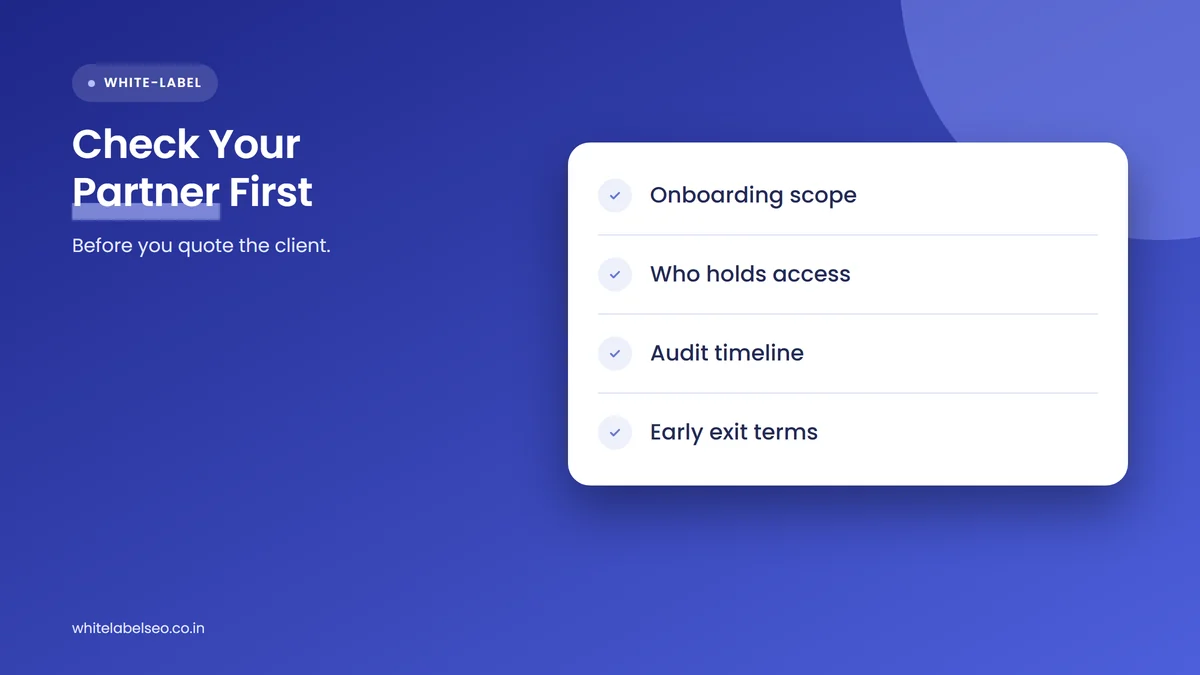
White-label partners handle onboarding differently. Some charge a setup fee for the first audit and technical work, some include it in the first month and some spread it across the package. Before you set your client-facing fee, confirm these points with your partner:
- What the partner’s onboarding covers. Audit depth, tracking setup, technical fixes and the content plan. Anything it leaves out, your team or the client has to do.
- Who requests and holds access. Decide whether your agency or the partner asks the client for Search Console, analytics and Google Business Profile access, and at what permission level. Keeping access requests under your brand protects the white-label relationship.
- The onboarding timeline. If the partner needs three weeks for the audit, do not promise the client a roadmap in week one.
- What happens on early exit. If the client leaves in month two, know whether the partner’s setup fee is refundable and make your own terms match.
- Branded deliverables. The audit and plan the client receives should carry your agency’s branding, ready to send without editing.
What mistakes make setup fees backfire?
Setup fees backfire when the client cannot see what they paid for. The common mistakes are vague line items, charging for work that is never delivered, adding the fee late in the sales process, and charging the same fee to every client regardless of how much onboarding the site actually needs.
- Revealing it late. A setup fee that first appears on the contract or first invoice feels like a bait and switch. Mention it on the discovery call and show it in the proposal.
- No visible output. If the client never sees the audit or the plan, the fee looks like padding. Send each setup deliverable as it is finished.
- Charging twice. Billing a setup fee and then putting the same audit work into month one’s retainer report erodes trust quickly.
- One fee for every site. A five-page brochure site and a multi-location business do not need the same onboarding. Scale the fee to the work.
- Using it to hide a low monthly price. A large setup fee paired with an unrealistically cheap retainer usually means the monthly scope cannot be delivered profitably.
Frequently asked questions
Is it normal for SEO agencies to charge a setup fee?
Yes, many agencies and white-label partners charge a one-time setup or onboarding fee alongside a monthly retainer, though practice varies and there is no reliable public benchmark for how common it is. What matters is that the fee covers real one-time work and that the client can see each deliverable.
Should a setup fee be refundable?
Usually not once the work has started, because the audit, tracking and plan have been delivered. State in the proposal that the fee covers listed onboarding deliverables and is non-refundable after work begins. If a client cancels before kickoff, a full or partial refund is a fair gesture that protects your reputation.
Can you charge a setup fee if the client already had an audit?
You can, but reduce it. Review the existing audit and tracking first, then charge only for the work still missing, such as access setup, technical fixes or the content plan. Charging a full setup fee for work that already exists is the fastest way to make the fee look like padding.
How do you explain a setup fee to a client who pushes back?
Explain that the first month needs one-time work that later months do not, list exactly what that work is, and show the monthly fee that follows. If they still object, offer a trade: waive the fee for a longer minimum term, or fold it into a higher first month.
Should a reseller pass the white-label partner’s setup fee straight to the client?
Do not pass it through at cost under the partner’s name. Build your own setup fee that covers the partner’s charge, your account management time during onboarding and your margin, and present it under your agency’s brand. The client should only ever see your agency’s pricing and deliverables.
What should you do next?
Write down every task your team or partner does in a new client’s first 30 days, estimate the hours, and compare that with what month one of your retainer actually pays. If the gap is large, add a setup line to your proposal template with listed deliverables, a delivery window and a clear waiver option for longer terms. Then mention it on your next discovery call, not on the contract. To see the onboarding and monthly work we deliver for agencies, read about our white-label SEO services at White Label SEO.
Want onboarding your clients can see from day one?
At White Label SEO, we handle the audit, tracking, technical fixes and content plan under your agency’s brand, so your setup fee is backed by real deliverables. Talk to us about how we scope onboarding for your clients.
Sources
- Search Engine Journal (Sophie Brannon), “Why Agencies Lose Clients In The First 90 Days (And How To Stop It)”, September 24, 2026. https://www.searchenginejournal.com/why-agencies-lose-clients-in-the-first-90-days-and-how-to-stop-it/582895/
- Search Engine Journal (Matt G. Southern), “Google Search Console AI Reports Rolled Out Worldwide”, August 31, 2026. https://www.searchenginejournal.com/google-search-console-ai-reports-rolled-out-worldwide/587836/
- Ahrefs, “SEO Pricing: How Much Does SEO Cost? 439 People Polled”, updated August 15, 2024. https://ahrefs.com/blog/seo-pricing/
- Google Search Console Help, “Managing owners, users, and permissions”, accessed November 16, 2026. https://support.google.com/webmasters/answer/7687615
- Google Business Profile Help, “Manage your Business Profile owners & managers”, accessed November 16, 2026. https://support.google.com/business/answer/3403100