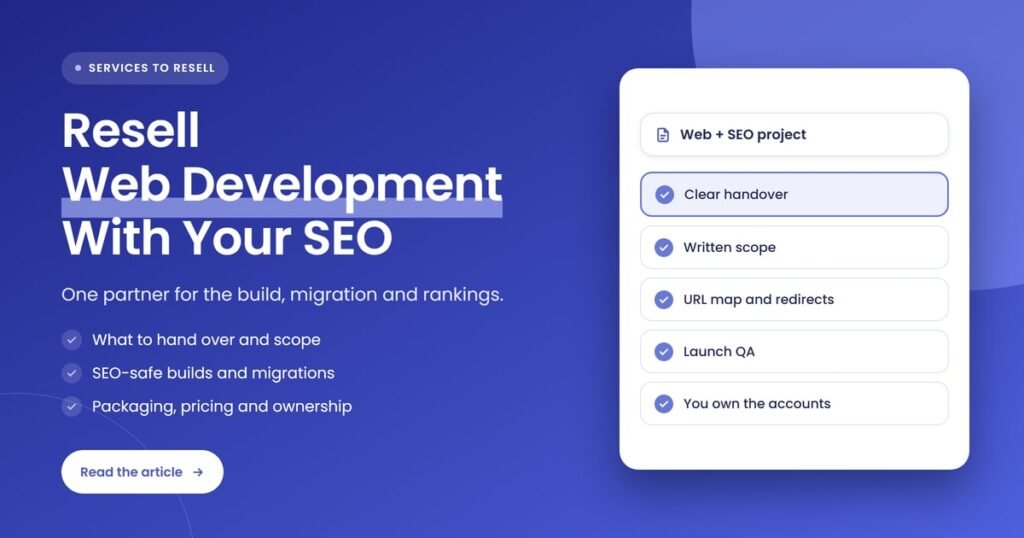
Quick answer: Yes. An agency can resell website development and SEO through one white-label partner that builds, migrates and optimizes sites under the agency’s brand. It works best when the agency owns the client relationship and accounts, the partner works from a written scope, and SEO is planned before design starts, so redirects, page structure and tracking survive launch.
Key takeaways
- One partner for the build and the SEO removes the handoff where most redesign problems start: the developer launches, then the SEO team finds what broke.
- Hand over a brief, the current site’s URL list and analytics access, brand assets and the client’s goals before anyone quotes.
- Every rebuild that changes URLs is a site move to Google. Map old URLs to new ones and use permanent server-side redirects kept for at least a year.
- The client, or your agency, should own the domain, hosting, analytics and Search Console. The partner gets user access, not ownership.
- Package the build as a project and the SEO as a retainer that starts at launch, so the website sale turns into recurring revenue.
What is white-label website development?
White-label website development means a partner designs and builds websites that your agency sells and delivers under its own brand. The client deals only with your agency. The partner works behind the scenes, follows your brief and brand rules, and hands the finished site over without its own name, credits or links on it.
When the same partner also delivers white-label SEO, the build and the ongoing search work sit with one team. That matters most at the riskiest moment in a website’s life: the launch of a redesign or a move to a new platform, when rankings can drop if old pages, redirects or tracking are lost along the way.
Can an agency resell web development and SEO through one partner?
Yes, and for many small agencies it is simpler than managing two vendors. A single partner plans the site structure with search in mind, handles redirects during a migration and starts SEO work the day the site goes live. The agency keeps the client, sets the price and approves the work at each stage.
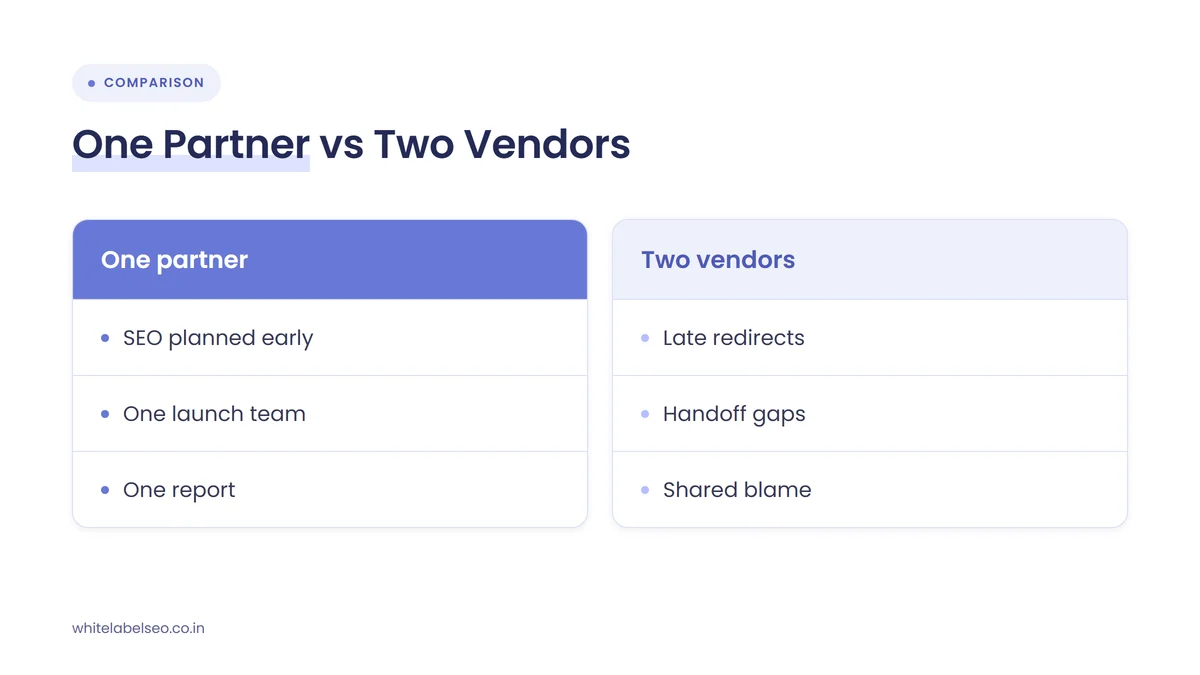
Two separate vendors can work too, but someone has to own the gap between them. With one partner, the questions that usually fall through that gap have a single owner:
| Question at launch | One partner for web and SEO | Separate web and SEO vendors |
|---|---|---|
| Who maps old URLs to new ones? | Planned together before design starts | Often left until the week of launch, or missed |
| Who checks titles, headings and schema? | Built into the page templates | Added by the SEO team after the developer has moved on |
| Who answers if traffic drops? | One team checks the build and the search data | Each vendor may point to the other |
| Who reports to the client? | Your agency, using one set of reports | Your agency, merging two sets of updates |
This is also why web development sits well alongside the other SEO services agencies can resell without hiring. Clients who are redesigning are already thinking about leads and visibility, so the conversation about search follows naturally.
What should an agency hand over to a white-label web partner?
Hand over everything the partner needs to quote accurately and build without guessing: the client’s goals, the page list, brand assets, examples the client likes, access to the current site and its data, and any rules on tone or compliance. A complete handover is the easiest way to keep a build on time and on budget.
- A short project brief. What the business sells, who it sells to, what a lead looks like and what is wrong with the current site.
- The sitemap you want. The pages the new site needs, with any services or locations that must have their own page.
- Brand assets. Logo files, colors, fonts, photography and any style guide.
- Reference sites. Two or three sites the client likes, and what they like about each one.
- Access to the current site. CMS, hosting or DNS details if the partner will handle the move, plus user access to Google Analytics and Search Console.
- Content plan. Who writes the copy, and whether existing pages that already rank will be kept, rewritten or merged.
- White-label rules. No partner branding in the footer, code comments or admin area, and who talks to the client (usually only your agency).
How do you scope a white-label website project?
Scope a website project by writing down the page count, templates, features, integrations, content responsibility, number of revision rounds, migration work and what happens after launch. A tight scope protects your margin, because the costs in web projects usually come from extra pages, extra features and extra rounds of changes, not the original build.
| Scope item | What to agree in writing | Why it matters |
|---|---|---|
| Pages and templates | Number of unique page designs and total pages to build | Extra pages are the most common source of overruns |
| Platform | CMS, theme or page builder, and any custom code | Affects speed, cost and who can edit the site later |
| Features | Forms, booking, ecommerce, integrations with the client’s tools | Each integration adds build and testing time |
| Content | Who writes, who loads it, and how many words per page | Missing copy is a common reason launches slip |
| Revisions | Rounds of design and build changes included | Unlimited revisions eat the margin |
| Migration and SEO | URL mapping, redirects, metadata transfer and post-launch checks | Protects the rankings the client already has |
| After launch | Hosting, updates, backups, security and support hours | Turns a one-off project into recurring work |
We list the main web services we deliver for agencies, including design, WordPress and WooCommerce builds, speed and security work and maintenance, on our web development and design services page. Whatever partner you use, ask for the scope in this level of detail before you price the job for your client.
How do you keep a new build or migration SEO-safe?
Keep a build SEO-safe by treating it as a site move whenever URLs change. Crawl the old site first, map every old URL to its closest new page, set up permanent server-side redirects, carry over titles and content that already rank, and check indexing and traffic closely for several weeks after launch.
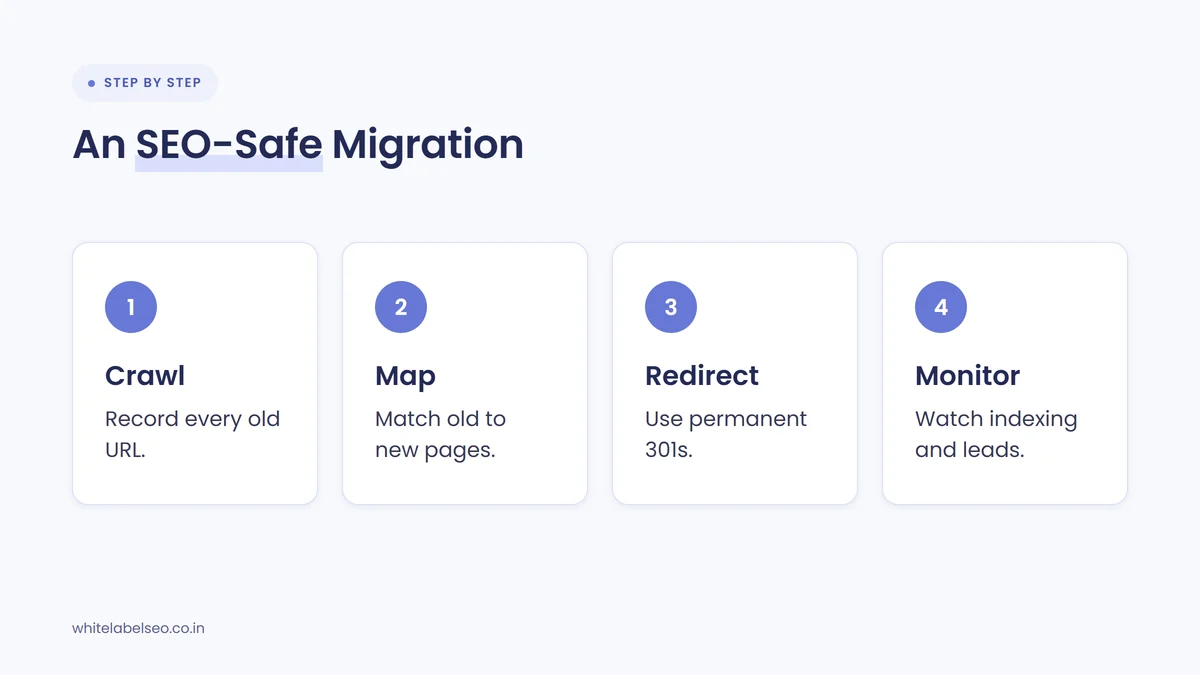
Google’s own site move guidance sets out the core rules, and they are worth building into every web project you resell:
- Crawl and record the old site. Export every live URL, its title and its traffic and links, so you have a baseline to compare against after launch.
- Map old URLs to new ones. Google recommends a mapping of each old URL to its new destination. Send each old page to the closest match, not to the homepage.
- Use permanent server-side redirects. Google recommends 301 or 308 redirects where possible and says to redirect straight to the final URL rather than through chains. JavaScript redirects are a last resort, because Google might not see them if rendering fails.
- Keep redirects in place. Google advises keeping them for at least one year, and ideally longer.
- Update the sitemap and Search Console. Submit a sitemap with the new URLs. If the domain itself changes, use the Change of Address tool.
- Watch the data after launch. Google notes that rankings can fluctuate while it recrawls a moved site, and that a medium-sized site can take a few weeks or more.
Domain moves need extra care. In June 2026, Google updated its guidance to ask site owners to submit Change of Address requests for all subdomains and both the www and non-www versions of the old domain, verified in Search Console, as Search Engine Journal reported.
AI coding tools add a newer question. More sites are now built or edited with AI agents, and on November 10, 2026, Google released version 1.0 of Modern Web Guidance, a set of guidelines AI coding agents read while writing code. Search Engine Journal reports that it focuses on performance, accessibility, security headers and loading priority, and that its accessibility review is not a full WCAG audit. Treat AI-built code like any other code: check that important content and links are in the rendered HTML, since Google’s JavaScript SEO documentation explains that it renders pages in a separate step, and test speed and accessibility yourself before launch.
What should QA cover before a white-label site goes live?
Pre-launch QA should cover search, tracking, speed, forms, mobile layout and white-label details. Test the staging site against the URL map, confirm the site is not blocked from indexing, check that analytics and conversion tracking fire, and remove anything that names the partner. Then repeat the key checks on the live site within hours of launch.
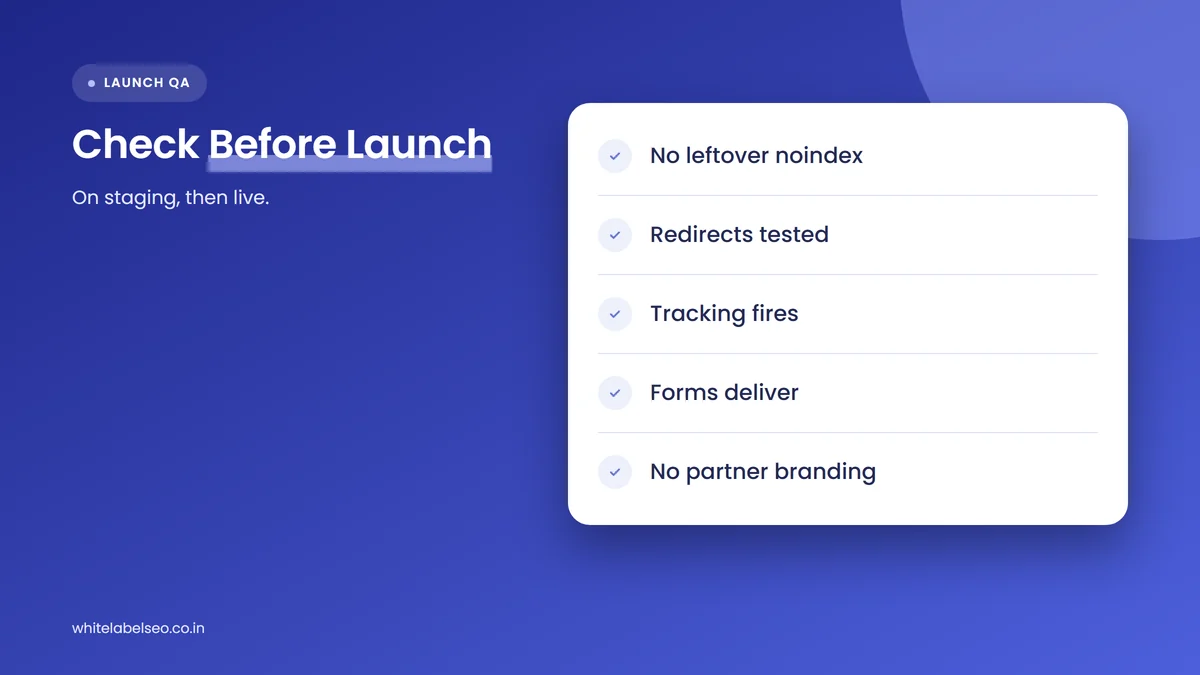
- Indexing: no leftover noindex tags or staging password, and robots.txt allows the pages that should rank.
- Redirects: every URL in the map returns a single permanent redirect to the right page.
- On-page SEO: titles, meta descriptions, headings and structured data carried over or improved.
- Tracking: analytics, call tracking and form conversions recorded on the new site.
- Forms and email: every form submits and reaches the right inbox.
- Mobile and speed: layouts tested on real phone sizes and key pages checked for speed.
- White-label details: no partner names in the footer, admin screens, file names or code comments.
Who should own the domain, hosting and accounts?
The client, or your agency on the client’s behalf, should own the domain, hosting account, analytics, Search Console and the website’s admin account. The white-label partner should work through user access that you can remove at any time. That way the client is protected, your agency stays in control, and changing partners never puts the website at risk.
- Domain and DNS: registered to the client or your agency, never to the partner.
- Hosting: in an account you control, even if the partner sets it up.
- Analytics and Search Console: the client or your agency as owner, with the partner added as a user.
- CMS admin: your agency holds the main administrator login, and the partner gets its own named user.
- Code and licenses: agree in writing that the finished site, theme licenses and plugin licenses belong to the client.
How do you package and price web development with SEO?
Package the website as a fixed-scope project and the SEO as a monthly retainer that starts at launch. Price the project from the partner’s cost plus your project management and margin, then offer care plans and SEO as the ongoing layer. Selling them together means the client never ends up with a new site that nobody is looking after.
| Package | What it includes | How it is usually billed |
|---|---|---|
| Website build | Design, development, content loading and launch QA | One-off project fee, often split into stage payments |
| SEO-safe migration | Crawl, URL map, redirects, metadata transfer and post-launch monitoring | Included in the build or quoted as a separate line |
| Care plan | Hosting, updates, backups, security and small edits | Monthly fee |
| SEO retainer | Technical fixes, content, local SEO, links and reporting | Monthly fee, starting at or soon after launch |
A few general rules keep the margin healthy:
- Price from cost up. Add the partner’s fee, your own time for briefing, client calls and QA, then your margin. Check the total against what clients in your market pay.
- Never sell a redesign without the migration line. If the client refuses it, write down that rankings may be affected.
- Bundle the first months of SEO. It keeps the same team watching the site while Google recrawls it.
Agencies that already build sites can use the same model in reverse. Our guide on turning website launches into SEO retainers covers that side of the offer.
How should communication work between the agency, partner and client?
Your agency should be the only voice the client hears. The partner talks to your team through a shared project channel, works to agreed milestones and sends updates you can pass on under your brand. Agree response times, a single point of contact on each side and how change requests are logged before the project starts.
- Kickoff call: walk the partner through the brief, scope and launch date.
- Milestone sign-offs: sitemap, design, build on staging, then launch. Each one approved by your agency, then the client.
- Change requests in writing: anything outside scope is logged, quoted and approved before work starts.
- Launch day plan: who flips DNS, who tests redirects and who watches Search Console.
- Post-launch reporting: indexing, traffic and leads compared with the old site for the first weeks.
Set expectations early that a new site can take time to settle in search. Our post on what to tell clients while a new site gets indexed gives you wording for that conversation.
Frequently asked questions
Will the client know a white-label partner built the website?
Not if the partner follows white-label rules. The site carries no partner credits, links or names in the footer, admin area or code, and all communication runs through your agency. Agree these rules in writing before the project starts, and check them during launch QA.
Does a website redesign always hurt SEO?
No. A redesign that keeps URLs, or maps every changed URL to its new page with permanent redirects and carries over content that ranks, can launch without lasting damage. Google notes that rankings can fluctuate for a while during a site move, so watch the data closely in the weeks after launch.
How long should redirects stay in place after a migration?
Google advises keeping redirects for at least one year, and ideally longer. Removing them early can send visitors and links to error pages and lose the signals the old URLs built up.
Can AI-built websites rank in Google?
Yes, if the finished site meets the same standards as any other site: crawlable pages, important content in the rendered HTML, good speed and useful content. Tools such as Google’s Modern Web Guidance help AI coding agents follow current web practices, but someone still needs to test the result before launch.
Should the SEO retainer start before or after the website launches?
Ideally the SEO work starts before launch, with URL mapping and page structure, and the retainer continues after launch. That way the same team that planned the migration watches indexing and rankings while Google recrawls the new site.
What should you do next?
Pick one client who has asked about a new website and run the project through the steps above: a full handover, a written scope, a URL map, launch QA and an SEO retainer that starts at launch. Keep ownership of every account on your side, and keep the client talking only to your agency. To see the search work we deliver behind builds like this, read about our white-label SEO services at White Label SEO.
Want one partner for your clients’ websites and SEO?
At White Label SEO, we build websites and deliver SEO under your agency’s brand, with written scopes, SEO-safe migrations and reports you can send as your own. Tell us about your next website project and we’ll help you scope it.
Sources
- Search Engine Journal, “Google Releases Modern Web Guidance 1.0 For AI Coding Agents”, November 10, 2026. https://www.searchenginejournal.com/google-releases-modern-web-guidance-1-0-for-ai-coding-agents/596495/
- Google Search Central, “How to move a site”, last updated August 20, 2026. https://developers.google.com/search/docs/crawling-indexing/site-move-with-url-changes
- Google Search Central, “Redirects and Google Search”, last updated April 14, 2026. https://developers.google.com/search/docs/crawling-indexing/301-redirects
- Search Engine Journal, “Google Tightens Requirements For Domain Migrations”, June 18, 2026. https://www.searchenginejournal.com/google-tightens-requirements-for-domain-migrations/579781/
- Google Search Central, “Understand JavaScript SEO basics”, last updated March 4, 2026. https://developers.google.com/search/docs/crawling-indexing/javascript/javascript-seo-basics