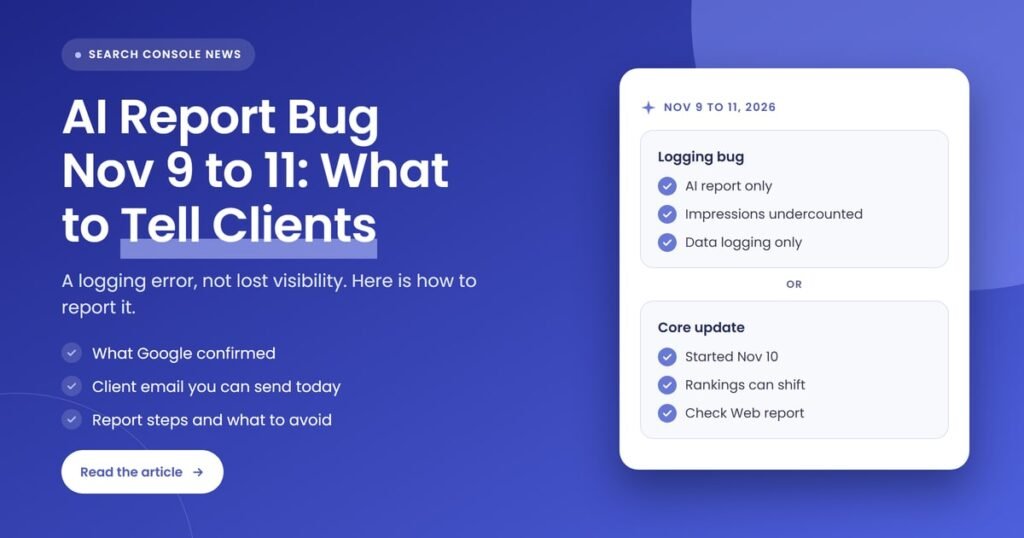
Quick answer: Tell clients the drop in AI impressions from November 9 to 11, 2026 is a Google logging error, not a loss of visibility. Google says it affects data logging only. Annotate those dates, leave them out of month-over-month comparisons, and check the standard Search results report before linking any dip to the November 2026 core update.
Key takeaways
- Google confirmed that a logging error lowered impressions in Search Console’s Generative AI performance report for November 9 to 11, 2026.
- Google’s wording is that the issue affects data logging only. It describes missing records, not lost appearances in AI Overviews or AI Mode.
- The November 2026 core update started on November 10, inside the same window, so two very different causes can look like one dip on a chart.
- Flag the three days in every client report, exclude them from trend math, and use the standard Search results report to judge any core update effect.
- Send clients a short note before they spot the dip themselves. A proactive explanation reads as expertise, while a late one reads as an excuse.
What did Google confirm about the Search Console AI report?
Google added an entry to its Search Console data anomalies page saying a logging error caused a decrease in impressions on the Generative AI performance report in Search, for data from November 9 to November 11, 2026. The same entry states that the issue affects data logging only, meaning the report undercounted what happened.
The data anomalies page is where Google records known problems with Search Console figures, so it is the source to cite in a client report. The entry reads:
- “A logging error caused a decrease in impressions on the Generative AI performance report in Search”
- “This issue affects data logging only.”
Barry Schwartz covered the bug at Search Engine Roundtable on November 12, 2026, and noted that anyone opening the report now sees an annotation about the error. He also pointed out the timing problem agencies will run into: the November 2026 core update began on November 10, right in the middle of the affected dates.
What Google has not said matters too. The entry does not say whether the missing impressions will be restored, and it names only the Generative AI performance report. It says nothing either way about the standard Search results report, so do not tell clients that report was affected unless Google adds a note.
What is the Generative AI performance report?
The Generative AI performance report is a Search Console view that shows how often a site’s URLs appeared in Google’s generative AI features, including AI Overviews and AI Mode. It reports impressions, not clicks, broken down by page, country, device and date. Google launched it in June 2026 and rolled it out to all sites by August 31, 2026.
Because the report only counts impressions, a logging error hits its single headline number directly. There is no click line to cross-check against inside the report. If you want the full background on what the report leaves out, our post on the missing click data in Search Console’s AI report covers it, so we will not repeat it here.
Two terms are worth defining for clients in plain language:
- Logging error: a fault in how Google recorded the data. The event (your page appearing in an AI answer) may have happened, but it was not fully counted.
- Data anomaly: Google’s label for a known problem in Search Console figures. Google lists these on a public page so site owners can explain odd numbers.
How is the logging bug different from the November 2026 core update?
The logging bug is a reporting problem: Google undercounted AI impressions for three days, and Google says only the data logging was affected. The core update is a ranking change that began on November 10 and can take up to two weeks to roll out. One changes the numbers you see, the other can change actual search positions.
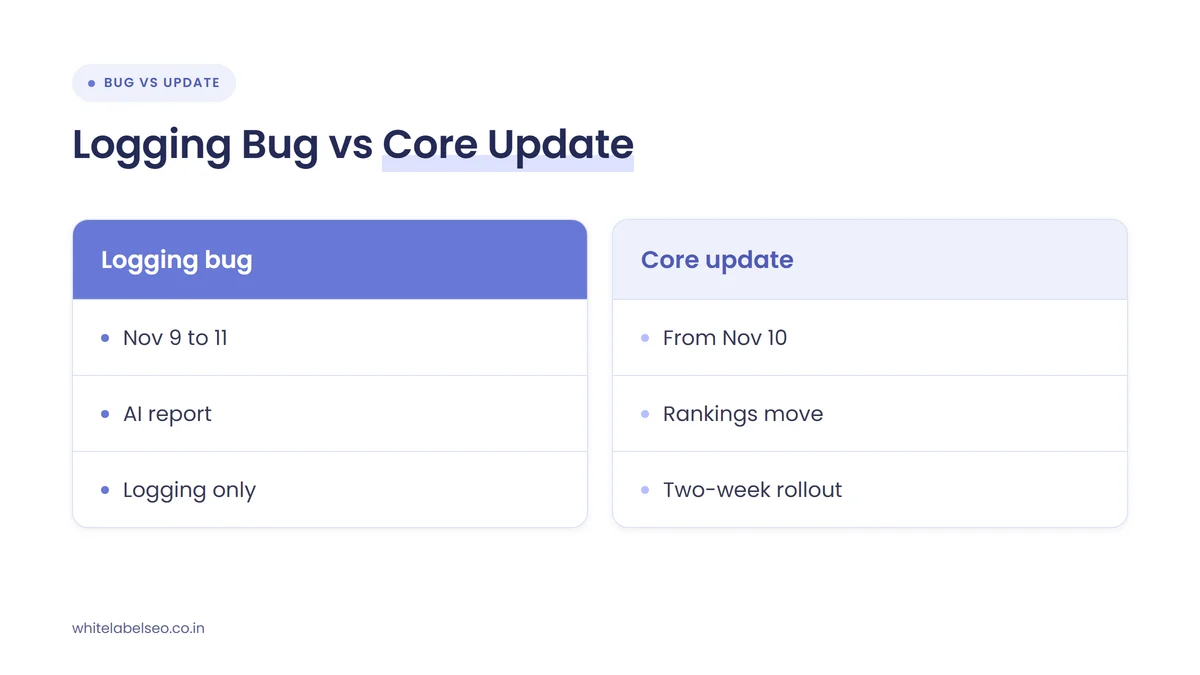
Google listed the November 2026 core update on its Search Status Dashboard on November 10. Search Engine Roundtable reported that Google said the rollout may take up to two weeks to complete. That means a real ranking shift could show up during the bug window and keep moving for days after it ends.
| Question | AI report logging bug | November 2026 core update |
|---|---|---|
| What is it? | A data recording error in Search Console | A broad change to Google’s ranking systems |
| Dates | November 9 to 11, 2026 | Started November 10, 2026, rollout up to about two weeks |
| What it affects | Impressions shown in the Generative AI performance report | Rankings across Search, which can also affect other features |
| Google’s description | “This issue affects data logging only.” | A regular broad core update |
| Where to check | Search Console data anomalies page and the in-report annotation | Search Status Dashboard and the standard Search results report |
| What to do | Annotate and exclude the dates from trends | Wait for the rollout to finish, then review page-level changes |
What should agencies tell clients about the November 9 to 11 dip?
Tell clients that Google confirmed a reporting error for those three days, that the error affected how impressions were recorded rather than how often their pages appeared, and that you have marked the dates in the report. Then explain separately that a core update is rolling out and you are watching rankings through a different report.
Keeping the two messages separate is the main job. If you blend them, a client may hear “Google broke something and we lost visibility”, which is not what either source says. Use this table as a script for account managers:
| Client question | What to say | What not to say |
|---|---|---|
| Why did AI impressions drop on November 9 to 11? | Google confirmed a logging error that undercounted impressions in that report for those dates. | “Your AI visibility fell.” |
| Did we lose rankings? | The bug affects data logging only. We check rankings in the standard Search results report, not this one. | “No impact at all, ever.” You cannot confirm that for the core update yet. |
| Will Google fix the numbers? | Google has not said. We are treating the three days as unreliable either way. | “Google will restore the data next week.” |
| Is the core update hurting us? | It began November 10 and can take up to two weeks. We will review the full picture once it finishes. | Any verdict based on the first few days |
| What does this change in our plan? | Nothing yet. The work continues, and next month’s report will show the trend with these dates flagged. | A rushed change of strategy |
On the question of whether the data comes back, the best guide is past behavior rather than a promise. Barry Schwartz, who reported the bug, gave his expectation on X:
“normally google does not repopulate the data”
Barry Schwartz (@rustybrick) on X, November 13, 2026 (source)
That is his read of how Google usually handles these anomalies, not a Google statement. It is still the safest planning assumption: build your reports as if November 9 to 11 will stay low, and treat any later correction as a bonus.
How should agencies handle the bug in client reports?
Handle the bug in four steps: annotate November 9 to 11 on every chart that uses AI impressions, exclude those dates from period comparisons, check the standard Search results report for the same days, and add a short note to the report summary. Do this once in your template so every client report treats the dates the same way.
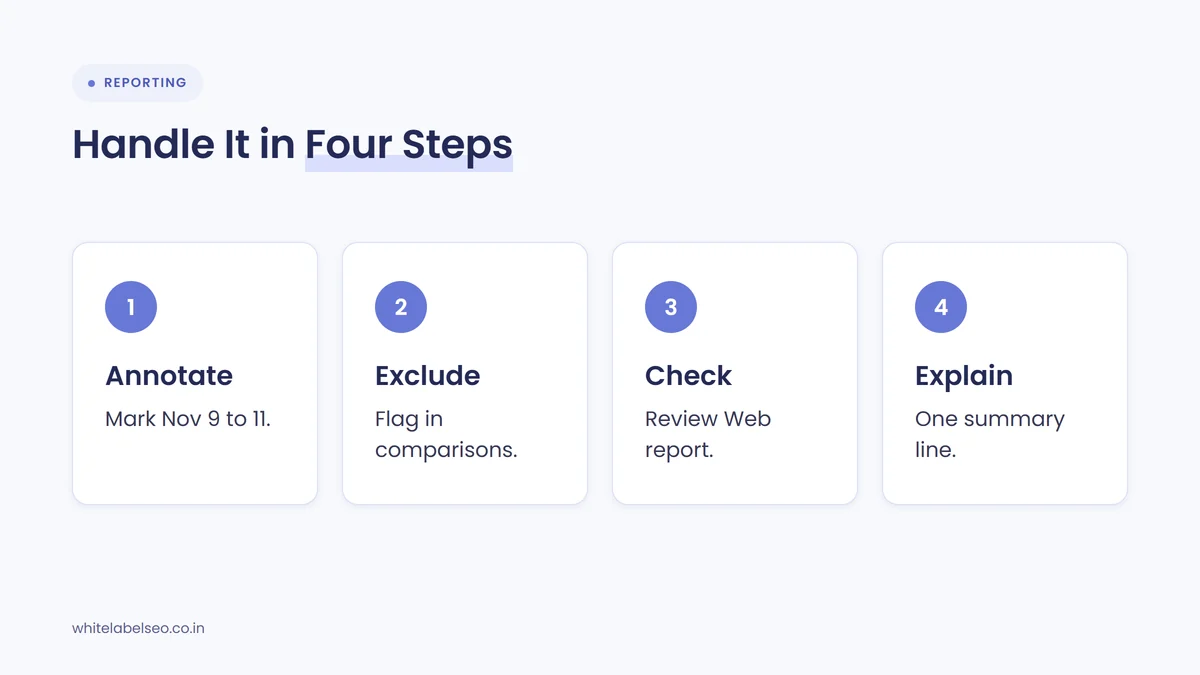
- Annotate the chart. Add a marker for November 9 to 11, 2026 on any AI impressions chart, labeled “Google logging error (confirmed)”. If your dashboard tool supports annotations, add it at the template level so it appears for every client.
- Exclude or flag the dates in comparisons. When you compare November with October, either remove the three days from both the total and the daily average, or show the full month with a clear footnote. Pick one method and use it for every client.
- Check the standard Search results report. Look at web search impressions and clicks for the same dates. If those held steady while AI impressions dipped, the bug explains the gap. If web search figures also moved from November 10 onward, that is a separate signal to review once the core update finishes.
- Write one line in the summary. Something like: “AI impressions for November 9 to 11 are undercounted because of a Google logging error. These dates are excluded from the trend.” Link the Google data anomalies page in the appendix.
Monthly comparisons are where this bug does the most damage. Three low days in a 30-day month can turn a flat month into an apparent decline. Weekly reports are hit harder still, since the week of November 9 includes all three affected days.
Should agencies blame the core update for any drop?
No, not from the AI report alone. The AI report’s November 9 to 11 figures are known to be undercounted, so they cannot show a core update effect. Judge the core update with the standard Search results report, at page and query level, after the rollout finishes. Until then, any explanation is a guess.
The risk runs in both directions. An agency that blames the update for a dip caused by the bug sets up a false story the client will repeat. An agency that blames the bug for a real ranking loss delays the work needed to respond. Our guide on what to tell clients after a core update ranking drop covers the second conversation if the web data does show a decline.
A simple order of checks keeps the diagnosis honest:
- Compare web search impressions and clicks for the two weeks before November 10 with the days since.
- Look at which pages and queries moved, not just the site total.
- Check that nothing else changed on the client’s side, such as a site migration, new pages or tracking edits.
- Wait for the rollout to complete before giving a final verdict.
When rankings swing and Google has not confirmed why, the same discipline applies. See our post on what to tell clients when rankings swing for the general approach.
What client email can agencies send about the AI report bug?
Send a short, plain email that names the dates, cites Google, separates the bug from the core update and says what you are doing about each. Send it before the next report goes out, so the client hears it from you first. Adapt the template below to your agency’s voice and send it under your own brand.
- Subject: “A note on your Search Console AI data for November 9 to 11”
- What happened: “Google has confirmed a logging error that lowered impressions in Search Console’s Generative AI performance report for November 9 to 11, 2026. Google says the issue affects data logging only.”
- What it means: “This is a recording problem, not a sign that your pages stopped appearing in Google’s AI answers. You may see a dip on those dates if you look at the report.”
- What we are doing: “We have marked these dates in your report and excluded them from month-over-month comparisons, so the trend stays accurate.”
- The separate update: “Google also started a core update on November 10, which can take up to two weeks to roll out. We are tracking your rankings in the main Search report and will share a full review once it finishes.”
- Close: “No action is needed from you. Reply if you have any questions.”
Keep the email short. Clients do not need the history of Search Console anomalies, just confidence that you noticed, understood it and handled it.
What should agencies avoid saying about the bug?
Avoid any claim the sources do not support. Do not say the client lost AI visibility, do not promise Google will restore the data, do not declare the core update harmless or harmful yet, and do not estimate the “real” missing impressions as if it were Google’s number. Each of these can come back at the next review.
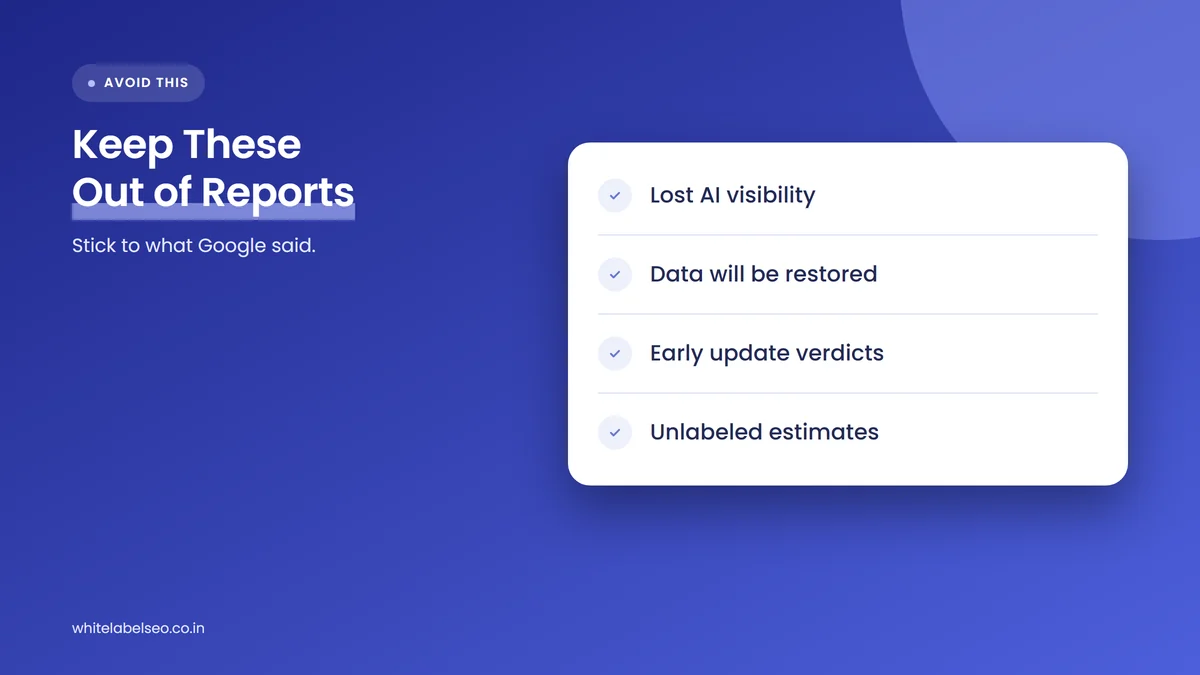
- “Your AI visibility dropped.” Google says the issue affects data logging only.
- “Google will fix the numbers.” Google has not said so, and the expectation from the person who reported the bug is that it usually does not.
- “The core update didn’t touch you.” The rollout may take up to two weeks. Wait for it to finish.
- “You actually had X impressions.” If you fill the gap with an average of nearby days, label it clearly as your estimate.
- Silence. Saying nothing and hoping the client misses the dip is the riskiest option of all.
If you resell SEO under your own brand, make sure your fulfillment partner flags anomalies like this in the report notes, so your account managers are not caught out. Our post on what white-label partners must report differently now covers how AI search data should sit in partner reports.
Frequently asked questions
Which dates did the Search Console AI report bug affect?
Google’s data anomalies page lists November 9 to November 11, 2026. A logging error lowered impressions in the Generative AI performance report in Search for those dates. Data outside that window is not covered by the note.
Did the logging error affect actual visibility in AI Overviews or AI Mode?
Google says the issue affects data logging only. That describes a problem with how impressions were recorded, not with how often pages appeared. Rankings can still move for other reasons, such as the core update that began on November 10.
Will Google restore the missing impressions?
Google has not said. Barry Schwartz of Search Engine Roundtable said on X that Google normally does not repopulate the data, which is his expectation rather than a Google statement. Plan reports as if the three days stay low.
Was the standard Search results report affected too?
Google’s note names only the Generative AI performance report in Search. It does not mention the standard Search results report. Use that report to check whether anything else changed on the same dates, especially from November 10 onward.
How should the bug appear in a monthly client report?
Add an annotation for November 9 to 11 on AI impressions charts, exclude those days from period comparisons or footnote them, and add one line in the summary citing Google’s data anomalies page. Use the same method for every client.
What should agencies do next?
Update your reporting template today: add the November 9 to 11 annotation, decide how you will exclude the dates from comparisons, and draft the client email. Then put a reminder in the calendar to review the core update with the standard Search results report once the rollout finishes. Handled this way, a Google bug becomes a small proof that your agency watches the data closely. If you want reporting like this delivered under your brand, see our white-label SEO services at White Label SEO.
Want reports that flag Google data issues before clients ask?
At White Label SEO, we deliver white-label SEO under your agency’s brand, with monthly reports that note confirmed Google data anomalies and explain them in plain language your account managers can pass on.
Sources
- Google Search Console Help, “Data anomalies in Search Console”, entry for November 9 to November 11, 2026. https://support.google.com/webmasters/answer/6211453
- Search Engine Roundtable, “Google Search Console Generative AI Performance Report Data Bug Nov 9 – 11”, November 12, 2026. https://www.seroundtable.com/google-generative-ai-performance-report-data-bug-42527.html
- Search Engine Roundtable, “Google November 2026 Core Update Is Rolling Out”, November 10, 2026. https://www.seroundtable.com/google-november-2026-core-update-42504.html
- Google Search Status Dashboard, “November 2026 core update”, November 10, 2026. https://status.search.google.com/products/rGHU1u87FJnkP6W2GwMi/history
- Google Search Central Blog, “Introducing Search Generative AI performance reports in Search Console”, June 3, 2026. https://developers.google.com/search/blog/2026/06/gen-ai-performance-reports
- Barry Schwartz (@rustybrick) on X, November 13, 2026. https://x.com/rustybrick/status/2121232718767763735