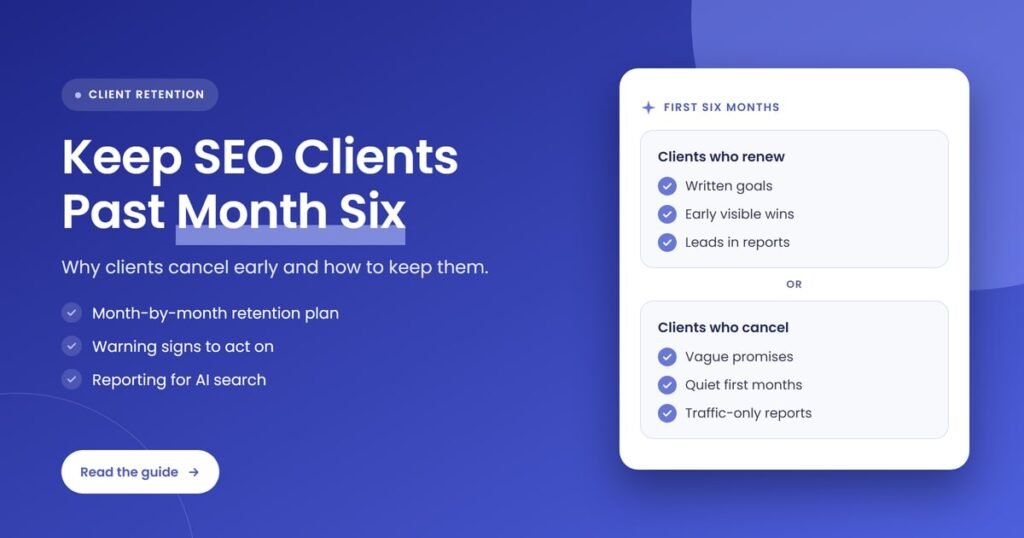
Quick answer: SEO clients usually cancel early because they can’t see progress they understand, not because the work failed. Agencies keep them by agreeing on business goals before month one, shipping visible early wins, reporting leads and AI search visibility alongside traffic, holding a structured 90-day review, and flagging at-risk accounts before the client raises them.
Key takeaways
- Most early cancellations come from a gap between what the client expected and what they can see, so retention work starts in the sales process.
- AI Overviews and AI Mode cut clicks per ranking, and Search Console’s AI report shows impressions without clicks, so a traffic-led report can make good work look like failure.
- Plan each of the first six months in advance: setup, early fixes, first content, a 90-day review, momentum, then a renewal conversation built on evidence.
- Watch for quiet signals such as unopened reports, missed calls and new stakeholders. They usually appear weeks before a cancellation email.
- If you resell SEO, your fulfillment partner’s speed and transparency directly shape what your client sees in months one to three.
What is SEO client churn?
SEO client churn is the share of clients who cancel or don’t renew their SEO retainer in a given period. Early churn means clients who leave within the first few months, before the work has had time to compound. For agencies it is the costliest kind, because onboarding and setup costs are spent but the retainer never reaches profit.
Agencies usually measure churn as clients lost in a period divided by clients at the start of that period. It is worth tracking early churn separately, for example clients lost within six months of signing, because the causes differ from those of a long-term client who leaves after two years. Early churn points to problems in sales, onboarding and reporting. Late churn more often points to stalled results, budget changes or a better offer elsewhere.
Client relationships are already short across the industry. CallRail’s 2026 outlook for marketing agencies, based on a survey of 100 US agencies, reports that the average client relationship lasts only 12 to 24 months, and that agencies not using analytics to prove ROI to clients have the shortest client lifespans. If a typical relationship is that short, losing a client at month four removes a large share of its total value.
Why do SEO clients cancel in the first six months?
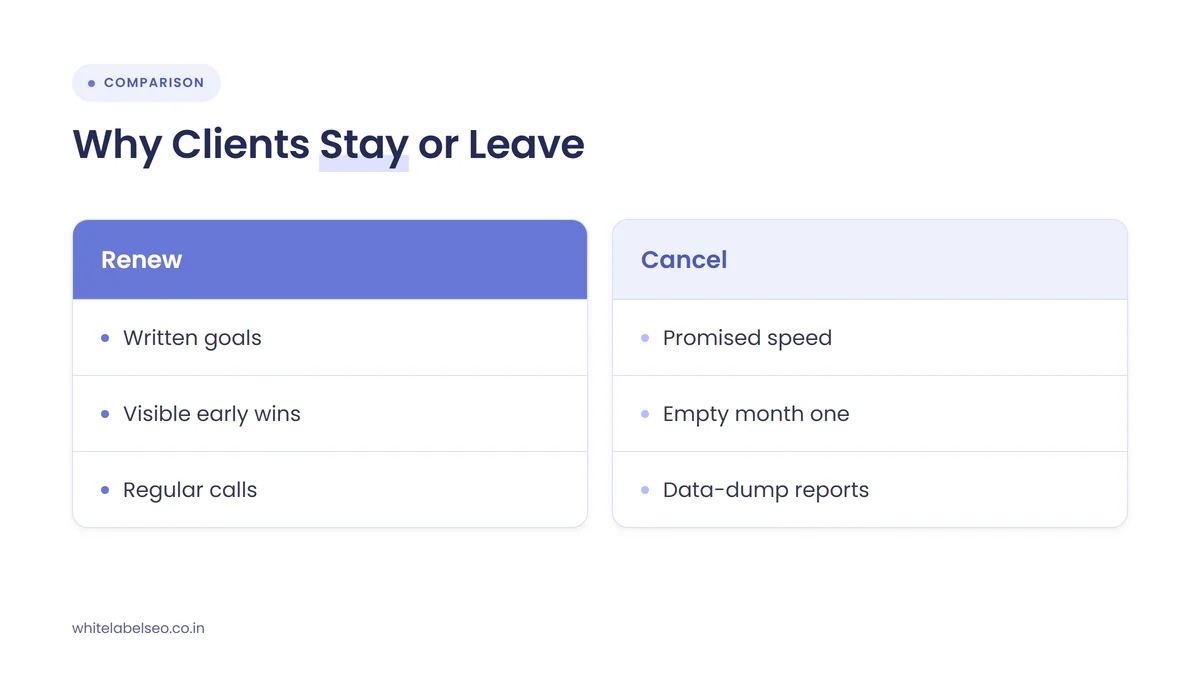
SEO clients cancel early when they feel they are paying without seeing anything happen. The usual causes are expectations set during the sale that the work can’t meet, slow or invisible onboarding, reports full of metrics they don’t understand, falling clicks they blame on the agency, and too little contact with a named person who explains what is going on.
The patterns are familiar to anyone who has run SEO retainers:
- The sale promised speed. A client told results will show “within a few weeks” starts counting from day one. SEO work on content and authority usually takes months to move leads.
- Month one looks empty. Audits, access requests and tracking setup matter, but to the client they look like nothing happened.
- Goals were never written down. If nobody agreed what success means, the client falls back on whatever number they check themselves, often traffic or one ranking.
- The report is a data dump. Ranking tables and session charts without a short explanation leave the client to draw their own conclusions.
- Clicks fall while visibility grows. More searches now end in an AI answer, so the client sees fewer clicks and assumes the work isn’t working.
- The relationship goes quiet. A missed call or a late reply in the first months reads as neglect, even when work is on track.
Our guide on how to set SEO expectations with a new client covers the first 30 days in detail. This post covers the full six months, from onboarding to the first renewal conversation.
Why is early churn harder to prevent now that AI search changes reporting?
Early churn is harder to prevent because the numbers clients check first, clicks and traffic, are now the least reliable signs of progress. AI summaries reduce clicks on many searches, and Google’s reporting on AI features shows impressions but not clicks. Without a new way to show value, a client can see falling traffic in month three while visibility is actually improving.
The evidence on clicks has been building for more than a year:
- Fewer clicks when AI summaries appear. Pew Research Center analyzed 68,879 Google searches by 900 US adults in March 2025. Users clicked a traditional result in 8% of visits when an AI summary appeared, compared with 15% when none did.
- AI impressions, no AI clicks. Google launched Search Console reports for generative AI features in June 2026, and Search Engine Journal reported they had rolled out worldwide by August 31, 2026. The reports show impressions in AI Overviews and AI Mode, not clicks.
- Click data may not be coming. On November 2, 2026, Search Engine Roundtable reported that Google’s Gary Illyes implied click and query data probably won’t be added to the AI report, while John Mueller suggested that reading was premature. Either way, agencies can’t plan on it soon.
- Early tests are small. On October 30, 2026, Search Engine Roundtable covered a small opt-out test by Cyrus Shepard that estimated about a 0.9% click-through rate on AI impressions for one site. It is a single-site study, so treat it as a sign of direction, not a benchmark.
Agencies feel the gap. In the AgencyAnalytics 2026 Marketing Agency Benchmarks Report, 64% of agencies named Google’s AI Overviews as their top concern, nearly half said they can’t track users who discover brands through AI tools, and 55% said the question they hear most from clients is whether marketing performance can be connected to revenue.
For retention, the practical answer is to change what the report leads with before the client notices the drop. Our list of nine metrics agencies should report to SEO clients covers the specifics, and our post on what to tell clients about the missing click data in Search Console’s AI report gives you language for the conversation.
What should happen in each of the first six months?
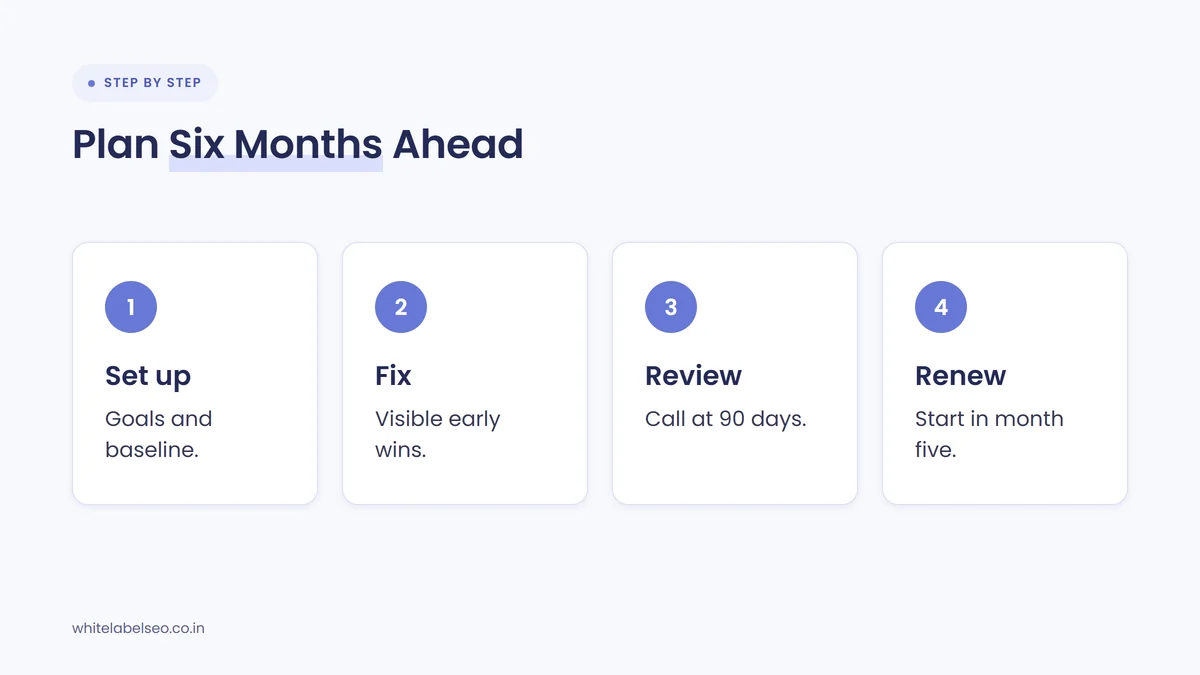
Each of the first six months should have a planned focus and a visible outcome the client can see. Month one sets up tracking and agrees goals, month two ships fixes, month three publishes content and holds a 90-day review, and months four to six build momentum and prepare a renewal conversation backed by evidence rather than hope.
| Month | Main focus | What the client should see | Churn risk to manage |
|---|---|---|---|
| 1 | Access, tracking, baseline audit, written goals | A kickoff summary, the agreed goals and a 90-day plan | “Nothing has happened yet” |
| 2 | Technical fixes, core page updates, Google Business Profile for local clients | A list of completed fixes with a plain-English reason for each | Doubts about what the fee is buying |
| 3 | First content, early link or mention work, 90-day review | A review call comparing the baseline with today, including leads | Traffic dips blamed on the agency |
| 4 | Adjust the plan from what the review showed | A revised priority list the client helped shape | Fading attention after the review |
| 5 | Scale what is working, keep publishing | Movement on priority terms, AI visibility checks and lead trends | Budget pressure or a new decision maker |
| 6 | Six-month review and next-term plan | Progress against the written goals and a proposal for the next six months | A renewal decision made without evidence |
Turned into steps, the playbook looks like this:
- Write the goals down before work starts. Agree two or three business outcomes, such as qualified calls, form leads or booked consultations, plus the leading indicators you will report on the way. Send them in writing and refer back to them in every report.
- Record a baseline. Capture impressions, clicks, priority rankings, AI feature impressions, Google Business Profile actions and leads from the month before you started. Every later conversation compares against this.
- Plan visible wins for months one and two. Fixing indexing problems, updating key service pages and cleaning up the business profile are real work the client can see, even before rankings move.
- Send a short note with every report. Three or four sentences on what was done, what changed, what it means and what comes next. Most clients read the note, not the charts.
- Hold a 90-day review on a call. Compare the baseline with today, explain any traffic dips in context, and agree priorities for months four to six together.
- Start the renewal conversation in month five. Don’t wait for the contract end date. Show progress against the written goals and propose the next term while results are fresh.
Onboarding speed matters most in month one. Our post on getting new white-label SEO clients live without delays covers access, kickoff and the first deliverables.
How do you spot an at-risk SEO client before they cancel?
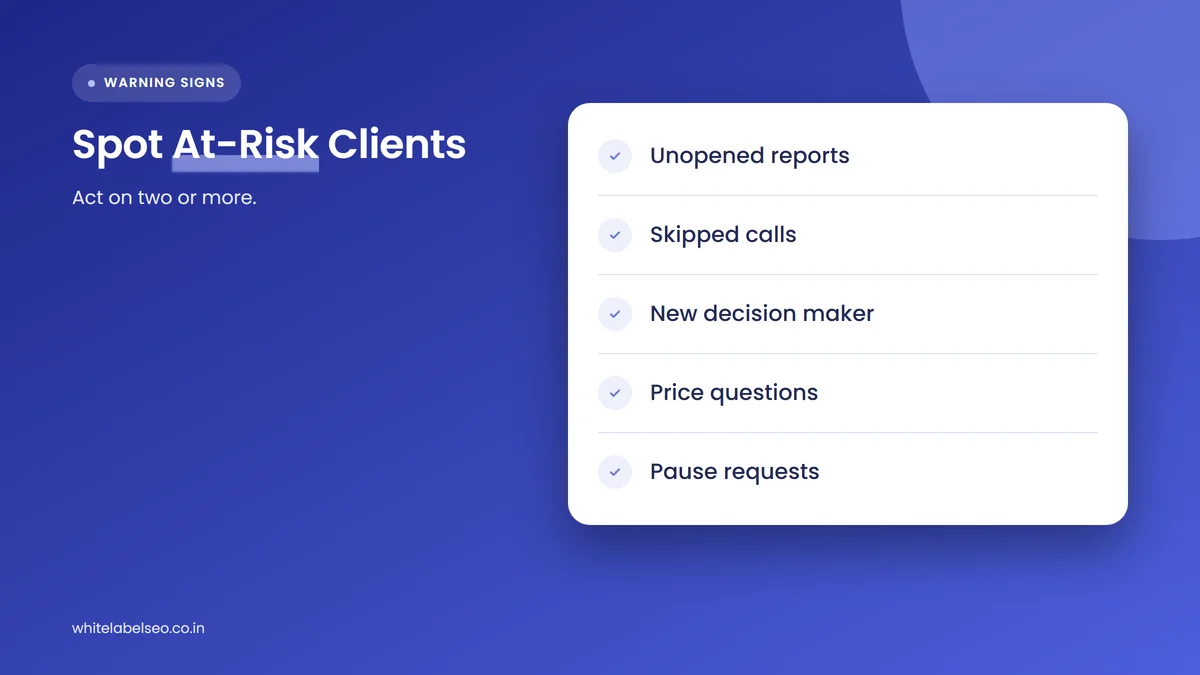
You spot an at-risk client by watching behavior, not just results. Unopened reports, skipped calls, slower replies, a new manager or owner, sudden questions about price, and requests to pause work are common warning signs. Track them in one place for every account, and act within a week of seeing two or more together.
| Warning sign | What it often means | What to do this week |
|---|---|---|
| Reports go unopened or unanswered | The client doesn’t see value in the report format | Replace the next report with a 15-minute call |
| Calls are skipped or shortened | SEO has dropped down their priority list | Send a one-page progress summary tied to their goals |
| Questions about traffic drops | They are reading clicks as the main sign of success | Show impressions, AI visibility and leads side by side |
| A new decision maker appears | The person who bought SEO may no longer be in charge | Book an introduction and walk them through the goals |
| Questions about price or contract terms | Budget pressure, or a cheaper quote from elsewhere | Review scope and outcomes before discussing price |
| Requests to pause work | A cancellation being softened | Ask what changed and offer a lighter tier if it fits |
A simple traffic light in your client list, green, amber or red, updated after each report and call, makes these signals visible to the whole team. When an account turns amber, the account manager calls the client, not the other way round.
Sometimes the warning sign is in the work, not the client. If deliverables arrive late or look thin, our guide to auditing your white-label partner’s deliverables explains what to check.
What should the 90-day review cover?
The 90-day review should compare the baseline with today against the goals you wrote down in month one. Cover the work completed, changes in impressions, AI feature visibility, priority rankings and leads, any traffic dips with their likely causes, and an agreed plan for months four to six. Hold it live, not as an emailed PDF.
- Work completed: every fix, page and piece of content from the first three months, grouped by goal.
- Visibility: impressions in Search Console, AI Overview and AI Mode impressions from the generative AI report, and priority rankings.
- Outcomes: calls, forms and bookings from organic search and the business profile, compared with the baseline.
- Context: anything outside your control, such as a Google update, seasonality or more AI answers on key searches.
- Next 90 days: two or three priorities the client agrees with, and what you need from them.
Google’s own advice to businesses hiring an SEO suggests asking what results to expect, in what timeframe, and how success will be measured. The 90-day review is where you answer those questions with real data. If leads haven’t moved yet, our guide on proving SEO ROI when results take months helps frame the leading indicators honestly.
How does white-label fulfillment affect early churn?
White-label fulfillment affects early churn because your client judges you on work your partner delivers. Fast onboarding, predictable delivery dates, clear task logs and reports you can brand all make the first three months visible. Slow access requests, vague updates or late reports create the “nothing is happening” feeling that drives early cancellations.
When we work with agencies, these are the things we agree with them up front, and they are worth asking any partner about:
- A month-one plan with dates: what will be set up and fixed, and when the agency will see it.
- A shared task log: every deliverable listed as it is completed, so the account manager can answer “what did we do this month?” in seconds.
- Reports that lead with outcomes: leads and visibility first, with AI feature impressions alongside clicks.
- Early warnings both ways: the partner flags delivery risks, and the agency flags client concerns, so neither side is surprised.
Frequently asked questions
What is a normal churn rate for SEO clients?
There is no reliable public benchmark for SEO-only churn, and figures quoted online often trace back to a single vendor. Track your own rate, separating clients lost in the first six months from later losses. CallRail’s 2026 agency survey found the average client relationship lasts 12 to 24 months, which gives a useful sense of scale.
How long should a new SEO client wait before judging results?
Most clients should judge early progress on completed work and leading indicators, such as impressions and priority rankings, in the first three months, and on leads over six months or more. Agree these timeframes in writing before the work starts so the client knows which signs to look for each month.
Should an SEO contract have a minimum term to reduce churn?
A minimum term can protect setup costs and give the work time to show results, but it doesn’t keep a client who feels ignored. Use a clear term and notice period, and pair it with a 90-day review so the client sees evidence well before the term ends.
How do you explain falling traffic to a new SEO client?
Show traffic alongside impressions, AI feature impressions and leads. Explain that more searches now end in an AI answer, so clicks per ranking are lower than they used to be, and that Search Console’s AI report shows impressions but not clicks. Then point to the business outcomes you agreed in month one.
What should you do when a client asks to pause their SEO retainer?
Ask what changed before agreeing. A pause is often a budget problem, a new decision maker or doubt about value. Review progress against the written goals, and if budget is the issue, offer a smaller scope that protects the work already done rather than stopping completely.
What should you change this month?
Pick your three newest SEO clients and check each against the six-month table above. Make sure each has written goals and a recorded baseline, add a short note to the next report, put a traffic light on every account, and book a 90-day review for anyone approaching month three. At White Label SEO, we build this cadence into the white-label SEO services we deliver for agencies, so the first six months stay visible to your clients.
Want fulfillment that keeps clients past month six?
At White Label SEO, we handle SEO delivery under your agency’s brand, with month-one plans, shared task logs and reports that lead with leads and visibility. Talk to us about how we can support your retention process.
Sources
- CallRail, “The 2026 outlook for marketing agencies”, 2026. https://www.callrail.com/learn/the-2026-outlook-for-marketing-agencies
- AgencyAnalytics, “AgencyAnalytics releases 2026 Marketing Agency Benchmarks Report”, June 30, 2026. https://agencyanalytics.com/company/newsroom/press-release-agency-benchmarks-report-2026
- Pew Research Center, “Google users are less likely to click on links when an AI summary appears in the results”, July 22, 2025. https://www.pewresearch.org/short-reads/2025/07/22/google-users-are-less-likely-to-click-on-links-when-an-ai-summary-appears-in-the-results/
- Google Search Central Blog, “Introducing Search Generative AI performance reports in Search Console”, June 3, 2026. https://developers.google.com/search/blog/2026/06/gen-ai-performance-reports
- Search Engine Journal, “Google Search Console AI Reports Rolled Out Worldwide”, August 31, 2026. https://www.searchenginejournal.com/google-search-console-ai-reports-rolled-out-worldwide/587836/
- Search Engine Roundtable, “Gary Illyes Implies Click Data Not Coming To Google Search Console AI Reporting”, November 2, 2026. https://www.seroundtable.com/click-data-search-console-ai-reporting-42437.html
- Search Engine Roundtable, “Google AI Overviews & AI Mode 0.9% Click-Through Rate, Opt Out Study Says”, October 30, 2026. https://www.seroundtable.com/google-ai-overviews-mode-ctr-42421.html
- Google Search Central, “Do you need an SEO?”, accessed November 11, 2026. https://developers.google.com/search/docs/fundamentals/do-i-need-seo