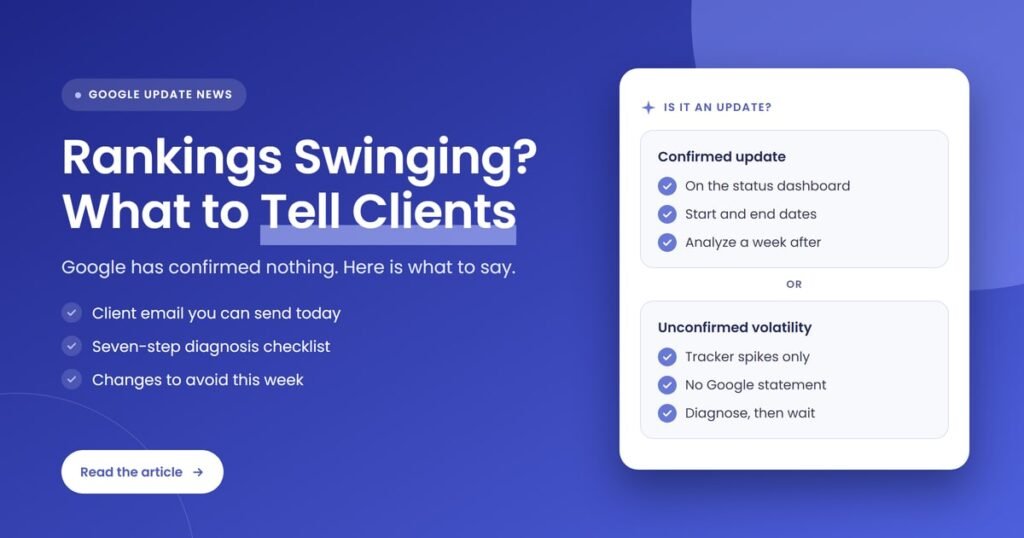
Quick answer: When rankings swing and Google has confirmed nothing, tell clients the truth: the movement is industry-wide, Google has not announced an update, and you are checking their data before changing anything. Then diagnose with Search Console, report clicks and leads rather than positions, and hold off on big edits until the volatility settles.
Key takeaways
- As of November 2, 2026, the last ranking update Google announced is the September 2026 spam update, which ran from September 24 to October 8, 2026.
- Rank trackers and SEO forums have reported several waves of unconfirmed volatility since mid-October, with the biggest spikes on October 24 and October 27, 2026.
- Contact clients before they contact you. A short, calm update sent early prevents the panicked email later.
- Diagnose before you act: rule out data issues, seasonality, technical problems, security problems and manual actions first.
- Do not rewrite pages, delete content or change site structure during a volatility week. Google’s own guidance warns against drastic changes for small drops.
What changed in Google Search in late October 2026?
Nothing official changed. Google’s Search Status Dashboard showed no new ranking incidents between October 25 and November 1, 2026, yet rank trackers and SEO forums reported repeated volatility from mid-October onward. The most recent announced ranking update remains the September 2026 spam update, which finished rolling out on October 8, 2026.
Here is the timeline, using only what Google and industry trackers have published:
- September 24, 2026: Google released the September 2026 spam update, which applies globally and to all languages, and said it could take up to two weeks to roll out.
- October 8, 2026: Google marked the spam update rollout complete on the Search Status Dashboard.
- October 16 and October 20 to 21, 2026: Search Engine Roundtable reported earlier rounds of unconfirmed ranking volatility.
- October 24, 2026: Many third-party rank trackers showed significant ranking movement on a Saturday, alongside SEO chatter about traffic changes. Search Engine Roundtable’s Barry Schwartz said he believed Google had made some ranking adjustment, but Google did not confirm one.
- October 27, 2026: Search Engine Roundtable reported a larger spike in volatility and chatter, again with no confirmation from Google. A follow-up note on October 29 said the volatility was still growing.
Some site owners commenting on the October 27 report described big keyword gains without matching traffic gains, and weak News and Discover traffic. That mix is exactly why clients get confused: one report says rankings are up, another says traffic is down, and nobody can point to an official announcement.
What is an unconfirmed Google update?
An unconfirmed Google update is a period when rank-tracking tools and site owners see unusual ranking movement, but Google has not announced anything on its Search Status Dashboard or Search Central blog. It may reflect a real system change, routine adjustments, or noise in tracking data, and nobody outside Google can say which for certain.
Google makes changes to Search constantly and only announces some of them. Confirmed updates, such as core updates and spam updates, get a dashboard entry with a start date and a completion date. Everything else shows up only as signals: rank tracker volatility scores, forum threads and Search Console charts that wobble for a few days.
| Question | Confirmed update | Unconfirmed volatility |
|---|---|---|
| Where does it appear? | Google Search Status Dashboard, with start and end dates | Rank tracker volatility scores and SEO news coverage only |
| Do you know when it ends? | Yes, Google posts a completion note | No, you judge it from your own data settling |
| When should you analyze impact? | At least a full week after the rollout completes, per Google | After positions and clicks have been stable for several days |
| What do you tell clients? | Name the update, its dates and what Google says it targets | Say movement is industry-wide, unconfirmed and being monitored |
| Should you make changes? | Only after diagnosis, and only for large, sustained drops | Not yet. Diagnose and wait |
Who is affected by this volatility?
Any site can see movement during unconfirmed volatility, so every agency with SEO clients is affected in one way: clients notice. Sites that depend on a few high-value keywords, on News or Discover traffic, or that were hit by the September 2026 spam update are most likely to ask questions this week.
For agencies and freelancers who resell SEO, the risk is less about rankings and more about trust. A client who sees a drop in a third-party tool, or reads a headline about a “Google update”, and hears nothing from you will assume you either missed it or are hiding it. Both feed churn. Our post on client churn warning signs covers what to watch for once trust starts to slip.
What should agencies tell clients when rankings move without a confirmed update?
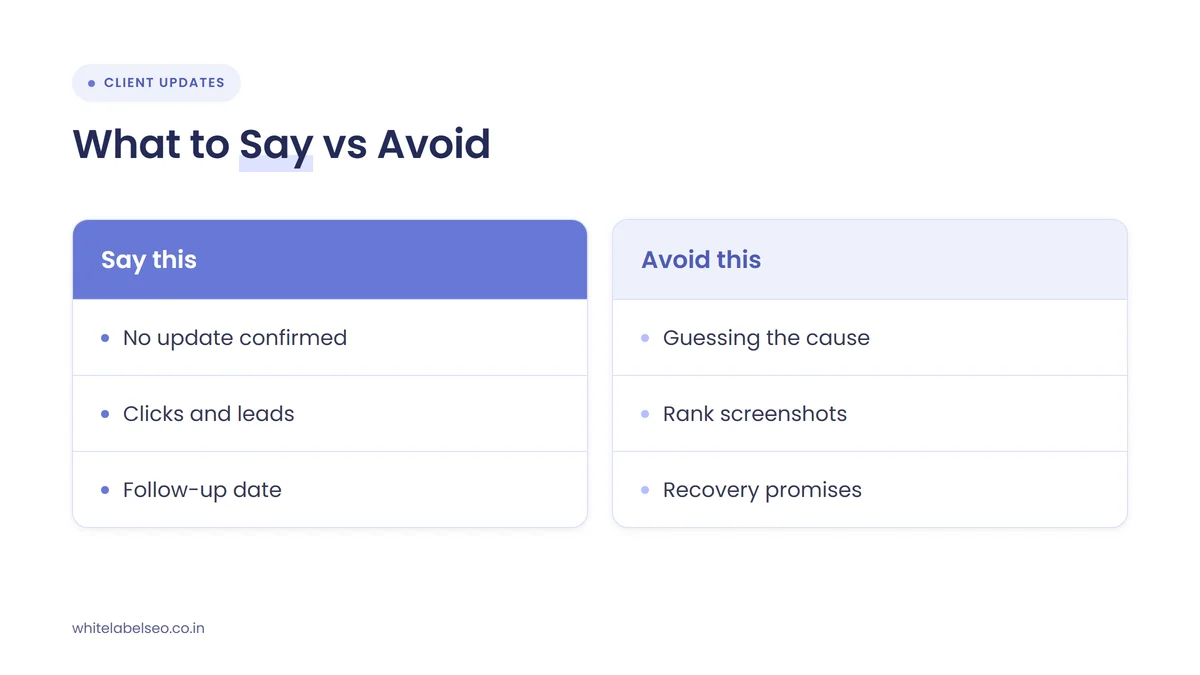
Agencies should tell clients four things: Google has not confirmed an update, the movement is visible across the industry, you are checking their specific data, and you will not make rushed changes. Send this proactively, in plain language, and promise a follow-up date. Calm, early communication is what clients remember after the volatility ends.
Here is a client update you can adapt and send under your own agency’s name. Fill in the bracketed parts from the client’s own data:
Subject: Google ranking movement this week: what we’re seeing for [client name]
Hi [first name],
You may see some ranking changes this week. Since mid-October, SEO tracking tools across the industry have shown unusual movement in Google results. Google has not announced an update. The last confirmed one, a spam update, finished on October 8.
For your site, here is what we see so far: [clicks and leads compared with the same period last month, plus any priority pages that moved]. We have checked Search Console for technical, security and manual-action issues and found [result].
Our plan is to keep monitoring daily and avoid changes to pages that are working while results are still moving. We will send you a full update on [date, about 7 to 10 days out].
If you have a question in the meantime, reply here and we will answer the same day.
A few rules make this message land well:
- Lead with leads and clicks, not positions. Google’s own debugging guide treats impressions and clicks as the primary measures and average position as secondary.
- Separate fact from inference. “Google has not confirmed an update” is a fact. “Google is testing X” is a guess, so leave it out.
- Give a date. A named follow-up date tells the client you have a process, not a reaction.
- Make no promises about recovery. Nobody controls Google’s rankings, and our guide on proving SEO ROI when results take months explains how to keep the focus on business outcomes instead.
How do you diagnose a ranking drop during unconfirmed volatility?
Diagnose a ranking drop by ruling out the causes you can verify before blaming Google. Check Search Console for data anomalies, compare periods, isolate which pages and queries lost clicks, review technical, security and manual-action reports, and check demand in Google Trends. Only a large, sustained drop that survives these checks points to a ranking change.
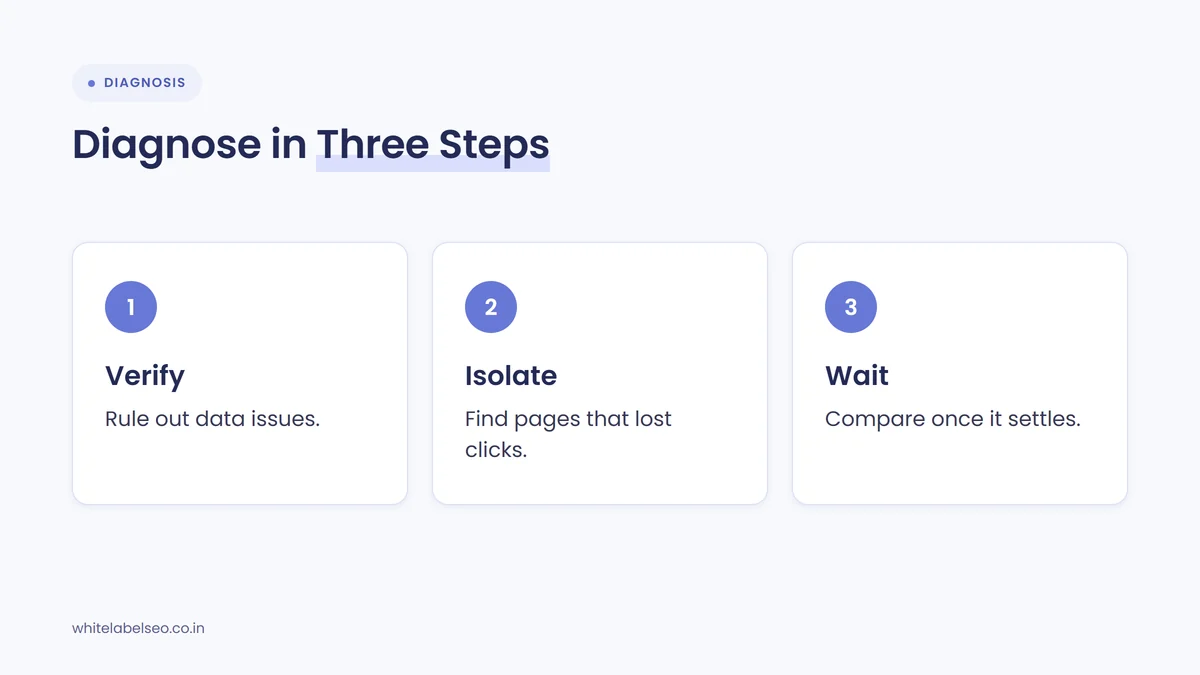
This checklist follows Google’s “Debugging drops in Google Search traffic” guide, in the order we work through it:
- Check for data problems. Look at Search Console’s Data anomalies page to make sure the dip is not a logging or reporting issue.
- Open a 16-month view. If the same dip happens every year, it is seasonality, not an update.
- Compare periods. Compare the last 7 to 14 days with the previous period and with the same period last year. Check queries, pages, countries, devices and search appearance.
- Split by search type. Review Web, Image, Video and News separately. A News or Discover drop is a different conversation from a web ranking drop.
- Find where the loss sits. Sort pages by clicks difference. A site-wide loss, a loss on one group of pages and a loss on one page each point to different causes. Run URL Inspection on a few affected pages.
- Rule out technical, security and spam issues. Check the Page indexing, Crawl stats, Security issues and Manual actions reports.
- Check demand. Use Google Trends to see whether interest in the client’s main queries fell across the web, not just on their site.
| What you see | Likely cause | Where to confirm | What to tell the client |
|---|---|---|---|
| Same dip at the same time last year | Seasonality | Search Console 16-month view, Google Trends | Demand is down, not visibility |
| Sudden drop across every page | Technical or indexing problem | Page indexing, Crawl stats, URL Inspection | We found a site issue and are fixing it |
| Drop on one template or section | Page-level issue or a ranking change for that query set | Pages report sorted by clicks difference | One group of pages moved, and here is our plan |
| Positions slip a few places, clicks steady | Normal fluctuation | Performance report, clicks versus position | Normal movement, no action needed |
| Large drop with no technical cause | Possible ranking system change | Compare against volatility reports, wait for stability | We are monitoring and will review once results settle |
| Warning or penalty in Search Console | Security issue or manual action | Security issues and Manual actions reports | A specific issue needs fixing, and here is the timeline |
If the client was affected by the September 2026 spam update, treat that separately from the late-October volatility, because the spam update is a confirmed event with its own guidance. Our post on protecting clients from Google spam updates covers that case.
What should agencies avoid doing during unconfirmed volatility?
Avoid making changes while results are still moving. Rewriting pages, deleting content, changing titles across the site or switching strategy mid-volatility makes it impossible to tell what caused any later recovery or decline. Google’s guidance on core updates says small drops do not call for drastic action, and quick fixes based on rumors rarely help.
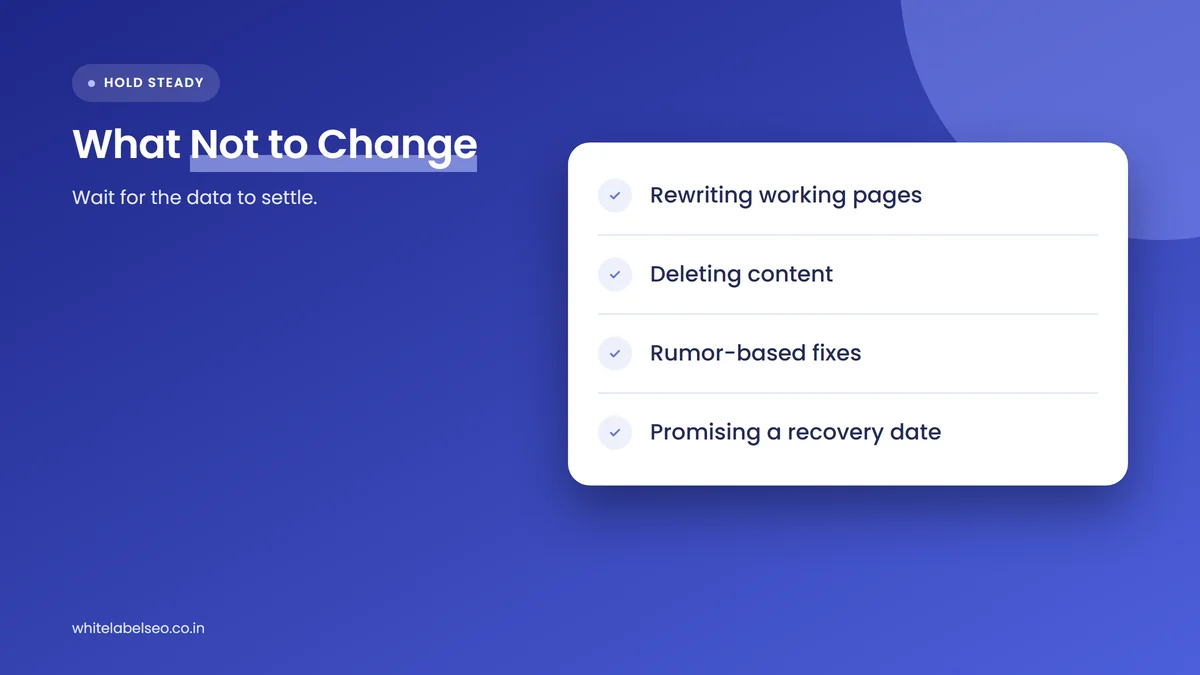
- Don’t rewrite pages that were performing well. Google advises against changing content that already works because of a small position drop.
- Don’t delete content in a panic. Google calls removing content a last resort for pages that cannot be improved.
- Don’t remove page elements because of SEO rumors. Google’s core update guidance specifically warns against this.
- Don’t send clients daily screenshots from rank trackers. Third-party tools amplify short-term noise and make every wobble look like a crisis.
- Don’t name a cause you can’t prove. If Google hasn’t confirmed an update, don’t tell the client “the algorithm changed” as if it were fact.
- Don’t promise a recovery date. Google says some changes show within days while others take months to be recognized.
When should you change strategy after a ranking drop?
Change strategy only after rankings have been stable for a while and a large drop has persisted. Google suggests waiting at least a full week after a confirmed update completes before comparing data. For unconfirmed volatility, wait until positions and clicks stop moving, then compare against the period before the swings began.
Google’s guidance draws a useful line between small and large drops. A slip from position 2 to position 4 may recover on its own and does not justify big changes. A fall from the top 10 to position 29 or so calls for a broader self-assessment of whether the site’s content is helpful, reliable and written for people. That self-assessment is a strategic project, and it deserves a proper scope and timeline, not a reaction in the middle of a volatile week.
When you reach that point, explain it to the client as a planned review: what you will assess, which pages come first, and when you will report back. If reporting has focused on positions alone, this is also a good moment to move to the metrics in our guide on what to report differently in a zero-click world.
How do we handle volatility weeks with partner agencies?
At White Label SEO, we treat volatility weeks as a communication task first and an SEO task second. We give partner agencies the facts, a client-ready summary they can send under their own brand, and a diagnosis of each affected site, so they can answer clients quickly without guessing.
In practice, that means three things. First, we check whether Google has confirmed anything and note the dates. Second, we run the diagnosis checklist above on any client site showing a meaningful change in clicks. Third, we pause non-urgent on-page changes on affected sites until the data settles, while continuing work that does not depend on rankings, such as technical fixes already in the queue.
What is likely to happen next?
This section is our opinion, not a forecast from Google. Repeated waves of unconfirmed volatility can come before an announced update, or they can simply fade. Neither outcome is certain, so the safest plan is the same either way: keep monitoring, keep clients informed and act only on data that has settled.
If Google does announce an update in the coming weeks, it will appear on the Search Status Dashboard with a start date. That changes the client message: you can name the update, link to Google’s announcement, and wait for the completion note before analyzing impact.
Frequently asked questions
Is there a Google algorithm update right now?
As of November 2, 2026, Google has not announced a new ranking update. The last confirmed one was the September 2026 spam update, which ran from September 24 to October 8, 2026. Industry trackers reported unconfirmed volatility through late October, but Google has not confirmed any update linked to it.
Should I tell clients about volatility before they notice?
Yes, if their sites are showing meaningful movement in clicks or priority rankings. A short, factual message sent early shows you are watching their account. Waiting until the client spots a drop in a third-party tool puts you on the defensive and makes the same facts sound like excuses.
How long does unconfirmed Google volatility usually last?
There is no fixed length, because Google does not announce these periods or say when they end. Judge it from your own data instead: once positions and clicks in Search Console have stopped swinging for several days, you can compare against the period before the volatility started.
Should I trust rank tracker volatility scores?
Treat them as an early warning, not a verdict. Volatility tools measure movement across their own keyword samples, which may not match your client’s queries. Confirm any concern in Search Console, where clicks and impressions come from Google’s own data for the client’s actual site.
What if a client wants us to change everything immediately?
Explain that changing several things during volatility makes it impossible to know what helped or hurt. Show them the diagnosis you ran, agree on a review date, and list what you will do if the drop persists. Most clients accept patience when it comes with a clear plan and a date.
What should you do next?
Today, send a short update to any client whose clicks or priority rankings have moved, using the template above. Then run the seven-step diagnosis on those sites, log what you find, and set a follow-up date. Hold off on major changes until the data settles. If you want a fulfillment team that runs this process for every client under your brand, read about our white-label SEO services at White Label SEO.
Want a partner that handles volatility weeks with you?
At White Label SEO, we deliver SEO under your agency’s brand, including diagnosis and client-ready updates when rankings move. Tell us about your clients, and we’ll show you how our process fits your agency.
Sources
- Google Search Status Dashboard, “September 2026 spam update”, October 8, 2026. https://status.search.google.com/incidents/XhUDXP7A67iHCD2kmbVu
- Google Search Status Dashboard, “Google Search Status Dashboard”, November 1, 2026. https://status.search.google.com/
- Search Engine Roundtable, “Google Search Ranking Volatility Gets Heated October 24th”, October 25, 2026. https://www.seroundtable.com/google-search-ranking-volatility-heated-42373.html
- Search Engine Roundtable, “Unconfirmed Google Search Ranking Update: Volatility & Chatter Spike”, October 27, 2026. https://www.seroundtable.com/google-search-ranking-volatility-42379.html
- Google Search Central, “Debugging drops in Google Search traffic”, last updated December 10, 2025. https://developers.google.com/search/docs/monitor-debug/debugging-search-traffic-drops
- Google Search Central, “Google Search’s core updates”, last updated December 10, 2025. https://developers.google.com/search/updates/core-updates