Quick answer: Multiturn ads are Google ads that can appear on follow-up questions in AI Mode, not just the first query. Google announced them for the U.S. on October 28, 2026, and they were seen live on November 9. Tell PPC clients existing Search, Shopping and Performance Max campaigns are eligible automatically, and tell SEO clients organic work still matters.
Key takeaways
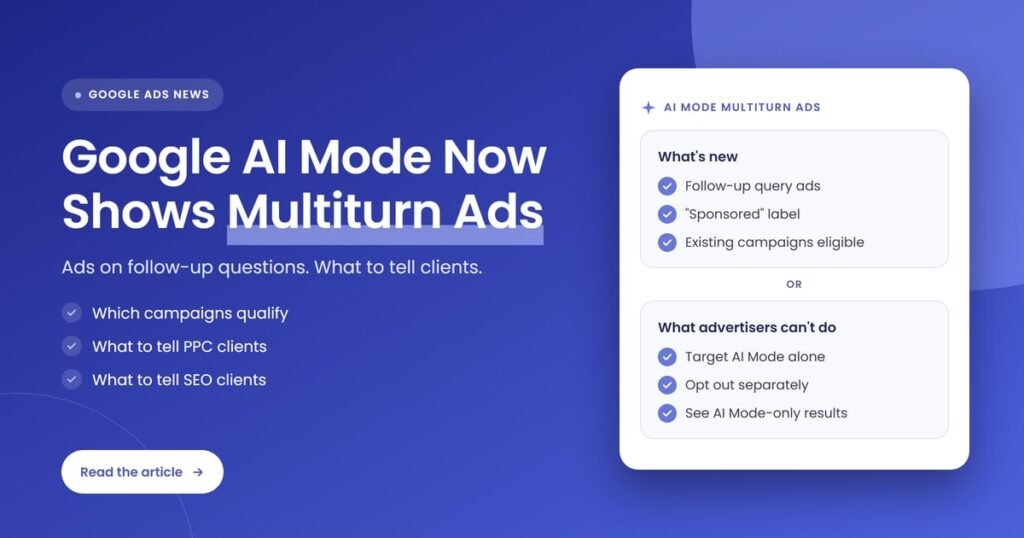
- Google announced multiturn ads in the U.S. on October 28, 2026, “to allow ads in follow-up queries in AI Mode.” On November 9, Search Engine Roundtable reported seeing them live on follow-up queries, labeled “Sponsored.”
- Google’s help page says existing Search, Shopping and Performance Max campaigns are automatically eligible for ads in AI Overviews and AI Mode. No new campaign or separate budget is needed.
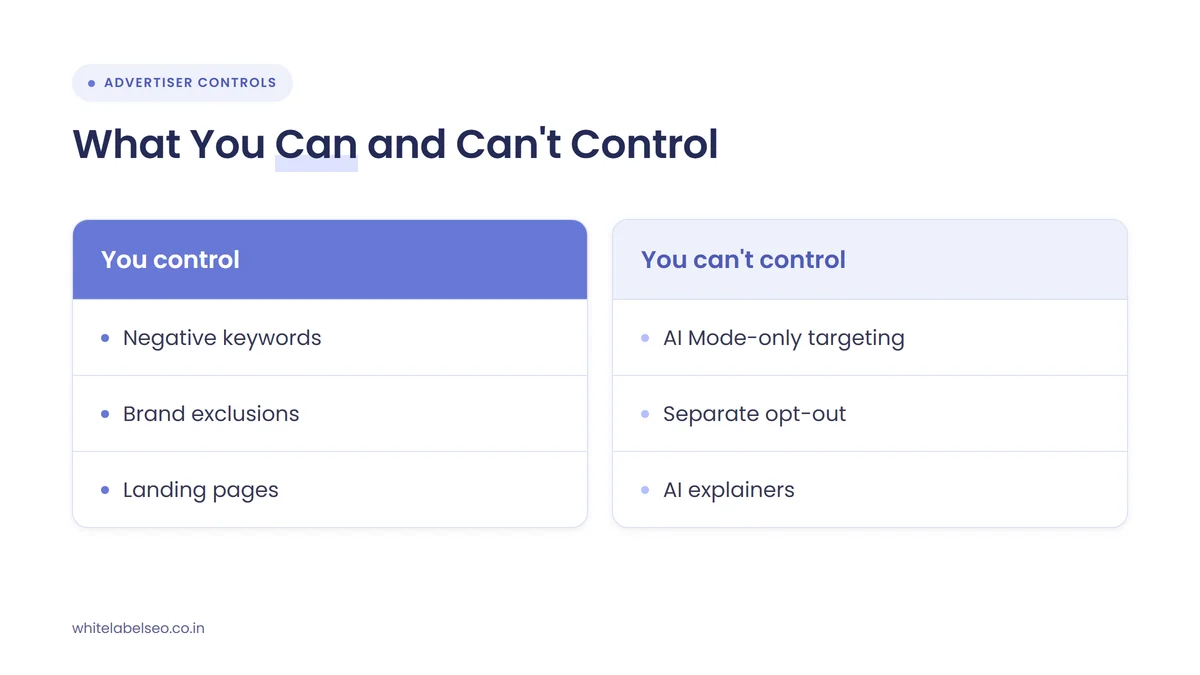
- Advertisers can’t target AI Mode on its own or opt out of it separately from Search, and the results are reported in aggregate inside standard campaign reports.
- For SEO clients, a “Sponsored” result can now sit next to a conversation at more points, so organic visibility and clear website content matter as much as before.
- Agencies should brief clients now, review search terms and negative keywords for PPC accounts, and avoid promising separate AI Mode ad numbers that Google does not report.
What did Google announce about multiturn ads?
On October 28, 2026, Google said it is launching multiturn ads in the U.S. so ads can appear in follow-up queries in AI Mode. In the same post, Google expanded ads in AI Mode to more English-language markets and said ads are labeled “Sponsored.” Google also said it will keep testing new formats.
The announcement came from Shashi Thakur, VP and GM of Google Search Ads, on the Google Ads & Commerce Blog. The main points from Google’s post:
- Multiturn ads in the U.S.: ads can now appear on follow-up questions, not only on the first query of an AI Mode session.
- New markets: ads in AI Mode are scaling in Australia, Canada, India, Kenya, Malaysia, New Zealand, Nigeria, Pakistan, the Philippines and Singapore, with Brazil, Mexico and the United Kingdom among the locales planned for Q4 2026.
- Longer queries: Google cites its own May 2026 U.S. AI Mode report saying AI Mode queries are, on average, three times longer than traditional searches.
- Clicks: Google says click-through rates are already similar between sponsored and organic product list items in AI Mode, based on U.S. internal data from August 20 to September 3, 2026.
Note what that click-through claim covers: product list items, measured by Google, over two weeks. It is not a claim about text ads or about every advertiser, so it should not go into a client deck as a general performance figure.
What are multiturn ads in Google AI Mode?
Multiturn ads are paid search ads that can show on the second, third or later question in an AI Mode conversation. AI Mode lets people ask a question, read an AI answer and then keep refining with follow-ups. Before this change, ads were tied to the opening query. Now a follow-up with commercial relevance can also trigger an ad.
Google’s help page describes AI Mode as built for “multi-turn conversations” and says ads can appear within or alongside AI responses, “including across follow-up questions in AI Mode.” A Google spokesperson told Search Engine Roundtable that multiturn ads “show up on responses to follow-up user queries as users engage in back-and-forth conversations with AI Mode.”
A simple way to explain it to a client: someone asks AI Mode a broad question, then narrows it down with a follow-up, such as adding a location, a budget or a product feature. That narrower follow-up is often closer to a buying decision, and it is now a place where an ad can appear.
Are multiturn ads live yet?
Yes, they appear to be. Barry Schwartz of Search Engine Roundtable reported on November 9, 2026 that while testing AI Mode he saw ads on follow-up queries, including the third and fourth follow-ups. His screenshot showed two ads labeled “Sponsored” at the bottom of the AI Mode response.
That is one observer’s test, not a statement of how often the ads show. Google’s help page says ad layouts are tested regularly and the visual presentation may change. Treat placement as fluid: some clients will see these ads when they test, and some will not.
Which campaigns are eligible for ads in AI Mode?
Google says existing Search, Shopping and Performance Max campaigns are automatically eligible to serve ads within AI Overviews and AI Mode. Advertisers don’t need new campaigns or separate budgets. Ads enter through the normal Google Ads auction when relevant, and the formats are text ads and Shopping ads, with local inventory and vehicle ads in testing.
The help page explains two ways an ad can match:
- Direct matching: the ad matches the user’s query itself.
- Contextual matching: the ad matches based on both the query and the AI response.
Keyword match type changes which of these a campaign can reach. Google says AI Max for Search, broad match on Search, Shopping and Performance Max can match both directly and contextually. Exact and phrase match keywords are eligible only when a query shows direct commercial intent, and “aren’t eligible for contextual matching on broader exploratory questions.”
| Question a client asks | What Google’s help page says | What it means for the account |
|---|---|---|
| Do we need a new campaign? | No. Existing Search, Shopping and Performance Max campaigns are automatically eligible | Ads may already be showing in AI Mode for eligible U.S. accounts |
| Can we run ads only in AI Mode? | No. You can’t target AI Overviews or AI Mode exclusively | AI Mode is part of Search, not a separate channel to buy |
| Can we opt out? | Not separately from Search. Negative keywords and brand exclusions still work | Use the usual controls to block irrelevant queries |
| Can we see AI Mode results on their own? | Metrics are included in aggregate in standard reports and the search terms report | Don’t promise a separate AI Mode ads report |
| Who writes the text shown with the ad? | Some placements add AI explainers generated by Gemini. Advertisers can’t write, edit, approve or opt out of them | Keep the website accurate, since it feeds that context |
| Which match types reach follow-ups? | Broad match, AI Max, Shopping and Performance Max can match contextually. Exact and phrase match only match direct commercial intent | Match type strategy decides how much AI Mode traffic an account can reach |
Who is affected by multiturn ads?
Multiturn ads affect three groups. U.S. advertisers running Search, Shopping or Performance Max campaigns are eligible now. Businesses that rely on organic search may see sponsored results sitting alongside more AI Mode answers. And agencies have to explain both, often to clients who only buy one of the two services from them.
- PPC clients in the U.S.: multiturn ads are U.S. only in Google’s announcement. Their existing campaigns may already be serving on follow-ups.
- PPC clients outside the U.S.: Google’s help page lists ads within AI Overviews and AI Mode for the United States, Australia, Canada, India, Kenya, Malaysia, New Zealand, Nigeria, Pakistan (text ads only), the Philippines and Singapore, with Indonesia for AI Overviews only, and in English. Google has not said when multiturn ads will reach those markets, so don’t tell them it has.
- SEO-only clients: they don’t buy ads, but their buyers now see sponsored results at more points in an AI Mode conversation.
- Agencies and freelancers: client questions about “ads in AI” will arrive before most clients see one, so a short, sourced explanation saves time.
What should agencies tell PPC clients about multiturn ads?
Tell PPC clients that Google can now show their ads on follow-up questions in AI Mode, that eligible campaigns take part automatically, and that there is no separate switch or separate report. Then explain that match types, negative keywords and landing pages decide how well those placements work, and that the agency is reviewing them.
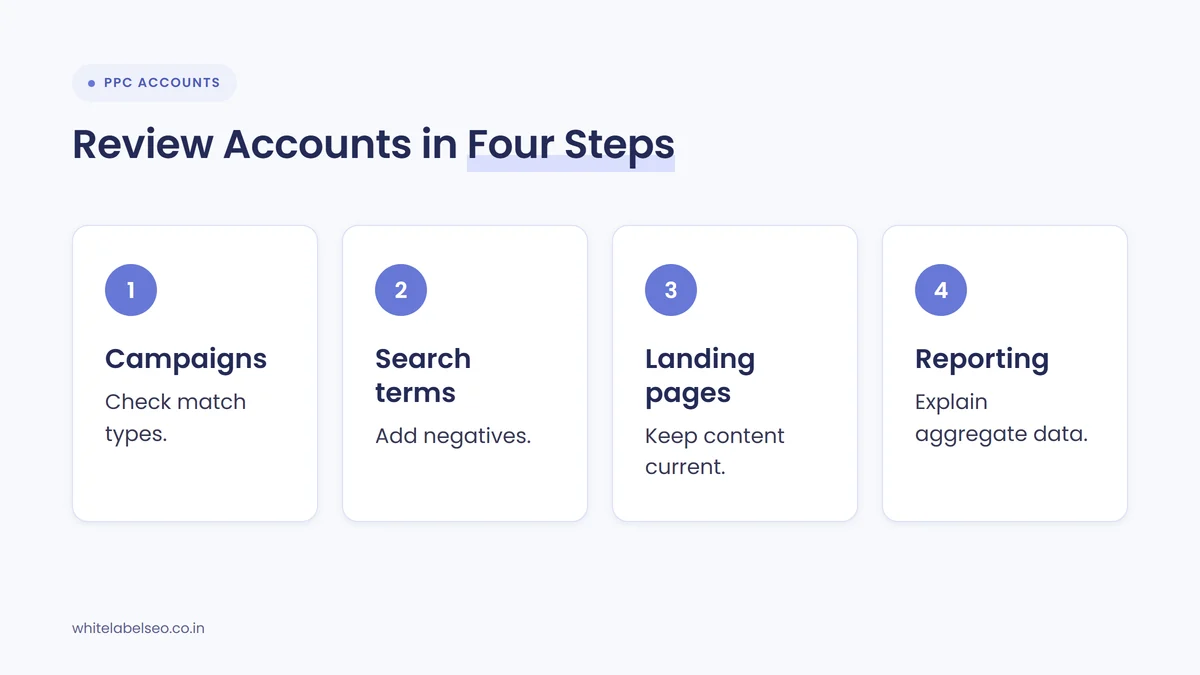
- Check which campaigns are eligible. List each client’s Search, Shopping and Performance Max campaigns, and note which use broad match or AI Max and which rely on exact and phrase match. That tells you how much contextual matching each account can reach.
- Review the search terms report. Google says queries that trigger ads in AI Mode are included in aggregate. Look for longer, conversational queries and add negative keywords where they are irrelevant.
- Tidy landing pages and feeds. Google’s own recommendations include keeping website content clear and up to date, which helps it surface accurate context in AI explainers, and keeping Merchant Center feeds complete and fresh for Shopping.
- Reset reporting expectations. Tell the client in writing that AI Mode ad performance sits inside normal campaign numbers. If a change in cost or conversions coincides with the rollout, say it may be related, not that it is.
Google’s help page also recommends pairing AI-powered targeting with Smart Bidding and strong conversion data, and keeping budgets flexible on high-performing campaigns. Those are Google’s recommendations. Whether they suit a given account is still the account manager’s call.
What should agencies tell SEO clients about multiturn ads?
Tell SEO clients that ads in AI Mode do not change how organic content gets into AI answers. Google says there are no additional requirements or special optimizations to appear in AI Overviews or AI Mode. What changes is the page around the answer: sponsored results can now appear deeper into a conversation, next to the organic sources.
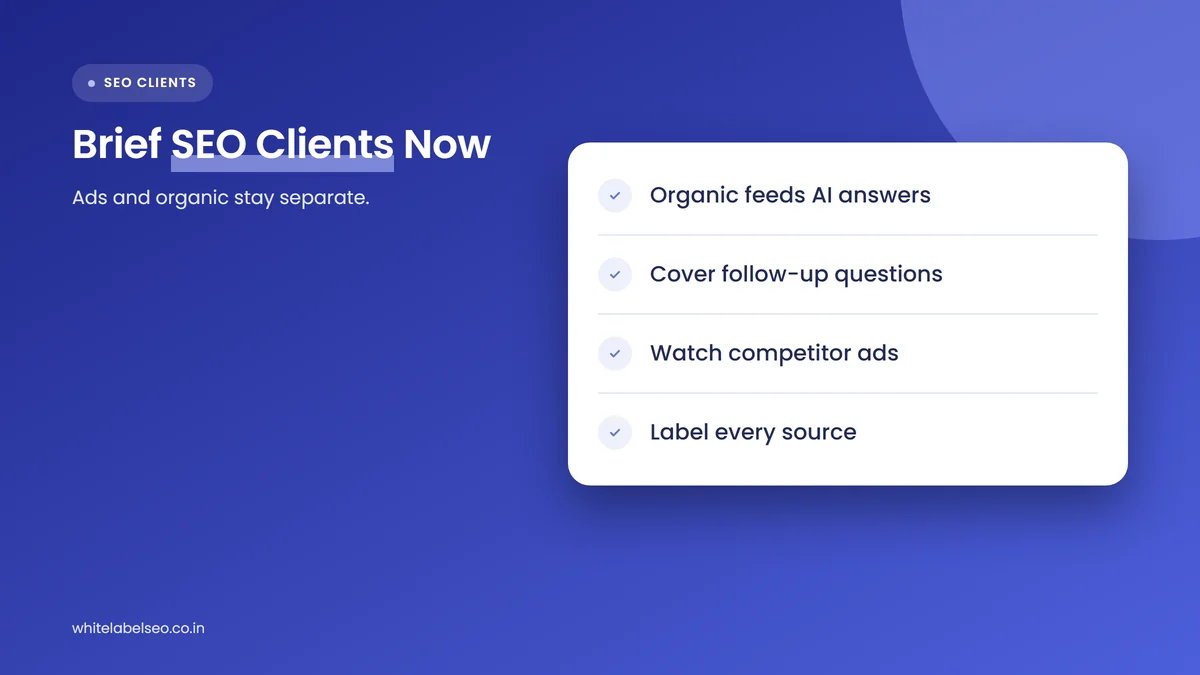
- Organic still feeds the answer. AI Mode builds responses from web pages, and Google says it may use a “query fan-out” technique to find supporting pages. Clear, useful pages remain the way in.
- Follow-up questions are worth covering. If buyers narrow their question with location, price range or features, pages that answer those specifics give AI Mode something to cite at each step.
- Competitors may now appear as ads on those follow-ups. That is a reason to review whether the client should test paid search, not a reason to panic about organic.
- Reporting stays honest. Search Console’s AI report shows impressions, not clicks, and Google Ads reports AI Mode results in aggregate. Neither shows exactly how ads and organic answers interact for one client.
If a client asks whether they should now buy ads to “be in AI Mode”, the honest answer is that ads and organic citations are separate. Paying for ads does not make the website more likely to be cited in the AI answer, and Google does not say otherwise.
How should agencies report on AI Mode ads and visibility?
Report what the data actually shows. Google Ads includes AI Mode results in aggregate, so show total campaign performance and search terms, not a separate AI Mode line. For organic, use Search Console’s AI report for impressions and your own lead tracking for outcomes, and label every number by its source.
A short reporting note for the next monthly report could say:
- What changed: Google began showing ads on AI Mode follow-up questions in the U.S. in late October and early November 2026.
- What we can see: total campaign impressions, clicks, conversions and cost, which include AI Mode placements, plus the search terms report.
- What we can’t see: a separate breakdown of results from AI Mode ads, because Google does not offer one.
- What we are doing: reviewing search terms, negative keywords and landing pages, and keeping organic content focused on the questions buyers ask.
For the organic side, our post on explaining Search Console’s AI report without click data covers the impressions-only problem, and our list of SEO metrics to report to clients shows where AI search fits in a monthly report.
What should agencies avoid saying about multiturn ads?
Avoid quoting Google’s click-through comparison as a general figure, implying clients can buy AI Mode placements on their own, promising a separate AI Mode report, or saying multiturn ads are live outside the U.S. Each of these goes beyond what Google has published, and each can come back to the agency later.
- “Ads in AI Mode get the same clicks as organic.” Google’s comparison covers product list items over two weeks of U.S. internal data, not text ads in general.
- “We’ll set up an AI Mode campaign.” There is no AI Mode-only campaign. Eligibility comes through existing campaign types.
- “You’ll get a report of your AI Mode ad results.” Google reports these in aggregate.
- “Buying ads will get you cited in AI answers.” Ads and organic sources are separate.
The same approach applies to other AI search news: share what the official source says, label anything reported second-hand, and keep opinions marked as opinions. We used it for the reported ChatGPT business analytics tool too, and it keeps client trust intact when details change.
What is likely to happen next?
This section is our view, not a Google statement. Google says it will keep testing new formats, and its help page says layouts change regularly. We expect multiturn ads to follow the same path as the earlier AI Mode ad rollout, starting in the U.S. and reaching more English-language markets over time.
Our reasoning is the order Google has already followed: ads in AI Mode reached more markets in its October 28 post, with more locales planned for Q4 2026, while multiturn ads were limited to the U.S. Until Google says otherwise, agencies with clients outside the U.S. should treat multiturn ads as a U.S. feature and set expectations accordingly. If a client is new to how search changes are handled, our guide to setting SEO expectations with new clients helps frame these updates from the start.
Frequently asked questions
What are multiturn ads in Google AI Mode?
Multiturn ads are Google ads that can appear on follow-up questions in an AI Mode conversation, not only on the first query. Google launched them in the U.S. in October 2026, and they are labeled “Sponsored.” They come from existing Search, Shopping and Performance Max campaigns through the normal Google Ads auction.
Do advertisers need to set anything up for multiturn ads?
No. Google says existing Search, Shopping and Performance Max campaigns are automatically eligible to serve ads in AI Overviews and AI Mode, with no new campaigns or separate budgets. Match types still matter: exact and phrase match only reach queries with direct commercial intent.
Can advertisers opt out of ads in AI Mode?
Not separately from Search. Google’s help page says advertisers can’t target AI Overviews or AI Mode exclusively, or opt out of them on their own. Negative keywords and brand exclusions remain available to control which queries trigger ads.
Can you see AI Mode ad performance separately in Google Ads?
No. Google says metrics for ads in AI Overviews and AI Mode are included in aggregate in standard campaign reports, and the queries that trigger them are included in aggregate in the search terms report. There is no separate AI Mode line to report.
Do multiturn ads affect organic SEO?
They do not change how pages get cited in AI Mode. Google says there are no special optimizations needed to appear in AI Overviews or AI Mode. They do mean sponsored results can appear at more points in a conversation, next to the organic sources a client is competing for.
Are multiturn ads available outside the U.S.?
Google’s October 28, 2026 announcement launched multiturn ads in the U.S. only. Ads in AI Mode in general are available in more markets, including Australia, Canada, India and New Zealand, with Brazil, Mexico and the United Kingdom among the locales planned for Q4 2026.
What should you do next?
Send PPC clients a short note this week explaining that their eligible campaigns can now show on AI Mode follow-ups, and review search terms, negative keywords and landing pages. Brief SEO-only clients that organic content still feeds AI answers, and add a sourced line about the change to the next monthly report. If you want a partner to handle the SEO side under your agency’s brand, see our white-label SEO services at White Label SEO.
Want SEO reports that explain AI search changes clearly?
At White Label SEO, we deliver SEO under your agency’s brand, with monthly reports that label every figure by its source so you can explain Google’s AI changes to clients with confidence. Tell us about your clients, and we’ll show you how we’d support them.
Sources
- Google Ads & Commerce Blog (Shashi Thakur), “Ads in AI Mode expand to new markets”, October 28, 2026. https://blog.google/products/ads-commerce/ads-in-ai-mode-global/
- Google Ads Help, “About ads in AI-powered experiences in Google Search”, accessed November 10, 2026. https://support.google.com/google-ads/answer/18826097
- Search Engine Roundtable, “Google AI Mode Multiturn Ads Are Live – Follow-Up Query Ads”, November 9, 2026. https://www.seroundtable.com/google-ai-mode-multiturn-ads-42478.html
- Search Engine Roundtable, “Google Expands Ads In AI Mode To More Countries & Multiturn Ads In U.S.”, October 28, 2026. https://www.seroundtable.com/google-expands-ads-ai-mode-42412.html
- Google Search Central, “AI features and your website”, accessed November 10, 2026. https://developers.google.com/search/docs/appearance/ai-features
- Google Search Central Blog, “Introducing Search Generative AI performance reports in Search Console”, June 3, 2026. https://developers.google.com/search/blog/2026/06/gen-ai-performance-reports