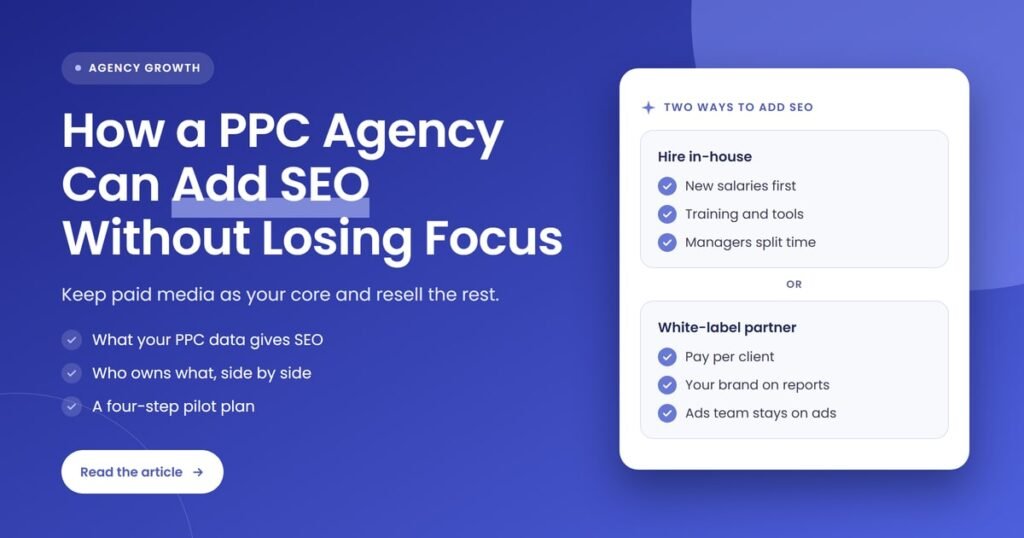
Quick answer: A PPC agency can add SEO services without losing focus by keeping strategy, the client relationship and paid media in-house, then handing SEO fulfillment to a specialist or white-label partner. Start with one SEO offer that reuses your paid search data, pilot it with a few existing clients, and report paid and organic results together.
Key takeaways
- Your paid media clients are already asking about organic and AI search. Saying “we only do ads” now sends them to another agency for half of their search budget.
- Google expanded ads in AI Mode to ten more countries on October 28, 2026, and reports those ads only in aggregate with regular Search. Organic visibility is the part of AI search your clients can still see clearly.
- A PPC agency already owns the most useful SEO inputs: search terms data, conversion tracking and landing page tests.
- Keep strategy, client communication and paid media in-house. Hand research, on-page work, content, technical fixes and local SEO to a partner who works under your brand.
- Add one starter offer, pilot it with a few current clients, then package and price it. Don’t launch a full SEO menu on day one.
What does adding SEO mean for a PPC agency?
For a PPC agency, adding SEO means selling organic search work, such as on-page optimization, content, technical fixes and local SEO, alongside paid campaigns. It doesn’t have to mean hiring an SEO team. Many agencies keep the strategy and client relationship, and use a white-label partner to deliver the work under their own brand.
A PPC agency, or paid media agency, manages ads that charge per click or per result, mainly on Google Ads, Microsoft Ads and social platforms. White-label SEO is SEO work delivered by a partner and presented as yours: your logo on reports, your team on calls, and the partner’s specialists doing the fulfillment behind the scenes. If you want the full list of what can be resold this way, see our guide to SEO services agencies can resell without hiring.
Why are paid media clients asking about SEO now?
Paid media clients are asking about SEO because search itself is changing. Google now places ads inside AI Mode and AI Overviews with limited reporting, AI answers reduce clicks on regular results, and owners want to be visible in those answers too. Agencies that only run ads can’t answer the organic half of that question.
The last few weeks made this sharper for paid media teams:
- AI Mode ads are spreading. On October 28, 2026, Google said it is scaling ads in AI Mode to Australia, Canada, India, Kenya, Malaysia, New Zealand, Nigeria, Pakistan, the Philippines and Singapore, with Brazil, Mexico and the United Kingdom planned for later in Q4. It also launched multiturn ads in the US, which can appear on follow-up questions inside an AI Mode conversation.
- Queries look different. In the same announcement, Google said AI Mode queries are on average three times longer than traditional searches, based on its US data from May 2026.
- Advertisers can’t separate the results. Google Ads Help says you can’t target ads only to AI Overviews or AI Mode, or opt out of them separately from Search. Performance from these placements is included in aggregate in standard campaign reports and the search terms report.
- Fewer clicks reach regular results. Pew Research Center analyzed 68,879 Google searches by 900 US adults in March 2025. When an AI summary appeared, users clicked a traditional result on 8% of visits, against 15% when there was no summary.
Agencies feel the demand directly. In the AgencyAnalytics 2026 benchmarks survey of 494 agency professionals, 66% said clients want them to add AEO or SEO for AI search, ahead of performance-based paid ads at 55%. The same survey found 43% of agencies face more competition for high-intent traffic and 40% report increased investment in paid search. For a paid media agency, that adds up to clients spending more on ads while asking how to show up without paying for every click.
What does a PPC agency already have that SEO needs?
A PPC agency already has most of the inputs good SEO depends on: search terms that convert, conversion tracking, landing pages, and an existing relationship with the client’s decision maker. What it usually lacks is the people and process to do ongoing organic work every month. That gap is smaller than most paid teams assume.
| What your PPC team already has | How SEO uses it |
|---|---|
| Search terms report | Shows which queries lead to sales, so organic pages target proven terms instead of guesses |
| Conversion tracking in Google Ads and GA4 | Lets you report organic leads and sales, not just rankings |
| Landing page tests | Headlines, offers and layouts that already convert can shape service pages |
| Ad copy that wins clicks | Informs title tags and meta descriptions for organic listings |
| Negative keyword lists | Show which topics the client doesn’t want to attract, so content stays on target |
| Client trust and a monthly reporting slot | Gives you a place to introduce SEO without a cold pitch |
Google Ads also has a built-in bridge. Its paid and organic report shows how often a client’s pages appear in unpaid results, which queries triggered them, and how those compare with text ads. It needs a Search Console account linked to the Google Ads account, it counts text ads only, and organic data starts from the day you link. Linking it is a sensible first step, because you will want history once SEO work begins.
What should you keep in-house and what should you hand off?
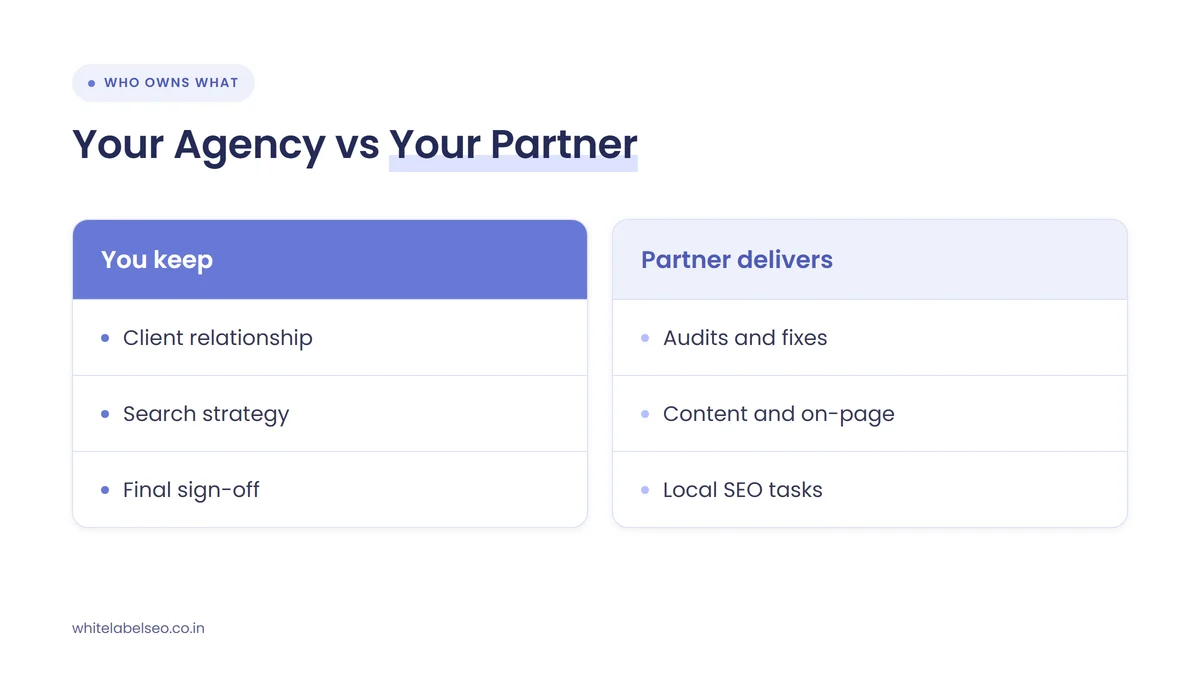
Keep anything that shapes the client relationship or the budget decisions in-house: strategy, keyword priorities, sign-off and reporting conversations. Hand off the repeatable production work, such as audits, on-page changes, content, technical fixes and local SEO tasks, to a partner with documented processes. This split is what protects your focus on paid media.
| Task | Who owns it | Why |
|---|---|---|
| Client relationship and calls | Your agency | The client hired you, and one voice avoids confusion |
| Search strategy across paid and organic | Your agency, with partner input | You see the budget, margins and conversion data |
| Keyword priorities | Your agency | Your search terms data shows what converts |
| Technical audit and fixes | Partner | Specialist work that is easy to document and check |
| On-page optimization and content | Partner, with your approval | Volume work that would pull your PPC managers off campaigns |
| Google Business Profile and local SEO | Partner | Ongoing tasks with clear monthly checklists |
| Monthly report and review call | Your agency, using partner data | Paid and organic results belong in one conversation |
How do you add SEO step by step?
Add SEO in four steps: choose one starter offer that fits your paid clients, connect the data you already have, pilot the offer with a small group of existing clients, and only then package and price it. Each step limits how much of your team’s time SEO can take before you know it works.
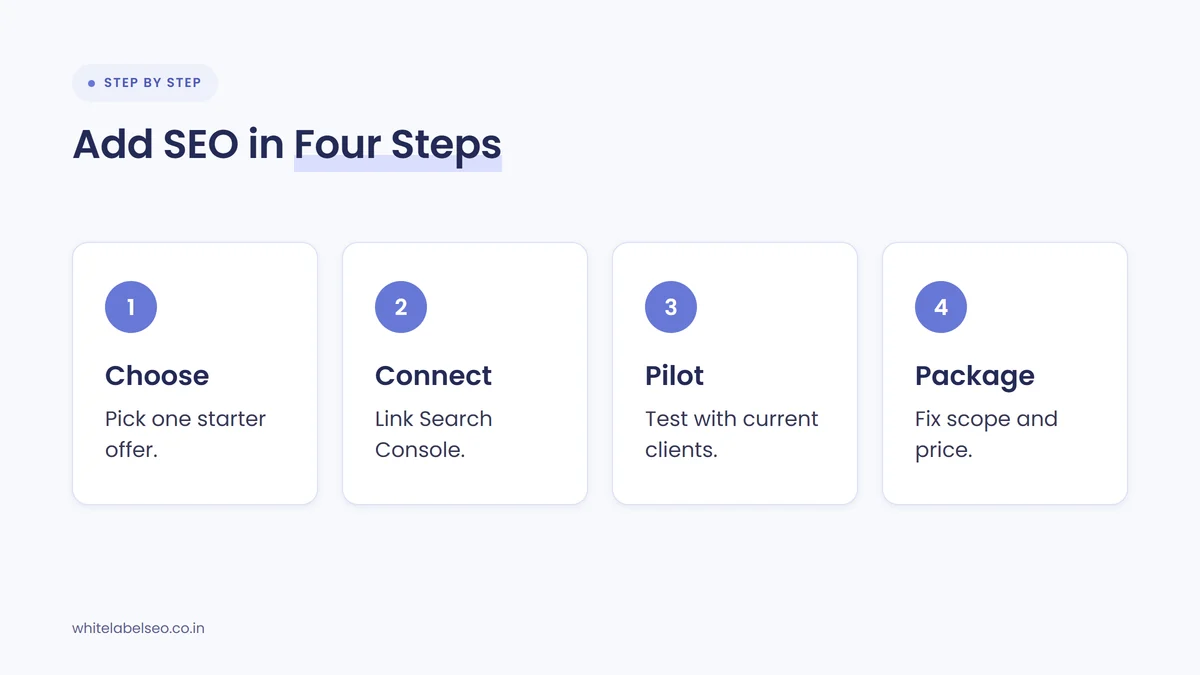
- Choose one starter offer. Pick the SEO service closest to the work you already do. For most paid media agencies, that is landing page and service page optimization, or local SEO for clients who run location-based campaigns.
- Connect the data. Link each pilot client’s Search Console to Google Ads, confirm conversion tracking covers organic traffic in GA4, and export the converting search terms. This gives the SEO work a starting list built on real sales data.
- Pilot with two or three current clients. Choose clients who trust you and have asked about organic or AI search. Agree a fixed scope for 90 days, set honest expectations about timing, and report progress monthly. Our guide to setting SEO expectations with new clients has wording you can reuse.
- Package and price it. Use what you learned in the pilot to fix scope, delivery time and cost, then add a markup that covers account management. Our guide to pricing white-label SEO for healthy agency margins walks through the numbers.
Which SEO service should a PPC agency sell first?
Sell the SEO service that connects most clearly to the paid campaigns you already run. For lead generation clients, that is usually landing page and service page SEO. For local businesses, it is Google Business Profile and local SEO. A technical audit works as a paid entry point when a client’s site is slowing campaigns down.
| Starter offer | Best for | Link to your PPC work |
|---|---|---|
| Landing page and service page SEO | Lead generation and B2B clients | Optimizes the pages your ads already send traffic to |
| Local SEO and Google Business Profile | Service businesses with one or more locations | Supports local campaigns and call tracking |
| Technical SEO audit | Clients with slow or messy sites | Page experience affects both organic visibility and how well paid landing pages convert |
| Content for high-cost queries | Clients paying heavily for informational or research terms | Builds organic pages for queries the client now pays to appear on |
Whichever you choose, describe it to clients as part of one search plan, not a separate product. Google’s own guidance says there are no additional requirements or special optimizations needed to appear in AI Overviews or AI Mode, so the same organic basics that help regular rankings also support AI search visibility. That makes the offer easier to explain to clients who ask about AI answers.
How do you keep SEO from pulling your team off paid media?
Keep SEO from pulling your team off paid media by giving it a separate owner, a fixed scope per client, and a partner who handles delivery on a set schedule. Your PPC managers should spend minutes a week on SEO, mostly approvals and shared reporting, not hours on writing content or fixing sites.
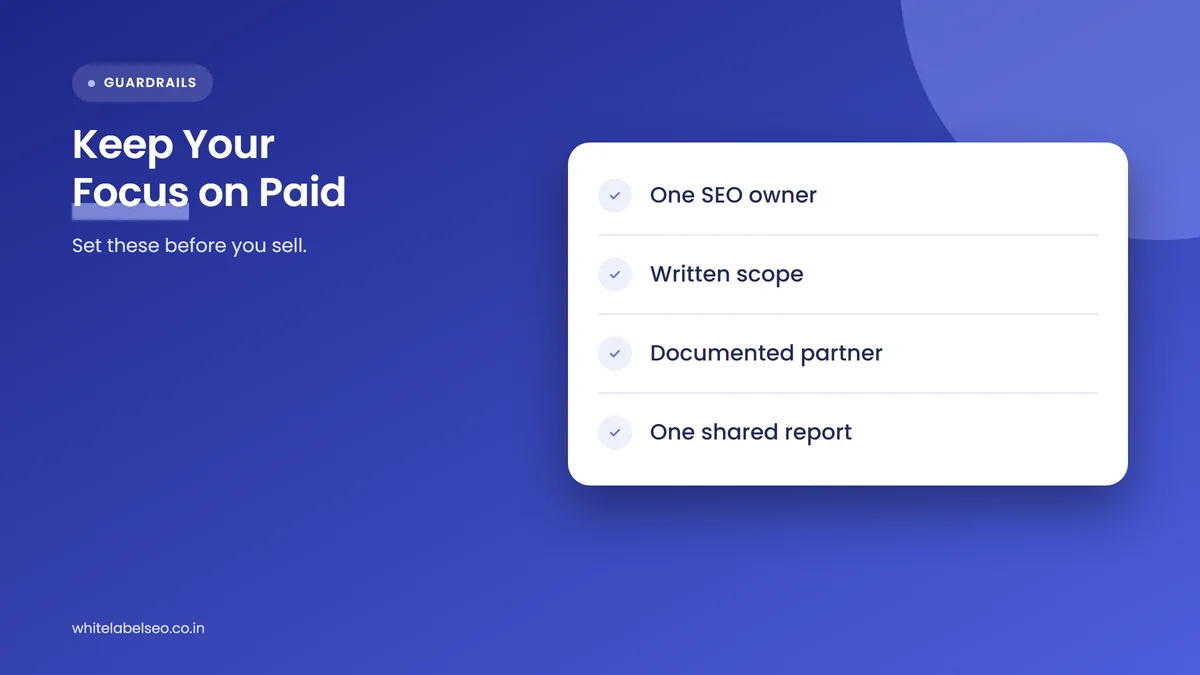
These guardrails work for most paid media agencies:
- Name one SEO owner. One account lead or partner manager handles SEO questions, so they don’t land on whoever runs the client’s ads.
- Write the scope down. List monthly deliverables with quantities and what is excluded. Website rebuilds and copy rewrites are separate projects.
- Use a partner with documented processes. You should get task lists, change logs and report drafts on a fixed day each month.
- Share one monthly report. Put paid and organic results side by side, so the review call stays one conversation.
- Set a review point. After the pilot, check whether SEO added revenue without hurting campaign results or response times. If it didn’t, adjust the scope before selling more.
How should you report paid and organic results together?
Report paid and organic results in one monthly view that shows leads and sales by channel, visibility in Google and AI search, and the work done. Use the Google Ads paid and organic report for query overlap, and Search Console for organic and AI feature impressions. Keep clicks in context, since AI answers now absorb some of them.
Search Console now helps here. Google introduced generative AI performance reports in Search Console in June 2026, and Search Engine Journal reported on August 31, 2026 that they had rolled out to all sites worldwide. They show impressions in AI Overviews and AI Mode, not clicks, so pair them with lead and sales tracking from GA4 and the client’s CRM. For the full list of numbers worth sharing, see our guide to the SEO metrics to report to clients.
Measurement is a wider industry problem, too. In the same AgencyAnalytics survey, 41% of agencies said they face new challenges measuring ROI as traditional attribution becomes less reliable. A combined report won’t solve attribution, but it stops paid and organic teams from claiming the same lead twice and makes the conversation about total search results.
Frequently asked questions
Do I need to hire an SEO specialist to offer SEO?
No. Many PPC agencies start by reselling SEO through a white-label partner while their own team keeps strategy and client communication. Hiring makes more sense once SEO revenue is steady enough to cover a full salary, tools and training, and you know which services your clients actually buy.
Will adding SEO hurt my PPC results?
It shouldn’t, if the work is set up so your paid team isn’t doing it. Problems usually come from PPC managers writing content or chasing website fixes between campaign checks. Give SEO a separate owner and a partner on a fixed schedule, and review campaign performance after the pilot.
How do I explain SEO to clients who only bought ads from us?
Explain it as the other half of the same search plan. Paid ads buy visibility on the queries that convert today, and SEO builds visibility on those same queries without paying for each click. Use the client’s own search terms data to show which queries the SEO work will target first.
Can I stop ads from showing in AI Mode for my clients?
Not separately. Google Ads Help says advertisers can’t target ads only to AI Overviews or AI Mode, or opt out of them separately from Search. Negative keywords and brand exclusions still apply, and performance from these placements is reported in aggregate with regular Search results.
How long before SEO results show for a paid media client?
Expect early technical fixes and profile updates in the first month or two, with ranking and lead changes taking longer, depending on competition and the site’s starting point. Set this expectation before the client signs, and report the work done each month so the slower start doesn’t look like inactivity.
Is adding SEO worth it for a PPC agency?
For most paid media agencies, adding SEO is worth it when it stays a supporting service rather than a second business. Your clients are already asking about organic and AI search, and you already hold the search data that makes SEO work. So can a PPC agency add SEO without losing focus? Yes, if you keep paid media as your core, choose one starter offer, pilot it with clients who trust you, and let a partner handle delivery. If you want SEO fulfillment that runs under your brand, see our white-label SEO services at White Label SEO.
Add SEO without taking your team off paid media
At White Label SEO, we deliver SEO under your agency’s brand, with fixed scopes, documented work and reports you can share alongside your paid results. Tell us which clients are asking about organic or AI search, and we’ll help you plan a pilot.
Sources
- Google, “Ads in AI Mode expand to new markets”, October 28, 2026. https://blog.google/products/ads-commerce/ads-in-ai-mode-global/
- Search Engine Roundtable, “Google Expands Ads In AI Mode To More Countries & Multiturn Ads In U.S.”, October 28, 2026. https://www.seroundtable.com/google-expands-ads-ai-mode-42412.html
- Google Ads Help, “About ads and AI Overviews”, accessed November 10, 2026. https://support.google.com/google-ads/answer/16297775?hl=en
- Google Ads Help, “About measuring paid and organic search results”, accessed November 10, 2026. https://support.google.com/google-ads/answer/3097241?hl=en
- Pew Research Center, “Google users are less likely to click on links when an AI summary appears in the results”, July 22, 2025. https://www.pewresearch.org/short-reads/2025/07/22/google-users-are-less-likely-to-click-on-links-when-an-ai-summary-appears-in-the-results/
- AgencyAnalytics, “How AI Search Is Changing SEO for Agencies in 2026”, June 30, 2026. https://agencyanalytics.com/blog/agency-benchmarks-2026-ai-search
- Google Search Central, “AI features and your website”, last updated December 10, 2025. https://developers.google.com/search/docs/appearance/ai-features
- Google Search Central Blog, “Introducing Search Generative AI performance reports in Search Console”, June 3, 2026. https://developers.google.com/search/blog/2026/06/gen-ai-performance-reports
- Search Engine Journal, “Google Search Console AI Reports Rolled Out Worldwide”, August 31, 2026. https://www.searchenginejournal.com/google-search-console-ai-reports-rolled-out-worldwide/587836/