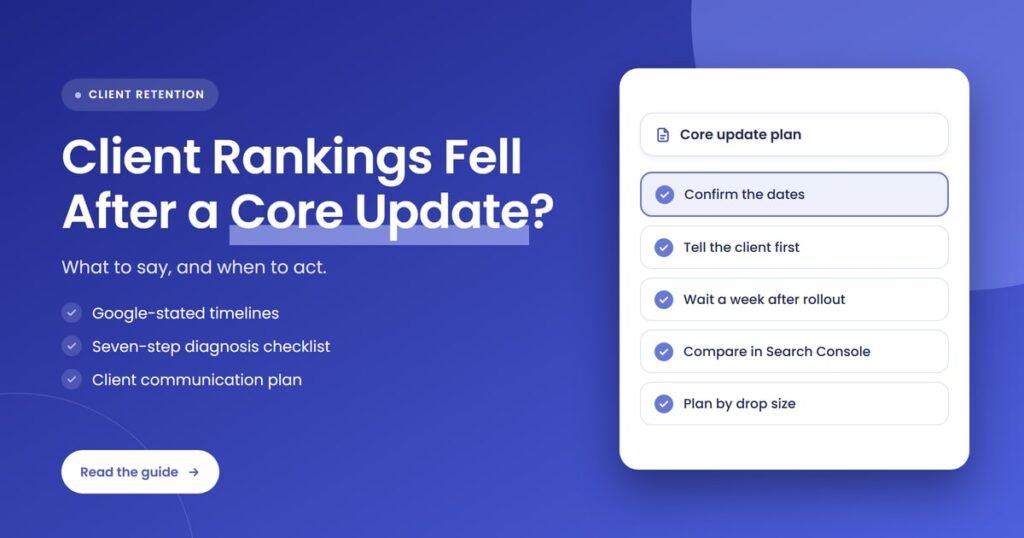
Quick answer: When a client’s traffic falls after a confirmed Google core update, tell them early, explain that core updates are broad changes rather than penalties, and wait until the rollout ends. Then wait one more week, compare the week after with the week before in Search Console, rule out other causes, and agree a plan based on the size of the drop.
Key takeaways
- Google confirms core updates on its Search Status Dashboard, and recent rollouts have said they “may take up to 2 weeks” to complete.
- Google advises waiting at least a full week after a rollout finishes before analyzing, then comparing that week with the week before the update began.
- A small position drop usually needs no drastic action. A large, sustained drop calls for a site-wide review of how helpful and reliable the content is.
- Recovery is slow by design: Google says some changes show within days, but confirming long-term improvement can take several months.
- The agencies that keep clients through an update are the ones that speak first, set the timeline in writing and avoid rushed changes based on rumors.
What is a Google core update?
A Google core update is a broad change to Google’s ranking systems, made several times a year, that changes how Google assesses content across the whole web. Core updates don’t target specific sites or pages. When a client’s pages move down after one, it usually means other pages are now judged more useful, not that the site was penalized.
Google’s own guide, “Google Search’s core updates and your website”, compares the process to a list of best restaurants being refreshed: a restaurant that moves down the list is not necessarily bad. That framing is worth repeating to clients, because many of them hear “Google update” and assume they did something wrong.
Three details matter for agencies:
- Confirmation: Google posts each core update on the Google Search Status Dashboard with a start date and a completion note.
- Rollout length: the May 2026 core update notice said “The rollout may take up to 2 weeks to complete.” It started on May 21, 2026 and finished on June 2, 2026.
- Frequency: the dashboard lists three core updates in the last year: December 2025 (starting December 11 and running about 18 days), March 2026 (starting March 27 and running about 12 days) and May 2026.
How is a core update different from unconfirmed volatility or a spam update?
A core update is confirmed by Google, has published start and end dates and affects ranking across the web. Unconfirmed volatility is ranking movement that rank trackers detect without any Google statement. A spam update targets sites that break Google’s spam policies. Each one needs a different conversation with the client, so identify which one you are dealing with first.
The timing right now makes this distinction important. Google’s September 2026 spam update started on September 24 and, according to the Status Dashboard, “was complete as of October 8, 2026.” Since then, Search Engine Roundtable’s November 2026 Google Webmaster Report has tracked several rounds of unconfirmed ranking volatility while the industry waits for the next core update, which Google had not announced as of early November 2026.
| Type | Confirmed by Google? | What it targets | What agencies should do |
|---|---|---|---|
| Core update | Yes, on the Status Dashboard with start and end dates | Broad assessment of content quality across all sites | Wait for completion plus one week, then compare periods and review content quality |
| Spam update | Yes, on the Status Dashboard | Sites that break Google’s spam policies | Audit links, content and tactics against the spam policies |
| Unconfirmed volatility | No | Unknown; seen only in tracker data and industry chatter | Rule out site problems, keep monitoring and avoid big changes |
If the drop you are looking at has no confirmed update behind it, our guide on what to tell clients when rankings swing without a confirmed update covers that case. If the timing lines up with a spam update instead, see how your white-label SEO partner should protect clients from spam updates. The rest of this guide is about confirmed core updates.
What timelines does Google give for core updates?
Google gives four timelines that agencies can share with clients: a rollout that can take up to two weeks, a wait of at least one full week after completion before analysis, effects from improvements that may show within days but take several months to confirm, and the next core update as a possible point of change if nothing moves.
| Stage | What Google says | What it means for the client |
|---|---|---|
| Rollout | Recent notices say the rollout “may take up to 2 weeks to complete” | Rankings can move up and down during this window, so no conclusions yet |
| Analysis | Wait at least a full week after the update finishes rolling out, then compare that week with a week before the rollout started | The first real read on impact comes about three weeks after the announcement |
| After changes | Some changes show effects within days, but confirming long-term improvement can take several months | Content improvements are a quarter-long project, not a quick fix |
| Next update | If there is no effect after a few months, the next core update may be the point to reassess; smaller, unannounced updates can also bring gains | Recovery may line up with a future update, and Google makes no promise of a visible change |
How do you diagnose a ranking drop after a core update?
Diagnose a ranking drop after a core update by confirming the update dates first, then ruling out every cause that is not the update: technical errors, manual actions, security issues, spam update timing, seasonal demand, site changes and broken tracking. Only when those are clear should you treat the drop as a core update effect and move to content review.
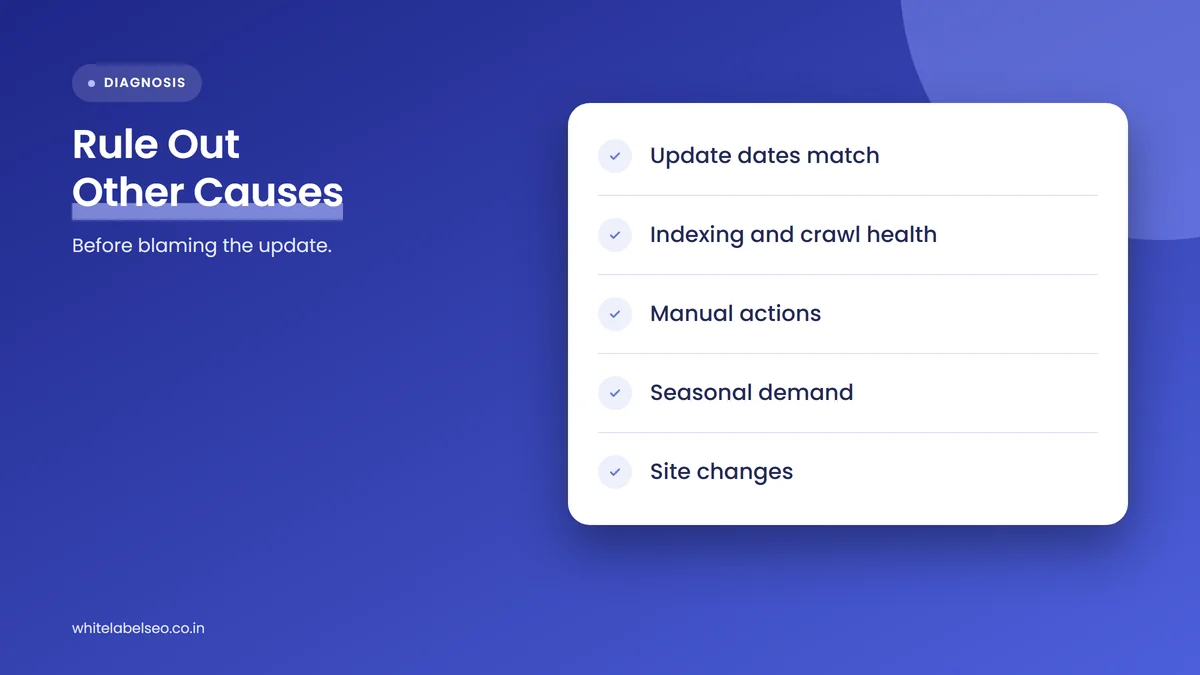
Google’s guide to debugging drops in Search traffic lists the main causes. We turn them into a checklist that runs before any client report:
- Match the dates. Check the Status Dashboard and confirm the drop started during the core update window, not before it.
- Check technical health. Review the Page indexing and Crawl stats reports in Search Console for server errors, robots.txt problems or pages dropping out of the index.
- Check Manual Actions and Security Issues. Both reports sit in Search Console, and either one changes the whole conversation.
- Check for spam update overlap. If the drop began between September 24 and October 8, 2026, the September 2026 spam update is also a candidate.
- Check demand. Google suggests using Google Trends to see whether interest in the client’s main queries fell across the market, which would mean the site is not the problem.
- Check recent site changes. Migrations, redesigns, URL changes and template edits can cause drops that look like an update. Google notes that a site move can take weeks to settle for a medium-sized site.
- Check the tracking. Confirm that analytics tags, consent banners and goal tracking were not changed around the same date.
How do you measure a core update drop in Search Console?
Measure a core update drop in the Search Console Performance report by comparing the full week after the rollout finished with the week before it began, then breaking the change down by search type, page, query, country and device. This shows whether the drop is site-wide, limited to a group of pages, or tied to a few key queries.
The steps we follow:
- Set the comparison. Use the Compare tab with the week after completion against the week before the start date, as Google recommends.
- Separate search types. Google advises checking Web, Image, Video and News separately, because a drop may sit in one of them only.
- Read impressions and clicks together. Google explains that falling impressions and clicks point to a visibility problem, while steady impressions with fewer clicks point to titles, snippets or result features.
- Group by page, then query. Find the pages and topics that lost the most, since those are the ones to review.
- Treat average position as secondary. Google calls clicks and impressions the better measures; position alone can mislead.
- Look at the longer trend. Set the date range to the last 16 months to spot yearly patterns before you call a drop unusual.
Search Console marks its newest data as preliminary, so leave the last day or two out of any comparison you show a client.
Is it a small drop or a large, sustained drop?
The size and shape of the drop decide the response. Google says a small drop in position usually needs no drastic action and that well-performing content should be left alone. A large drop that holds after the rollout calls for a deeper review of the whole site and the most affected pages, measured against what Google says it rewards.
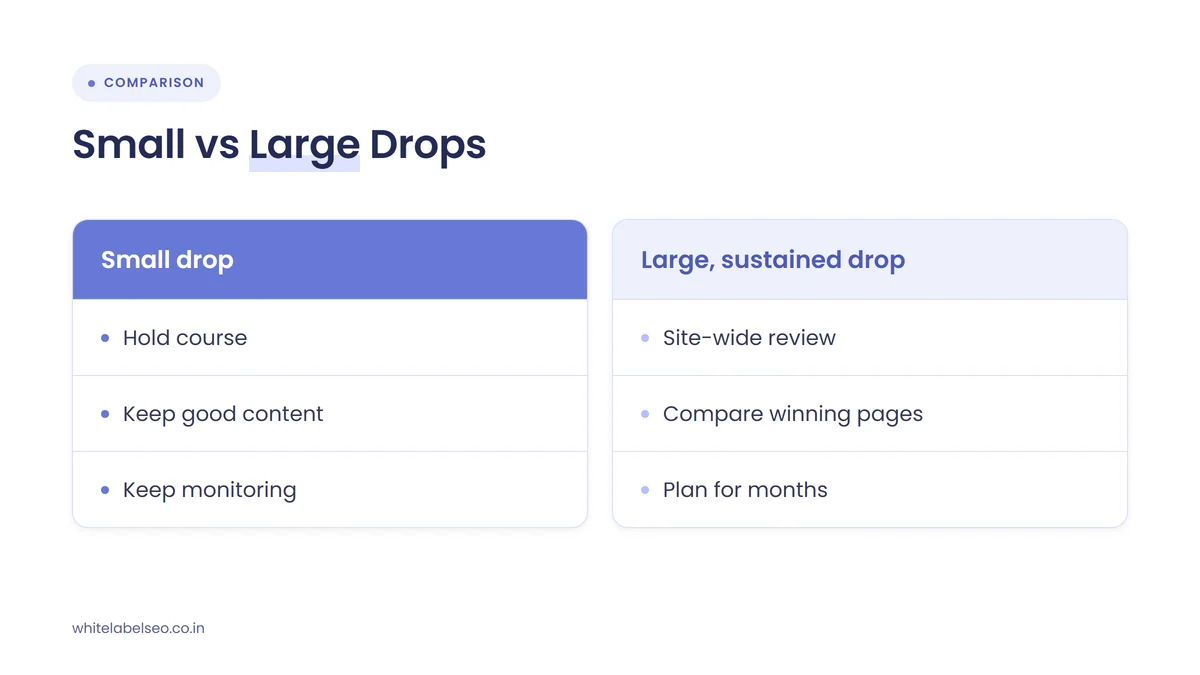
For a large, sustained drop, Google’s guidance points to a few concrete actions:
- Self-assess the content. Use the questions in Google’s “Creating helpful, reliable, people-first content” page: is the content original and substantial, does it show real expertise, is it clear who wrote it and how it was made, and does it exist mainly to help people?
- Compare with the pages that won. Look at the pages now ranking for the lost queries and ask honestly whether they serve searchers better.
- Get an outside view. Google suggests asking people unaffiliated with the site to review it.
- Treat deletion as a last resort. Google says removing content should not be the first move.
What should an agency say to a client after a core update drop?
An agency should tell the client what happened, what it means and what happens next, in that order and before the client asks. Say that Google confirmed a broad core update, that it is not a penalty, that analysis starts one week after the rollout ends, and when they will hear from you next. Then keep every promise on that timeline.
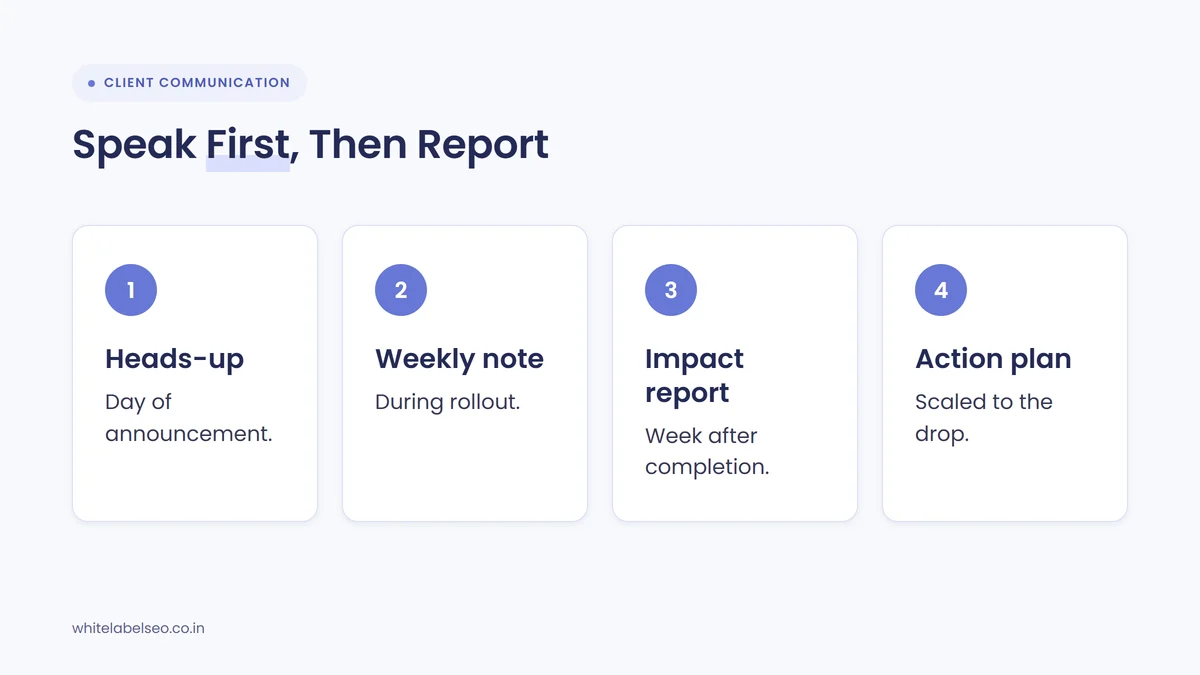
Here is the communication plan we use and recommend to partner agencies:
| When | What to send | What to include | What to avoid |
|---|---|---|---|
| Day the update is announced | Short heads-up email | Google confirmed a core update, rollout can take up to two weeks, you are monitoring | Predicting the impact before any data exists |
| During the rollout | Brief weekly note | Movement so far, a reminder that rankings shift during rollout, the analysis date | Making site changes in response to daily swings |
| One week after completion | Impact report | Week-after versus week-before comparison, pages and queries affected, causes ruled out | Blaming Google or the client’s past decisions |
| Two to four weeks after completion | Action plan | Small drop: hold course. Large drop: content review scope, priorities and timing | Promising recovery by a set date |
| Monthly after that | Regular report with a short update section | Progress on the plan, leads and conversions, any new Google announcements | Dropping the topic once the client stops asking |
A first email can be this short:
“Google has confirmed a broad core update, which it says can take up to two weeks to roll out. Core updates change how Google assesses content across the whole web; they are not penalties. We are monitoring your site daily, and we will send a full comparison one week after Google confirms the rollout is complete. We are not making changes until then, because rankings often move back and forth during a rollout.”
That message works because it sets the timeline before the client sets one for you. It also matches the expectations most agencies agree at onboarding; if yours didn’t cover updates, our guide on setting SEO expectations with new clients shows where to add it.
What should agencies avoid after a core update?
Agencies should avoid rushed changes, rumor-based fixes, mass deletion of content and any promise about when rankings will return. Google warns against acting on general SEO rumors and says there may be nothing to fix at all. Panicked edits during a rollout also make it impossible to tell what caused any later movement.
- Editing during the rollout. Wait for completion plus a week, as Google advises.
- Chasing tactics from forums. Google says to focus on lasting improvements for users, not rumors.
- Deleting large sections of content. Google calls deletion a last resort.
- Promising a recovery date. Google states that improvements may take several months to confirm and may not produce a visible change.
- Reporting rankings alone. Leads, calls and sales tell the client whether the business was hurt, which is what they care about. Our guide on proving SEO ROI when results take months covers that reporting.
How long does recovery from a core update take?
Recovery from a core update has no fixed timeline. Google says some improvements show effects within days, but confirming long-term improvement can take several months, and the next core update may be the point where a site regains ground. Google also notes that smaller, unannounced updates can bring gains between core updates.
For client planning, that means a content review after a large drop should be scoped as at least a quarter of work, with monthly check-ins rather than weekly ranking debates. With core updates arriving several times a year, the review also prepares the site for the next one.
How do we handle core updates with partner agencies?
At White Label SEO, we treat a confirmed core update as a scheduled process rather than an emergency. We monitor partner clients during the rollout, run the diagnosis checklist one week after completion and deliver an unbranded impact report your team can send under your own name, with a recommended action for each affected client.
In practice that means three things for partner agencies:
- A heads-up draft on announcement day, written for your client and ready for your branding.
- A comparison report one week after completion, built on the week-after versus week-before method Google recommends.
- A scoped action plan that separates “hold course” clients from those who need a content review, so you can quote any extra work clearly.
Frequently asked questions
Should we tell clients about a core update before they notice a drop?
Yes. A short heads-up on the day Google announces a core update positions your agency as the one watching. If the client sees a drop first and hears from you second, the conversation starts with doubt. Keep the first note factual: what Google confirmed, how long rollout can take and when your analysis will arrive.
How soon after a core update can we tell if a client was affected?
Google advises waiting at least a full week after the rollout finishes, then comparing that week with the week before the update started. Since recent rollouts have taken up to about two weeks, the first reliable read usually comes around three weeks after the announcement.
Is a ranking drop after a core update a Google penalty?
No. Google says core updates don’t target specific sites or pages. A penalty for breaking Google’s rules is a manual action, which appears in the Manual Actions report in Search Console. A core update drop means Google’s systems now judge other pages as more useful for those searches.
Should we change the client’s content during a core update rollout?
Generally no. Rankings often move during a rollout, and changes made mid-rollout make it hard to tell what caused later movement. Fix clear technical problems at once, such as server errors or pages dropping out of the index, but hold content changes until the post-rollout analysis is done.
What if the client recovers on their own?
That happens. Google notes that small drops often need no drastic action and that smaller, unannounced updates can also bring gains. Report the recovery honestly, note that no major changes were made, and use it to reinforce why the agency did not rush into edits.
What should you do next?
Save the communication plan and the diagnosis checklist from this guide into your agency’s client playbook now, while no core update is rolling out. Draft the heads-up email in your own voice, agree who sends it, and decide how the one-week comparison report will look. When Google posts the next core update on the Status Dashboard, your team will already know what to say. If you want a partner that handles this process behind your brand, see our white-label SEO services at White Label SEO.
Want a partner ready for the next core update?
At White Label SEO, we monitor your clients through every confirmed Google update and deliver unbranded impact reports and action plans your agency can send as its own. Talk to us about how we support partner agencies.
Sources
- Google Search Central, “Google Search’s core updates and your website”, accessed November 8, 2026. https://developers.google.com/search/updates/core-updates
- Google Search Central, “Debugging drops in Google Search traffic”, accessed November 8, 2026. https://developers.google.com/search/docs/monitor-debug/debugging-search-traffic-drops
- Google Search Central, “Creating helpful, reliable, people-first content”, accessed November 8, 2026. https://developers.google.com/search/docs/fundamentals/creating-helpful-content
- Search Console Help, “Performance report (Search results)”, accessed November 8, 2026. https://support.google.com/webmasters/answer/7576553
- Google Search Status Dashboard, “Ranking incident history”, accessed November 8, 2026. https://status.search.google.com/products/rGHU1u87FJnkP6W2GwMi/history
- Google Search Status Dashboard, “May 2026 core update”, May 21, 2026 to June 2, 2026. https://status.search.google.com/incidents/wdAXJk6LRRihEjpzEeWE
- Google Search Status Dashboard, “September 2026 spam update”, September 24, 2026 to October 8, 2026. https://status.search.google.com/incidents/XhUDXP7A67iHCD2kmbVu
- Search Engine Roundtable, “November 2026 Google Webmaster Report”, November 2, 2026. https://www.seroundtable.com/november-2026-google-webmaster-report-42431.html