Quick answer: In a typical month, a white-label SEO partner plans the month’s priorities with your agency, runs technical checks and fixes, optimizes pages, writes and refreshes content, manages local listings and Google Business Profiles, builds links, tracks visibility in Google and AI search, and sends a branded report you can pass to clients. Your agency keeps the client relationship and strategy sign-off.
Key takeaways
- A partner’s month follows a rhythm: plan, deliver, check and report. The order matters more than the exact dates.
- Monthly work usually spans eight workstreams: technical, on-page, content, local and Google Business Profile, links and digital PR, AI search visibility, reporting and communication.
- Your agency still owns the client relationship, goals, budget, approvals and anything that touches the client’s brand voice.
- AI search tracking is now part of a normal month. Search Console has shown impressions for AI Overviews and AI Mode for all sites since August 2026.
- Judge deliverables by whether each one is visible, explained and tied to the agreed plan, not by the length of the report.
What is a white-label SEO partner?
A white-label SEO partner is a specialist team that delivers SEO work for an agency’s clients under the agency’s brand. The partner does the research, fixes, content, links and reporting, while the agency sells the service, owns the client relationship and presents the results as its own. Clients deal only with the agency.
That last point shapes how a month runs. At White Label SEO, we communicate directly with you or your project manager, not with your clients, so every task, question and report passes through your agency first. The month is built around giving you what you need to manage the client with confidence.
What does a white-label SEO partner do each month?
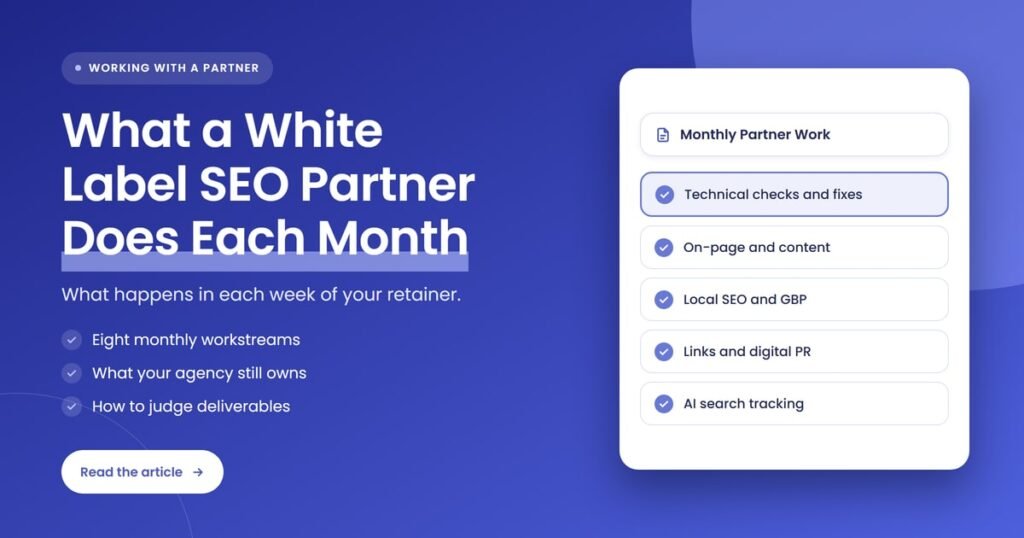
Each month, a white-label SEO partner works through a set of recurring workstreams: technical health, on-page optimization, content, local SEO and Google Business Profile, link building and digital PR, AI search visibility, reporting and communication. The mix changes by client and package, but each workstream should produce something you can see and explain to a client.
| Workstream | What the partner does | What you should receive | How to judge it |
|---|---|---|---|
| Technical SEO | Crawls the site, checks indexing and Search Console errors, watches for Google updates, fixes or flags issues | A list of issues found, fixed and still open | Issues are explained in plain language with a reason they matter |
| On-page SEO | Optimizes titles, headings, internal links and page copy on priority pages | Before-and-after changes for each page | Changes match the agreed priority pages and keywords |
| Content | Plans, writes or refreshes articles and service pages | Drafts for approval, then published URLs | Content answers real questions and fits the client’s voice |
| Local SEO and Google Business Profile | Updates profile details, posts, photos and listings; monitors reviews | A log of profile updates and local ranking checks | Business details stay accurate and consistent everywhere |
| Links and digital PR | Earns links and brand mentions on relevant sites | A list of live links or mentions with URLs | Sites are relevant and real, not link farms |
| AI search visibility | Tracks AI Overview and AI Mode impressions and checks agreed prompts in AI tools | A visibility section in the monthly report | Data sources are named and limits are stated |
| Reporting | Compiles work done, visibility, leads and next month’s plan | A report branded for your agency | You can explain every line to the client |
| Communication | Answers questions, flags risks and confirms priorities | Updates on your agreed channel | Problems reach you before the client notices them |
Our own service covers technical audits and implementation, keyword and competitor research, on-page optimization, content strategy, link building, local SEO and Google Business Profile management. Not every client needs every workstream every month, so the plan for each month should say which ones are active and why.
What does a typical month look like, week by week?
A typical month moves from planning to delivery to review. The first week confirms priorities and clears anything that blocks work, the middle weeks deliver the main tasks, and the final week checks results and builds the report. Exact timing varies by client and package, so agree the rhythm with your partner in writing.
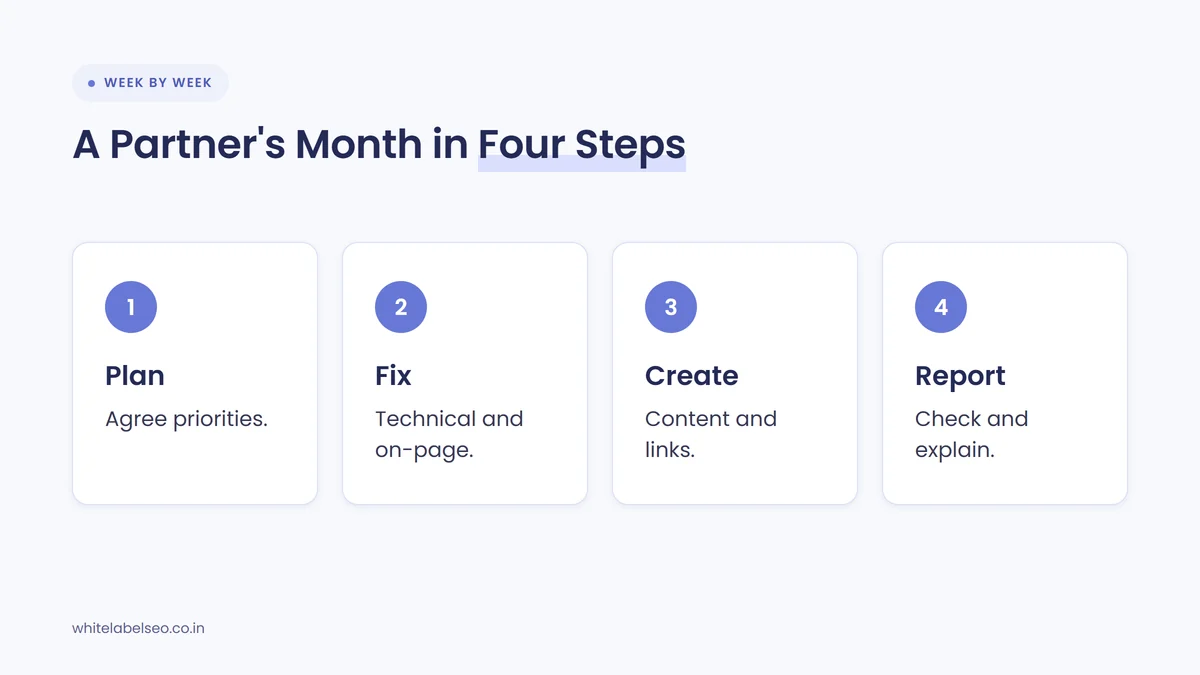
- Week 1: plan. Review last month’s results and Search Console data, confirm this month’s priority pages and topics with your agency, and list anything the partner needs from the client, such as logins, approvals or new service details.
- Week 2: fix and optimize. Work through technical fixes, on-page changes and Google Business Profile updates. These tasks often unblock the rest of the month, so they go first.
- Week 3: create and build. Draft and refresh content, send drafts for approval, and work on links and digital PR.
- Week 4: check and report. Publish approved content, check rankings, local visibility and AI search visibility, then compile the report and next month’s plan for your review before it goes to the client.
The first month with a new client looks different. It is heavier on audits, access and setup, and lighter on visible output. Our guide on getting new clients live without delays covers that first stretch.
What technical SEO work happens every month?
Monthly technical SEO work means crawling the site for new errors, checking indexing and coverage in Search Console, reviewing site speed and mobile issues, and watching for Google updates that could affect the client. The partner fixes what it has access to and sends a clear list of anything your agency or the client’s developer must handle.
Google updates are a good example of why this work never finishes. Google’s September 2026 spam update began on September 24 and finished rolling out on October 8, 2026, about two weeks in total, as Search Engine Roundtable reported. Search Engine Roundtable also logged several periods of unconfirmed ranking volatility in October 2026. A partner should check client rankings around updates like these and tell you, in plain words, whether anything moved and what it plans to do.
Typical monthly technical checks include:
- New crawl errors, broken links and redirect chains
- Pages dropping out of the index, or pages indexed that shouldn’t be
- Sitemap and robots.txt changes after site edits
- Page speed and mobile usability on key templates
- Structured data errors flagged in Search Console
What on-page and content work should you expect?
Expect on-page work on a set list of priority pages each month, such as rewriting titles and headings, improving internal links and tightening copy, plus new or refreshed content mapped to the client’s services. Every piece of content should go to your agency for approval before it is published, because you know the client’s voice and limits.
Good on-page and content work has three traits:
- It follows a plan. Each page or article ties back to a keyword or question agreed at the start of the month.
- It answers questions directly. Content that opens with a clear answer serves readers and is easier for search features to quote. Google says there are no extra requirements to appear in AI Overviews or AI Mode beyond normal SEO best practices, so the same content work supports both.
- It is reviewable. You should see drafts, then live URLs, with a note on what changed on each existing page.
What local SEO and Google Business Profile work is included?
Local SEO work each month keeps the client’s Google Business Profile accurate and active, checks that the business name, address and phone number match across listings, adds posts and photos, monitors reviews, and tracks local rankings. For local clients, this workstream often produces the earliest changes a client notices.
Google’s own Business Profile help lists the basics behind local ranking: verify the business, keep information up to date, respond to reviews and add photos. Google says local results are based mainly on relevance, distance and prominence. A partner can influence relevance and prominence through profile work, content and mentions. Distance is outside anyone’s control, which is worth telling clients early.
Review replies need a clear owner. Some agencies let the partner draft responses for approval; others keep replies in-house because they speak for the client’s business. Decide this up front and write it into the monthly plan.
What link building and digital PR work happens each month?
Each month, a partner should earn a set number of relevant links or brand mentions, agreed in your package, through outreach, digital PR, local citations and partnerships. You should receive a list of every live link with its URL, so you can check that each site is real, relevant to the client and something you would be comfortable showing them.
Brand mentions matter more now that AI tools summarize what the web says about a business. Our post on digital PR and brand mentions for AI search visibility explains why mentions on trusted sites help clients show up in AI answers. Ask your partner to avoid paid link networks and anything that breaks Google’s spam policies. The September 2026 spam update is a fresh reminder that shortcuts can cost a client its rankings.
How does a partner track AI search visibility each month?
A partner tracks AI search visibility by reviewing Search Console’s generative AI reports for AI Overview and AI Mode impressions, checking an agreed list of prompts in tools such as ChatGPT, Gemini and Perplexity, and noting whether the client’s brand and pages are mentioned or cited. Results go into a dedicated section of the monthly report.
The Search Console data is new. Google introduced Search Generative AI performance reports in June 2026, and Search Engine Journal reported on August 31, 2026 that they had rolled out worldwide. The reports show impressions from AI Overviews, AI Mode and generative AI features in Discover, broken down by page, country and date. They did not include clicks at the time of that report, so pair them with lead and conversion tracking.
Clicks from AI features are still hard to pin down. On October 30, 2026, Search Engine Roundtable covered a small test by Cyrus Shepard on one website that estimated a 0.9% click-through rate for AI impressions. Its author called it a limited study, so treat the figure as a signal, not a benchmark. The practical point for your clients holds: visibility in AI answers and clicks to the site are now separate measures, and the report should show both.
A monthly AI visibility check should cover:
- AI Overview and AI Mode impressions from Search Console, compared with last month
- An agreed list of prompts tied to the client’s main services, checked in the same AI tools each month
- Whether the client is mentioned, cited with a link, or missing, and which competitors appear instead
- One or two actions for next month, such as a content update or a mention to pursue
What should the monthly report include?
The monthly report should include the work completed against the plan, changes in rankings and impressions, local visibility, AI search visibility, leads or conversions from organic search, and the plan for next month. It should carry your agency’s branding and read like your team wrote it, so you can send it with little editing.
Our reports are monthly and branded with your agency’s logo, and they include keyword rankings, traffic insights, a summary of completed work and recommendations, plus live keyword tracking and local grid rankings for Google Business Profile clients. Whichever partner you use, ask to see a sample report before you sign. For a closer look at which metrics belong in reports now that AI answers take some clicks, read what white-label partners must report differently.
How does communication with a white-label partner work during the month?
Communication runs between the partner and your agency only. The partner sends updates, questions and risk alerts on a channel you agree, such as email, Slack or Microsoft Teams, and your agency decides what reaches the client. A good partner raises problems early instead of leaving them for the end-of-month report.
We work on whichever channel suits your team, including email, Slack and Teams. Whatever the channel, a month should include at least three touchpoints:
- A planning check-in at the start, to agree priorities and anything needed from the client.
- Ad hoc alerts when something changes, such as a ranking drop after an update, a suspended profile or a site change that broke tracking.
- A report review at the end, so you can ask questions before the client sees the numbers.
What does your agency still own when you use a white-label partner?
Your agency still owns the client relationship, the business goals, the budget and package, approvals on content and brand voice, and the decision on what to tell the client. The partner owns execution, quality control on its own work and honest reporting to you. Clear ownership stops tasks from falling between the two teams.
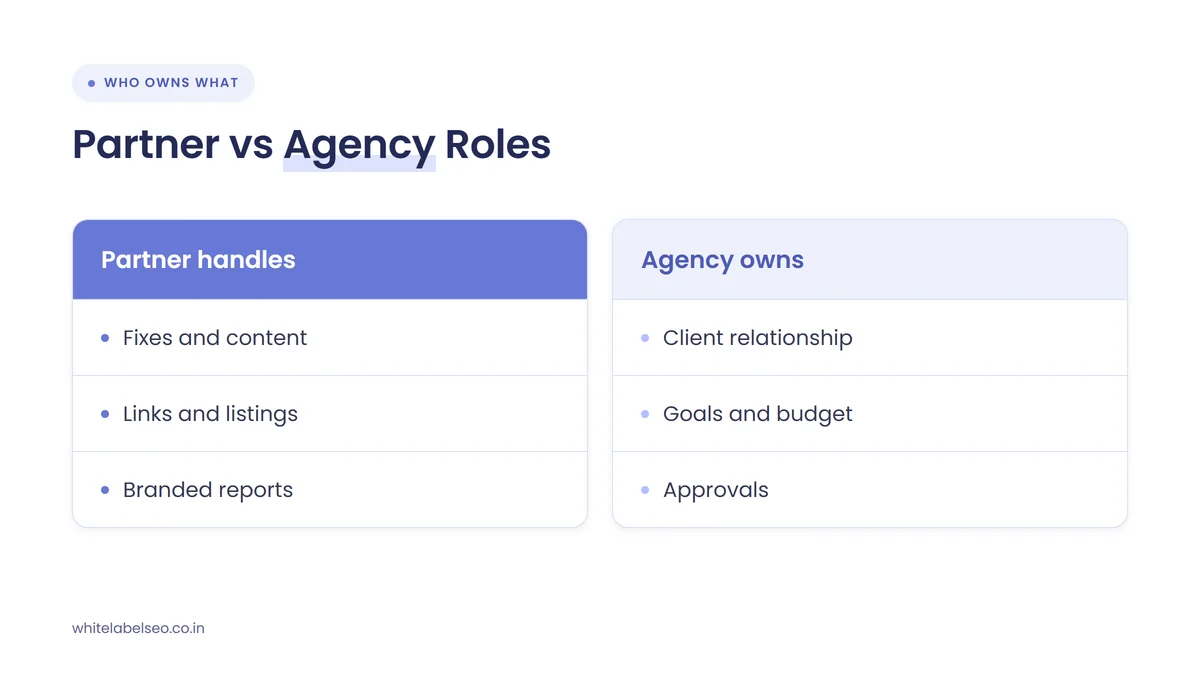
| Your agency owns | The white-label partner handles |
|---|---|
| Client calls, emails and the overall relationship | Research, audits and technical fixes |
| Business goals, budget and which package the client buys | On-page changes and content drafts |
| Approving content, review replies and anything in the client’s voice | Google Business Profile updates and listings work |
| Access to the client’s site, accounts and developer | Link building, digital PR and AI visibility tracking |
| Deciding what goes in front of the client and when | A branded report and next month’s plan for your review |
Scope sits with your agency too. If a client asks for extra work mid-month, decide whether it fits the package before passing it on, and write these responsibilities into your agreement with the partner so both teams work from the same list.
How do you judge whether your partner’s monthly deliverables are good?
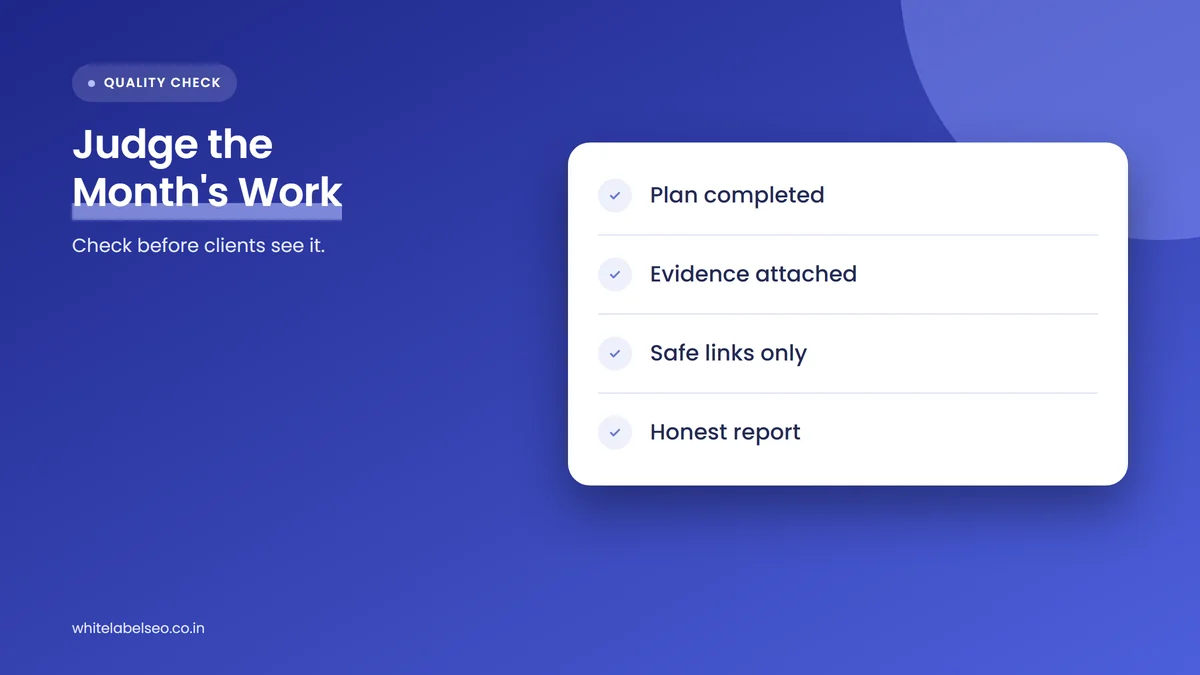
Judge monthly deliverables by checking that each task in the plan was done, that you can see the evidence, such as URLs, screenshots or before-and-after changes, that the work fits Google’s guidelines, and that the report explains results honestly, including what did not move. Volume alone is not a sign of quality.
Google’s guidance on hiring an SEO is a useful yardstick. It suggests asking how you can expect to communicate with the provider and whether they will share all the changes they make to your site, and it tells readers to find someone else if an SEO promises first place in search results. Apply the same test to a white-label partner each month:
- Did the plan get done? Compare the start-of-month plan with the work log line by line.
- Can you see the evidence? Every task should come with a URL, a screenshot or a before-and-after note.
- Is the work safe? Links should come from relevant, real sites, and content should be written for readers, not stuffed with keywords.
- Is the report honest? It should show drops as clearly as gains, with a reason and a next step.
- Could you explain it to the client? If you can’t, ask the partner before the report goes out.
If several months in a row fail these checks, or clients start asking questions you can’t answer, it may be time for a deeper review. Our guide to churn warning signs and when to audit your partner’s deliverables explains what to look for.
Frequently asked questions
How long before a white-label partner’s monthly work shows results?
SEO results build over months, not weeks. Our service page sets the expectation that visible improvements typically start within three to six months, depending on competition and industry. Technical fixes and profile updates can show earlier, so report those wins while bigger changes in rankings and leads take shape.
Does a white-label SEO partner talk to my clients?
Not in a true white-label setup. The partner works with your agency or your project manager, and your agency handles every client conversation. That keeps your brand in front of the client and lets you decide how results and problems are explained.
Should AI search tracking be part of every monthly package?
Yes, at least a basic check. Search Console now reports AI Overview and AI Mode impressions for all sites, so a short monthly review costs little. Larger packages can add prompt tracking across ChatGPT, Gemini and Perplexity, with actions based on which competitors appear instead of the client.
What should I do if a month’s deliverables are late or missing?
Raise it with the partner straight away and ask for a revised date and a reason. One slip is normal. A pattern of missed work, vague reports or unanswered questions means the agreement or the partner needs a review before clients notice the gap.
Can a white-label partner promise rankings or AI Overview placement?
No. Google tells businesses to walk away from any SEO that promises first place in search results, and no one controls which sources an AI answer cites. A partner can commit to the work, the reporting and the communication, and should be open about what it cannot control.
What should you do next?
Write down what your current or future partner does in each of the eight workstreams, who owns each task, and what evidence you receive at the end of the month. Then compare that list with last month’s report. Any gap is a question to ask before your next client review. To see how we run this month after month, read about our white-label SEO services at White Label SEO.
Want a partner whose monthly work you can see?
At White Label SEO, we deliver technical, on-page, content, local and link building work under your agency’s brand, with monthly branded reports and updates on the channel your team already uses. Tell us about your clients and we’ll walk you through how a month with us would run.
Sources
- Search Engine Roundtable, “Google September 2026 Spam Update Has Finished Rolling Out”, October 8, 2026. https://www.seroundtable.com/google-september-2026-spam-update-done-42235.html
- Search Engine Roundtable, “Unconfirmed Google Search Ranking Update: Volatility & Chatter Spike”, October 27, 2026. https://www.seroundtable.com/google-search-ranking-volatility-42379.html
- Google Search Central Blog, “Introducing Search Generative AI performance reports in Search Console”, June 3, 2026. https://developers.google.com/search/blog/2026/06/gen-ai-performance-reports
- Search Engine Journal, “Google Search Console AI Reports Rolled Out Worldwide”, August 31, 2026. https://www.searchenginejournal.com/google-search-console-ai-reports-rolled-out-worldwide/587836/
- Search Engine Roundtable, “Google AI Overviews & AI Mode 0.9% Click-Through Rate, Opt Out Study Says”, October 30, 2026. https://www.seroundtable.com/google-ai-overviews-mode-ctr-42421.html
- Google Search Central, “AI features and your website”, last updated December 10, 2025. https://developers.google.com/search/docs/appearance/ai-features
- Google Business Profile Help, “Tips to improve your local ranking on Google”, accessed November 2, 2026. https://support.google.com/business/answer/7091
- Google Search Central, “Do you need an SEO?”, last updated June 5, 2026. https://developers.google.com/search/docs/fundamentals/do-i-need-seo