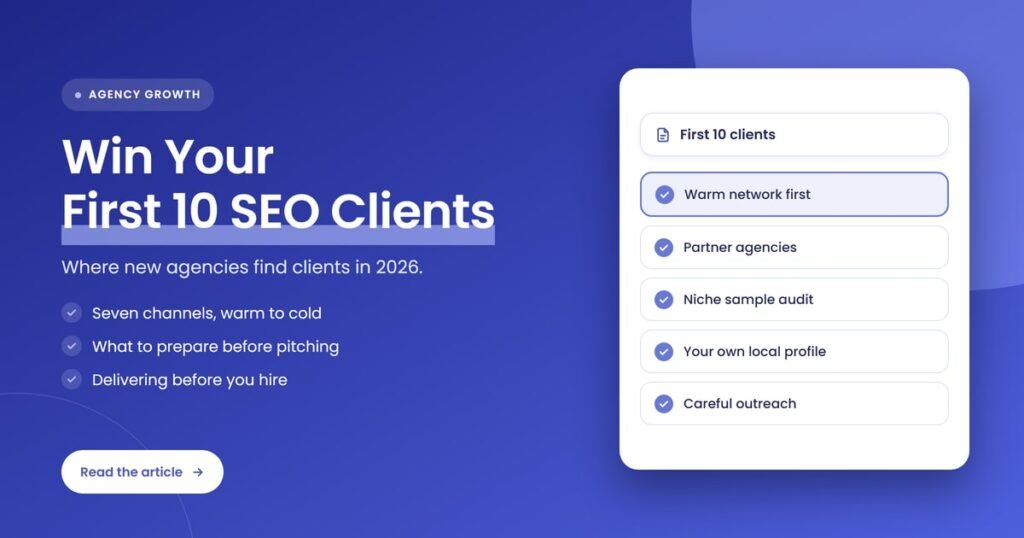
Quick answer: New agencies usually find their first SEO clients through people who already trust them: past employers, personal contacts and partner agencies that don’t offer SEO. After that, a narrow niche, a sample audit, a visible Google Business Profile, directory listings, careful outreach and useful LinkedIn posts turn strangers into sales calls. Expect a mix of channels, not one.
Key takeaways
- Warm channels come first. Your network and partner agencies already trust you, so the first conversations are easier to start.
- Winning new business got harder in 2026. In an RSW/US survey published in October 2026, 75% of agency executives said it is harder to break through to prospects, up from 35% a year earlier.
- A narrow niche plus a short sample audit gives you proof before you have case studies.
- Cold outreach still works when it is specific, useful and compliant, because Google itself tells business owners to be wary of SEO emails that arrive out of the blue.
- You don’t need to hire before you sell. A white-label partner can handle delivery while you keep the strategy and the client relationship.
What does winning your first 10 SEO clients mean for a small agency?
Winning your first 10 SEO clients means signing ten paying, recurring SEO accounts, not ten one-off audits or favors. For a small agency or freelancer, ten retainers is the point where you can see which channels bring clients, predict monthly revenue, and test whether your delivery process holds up under real load.
The first client proves someone will pay. Clients two to five show you which channel works for you. Clients six to ten tell you whether your pricing, onboarding and reporting can run without you doing everything by hand. That is why this guide treats the first ten as one project, with a mix of channels rather than a single trick.
A client acquisition channel is any repeatable way a prospect first hears about you and agrees to a call: a referral, a partner, a directory profile, an email, a post. The goal for a new agency is to find two or three channels that work and drop the rest.
Why is winning new SEO clients harder for agencies in 2026?
Winning new SEO clients is harder in 2026 because prospects are tougher to reach and referrals bring in less work than they used to. Agency surveys from 2026 show more prospects going quiet after early meetings and fewer agencies naming referrals as a top source, so new agencies need several proactive channels from the start.
The numbers come from RSW/US, a new business firm that surveys agency leaders every year. Its 2026 Agency New Business Report, released on October 21, 2026, surveyed 150 senior executives at ad, marketing and PR firms in the US and Canada in August and September 2026. It found:
- Harder to break through: 75% said it is harder to break through to prospects, up from 35% the year before.
- Prospects going dark: 46% said prospects go dark after a first or second meeting, up from 16%.
- Fewer referrals: referrals fell from 76% to 44% as a top source of new business in one year.
- AI prospecting tools: only 13% of smaller agencies said AI prospecting platforms delivered the meetings they expected, compared with 69% of larger firms.
The client side tells the same story. RSW/US’s 2026 New Year Outlook, reported by Agility PR Solutions in January 2026, found that 58% of clients cited networking as a way they learn about new agencies in 2025, down from 73% in 2022. Past relationships fell from 67% to 48%.
None of this means a small agency can’t grow. It means waiting for word of mouth is too slow on its own. The seven ways below start with the warmest channels and move toward colder ones you build over time.
Which client acquisition channels suit a new SEO agency?
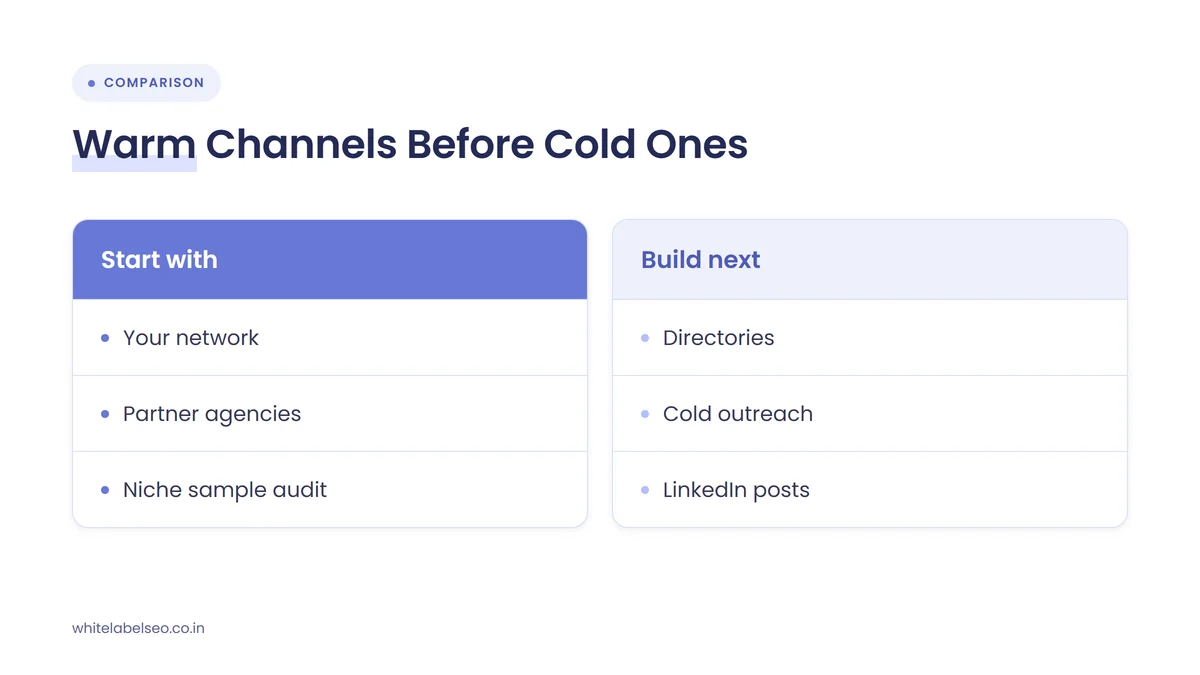
The channels that suit a new SEO agency are the ones that need trust you already have or proof you can create quickly. Warm channels such as your network and partner agencies usually start conversations sooner. Directories, outreach and content take longer to build but keep working once they are set up.
| # | Way | Best for | Main cost | Main limitation |
|---|---|---|---|---|
| 1 | Your existing network | Anyone with past employers, clients or a local business circle | Time | Runs out quickly and doesn’t scale |
| 2 | Partner agencies | Web design, PPC and social agencies that don’t sell SEO | Time and a referral fee or margin share | Partners refer only once they trust your delivery |
| 3 | Niche plus sample audit | Agencies with experience in one industry | Research time per prospect | A narrow niche means a smaller list |
| 4 | Your own local visibility | Agencies that meet clients in person | Time | Fully remote agencies may not qualify for a Business Profile |
| 5 | Directories and review platforms | Agencies that can collect early client reviews | Profile time, optional paid placement | Empty profiles with no reviews do little |
| 6 | Targeted outreach | Agencies with a clear niche and offer | Research time and email setup | Low reply rates and legal rules to follow |
| 7 | LinkedIn and communities | Founders willing to post and answer questions | Time, consistently | Slow to build, easy to abandon |
What are the 7 ways a small agency can win its first 10 SEO clients?
The seven ways are: start with people who already trust you, partner with agencies that don’t sell SEO, pick a niche and lead with a sample audit, make your own agency visible in local search, get listed on directories, send fewer but better outreach emails, and publish proof on LinkedIn and in communities.
1. Start with people who already trust you
Your first SEO client is most likely someone who already knows your work. Make a list of past employers, former colleagues, past clients from any service you’ve offered, friends who own businesses and local business groups you belong to. Then contact each one personally, not with a mass announcement.
- Be specific: say who you help and what problem you fix, for example “I help home service businesses get more calls from Google Maps”.
- Ask for introductions, not favors: “Who do you know who has a website but gets few enquiries from it?” is easier to answer than “Do you need SEO?”
- Limitation: this list runs out. Treat it as a way to land your first two or three clients and collect your first reviews, not as a long-term pipeline.
2. Partner with agencies that don’t sell SEO
Web design studios, PPC agencies, social media agencies and copywriters all get asked about SEO by their clients. Many don’t want to deliver it themselves. A referral partnership lets them say yes to their clients while you do the work.
- Offer a clear arrangement: a referral fee, a margin share, or a white-label option where you deliver under their brand.
- Make it easy to refer: one page that explains who you help, what is included and how handover works.
- Limitation: partners refer slowly at first. They will send one client, watch how you handle it, and only then send more.
Web design agencies are a strong fit because every new site launch raises the question of who will handle search. We wrote about this model in more detail in our guide to white-label SEO for freelancers and solo consultants.
3. Pick a niche and lead with a sample audit
A niche makes every other channel work better. “SEO for physiotherapy clinics” is easier to remember, refer and search for than “SEO for businesses”. It also lets you reuse research, page templates and examples across clients, which protects your margin.
- Choose a niche you understand: an industry you’ve worked in, or one where you already have two or three contacts.
- Build a sample audit: three to five findings on a prospect’s site and Google Business Profile, each tied to calls, bookings or sales. Keep it short enough to read in five minutes.
- Limitation: a small niche means a smaller list of prospects, so pick one with enough businesses in your target area or market.
Some agencies charge for a fuller audit as a first step. If that fits your offer, our post on paid SEO audits as a front-end offer explains how to scope one.
4. Make your own agency visible in local search
Prospects will search for you before they reply. If an SEO agency can’t be found for its own name or city, that undermines the pitch. Fix your own website and profile before you contact anyone.
- Check eligibility first: Google’s guidelines say a service-area business can’t list a virtual office unless it is staffed during business hours, and a co-working office needs clear signage and must receive customers during business hours. A fully remote agency may not qualify for a Business Profile at all.
- If you qualify, complete the profile: Google says local results are based on relevance, distance and prominence, and that more reviews and positive ratings can help a business’s local ranking.
- Ask every early client for a review: your first reviews matter more than any later ones, because they turn an empty profile into a credible one.
- Limitation: local visibility brings local enquiries. If you sell to clients in other countries, the other channels matter more.
Many agencies neglect their own marketing while busy with clients. Our post on fixing your own agency’s lead generation covers that problem.
5. Get listed where buyers and AI tools look
Agency directories and review platforms now matter twice: buyers browse them, and AI assistants cite them. Momentic Research’s State of Agency Discoverability 2026 reports, based on an AI citation analysis by Hall, that Clutch shows up in about 84.5% of AI-generated agency citations it reviewed. The same report says 29% of B2B buyers start vendor research in an AI tool rather than a search engine, citing G2 and TrustRadius research.
- Create complete profiles: services, industries, locations, pricing model and team details, written the same way on every platform.
- Collect reviews from early clients: a profile with real reviews does far more than a long description.
- Limitation: a new profile with no reviews rarely wins work on its own. Treat directories as a credibility layer for the other six channels.
6. Send fewer, better outreach emails
Cold outreach can work for a new agency, but only when it reads as research, not a sales blast. Google’s own guide for business owners says to be wary of SEO firms and agencies that email out of the blue. Your email has to overcome that warning in the first two lines.
- Pick 20 to 30 businesses in your niche that clearly need help, for example sites with thin service pages or a Business Profile with few reviews.
- Lead with one specific observation about their site or profile, and say what it may be costing them in calls or bookings.
- Offer the sample audit, not a meeting, as the first step.
- Never promise rankings. Google tells business owners to find someone else if an SEO promises first place.
- Follow the rules. The US Federal Trade Commission says CAN-SPAM makes no exception for business-to-business email, and requires accurate headers, a valid postal address and an opt-out you honor within 10 business days. Gmail’s sender guidelines require all senders to set up SPF or DKIM authentication.
Limitation: outreach is a numbers game with low reply rates, and RSW/US found prospects are going quiet after early meetings more often. Plan for follow-ups, and keep the volume small enough to personalize every email.
7. Publish proof on LinkedIn and in communities
Useful public posts let prospects see how you think before they ever talk to you. LinkedIn says freelancers and small business owners who offer a service can create a Service Page, and that any member can create one for free. That gives a new agency a listing where potential clients can send requests.
- Post what you find: short breakdowns of common problems in your niche, anonymized audit findings, or what a Google change means for local businesses.
- Answer questions where your niche gathers: industry forums, local business groups and Reddit threads, without dropping links.
- Limitation: content builds slowly. It is the channel most new agencies start and then abandon, so pick a pace you can keep, such as two posts a week.
What should you have ready before your first SEO sales call?
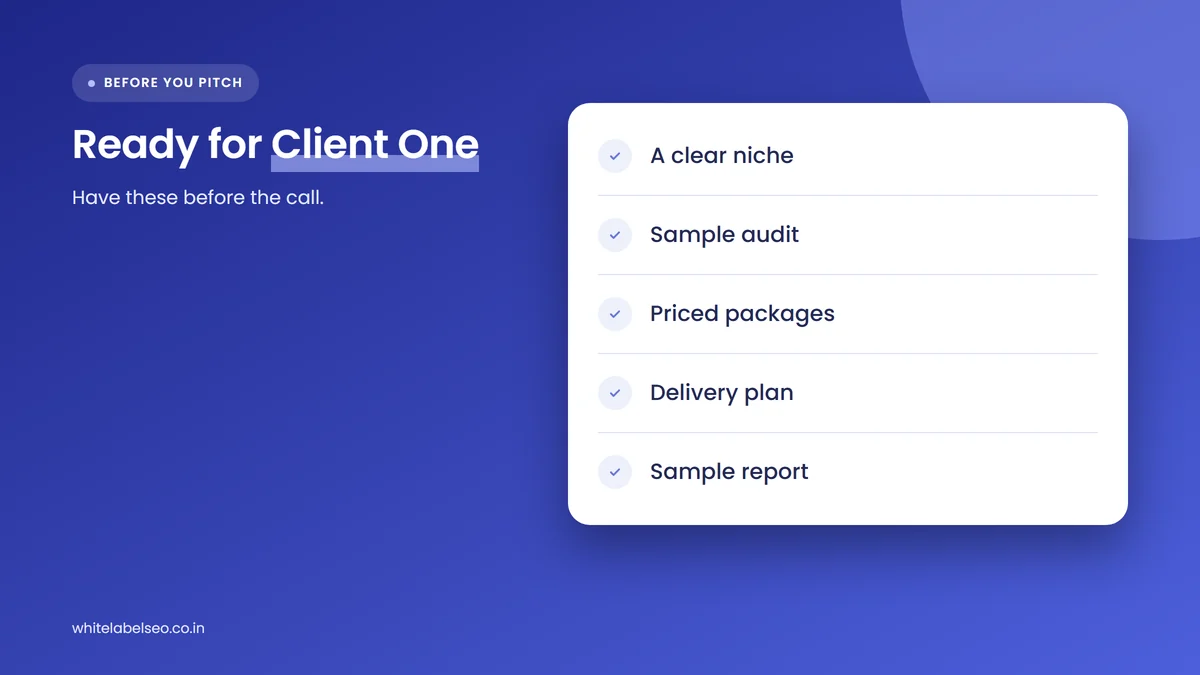
Before your first SEO sales call, have a defined niche, a sample audit you can produce quickly, two or three fixed-scope packages with prices, a plan for who does the delivery, and a sample monthly report. Prospects ask about results, timelines and process, so these answers should exist before the call.
Google’s guide for business owners lists the questions they should ask an SEO, and a new agency should prepare for each one:
- Examples of previous work: Without case studies, show your sample audit, your own site and profile, and your step-by-step process.
- Expected results and timeframe: Give honest ranges and say what you will report each month.
- Experience in their industry: This is where a niche pays off.
- How you communicate changes: Show a sample report and say how often you will meet.
How do you turn a first conversation into a signed SEO retainer?
Turn a first conversation into a signed SEO retainer by running a short discovery call, sharing a sample audit that ties problems to leads, and sending a clear proposal with two or three priced options soon after. Agree on a start date or a next call before you hang up, so the deal keeps moving.
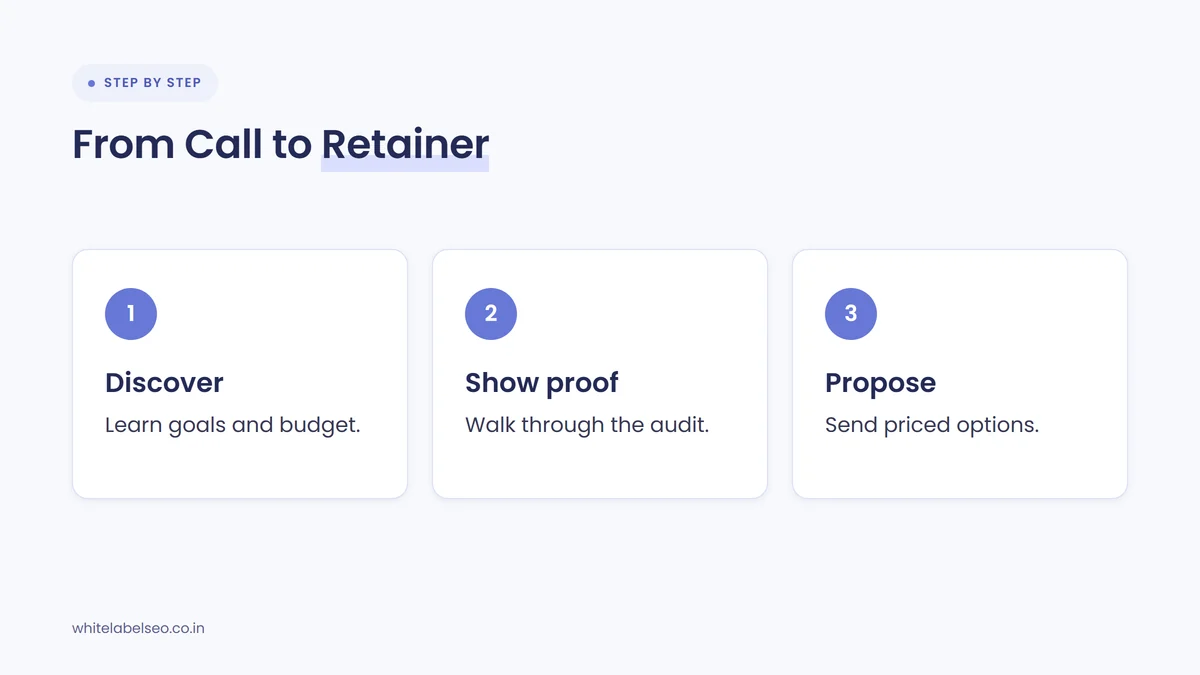
- Discover: ask about their best services, service area, budget range, who signs, and what went wrong with any past SEO provider.
- Show proof: walk through the sample audit and explain what each finding may be costing them.
- Propose: send a short proposal with quantities for each deliverable, two or three options and a clear price.
- Close on one step: a start date, a signature or a scheduled follow-up call.
For the proposal itself, our guide on writing an SEO proposal that wins retainers includes a section-by-section table you can copy.
How can a small agency deliver SEO before it hires staff?
A small agency can deliver SEO before hiring by using a white-label partner or a trusted freelancer for the hands-on work, while the agency keeps the strategy, client communication and reporting. That lets you say yes to clients one to ten without carrying a salary before the revenue exists.
At White Label SEO, this is the stage where we see small agencies get stuck most often: they hold back on selling because they worry about who will do the work if the client says yes. A partner removes that worry, but only if you check a few things first:
- Fixed scopes and wholesale prices, so you know your margin before you quote.
- Unbranded reports you can send under your own agency’s name.
- Clear turnaround times for onboarding, monthly tasks and client questions.
- Visibility into the work, such as task logs, so you can answer any client question.
A partner does not replace your judgment. You still own the relationship, the expectations you set and the results conversation each month. Start with one client, review the work closely, and scale once you trust the process.
What mistakes slow down a new agency’s first clients?
The mistakes that slow down a new agency’s first clients are chasing every industry at once, promising rankings, underpricing to win the first deal, sending generic cold emails, and having no follow-up process. Each one either reduces trust or creates clients who leave within a few months.
- No niche: “We do SEO for everyone” gives prospects and partners nothing to remember.
- Ranking promises: they win some deals and lose the client when rankings move slowly.
- Pricing below delivery cost: a client you lose money on is hard to keep and harder to raise later.
- Generic outreach: a template email confirms Google’s warning about unsolicited SEO pitches.
- No follow-up: with more prospects going quiet after early meetings, one email after the call is not enough.
Frequently asked questions
How long does it take a new agency to get its first SEO client?
There is no reliable benchmark, because it depends on your network, niche and how much time you spend on sales. Agencies with a strong network or a partner agency sending work often sign a first client sooner than those starting from cold outreach alone. Track how long each channel takes for you and adjust.
Should a new agency offer free SEO audits?
Offer a short sample audit with three to five findings, not a full audit. It proves you understand the prospect’s site without handing over a complete to-do list. If prospects want more detail, sell a fuller audit as a paid first step that leads into a monthly retainer.
Can you sell SEO without case studies?
Yes. Show a sample audit, your own website and Business Profile, a clear process and a sample monthly report. Be honest that you are new and explain how you will measure progress. Ask your first clients for reviews and permission to share anonymized results, so you have proof for the next prospects.
Is cold email still worth it for SEO agencies?
Cold email can still work when it is targeted, personal and useful, such as one specific observation about a prospect’s site. It must follow the law: the FTC says CAN-SPAM applies to business-to-business email too. Keep volumes low enough to personalize every message and set up email authentication first.
Do you need to hire an SEO specialist before signing clients?
No. Many small agencies use a white-label partner or a trusted freelancer for delivery until recurring revenue can support a hire. Keep strategy, client communication and reporting in-house, check the partner’s work closely on the first accounts, and hire once the client load is steady.
Which way should you start with this week?
Start with the warmest channel you have. Write down twenty people who already trust your work and contact five of them this week with a specific offer. In parallel, pick your niche, build one sample audit, and fix your own website and profile so prospects find something credible when they search for you. Add directories, outreach and LinkedIn once those basics are in place. If delivery capacity is what holds you back, our white-label SEO services at White Label SEO let you take on clients before you hire.
Want to sell SEO before you hire a team?
At White Label SEO, we deliver SEO under your agency’s brand, with fixed scopes, wholesale pricing and unbranded reports. Talk to us about your first clients, and we’ll help you build packages you can deliver at a healthy margin.
Sources
- RSW/US via EIN Presswire, “New RSW/US Report: 75% of Agencies Say It’s Harder to Break Through to Prospects, Up from 35% Last Year”, October 21, 2026. https://www.einpresswire.com/article/951224945/new-rsw-us-report-75-of-agencies-say-it-s-harder-to-break-through-to-prospects-up-from-35-last-year
- Agility PR Solutions, “New RSW/US 2026 Outlook Report Finds Referrals and Networking Losing Effectiveness; Agencies Must Take a More Proactive Approach to New Business”, January 16, 2026. https://www.agilitypr.com/pr-agency-news/new-rsw-us-2026-outlook-report-finds-referrals-and-networking-losing-effectiveness-agencies-must-take-a-more-proactive-approach-to-new-business/
- Momentic Research, “The State of Agency Discoverability 2026”, updated May 28, 2026. https://research.momenticmarketing.com/state-of-agency-seo-2026
- Google Business Profile Help, “Guidelines for representing your business on Google”, accessed November 12, 2026. https://support.google.com/business/answer/3038177
- Google Business Profile Help, “Tips to improve your local ranking on Google”, accessed November 12, 2026. https://support.google.com/business/answer/7091
- Google Search Central, “Do you need an SEO?”, last updated June 5, 2026. https://developers.google.com/search/docs/fundamentals/do-i-need-seo
- Federal Trade Commission, “CAN-SPAM Act: A Compliance Guide for Business”, accessed November 12, 2026. https://www.ftc.gov/business-guidance/resources/can-spam-act-compliance-guide-business
- Gmail Help, “Email sender guidelines”, accessed November 12, 2026. https://support.google.com/a/answer/81126
- LinkedIn Help, “LinkedIn Service Pages FAQs”, accessed November 12, 2026. https://www.linkedin.com/help/linkedin/answer/a569534