Quick answer: The Federal Bureau of Investigation (FBI) says Gootloader malware, which uses SEO poisoning and compromised websites, led to over $28 million in ransomware payments. Agencies should check client WordPress sites for updates, strong logins and unusual search activity, then tell clients plainly what was checked, what was found and who handles site security.
Key takeaways
- SEO poisoning is an attack that uses SEO techniques to push malicious or hijacked pages into search results, and hacked WordPress sites can serve as the lure.
- The FBI’s November 16, 2026 FLASH ties over 1,000 infected WordPress sites and 216 domains to over $28 million in ransomware payments, as of October 2026.
- The FBI describes 4 stages: scanning for weak sites, reusing stolen credentials, boosting lure pages in search and filtering which visitors see them.
- The people affected are the organizations that open the malware, the owners of hijacked sites and the agencies that manage those sites.
- Agencies should run 6 checks on each client WordPress site: Search Console, updates, multi-factor logins, xmlrpc.php, file integrity and backups.
- Clients need 5 plain points: what the FBI said, what the number means, what you checked, what you need from them and what you cannot promise.
- Write down in the retainer who is responsible for site security, because the contract decides it.
What is SEO poisoning?
SEO poisoning is an attack in which criminals use search engine optimization techniques to push malicious or compromised pages into search results, so people click them because they trust what ranks. The Canadian Centre for Cyber Security, in its April 2025 guidance on SEO poisoning, says attackers manipulate rankings so malicious sites appear above legitimate ones, often with trending search terms, and may also hijack established websites to host malicious downloads or spam links.
SEO poisoning is a security problem that borrows SEO methods, which is why it lands in our field. When a legitimate site is hijacked, Google Search Central’s spam policies call the result hacked content, meaning content placed on a site without permission because of security weaknesses. As a partner behind white-label SEO services, we read an alert that names SEO the way an agency owner should: as a check to run on every client site, not a reason to panic.
The FBI uses the term for one malware framework. It says Gootloader is an initial access framework that combines a JavaScript malware loader, compromised websites and SEO techniques to infect organizations.
What did the FBI say about SEO poisoning and ransomware payments?
The FBI said on November 16, 2026 that Gootloader, which uses SEO poisoning, led to over $28 million in ransomware payments, with over 1,000 infected WordPress sites and 216 domains identified as of October 2026. The Federal Bureau of Investigation published the figures in FLASH CC-111626-MW, titled “Gootloader Malware Using SEO Poisoning and Compromised Websites to Gain Initial Access”.
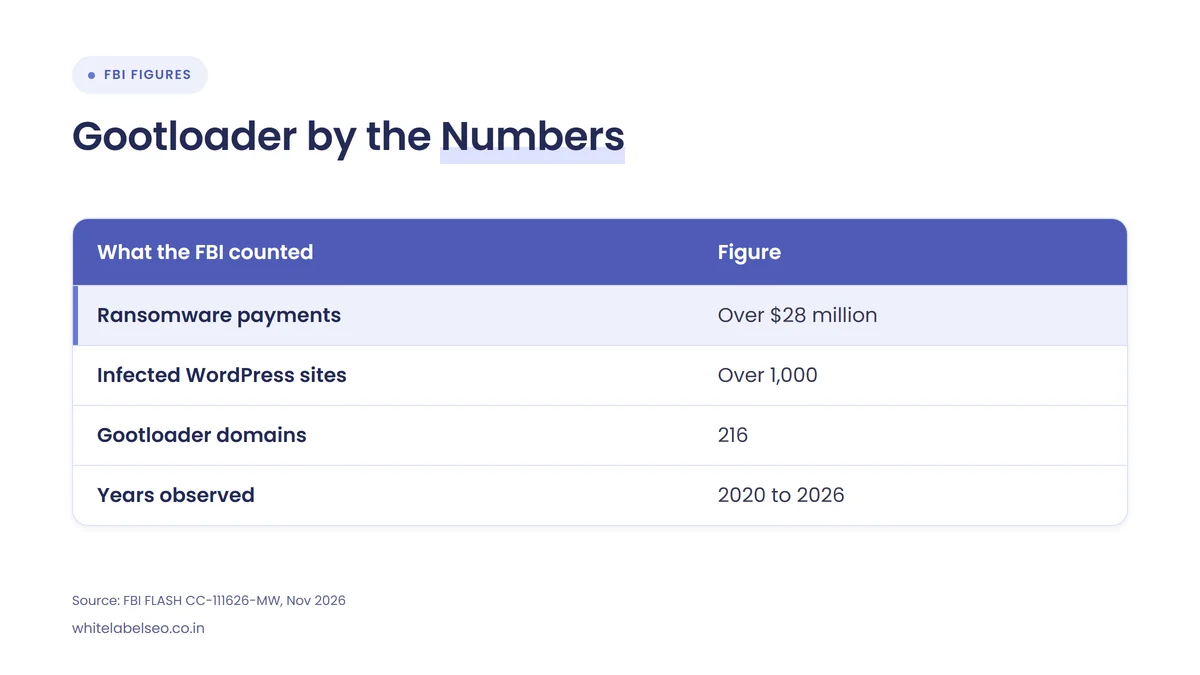
The FBI figures for the Gootloader campaign are listed in the table below.
| What the FBI reported | Number | Where in the FLASH |
|---|---|---|
| Ransomware payments tied to Gootloader | Over $28 million | Summary |
| Infected WordPress sites identified | Over 1,000 | Summary |
| Domains controlled by the Gootloader administrator | 216 | Summary |
| Years of observed Gootloader activity | 2020 to 2026 | Threat |
| Date the counts run to | October 2026 | Summary |
The table shows that the $28 million, the 1,000 sites and the 216 domains sit in one summary sentence of the FLASH, so they describe one campaign and not SEO poisoning as a whole.
Barry Schwartz reported the story on Search Engine Roundtable on November 17, 2026, and noted that SEO poisoning is not a new topic but that it is unusual for the FBI to address it in an alert. His figures match the FLASH.
Two limits matter when you repeat the number to a client. The payments were made by ransomware victims, not by the hijacked sites, and the FLASH does not say which of the 1,000 sites belonged to agency clients or small businesses. State what the FBI said and no more.
How does SEO poisoning work through hacked WordPress sites?
SEO poisoning through hacked WordPress sites works by turning an ordinary site into a lure page that ranks beside legitimate results and sends selected visitors toward malware. The FBI says Gootloader used compromised WordPress sites as lure pages, redirectors, traffic filters or relay infrastructure.
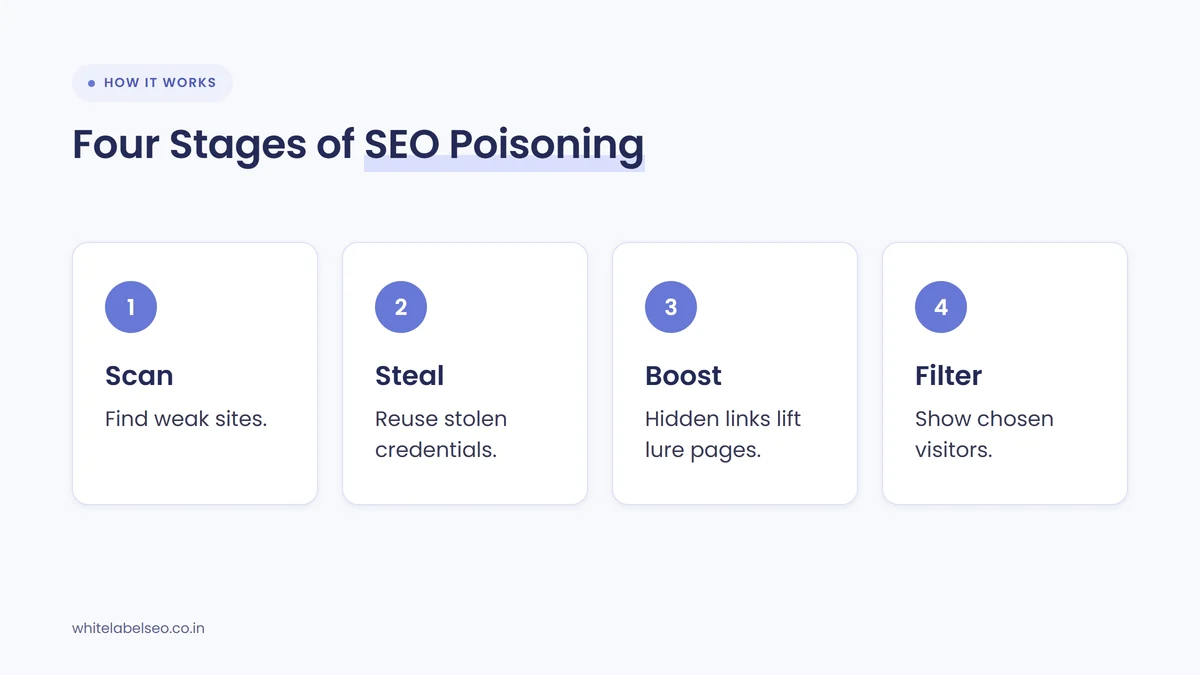
The 4 stages of SEO poisoning on hacked WordPress sites are listed below, in the order the FBI describes them.
- Scan for weak WordPress sites. The Gootloader administrator scanned WordPress sites looking for xmlrpc.php, a standard WordPress endpoint that the FLASH says attackers often target to brute-force credentials.
- Reuse stolen credentials on hacked WordPress sites. The administrator later used compromised credentials to reach vulnerable plugins and themes, injected posts and routes, and modified JavaScript.
- Boost the lure pages in search. Hidden keyword links and arranged backlinks raised the visibility of the lure pages, which targeted search phrases with low-ranking competition, such as a jurisdiction-specific contract clause.
- Filter who sees the SEO poisoning. A traffic distribution system filtered content by country, referrer, cookie or IP address, so the same page can look different to different visitors.
The FLASH says that between 2020 and 2026 the technique moved from poisoned document searches to WordPress comment paths, geofencing and traffic distribution services.
Who is affected by SEO poisoning?
SEO poisoning affects 3 groups: the organizations whose staff land on the poisoned results, the owners of the hijacked sites and the agencies that manage those sites. The 3 groups are listed below.
- Organizations that open the malware. The FBI says cyber actors used Gootloader as a ransomware precursor against victims across a wide variety of sectors, and that its 2025 to 2026 lures focused on U.S. legal professionals and legal technology decision makers.
- Owners of hijacked WordPress sites. The Canadian Centre for Cyber Security says hijacked sites may see lower rankings, reduced traffic and damage to their brand, and Google’s spam policies say hacked content gives poor search results to users. The owner is not the ransomware target, but the site carries the lure.
- Agencies and freelancers that manage client sites. The client will ask the agency what happened, what was checked and what happens next.
Hijacked WordPress sites are not limited to one campaign. The same FLASH lists 4 related WordPress campaigns, including DollyWay with 20,000+ sites since 2016 and StopAndProtect with 250+ sites in 12 countries found in mid-May 2026. It also reports that Operation Endgame took down 106 servers and cleaned 14,971 WordPress sites in June 2026 in a related campaign.
What should an agency check after the FBI’s SEO poisoning warning?
An agency should check 6 things on every WordPress client site after the FBI’s SEO poisoning warning: search activity, updates, logins, XML-RPC, file integrity and backups. Each check maps to a control in the FLASH’s WordPress section, so you can point to the FBI when a client asks why you are doing it.
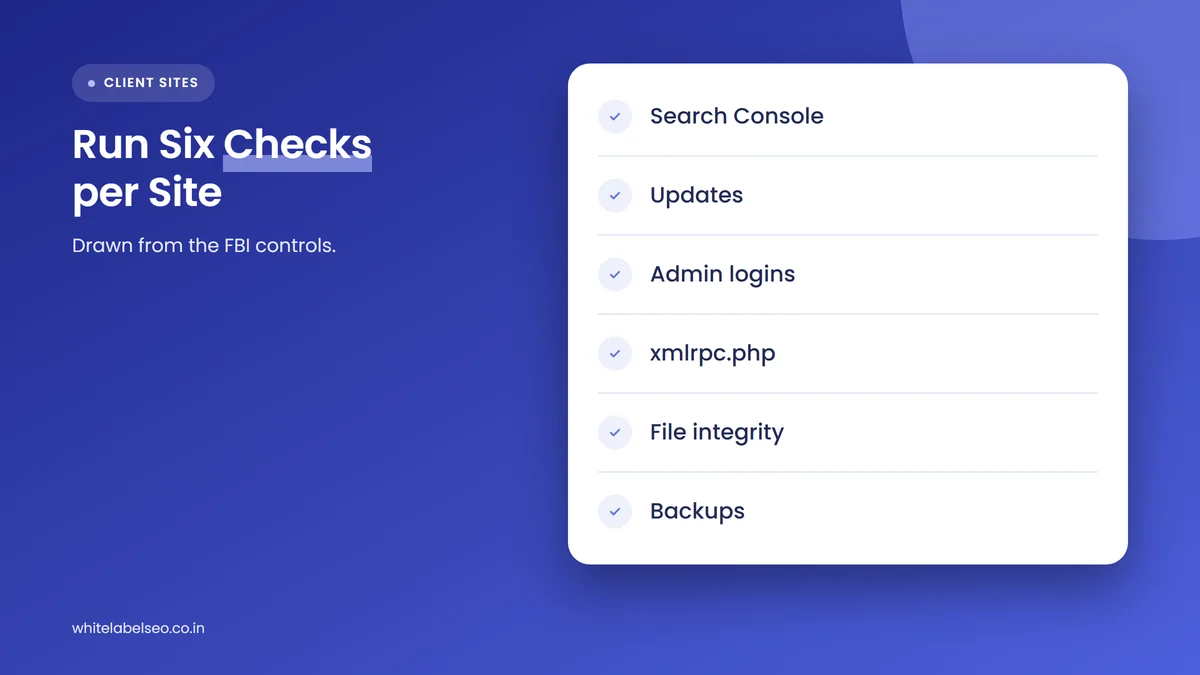
The 6 checks for a client site are listed below.
- Review Google Search Console. Open the Security Issues report and the Manual Actions report, then scan the Performance report for unrelated queries and sudden indexed pages, which the FLASH lists under “Monitor search abuse”.
- Update WordPress core, plugins and themes. Remove the unused plugins, themes, accounts and staging sites, as the FLASH advises to reduce the attack surface of hacked WordPress sites.
- Require multi-factor authentication. The FLASH asks for phishing-resistant or strong multi-factor authentication for WordPress administrators and hosting accounts.
- Disable xmlrpc.php if the client site does not use it. If the site needs it, rate-limit it and allow only the methods and integrations that are required.
- Compare core files with official checksums. Look for unexpected plugin, theme, mu-plugin, JavaScript, .htaccess and index-file changes on the client site.
- Confirm backups and a response plan. The FLASH says to restore from a known-clean backup only after the vulnerability or stolen credential that allowed entry has been removed.
Also open a few client pages in a private window by clicking from a Google result, not only by typing the address. The FLASH says Gootloader filtered content by referrer, cookie and IP address, so a direct visit may not show the problem.
If the client site has no developer, add these checks to the technical audit you already sell, as described in white-label technical SEO audits.
If a check finds a compromise, the FLASH tells site owners to restrict public access while keeping a forensic copy, reset hosting, SSH, SFTP, WordPress administrator, database, API and CDN credentials from a clean system, and find the initial access path before restoring. The FBI encourages suspected Gootloader intrusions to be reported to a local FBI field office or the Internet Crime Complaint Center at ic3.gov.
What should an agency tell clients about SEO poisoning?
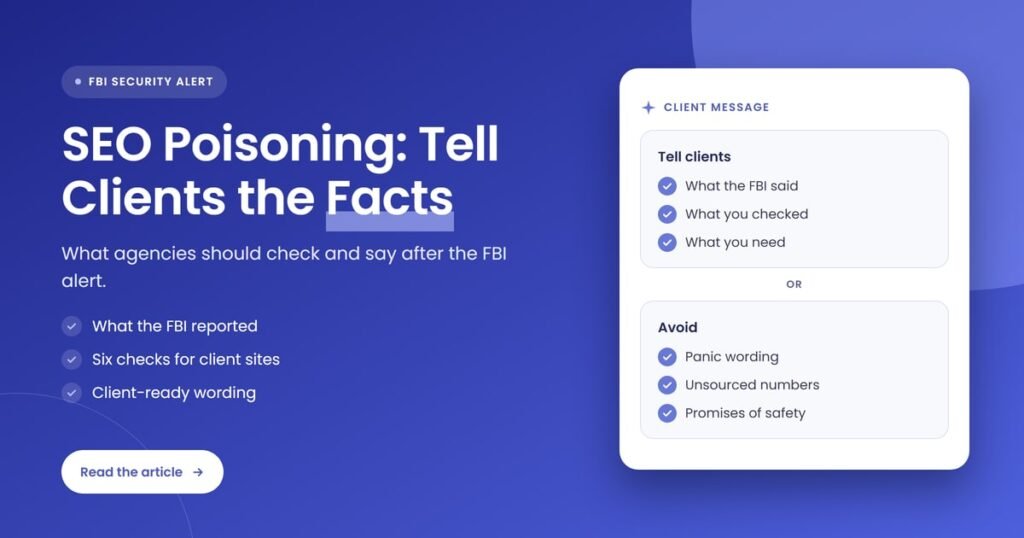
An agency should tell clients 5 things about SEO poisoning: what the FBI said, what the number means, what you checked, what you need from them and what you cannot promise. Keep the message short and factual, because the FLASH describes one malware campaign aimed mainly at U.S. legal professionals.
The 5 points to cover with a client are listed below.
- Explain what the FBI said. On November 16, 2026, the FBI warned that malware spread through SEO poisoning and hacked WordPress sites led to over $28 million in ransomware payments.
- Put the number in context. It covers over 1,000 infected sites and 216 domains across activity from 2020 to 2026, not every WordPress site.
- Report what you checked. Name the Search Console security and manual action reports, the update status and the administrator logins, with the date of each check.
- Ask for what you need. Request a named contact who approves updates, plus administrator and hosting access for the person who will do the work.
- State what you cannot promise. No agency can promise a site will never be hacked, but you can promise the checks you run and how quickly you report a finding.
A short version for an email, once you have run the checks, reads: “The FBI published an alert about malware that spreads through hacked WordPress sites and search results. Your site is not named in it. This week we checked your Search Console security reports, updates and administrator logins, and we will tell you if anything changes.”
If a client asks what Google does about a hacked site, Google Search Console Help says to fix the issue across the whole site before requesting a review, because fixing some pages earns no partial return to search results. Our guide on how your white label SEO partner should protect clients from Google spam updates covers the spam side of the same conversation.
Who is responsible for site security in an SEO retainer?
Whoever the written agreement names is responsible for site security in an SEO retainer, so write down whether your SEO scope includes security monitoring, patching or neither. A white-label SEO partner can watch Search Console and report what it finds, while hosting, updates and logins sit with whoever runs the site.
The 3 lines to write into a retainer are listed below.
- Owner of updates and hosting. Name the person or company that patches WordPress and holds the hosting login.
- Monitoring scope. State which Search Console reports the partner reviews for site security and how often they appear in the report.
- Escalation path. State who contacts the client and the host when a finding appears, and within how many days.
Commitments like these belong with the other service terms, covered in the SLAs you should expect from a white label SEO partner.
Frequently asked questions
Is SEO poisoning the same as a hacked site?
No, SEO poisoning and a hacked site are related but not the same. SEO poisoning is the ranking tactic, and a hacked site is one way to get a malicious page to rank, because the Canadian Centre for Cyber Security says attackers either promote their own malicious sites or hijack established ones.
Does the FBI warning mean our clients’ sites are infected?
No, the FBI warning does not name any client site. It reports over 1,000 infected WordPress sites as of October 2026, so each client site still needs the 6 checks above to know where it stands.
How do you check whether a client site is part of SEO poisoning?
You check a client site by opening the Google Search Console Security Issues report, which lists hacked content, malware and unwanted software and social engineering issues, then scanning Performance queries for terms unrelated to the business. Repeat the page check in a private window by clicking from a Google result.
Should an agency report a suspected compromise to the FBI?
The FBI encourages suspected Gootloader intrusions to be reported to a local field office or the Internet Crime Complaint Center, and the FLASH states that an organization has no obligation to share information. Let the client decide, and keep network logs, exposed credentials and any extortion messages.
How long does a Google security review take?
Google Search Console Help says a security review can take from several days to several weeks. It also asks site owners not to resubmit a request before they receive a decision on the one already open.
What should you do next?
List your 5 most important WordPress client sites this week, run the 6 checks on each one and send each client the short message above. Then add site security to your retainer wording so the next client alert is a routine email.
To see how we support agencies on search work like this, read about our white-label SEO services at White Label SEO.
Need a partner for your clients’ SEO questions?
At White Label SEO, we work behind your agency’s brand. Tell us what you manage, and we’ll talk through how to cover search monitoring in your retainers.
Sources
- Federal Bureau of Investigation (Internet Crime Complaint Center), “Gootloader Malware Using SEO Poisoning and Compromised Websites to Gain Initial Access”, FLASH CC-111626-MW, November 16, 2026. https://www.ic3.gov/CSA/2026/261116.pdf
- Search Engine Roundtable (Barry Schwartz), “FBI Says SEO Poisoning Led To $28 Million In Ransomware Payments”, November 17, 2026. https://www.seroundtable.com/fbi-says-seo-poisoning-led-to-28-million-in-ransomware-payments-42546.html
- Canadian Centre for Cyber Security, “Search engine optimization poisoning (ITSAP.00.013)”, April 2025. https://www.cyber.gc.ca/en/guidance/search-engine-optimization-poisoning-itsap00013
- Google Search Central, “Spam policies for Google web search” (hacked content), accessed November 21, 2026. https://developers.google.com/search/docs/essentials/spam-policies
- Google Search Console Help, “Security Issues report”, accessed November 21, 2026. https://support.google.com/webmasters/answer/9044101