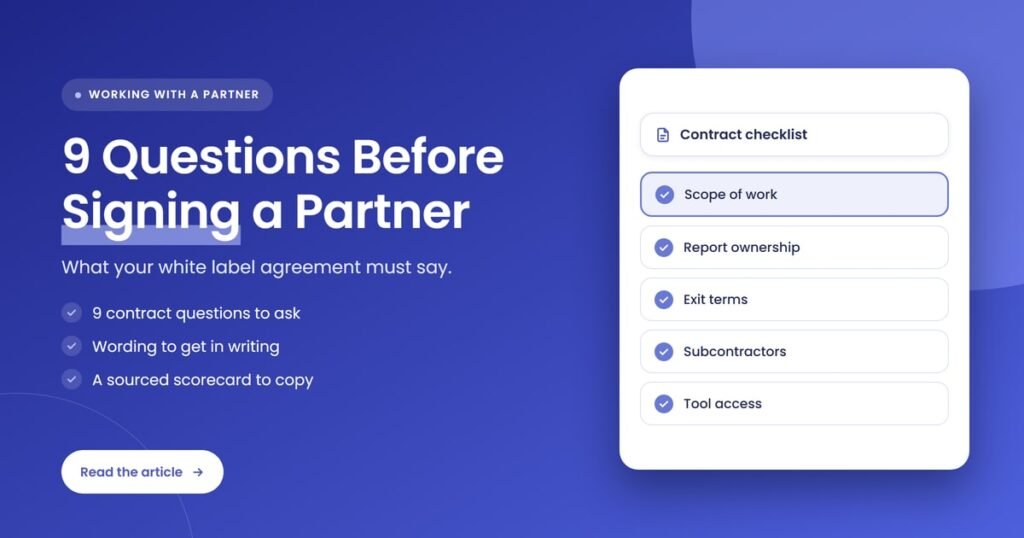
Quick answer: Before signing, ask a white label SEO partner 9 questions and get every answer in writing: what the scope of work covers, who owns the reports, what the non-disclosure agreement says, when pricing can change, what the exit terms include, who the subcontractors are, how quality control works, which service levels apply, and what tool access you keep.
Key takeaways
- A white label SEO partner agreement is the written contract that sets deliverables, ownership, price and exit, and it matters more than the sales call.
- The 9 questions to ask before signing are scope of work, reporting ownership, non-disclosure, pricing changes, exit terms, subcontractors, quality control, service levels and tool access.
- You or your client should own every report, export and account; the partner gets a user or manager role, never ownership.
- Pricing changes and exit terms need a written notice period, because 41.1% of agencies run gross margins under 30% and cannot absorb a surprise.
- Subcontractors, quality control and service levels should each be named in the agreement, because your agency answers to the client for all of them.
- Score the answers on a written scorecard, and sign only when all 9 questions have a clear answer in writing.
What is a white label SEO partner agreement?
A white label SEO partner agreement is the written contract that sets what a partner delivers under your agency’s brand, what you pay, who owns the work and how either side can leave. It is the only part of the relationship that both sides can be held to, which is why the agreement matters more than the sales call or the sample report.
The agreement carries the risk because your client signs with you, not with the partner. Google’s “Do you need an SEO?” guide says: “Ultimately, you are responsible for the actions of any companies you hire.” The same logic applies to a reseller: when a report is wrong or a link scheme causes a problem, your agency answers first. We expect agencies to ask us these questions about our own white label SEO services, and a partner that dislikes them is giving you an answer already.
This guide covers what the signed document should say. It does not cover how to test the partner’s work, which is a separate step you can run before or after you read the contract.
What are the 9 questions to ask a white label SEO partner before signing?
The 9 questions to ask a white label SEO partner before signing cover the scope of work, reporting ownership, the non-disclosure agreement, pricing changes, exit terms, subcontractors, quality control, service levels and tool access. Each question below has a plain answer to look for and the wording to ask for in writing.
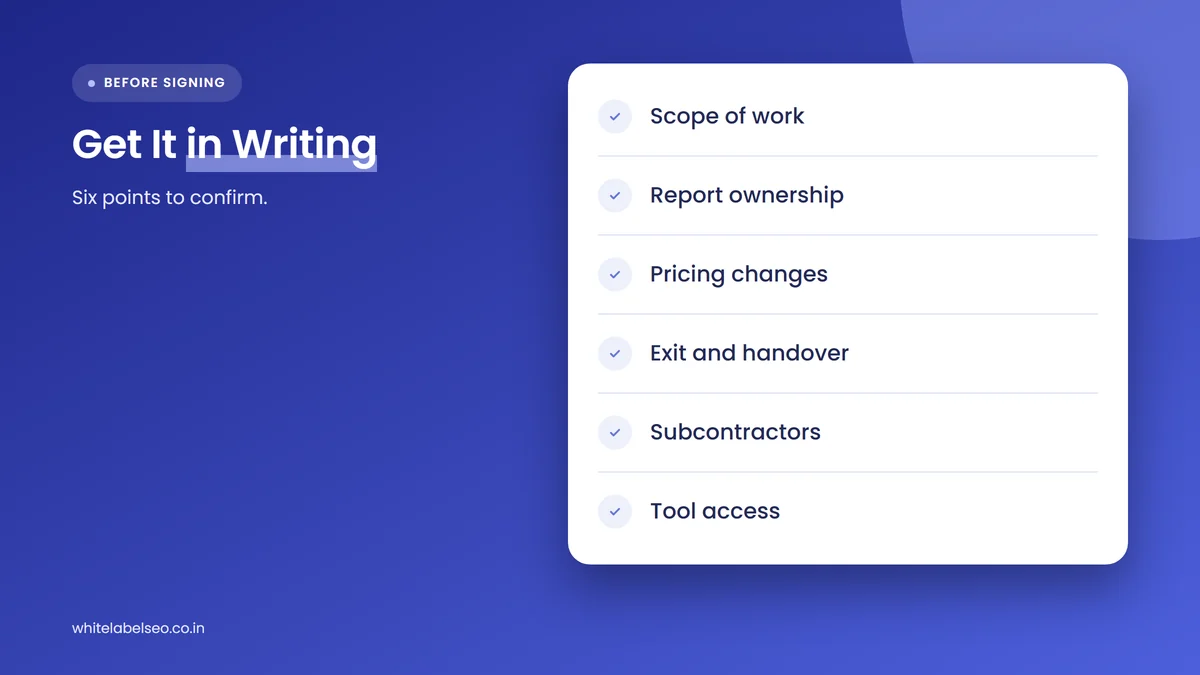
The 9 questions are explained one by one below, in the order a contract is usually read.
1. Does the scope of work list every deliverable and its monthly quantity?
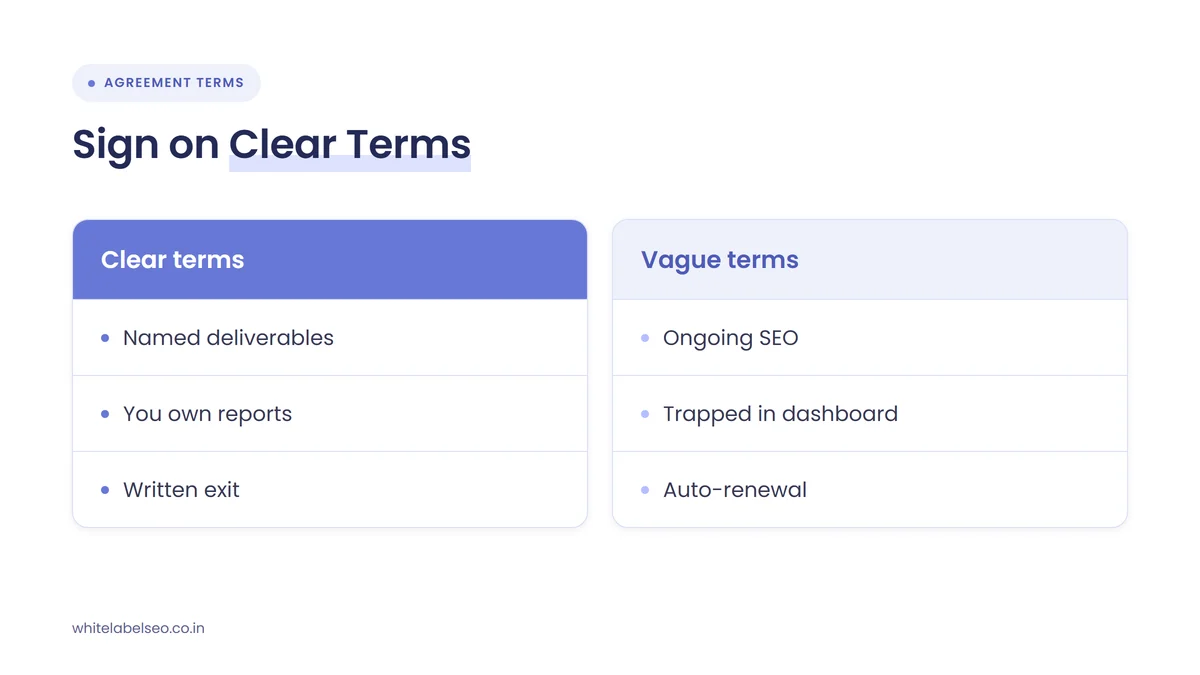
Yes, the scope of work should list every deliverable with a number, a format and a due date, for example 4 pages of content, 1 technical audit and 1 monthly report. A scope of work that says “ongoing SEO” without quantities cannot be checked, so neither side can tell when it has been met.
Ask the partner to put exclusions in writing too, such as extra revisions, new client sites or emergency fixes, and to price change requests before work starts. Compare the draft with what a white label SEO partner does each month, so the quantities match a real monthly cycle and not only month 1.
2. Who owns the reports, data and work the partner produces?
You and your client own them, and the white label SEO agreement should say that every report, page, audit and data export belongs to your agency from the moment it is delivered or paid for. Reporting ownership matters most if you leave: a report trapped in the partner’s dashboard cannot be shown to the client.
Account ownership follows the same rule. According to Google Search Console Help, only owners can add or remove users, and a property can have a maximum of 100 non-owners, so a partner should work as a full user while you or the client stay the owner. Google Business Profile Help says managers have almost the same access as owners, except that they can’t add or remove users or remove the profile. Ask for reports in a format you can export, such as a shared Looker Studio report, and check each one against the 10 red flags in a white label SEO report.
3. What does the non-disclosure agreement cover, and who may contact your clients?
The non-disclosure agreement should cover your client list, client data, pricing and the fact that you use a partner, and it should bar the partner from contacting your clients or naming your agency. A generic mutual non-disclosure agreement that does not list what is confidential protects very little.
Branding belongs in the same clause: every report, email and invoice that reaches a client should carry only your brand, and the partner’s staff should write to your team, not to your client. If the partner handles client data from the European Union, Article 28 of the General Data Protection Regulation requires a binding written contract and says the processor may act only on the controller’s documented instructions. Ask a lawyer to confirm which rules apply to you, then read our guide on protecting your agency brand for the branding side.
4. When and how can the pricing change?
Pricing changes should happen only with written notice of at least 30 days and only at a renewal date, never in the middle of a term. Ask for the rate card in writing, including setup fees, minimums and extras billed separately, such as link building or content.
The reason is margin. Ahrefs found that 78.2% of 439 SEO providers charge a monthly retainer, and the most common retainer is $501 to $1,000, according to its poll updated in August 2024. Sitechecker’s 2026 agency report found that 41.1% of 73 agencies run gross margins under 30%, so a partner’s price rise can wipe out an agency’s profit on a client. Set your own resale price against how much white label SEO costs before you accept any clause that lets the partner raise it.
5. What do the exit terms and handover include?
The exit terms should state a notice period, an end date for work in progress and a handover of every deliverable, login and report within a set number of days, such as 14. They should also say that no 12-month term renews on its own.
The handover list below is what to ask the white label SEO partner to commit to in writing.
- Deliverables: every page, audit and report paid for, in editable files.
- Access: removal of the partner’s user or manager role from Google Search Console and Google Business Profile on the exit date, which the owner can do in minutes.
- Client data: return or deletion of client data at your choice, as Article 28(3)(g) of the General Data Protection Regulation describes for processors.
- Work in progress: a written status of every open task, so a new partner can continue it.
6. Does the partner use subcontractors, and who are they?
Ask for a yes or no, and if the answer is yes, ask for the subcontractors by role and country, because you remain responsible to your client for their work. A partner that outsources link building or content to unnamed vendors is adding risk you cannot see.
Put the rule in the white label SEO agreement: no new subcontractors without your written approval, and the same confidentiality duties for each of them. Article 28 of the General Data Protection Regulation uses the same structure for client data: a processor may not use another processor without prior written authorisation, must pass on the same obligations, and stays fully liable to the controller if the subcontractor fails.
7. How does the partner run quality control before delivery?
A white label SEO partner should describe a written quality control step: who reviews each deliverable, against which checklist, and how errors found after delivery are fixed and reported. Quality control that exists only as a promise to “check everything” is not a process.
Ask the partner two of Google’s own questions from “Do you need an SEO?”: whether it follows Google Search Essentials, and whether it will share all the changes it makes to the client’s site. Google also tells site owners to be careful if a company is secretive or won’t clearly explain what it intends to do. Put the answers in the agreement, along with a fix time for errors, so a mistake in a client report has a deadline attached.
8. Which service levels does the contract commit to?
The contract should commit to service levels in numbers: business-day turnaround for each deliverable, a response time for messages, a report delivery date and a remedy when one is missed. Service levels should measure delivery, not rankings, because rankings depend on Google.
Google’s SEO Starter Guide says changes can take from a few hours to months to show, and that you should wait a few weeks before judging whether they worked. That is why a result clause tied to a ranking date fails, while a delivery clause can be checked every month. Ask the partner Google’s question, “What kind of results do you expect to see, and in what timeframe?”, and write the answer into the agreement. The wider checklist is in what to look for in an SEO reseller program before you sign.
9. Which tools and accounts will you have access to?
You should have named tool access to everything used on your clients: the rank tracker, the reporting dashboard, the project board and the client’s Search Console and Business Profile, with you or the client as owner. If a tool is not shared, you cannot check the work.
Start with the lowest role that does the job. Google’s guide says that for an audit you should only grant read access to Search Console, and Google Search Console Help states that a restricted user has simple view rights on most data, while a full user can also submit sitemaps. Google Business Profile Help adds that a new owner or manager must wait 7 days before managing some features, so ask for access to be set up a week before work starts.
How do you score a white label SEO partner’s answers before signing?
You score a white label SEO partner’s answers with a written scorecard that gives each question a pass mark and a sourced fact, and you sign only when every row passes. A vague or missing answer counts as a fail until the partner puts it in writing.
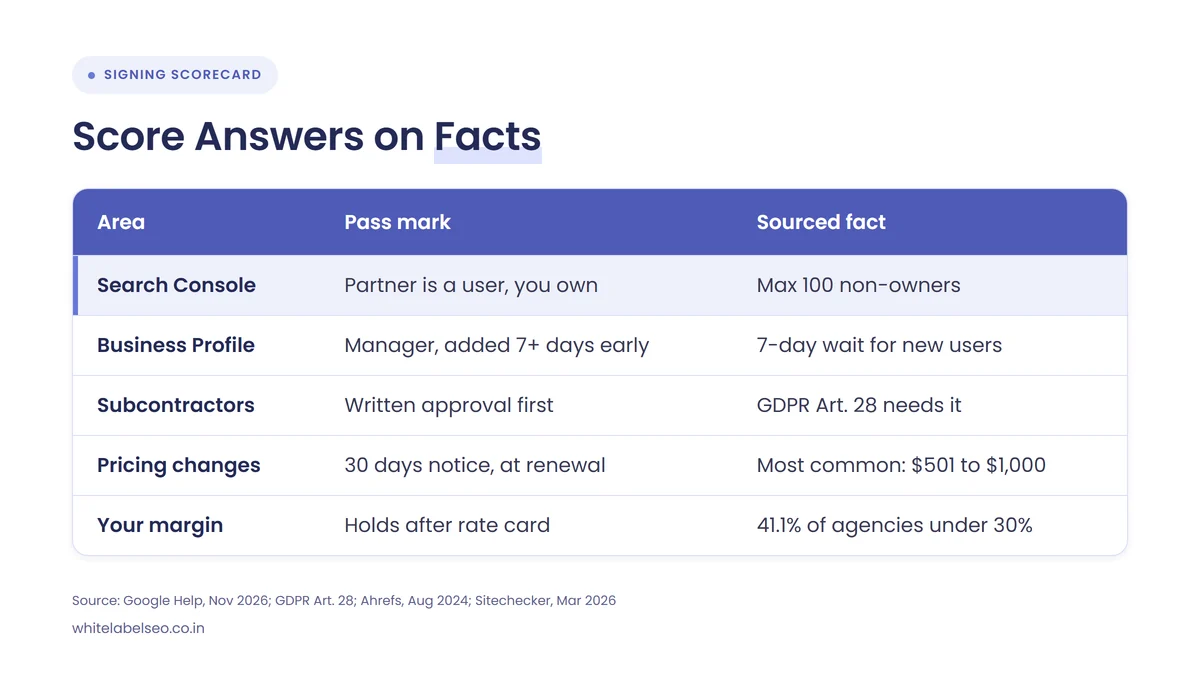
The scorecard below lists 6 contract areas in the order of the 9 questions, each with a pass mark and the fact behind it.
| Contract area | Pass mark | Sourced fact | Source |
|---|---|---|---|
| Reporting ownership and Search Console access | Partner is a full or restricted user; you stay owner | Only owners add or remove users; max 100 non-owners per property | Google Search Console Help, accessed Nov 2026 |
| Business Profile access | Partner is a manager; access added 7+ days before work starts | Managers can’t add or remove users; new managers wait 7 days for some features | Google Business Profile Help, accessed Nov 2026 |
| Subcontractors and client data | Written approval before any new subcontractor; written contract | A processor needs written authorisation to use another processor | GDPR Article 28, Regulation (EU) 2016/679 |
| Pricing changes | 30 days written notice, at renewal only | 78.2% of 439 providers charge a monthly retainer; most common $501 to $1,000 | Ahrefs, August 2024 |
| Margin after price changes | Your margin holds after the partner’s rate card | 41.1% of 73 agencies run gross margins under 30% | Sitechecker, March 2026 |
| Service levels | Delivery measured in days; no ranking-date clause | Changes take a few hours to months; wait a few weeks to assess | Google Search Central, SEO Starter Guide |
The table shows that 4 of the 6 pass marks rest on Google or EU documentation and 2 rest on industry surveys, so every row can be checked rather than argued.
If every row passes but you still want proof of the work itself, run a small paid test before you commit client volume, as described in running a pilot project before you commit to a white label SEO partner. The pilot should be written into the same agreement, with its own end date.
What happens after you sign a white label SEO partner agreement?
After you sign a white label SEO partner agreement, the first 30 days are onboarding: access is set up, the scope of work is turned into a task list and the first report date is fixed. Hold the partner to the dates in the contract from day 1, so the first month sets the pattern for the rest.
Keep your scorecard open and review it at the end of month 1 and month 3, using the same 9 questions. If any answer has drifted, such as a new subcontractor or a late report, raise it in writing and use the notice period if it is not fixed. The first weeks, from kickoff to the first report, are covered in how white label SEO onboarding gets new clients live.
Frequently asked questions
Should you sign a white label SEO agreement without a trial?
No, you shouldn’t commit client volume without a trial, but you can sign the agreement first if it has a short first term. A 60 to 90 day first term with a clear notice period lets you test the work under the contract instead of before it.
Is a month-to-month white label SEO agreement better than 12 months?
Yes, a month-to-month agreement is safer for the first 90 days, because you cannot judge a partner’s delivery before you have seen a full cycle. Move to a longer term only after the scorecard passes, and ask for a lower rate in return for the longer commitment.
Should a lawyer review the white label SEO agreement?
Yes, a lawyer should review the agreement, especially the non-disclosure agreement, the client data terms and the liability clauses. This guide lists what to ask for, but it is not legal advice, and the rules differ by country.
What if the partner refuses to answer one of the 9 questions?
If a white label SEO partner refuses to answer one of the 9 questions in writing, treat that row as failed and do not sign until it is fixed. Google tells site owners to be careful if a company is secretive, and a partner that hides a term before signing will not explain it afterwards.
Do freelancers need the same 9 questions?
Yes, freelancers need the same 9 questions, with extra weight on scope of work, exit terms and tool access. A freelancer has less time to review and fix a partner’s work, so a clear scope and a short notice period protect the most.
What should you do next?
Copy the 9 questions into a one-page checklist, send it to every white label SEO partner on your shortlist, and ask for the answers in writing before you read any proposal. Score each reply on the scorecard, drop any partner with a failed row and sign only with the one whose answers hold up.
If you want a partner that expects these questions, see our white label SEO services and how we work with agencies at White Label SEO.
Want clear answers to all 9 questions?
At White Label SEO, we answer every contract question in writing before an agency signs: scope, ownership, exit terms and tool access. Tell us which questions matter most to your agency, and we will walk through them with you.
Sources
- Google Search Central, “Do you need an SEO?”, accessed November 21, 2026. https://developers.google.com/search/docs/fundamentals/do-i-need-seo
- Google Search Central, “SEO Starter Guide”, accessed November 16, 2026. https://developers.google.com/search/docs/fundamentals/seo-starter-guide
- Google Search Console Help, “Managing owners, users, and permissions”, accessed November 21, 2026. https://support.google.com/webmasters/answer/7687615
- Google Business Profile Help, “Manage your Business Profile owners & managers”, accessed November 21, 2026. https://support.google.com/business/answer/3403100
- European Union, Regulation (EU) 2016/679 (General Data Protection Regulation), “Article 28: Processor”, accessed November 21, 2026. https://gdpr-info.eu/art-28-gdpr/
- Ahrefs, “SEO Pricing: How Much Does SEO Cost? 439 People Polled”, updated August 15, 2024. https://ahrefs.com/blog/seo-pricing/
- Sitechecker (Ivan Palii), “The 2026 SEO agency growth report”, March 11, 2026. https://sitechecker.pro/seo-agency-growth-data-study-2026/