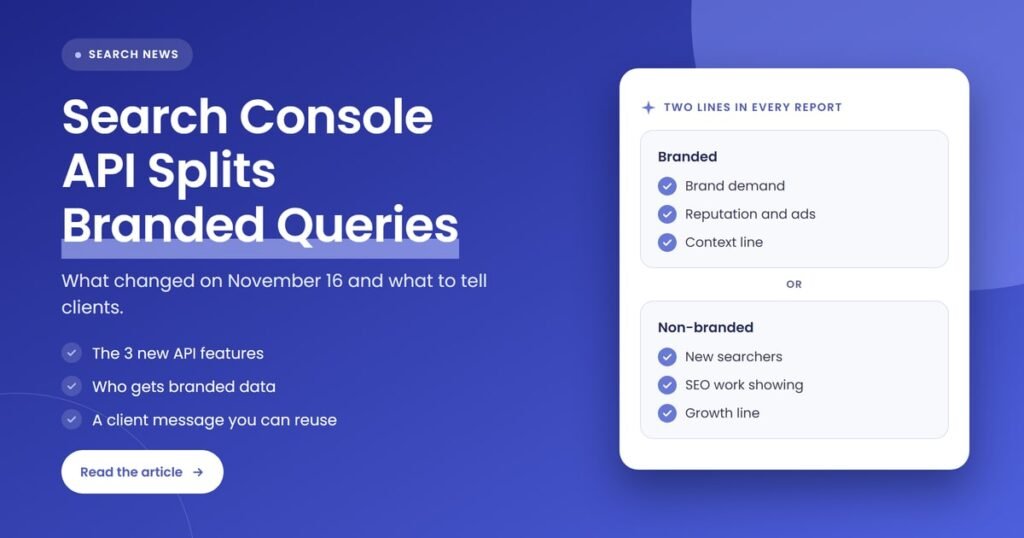
Quick answer: On November 16, 2026, Google added 3 features to the Search Console Search Analytics API: a branded and non-branded queries split, a web multimodal search type for Google Lens and Circle to Search, and filters for more than one country or device per request. Tell clients that brand demand and SEO growth can now be reported separately.
Key takeaways
- Google’s November 16, 2026 update brings 3 Search Console report features into the Search Analytics API: branded queries, web multimodal and multi-country or multi-device filters.
- The Search Analytics API is the data feed behind most agency dashboards, so these features can now reach automated client reporting, not only the Search Console screen.
- Branded queries are classified by an AI-assisted Google system, only for top-level properties with enough volume, and other properties get no rows back.
- Web multimodal data covers searches that start with an image, through Google Lens, Circle to Search on Android and image uploads in Google Search.
- The
filterListsfield filters a request by a list of countries or devices, which suits regional and multi-device client reports. - The client message is simple: branded clicks show brand demand, non-branded clicks show what SEO is winning, and both belong in the report.
What did Google add to the Search Console API on November 16, 2026?
Google added 3 capabilities to the Search Console Search Analytics API on November 16, 2026: branded query classification, a web multimodal search type and lists of countries or devices in one filter. All 3 already existed in the Search Console Performance report; the update makes them available to code, dashboards and data exports.
The 3 additions, as described in the Google Search Central post “New filtering and reporting capabilities in the Search Analytics API”, are listed below in order of their weight for client reporting.
- Branded queries: you can group or filter Search Analytics API data by
brandedClassificationto compare branded and non-branded performance, on eligible properties only. - Web multimodal: you can set the search
typetowebMultimodalto get performance data from Google Lens, Circle to Search on Android and image uploads in Google Search. - Multi-country and multi-device filters: a new
filterListsfield filters one request by more than one country or device, such as an EMEA, LATAM or DACH region group.
The post is signed by Daniel Waisberg, Nati Yosephian and Karin Gadasi of the Search Console team, and Search Engine Roundtable covered it the same day, quoting the team: “Today, we’re bringing all three capabilities to the Search Analytics API”. Google says the features combine, so one request can track branded growth across a regional hub. For agencies that resell SEO, including partners of our white label SEO services, the change matters because client reports are built from the API, not from screenshots.
What is the Search Analytics API in Search Console?
The Search Analytics API is the part of the Search Console API that returns Performance report data (clicks, impressions, click-through rate and average position) for a verified property, grouped by dimensions such as query, page, country, device and date. It is the same data as the Performance report, delivered to software instead of a browser.
Agencies use the Search Analytics API to feed dashboards, scheduled client reports and data warehouses. A Looker Studio report, a reporting tool or a script that pulls Search Console data into BigQuery all depend on what the API exposes. Until November 16, 2026, the branded queries filter and the web multimodal search type were visible in Search Console but missing from that feed, so agencies had to build their own brand lists or skip the split in client reporting.
How does the branded queries filter work in the Search Console API?
The branded queries filter works in the Search Console API through a brandedClassification dimension with 2 values, BRANDED and NON_BRANDED, which you can group by or filter on with the equals operator. Google decides the label, not the agency: there is no brand keyword list to upload.
Google’s November 20, 2025 post introducing the filter states that branded queries are classified by “an internal, AI-assisted system” and that the method is not based on regular expressions. The system recognizes the brand name in all languages and with typos, and it also tags queries that skip the brand name but refer to a unique product or service of the site. Google adds that some queries may occasionally be misidentified and that the filter has no effect on how Google Search ranking works.
The Search Analytics API reference adds one practical rule: a brandedClassification filter can’t be combined with a query filter in the same request. Agencies that already filter by query text need a separate request for the branded and non-branded split. For the transition, one practitioner’s advice on X is sensible.
“run it beside your own brand list before replacing it.”
Antoine G (@singulierweb) on X, November 16, 2026 (source)
We agree with that order. Run Google’s branded queries split and your existing brand regex side by side for 1 or 2 reporting months, note where they disagree, and switch client reporting to Google’s label once the gap is understood.
Which Search Console properties get branded query data?
Branded query data goes only to top-level Search Console properties with a sufficient volume of queries and impressions, according to Google. Properties that are not eligible get no rows back from the Search Analytics API, so an empty branded result means “not eligible”, not “no brand searches”.
Google rolled the filter out gradually from November 20, 2025 and made it available to all eligible sites on March 11, 2026. The API reference states that brandedClassification data is available from February 21, 2026, so a branded and non-branded comparison can’t reach back before that date. URL-prefix and subdomain properties are outside the filter, which matters for agencies that verified clients as URL-prefix properties years ago.
What does web multimodal data show in Search Console?
Web multimodal data shows Search Console performance for searches that start with an image: Google Lens, Circle to Search on Android and image uploads in Google Search. In the Search Analytics API, you request it by setting type to webMultimodal, one of 7 search types next to web, image, video, news, googleNews and discover.
Google launched web multimodal reporting in the Search Console Performance report on September 24, 2026, and its announcement also lists Chrome’s “Search this image” option among the covered searches. Metrics appear only when a site gets traffic from these searches. For properties with an active bulk data export, the November 16 post says web multimodal data also reaches BigQuery. Web multimodal is not the Google Images tab: Images tab traffic stays under the image type. Check web multimodal data first for retail, home services and product clients, since their customers can photograph a part, a plant or a product to search for it.
How do multi-country and multi-device filters work in the Search Console API?
Multi-country and multi-device filters work in the Search Console API through a filterLists field that matches a row if its country or device equals any value in a list. Countries use ISO 3166-1 alpha-3 codes (such as USA, GBR and AUS), and devices use 3 values: DESKTOP, MOBILE and TABLET.
Before filterLists, a report for “UK, Ireland and Australia” or “mobile plus tablet” needed one request per country or device, then a merge. Now one request returns the group. The API reference sets one limit: a request can’t filter the same dimension in both filters and filterLists. Regional reports for clients that sell abroad get simpler, which supports agencies reselling international SEO to clients with EMEA, LATAM or DACH targets.
What are the limits of the new Search Console API data?
The new Search Console API data has 3 main limits: eligibility for branded queries, a start date of February 21, 2026 for branded data, and the usual cap of 25,000 rows per request. The table below puts each capability next to its field, values and availability, so you can see which clients will get which data.
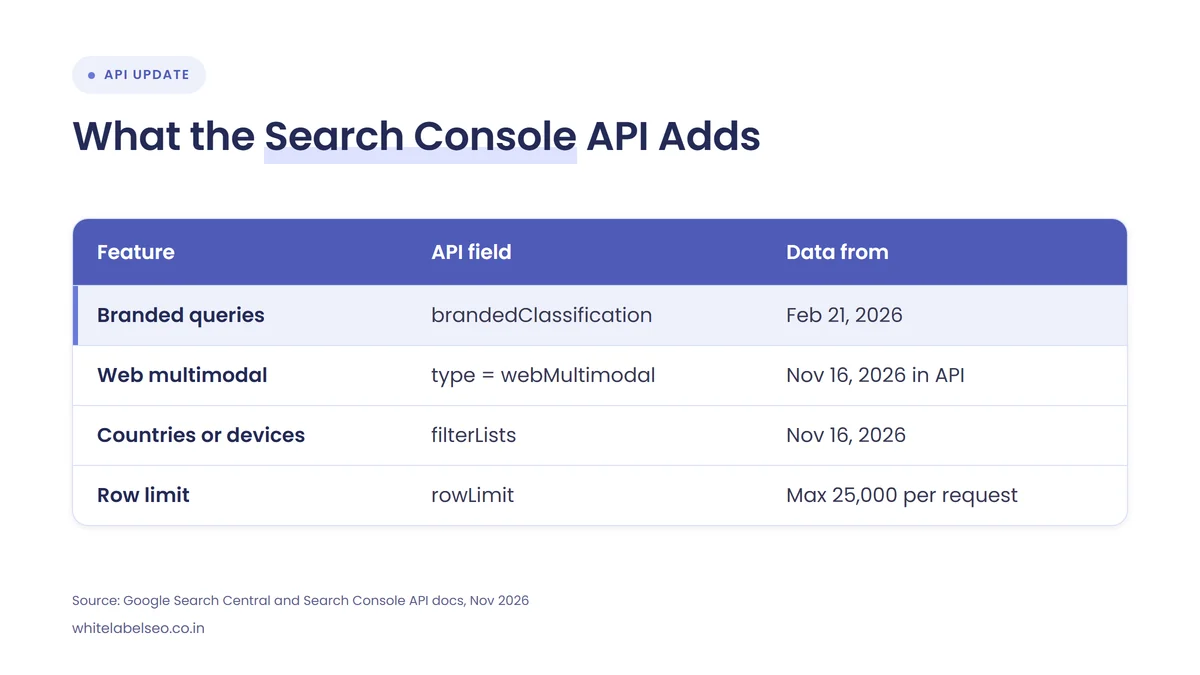
The 3 new capabilities and the API limits that apply to them are compared in the table below.
| Capability | API field | Values | Available since | Who gets it |
|---|---|---|---|---|
| Branded queries | brandedClassification |
2 values: BRANDED, NON_BRANDED | Report: Nov 20, 2025; API data from Feb 21, 2026 | Top-level properties with enough volume |
| Web multimodal | type = webMultimodal |
Lens, Circle to Search, image uploads | Report: Sep 24, 2026; API: Nov 16, 2026 | Sites with image-led search traffic |
| Multi-country and multi-device | filterLists |
Alpha-3 country codes; 3 devices | API: Nov 16, 2026 | All properties |
| Row limit | rowLimit |
1 to 25,000 rows, default 1,000 | Existing limit | All requests |
| Query quota | Usage limits | 1,200 queries per minute per site | Existing limit | All requests |
The table shows that only the branded queries split depends on the client’s property type and search volume, while web multimodal and filterLists work for any property that has the traffic.
The quota numbers come from Google’s Search Console API usage limits: 1,200 queries per minute per site, 1,200 per minute per user, and 40,000 per minute or 30,000,000 per day per project. The API reference also warns that the Search Analytics API returns top rows, not every row, so long-tail non-branded queries can still be cut off in large sites. One more gap is worth naming to clients. The November 16 post adds nothing from the generative AI performance report, a point Marie Haynes raised on X the same day.
“they did not mention adding the Generative AI impressions information”
Marie Haynes (@Marie_Haynes) on X, November 16, 2026 (source)
That keeps AI Overviews and AI Mode impressions a manual part of the report for now, with the caveats we covered in no click data in Search Console’s AI report.
Who is affected by the Search Console API update?
The Search Console API update affects agencies and SEO partners that report from automated dashboards more than anyone else, because the Search Console screen already had these features. Site owners who only read the Performance report see no change.
The 4 groups the Search Analytics API update touches most are listed below.
- Agencies with automated client reporting: dashboards and connectors can now show branded and non-branded queries without a hand-built brand regex, once the tools adopt the new fields.
- Agencies with well-known brand clients: brands with heavy brand search get the cleanest view of non-branded growth, which is where SEO work shows.
- Clients with image-led searches: product, retail and local service clients can see Google Lens and Circle to Search traffic in the same report as web search.
- Multi-region and multi-device clients: clients selling in EMEA, LATAM or DACH markets get regional rollups in one Search Console request.
What should agencies tell clients about branded and non-branded queries?
Agencies should tell clients that branded queries measure demand for the brand, and non-branded queries measure what SEO is winning, and that Google now labels the two for them. A client whose clicks rise only on branded queries has grown its reputation or advertising; a client whose non-branded clicks rise has gained new search visibility.
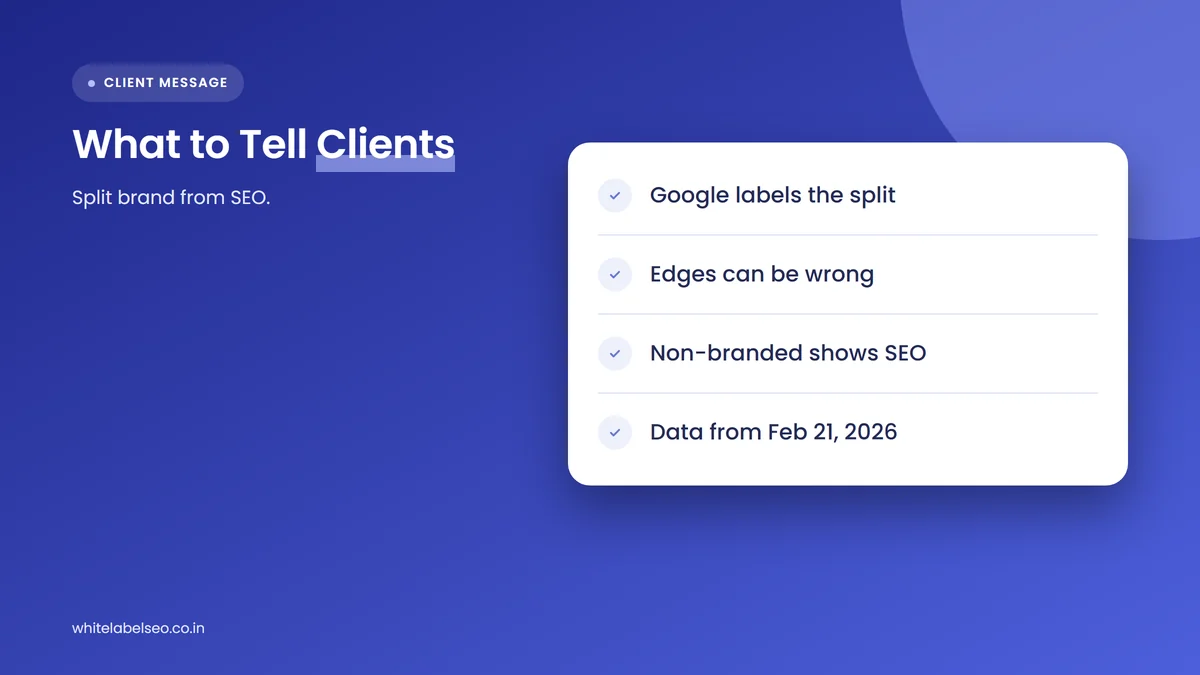
The 4 talking points we suggest for the first client report with the branded and non-branded queries split are listed below.
- The split comes from Google: Google Search Console labels branded queries with an AI-assisted system, so the numbers no longer depend on the agency’s own keyword list.
- The label can be wrong at the edges: Google says some queries may occasionally be misidentified, so treat small shifts between the 2 groups as noise.
- Non-branded growth is the SEO line: the non-branded queries trend is the clearest sign that content, local SEO and technical work are reaching new searchers.
- History starts on February 21, 2026: branded and non-branded comparisons can’t go further back, so year-on-year views will be partial until early 2027.
If a client’s property isn’t eligible, say so plainly and keep the agency’s own brand list for that report. The same principle runs through our list of 9 metrics agencies should report to SEO clients: report the number that shows value, and explain its limits in one sentence.
What should agencies do now with the Search Console API update?
Agencies should check eligibility, test the new fields on 1 or 2 clients and update the report template before the next monthly report goes out. The work takes a few hours per reporting setup and avoids a client asking why the dashboard and Search Console show different branded numbers.
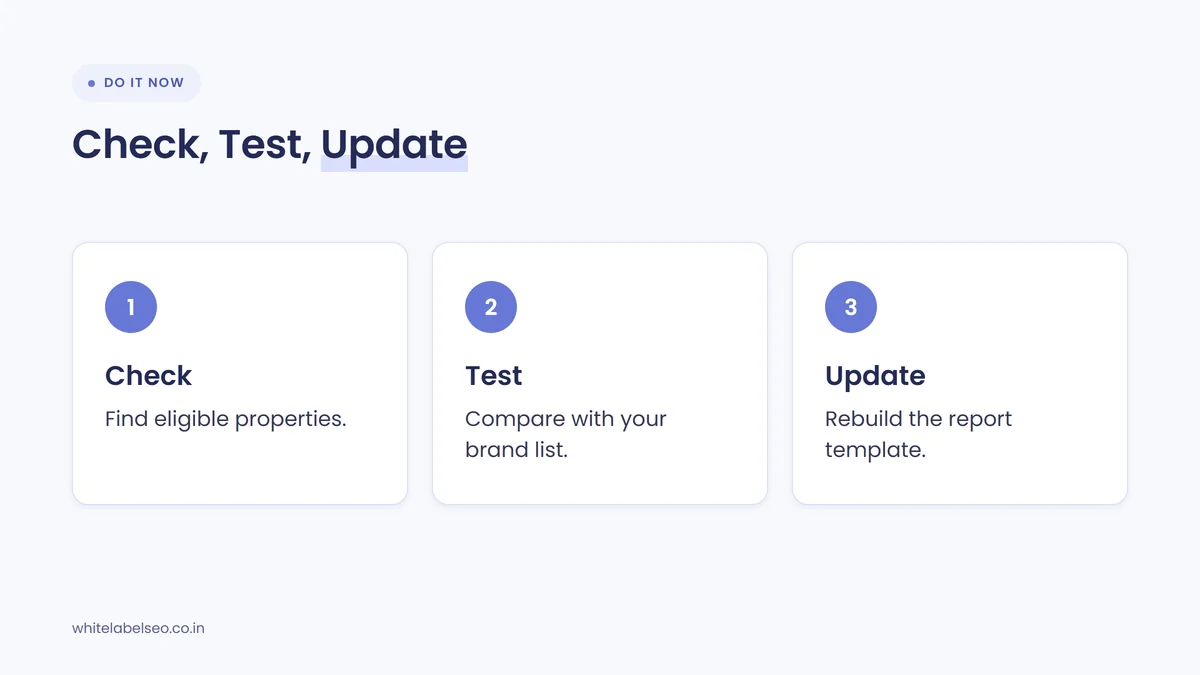
The 5 steps to add the Search Analytics API update to client reporting are listed below.
- Check each client property type in Search Console and note which are top-level (domain) properties eligible for branded queries.
- Run a
brandedClassificationrequest for each eligible client and compare it with your existing brand regex for the same dates. - Request the
webMultimodaltype for product, retail and local clients, and add it to the report only where it returns rows. - Replace merged regional requests with
filterListsfor clients reporting by region or by mobile and tablet together. - Ask your reporting tool vendor when its Search Console connector will support the new fields, and keep manual exports until it does.
How do you show SEO value when branded queries bring most clicks?
You show SEO value when branded queries bring most clicks by reporting non-branded clicks, impressions and leads as the SEO growth line, and branded clicks as context. Brand searches usually come from people who already know the business, so they reflect reputation and advertising as much as SEO.
The split also changes how a slow month reads. If total clicks dip because brand demand fell after a campaign ended, but non-branded queries kept growing, the SEO work is on track. Connecting that trend to leads and revenue is a separate job, covered in our guide to proving SEO ROI to clients when results take months.
Frequently asked questions
Does the branded queries filter affect Google rankings?
No, the branded queries filter does not affect Google rankings. Google states that the filter is designed to segment and analyze Search Console data and has no effect on how Google Search ranking works.
Can you correct a query that Google labels as branded by mistake?
No, Google’s documentation describes no way to edit or override a branded query label. The classification comes from Google’s AI-assisted system, so keep your own brand list for checks and explain small mismatches to clients as classification noise.
Does the Search Analytics API now include generative AI report data?
No, the November 16, 2026 update lists only 3 additions: branded queries, web multimodal and multi-country or multi-device filters. Data from the generative AI performance report is not among them.
Do URL-prefix properties get branded query data in the API?
No, URL-prefix and subdomain properties don’t get branded query data. Google limits the filter to top-level properties with enough queries and impressions, and the API returns no rows for properties that are not eligible.
Is web multimodal data the same as Google Images traffic?
No, web multimodal data is separate from Google Images traffic. Web multimodal covers searches that start with an image in Google Lens, Circle to Search and image uploads, while the Images tab stays under the image search type.
What should agencies do next?
Check which client properties are eligible for branded queries, run Google’s split next to your own brand list for a month or two, and rebuild the report template so non-branded queries sit at the top as the SEO growth line. Add web multimodal and regional views only where they return data.
If you want a partner that handles this reporting under your brand, see how our white label SEO services work for agencies at White Label SEO.
Want client reports that separate brand demand from SEO growth?
At White Label SEO, we build branded and non-branded reporting into the work we deliver under your agency’s name, with the data sources shown and the limits explained. Tell us how your client reports are built today, and we’ll show you what we would change.
Sources
- Google Search Central, “New filtering and reporting capabilities in the Search Analytics API”, November 16, 2026. https://developers.google.com/search/blog/2026/11/search-analytics-api-update
- Google Search Console API, “Search Analytics: query” reference, accessed November 17, 2026. https://developers.google.com/webmaster-tools/v1/searchanalytics/query
- Google Search Console API, “Usage limits”, accessed November 17, 2026. https://developers.google.com/webmaster-tools/limits
- Google Search Central, “Introducing the branded queries filter in Search Console”, November 20, 2025, updated March 11, 2026. https://developers.google.com/search/blog/2025/11/search-console-branded-filter
- Google Search Central, “Announcing web multimodal Search performance reporting in Search Console”, September 24, 2026. https://developers.google.com/search/blog/2026/09/web-multimodal-in-sc
- Search Engine Roundtable (Barry Schwartz), “Google Search Analytics API Adds Branded Queries, Multimodal & Country/Devices Filters”, November 16, 2026. https://www.seroundtable.com/google-search-analytics-api-addition-42544.html
- Antoine G (@singulierweb), post on X, November 16, 2026. https://x.com/singulierweb/status/2122359324995699039
- Marie Haynes (@Marie_Haynes), post on X, November 16, 2026. https://x.com/Marie_Haynes/status/2122350667268317254