Quick answer: Test a white label SEO partner with a small, paid trial on one client or one audit, run for 60 to 90 days. Check deliverable quality, method safety against Google’s spam policies, reporting, communication, client access and your margin. Keep ownership of every account, score the trial in writing, and agree exit terms before committing.
Key takeaways
- A white label SEO trial is a small, paid test of a partner’s real work under your brand, run before you commit more clients.
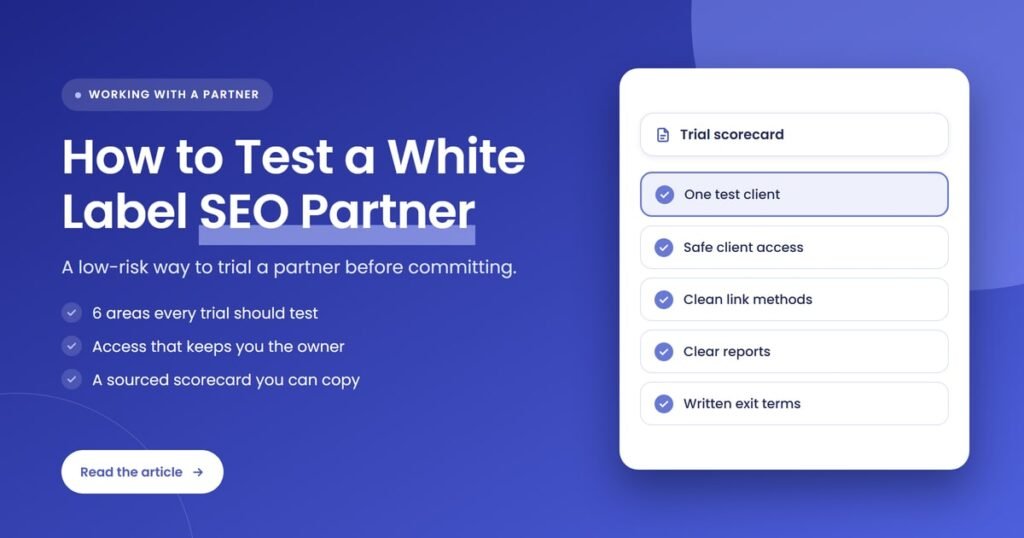
- The trial should test 6 things, in this order: deliverable quality, method safety, reporting, communication, client access and margin.
- The best test project is one you can check yourself: a paid audit, one client for one month, a content sample or a local SEO task.
- Safe methods mean no link spam, no scaled content abuse and nothing hidden, measured against Google’s spam policies.
- You stay the owner of Search Console and Google Business Profile; the partner gets a user or manager role.
- Run the trial for 60 to 90 days, price it like a real client month, and score it on a written trial scorecard with exit terms.
What is a white label SEO partner trial?
A white label SEO partner trial is a small, paid test in which a partner delivers real SEO work for one of your clients, or for your own agency, under your brand, so you can judge the work before committing more clients to that white label SEO partner. It is low risk because the scope, the time and the money are all capped.
The trial exists because the risk of white labeling sits with you, not with the partner. Your client sees your logo on every report, and if a link scheme triggers a penalty or a report misstates results, your agency answers for it. A trial lets you see how a partner handles real work, real deadlines and real access before that partner touches 10 or 20 accounts. It is the same logic we apply when agencies try our white label SEO services: start with one account, see the work, then decide.
A white label SEO trial is different from a free sample. A free blog post or a free audit shows what a sales team can produce once. A paid trial shows what the delivery team produces every month, which is what you are actually buying.
What should a white label SEO trial test?
A white label SEO trial should test 6 things, and deliverable quality comes first because it is the part your client sees. The other 5 are method safety, reporting, communication, client access and margin. A partner that passes on quality but fails on access or margin is still the wrong white label SEO partner for a reselling agency.
The 6 areas a white label SEO trial should test are listed below, in order of importance.
- Deliverable quality. Read every page, audit and link the white label SEO partner delivers. Check that recommended fixes were actually made, not just listed, and that content is accurate for the client’s industry.
- Method safety. The white label SEO partner’s link building and content methods should hold up against Google’s spam policies, with every link and page visible to you.
- Reporting. The trial report should be brandable, accurate and readable by your client without you translating it. Compare it against the 10 red flags in a white label SEO report before you forward it.
- Communication. Note how fast the white label SEO partner answers, who answers (a strategist or a salesperson), and how a missed deadline or mistake is reported.
- Client access. Watch how the white label SEO partner asks for access to Google Search Console and Google Business Profile, and whether it accepts a user role instead of ownership.
- Margin. Track your own hours spent reviewing and fixing the partner’s work. If your team rewrites half of it, the trial price hides the real cost.
Write these 6 areas into the trial agreement before the work starts. A test that is defined after the fact turns into a debate about feelings rather than a check against agreed facts.
Which test project should you give a white label SEO partner?
The best test project for a white label SEO partner is work you can check yourself within 30 to 90 days: a paid technical audit, one client for one month, a content sample of 2 to 4 pages, or a single local SEO task. Each option exposes a different part of the partner’s delivery, so choose the one closest to what you plan to resell.
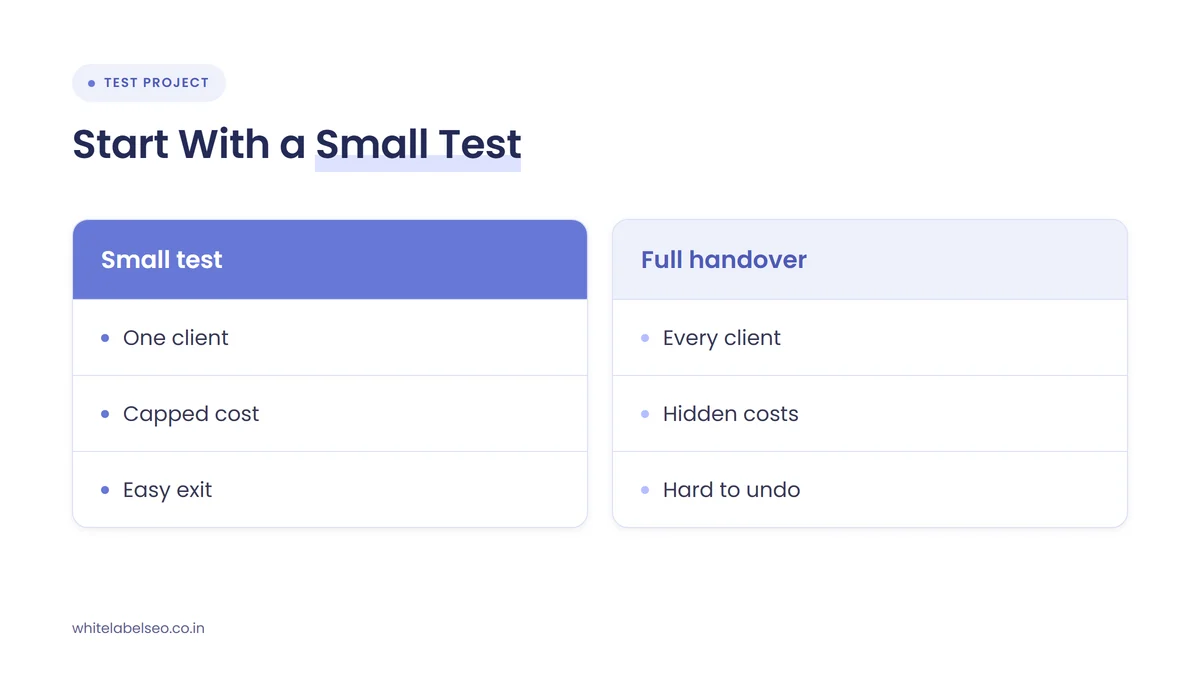
The 4 test projects that work best for a white label SEO trial are listed below, with what each one reveals.
- A paid technical audit. It shows how deep the white label SEO partner’s technical knowledge goes and whether its recommendations are prioritized or just pasted from a tool. You can check every finding yourself.
- One client for one month. It shows the full monthly cycle: onboarding questions, the work plan, delivery and the first report. Pick a client with a stable relationship, not your largest account.
- A content sample of 2 to 4 pages. It shows research quality, accuracy and tone. Have the pages written for a real client page, then check every fact and source.
- A single local SEO task. A Google Business Profile cleanup or a citation audit shows how the partner handles client access and local data.
Whatever you pick, the test project should match the monthly scope you want to resell. If you are unsure what that scope looks like, compare the trial plan with what a white label SEO partner does each month, so the test reflects month 6 and not only month 1.
How do you check a white label SEO partner’s methods are safe?
You check a white label SEO partner’s methods are safe by comparing every link and page it creates against Google’s spam policies, and by asking the partner to show its methods in writing before the trial starts. Safe methods are visible methods: a partner that won’t show where links come from fails this part of the test.
Google’s spam policies define link spam as “creating links to or from a site primarily for the purpose of manipulating search rankings”, and list buying or selling links for ranking purposes, excessive link exchanges and automated link programs as examples. The same policies cover scaled content abuse, where pages are generated mainly to manipulate rankings, and site reputation abuse. Google states that sites violating these policies may rank lower in results or not appear in results at all. For a reseller, that is a client lost and a reputation damaged.
The 5 checks that show whether a white label SEO partner’s methods are safe are listed below.
- Ask for the full link list with every live URL from the trial, then open each one and check that the site has real content and real readers.
- Ask how links are earned and whether any placement is paid. Paid placements for ranking purposes fall under link spam in Google’s spam policies.
- Check content for scale signals such as near-identical pages for different cities or topics, which point to scaled content abuse.
- Ask whether the partner follows Google Search Essentials, the question Google itself suggests in its “Do you need an SEO?” guide.
- Reject any promise of a top ranking. Google’s guide warns that no one can promise a first-place ranking and tells site owners to be careful with secretive SEOs.
Google’s “Do you need an SEO?” page also suggests asking “What kind of results do you expect to see, and in what timeframe?” Put that question to the partner in the trial kickoff and keep the answer, so you can hold the trial to it.
How should you give a white label SEO partner client access?
You should give a white label SEO partner client access as a full user in Google Search Console and a manager in Google Business Profile, while you or your client stay the owner. Ownership never moves to the partner during a trial, so client access can be removed in minutes if the test fails.
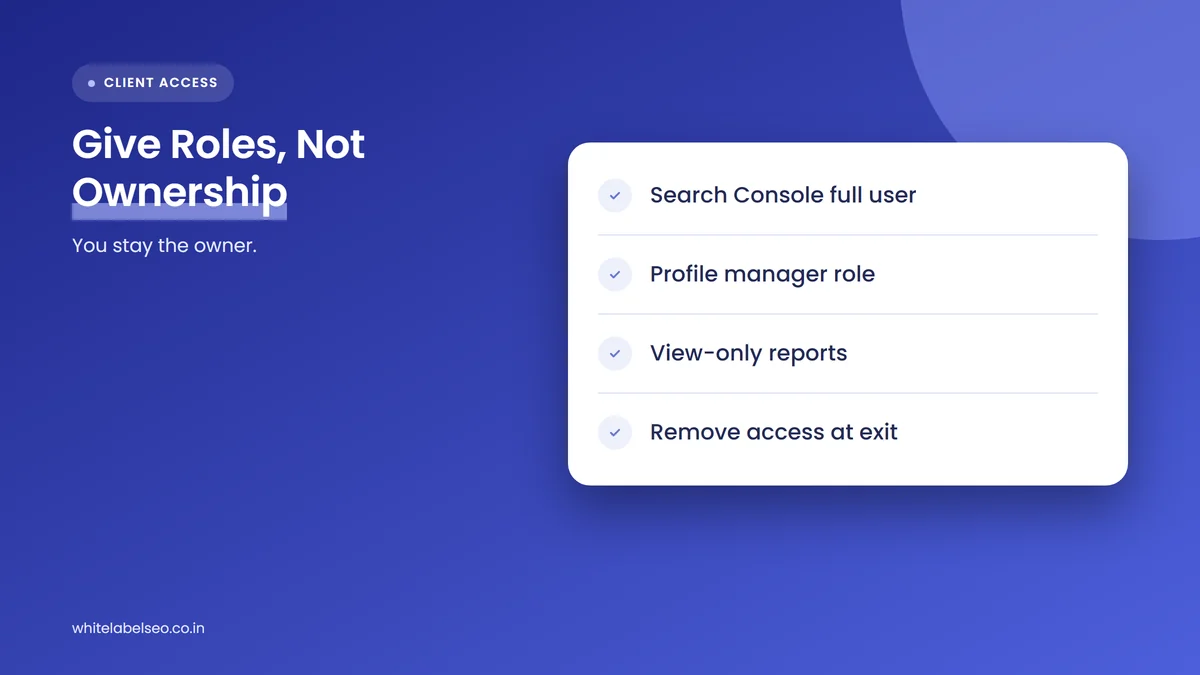
Google Search Console has 3 permission levels: owner, full user and restricted user. According to Google Search Console Help, only owners can add and remove users, and a property can have a maximum of 100 non-owners. A full user can view all data and take some actions, such as submitting a sitemap, which covers what a white label SEO partner needs. A restricted user has simple view rights on most data, which suits a trial that is limited to an audit.
Google Business Profile works the same way. Google Business Profile Help states that managers have mostly the same access as owners, except that they can’t add or remove users or remove the profile. It also states that a new owner or manager has to wait 7 days before managing some profile features, such as removing other users or transferring primary ownership. Plan the trial start date around that 7-day wait so the clock doesn’t start before the partner can work.
The client access rules for a white label SEO trial are listed below.
- Search Console role: full user for active work, restricted user for an audit-only trial.
- Google Business Profile role: manager, never owner or primary owner.
- Analytics and reports: view access to the reporting tool, such as a shared Looker Studio report, rather than admin rights.
- Website access: a named user account with the lowest role that allows the agreed fixes, removed when the trial ends.
How long should a white label SEO trial last?
A white label SEO trial should last 60 to 90 days. That is long enough to see one full delivery cycle, one or two reports and the first early indicators, and short enough to keep the risk small. A test project that is only an audit can finish in 30 days, but a monthly retainer test needs the full 60 to 90 days.
The timing follows how Google processes changes. Google’s SEO Starter Guide says each change takes time to be reflected in Google, from a few hours to months, and that you likely want to wait a few weeks to assess whether your work had beneficial effects. A white label SEO partner trial judged on rankings after 2 weeks is judged on noise.
A 90-day white label SEO trial splits into 3 parts. Days 1 to 30 test onboarding, access requests and the work plan. Days 31 to 60 test delivery: content, fixes and links. Days 61 to 90 test reporting and the early indicators, such as indexed pages, impressions in Search Console and fixed technical issues.
Is a 30-day trial enough?
No, a 30-day trial is not enough to judge a white label SEO partner on a monthly retainer, because results in Google take weeks to show. Thirty days is enough to judge onboarding, communication and the first deliverables, so use a 30-day test for audits and content samples, and a 60 to 90 day test for ongoing SEO.
How much should a white label SEO trial cost?
A white label SEO trial should cost the same as one real client month or one paid audit from that white label SEO partner, with no extra discount that hides the true price. In the wider SEO market, the most common monthly retainer is $501 to $1,000 and the most common per-project fee is $2,501 to $5,000, according to Ahrefs’ poll of 439 SEO providers, updated in August 2024.
The same Ahrefs poll found that 78.2% of SEO providers charge a monthly retainer and 48.9% charge per project, so both a one-month test and a one-off audit test are standard ways to buy a paid trial. A free trial looks cheaper, but it gives you a sample made to win the sale rather than a fair view of normal delivery.
Margin is the second half of the cost test. Sitechecker’s 2026 SEO agency growth report, a survey of 73 SEO agencies published in March 2026, found that 42.5% of agencies charge retainers under $1,000 a month and 41.1% run gross margins under 30%. Add your review and account management hours to the partner’s price, compare the total with what you charge the client, and check the gap against how much white label SEO costs at each service level.
How do you score a white label SEO partner trial?
You score a white label SEO partner trial with a written trial scorecard that gives each test area a pass mark and a sourced fact, agreed before the work starts. At the end of the test, mark each row pass or fail, and only move more clients to the white label SEO partner when every row passes.
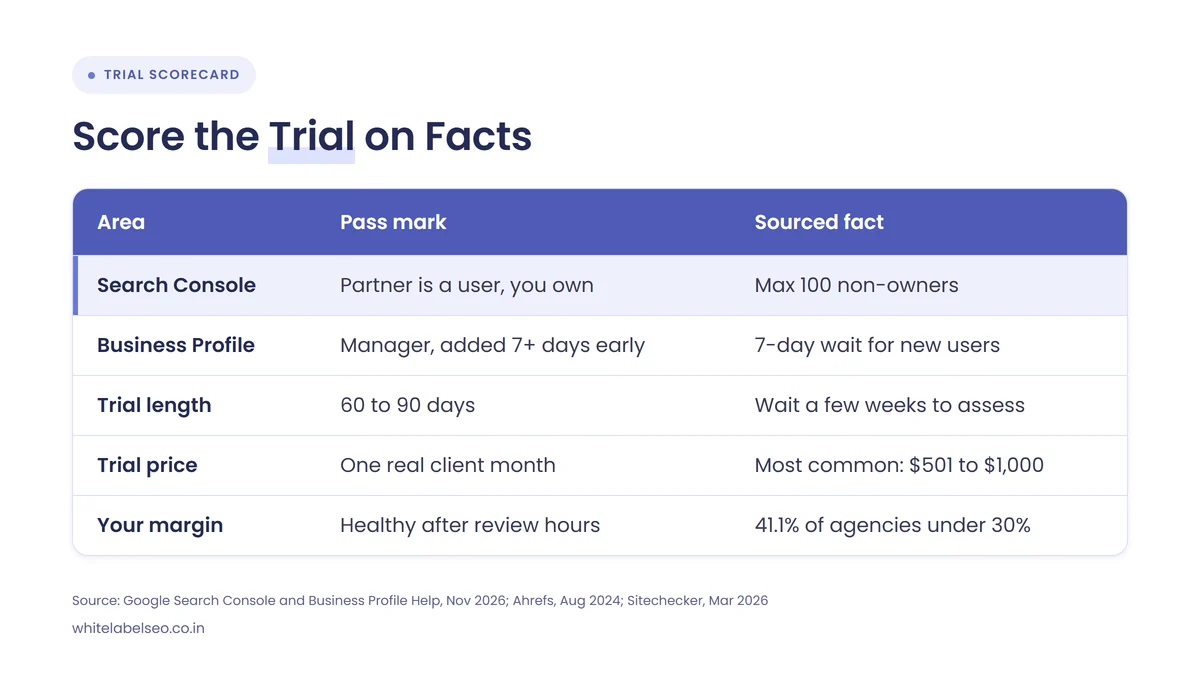
The trial scorecard below lists 6 scorecard areas in the order of this guide, each with a pass mark and the fact behind it.
| Scorecard area | Pass mark | Sourced fact | Source |
|---|---|---|---|
| Search Console access | Partner is a full or restricted user; you stay owner | Only owners add users; max 100 non-owners per property | Google Search Console Help, accessed Nov 2026 |
| Business Profile access | Partner is a manager, added 7+ days before work starts | New owners and managers wait 7 days for some features | Google Business Profile Help, accessed Nov 2026 |
| Link methods | Zero paid or exchanged links for ranking purposes | Link spam can make a site rank lower or not appear at all | Google Search Central, spam policies |
| Trial length | 60 to 90 days for ongoing SEO, judged on delivery first | Wait a few weeks to assess whether changes worked | Google Search Central, SEO Starter Guide |
| Trial price | Priced as one real client month or one paid audit | Most common retainer $501 to $1,000; 78.2% of 439 providers use retainers | Ahrefs, August 2024 |
| Your margin | Margin stays healthy after your review hours | 41.1% of 73 agencies run gross margins under 30% | Sitechecker, March 2026 |
The table shows that 4 of the 6 pass marks rest on Google’s own documentation and 2 rest on industry surveys, so every row can be checked rather than argued.
Add one more line under the scorecard: the exit terms. Agree in writing that the trial ends on a set date, that no 12-month contract starts automatically, and that all work, logins and reports stay with your agency if you stop. A white label SEO partner that refuses clear exit terms has failed the test before it starts. For the wider list of contract points, read what to look for in an SEO reseller program before you sign.
What happens after a white label SEO partner passes the test?
After a white label SEO partner passes the test, you move clients over in small steps, usually 2 to 3 more accounts at a time, while keeping the same scorecard. A passed trial proves the partner can handle one account; it doesn’t yet prove it can handle 20.
Keep scoring each new account for its first 90 days, and keep the review hours you tracked in the trial as your benchmark. If quality drops as volume rises, pause the rollout before it reaches your largest clients. Sitechecker’s 2026 report found that 17.8% of agencies name client churn as a growth constraint, and an untested jump in volume is one of the quickest ways to add to it. The full rollout, from pilot client to client portfolio, is covered in our guide to running a pilot project before you commit to a white label SEO partner.
Frequently asked questions
Should you expect a free trial from a white label SEO partner?
No, you shouldn’t expect a free trial from a white label SEO partner, and you are better off paying. A paid trial gets the normal delivery team and normal deadlines, so you test what you will actually resell. A free sample is useful only as a first look at writing or audit quality.
Should you tell your client that a new partner is being tested?
You don’t need to name the white label SEO partner, but you should tell the client what work is happening and when. Present the trial work as your agency’s work, as you would any white label delivery, and keep the client’s account ownership unchanged so nothing about their access depends on the test.
Can you test two white label SEO partners at once?
Yes, you can test two white label SEO partners at once if each one gets a similar test project and the same trial scorecard. Give them comparable clients or the same audit brief, run both for the same 60 to 90 days, and compare the scores row by row.
What if the white label SEO partner underdelivers during the trial?
If the white label SEO partner underdelivers, raise it in writing with the scorecard row it failed and give one chance to fix it within the trial. If the same row fails again, end the trial on the agreed exit terms, remove the partner’s access and keep every deliverable already paid for.
Do freelancers test a white label SEO partner the same way?
Yes, freelancers test a white label SEO partner the same way, with one change: the test project should be smaller, usually one audit or one client month. A freelancer has less review time, so the communication and margin rows of the trial scorecard matter even more.
What should you do next?
Pick one test project, write the 6 scorecard areas and their pass marks into a one-page trial agreement, and add the exit terms before you contact any partner. Then set up access with you as owner, start the 60 to 90 day clock, and score the white label SEO partner on facts at the end.
If you want a partner that expects to be tested this way, see how our white label SEO services start with one account at White Label SEO.
Want to test a white label SEO partner on one account first?
At White Label SEO, we start agencies with a single paid test project under their brand, with them as owner of every account and the work shown in full. Tell us which client or audit you want to test, and we’ll scope the trial with you.
Sources
- Google Search Central, “Spam policies for Google web search”, accessed November 16, 2026. https://developers.google.com/search/docs/essentials/spam-policies
- Google Search Central, “Do you need an SEO?”, accessed November 16, 2026. https://developers.google.com/search/docs/fundamentals/do-i-need-seo
- Google Search Central, “SEO Starter Guide”, accessed November 16, 2026. https://developers.google.com/search/docs/fundamentals/seo-starter-guide
- Google Search Console Help, “Managing owners, users, and permissions”, accessed November 16, 2026. https://support.google.com/webmasters/answer/7687615
- Google Business Profile Help, “Manage your Business Profile owners & managers”, accessed November 16, 2026. https://support.google.com/business/answer/3403100
- Ahrefs, “SEO Pricing: How Much Does SEO Cost? 439 People Polled”, updated August 15, 2024. https://ahrefs.com/blog/seo-pricing/
- Sitechecker (Ivan Palii), “The 2026 SEO agency growth report”, March 11, 2026. https://sitechecker.pro/seo-agency-growth-data-study-2026/