Quick answer: White-label SEO usually costs an agency a fixed wholesale fee per client each month, or a set price per task such as a link, a page or a location. Published wholesale packages run from a few hundred dollars to several thousand a month. Scope, competition, content volume, link building, reporting and AI search work move the price most.
Key takeaways
- There is no single market rate. Published white-label price lists we reviewed range from $40 for a single content refresh to $5,000 a month for a top-tier AI visibility package.
- Four pricing models dominate: monthly packages, per-task pricing, per-location pricing and hourly billing. Each one moves risk between you and your partner in a different way.
- Price follows workload. Competition, content volume, link building and AI search work add the most cost; reporting and account access add less.
- Price from your total cost, not the wholesale fee alone. Account management, sales time and tools sit on top of what you pay the partner.
- Very low prices usually mean less work, automated work or risky links. Ask for a written scope with quantities before comparing quotes.
What is white-label SEO pricing?
White-label SEO pricing is the wholesale rate an agency pays a fulfillment partner to deliver SEO under the agency’s own brand. The agency then sets its own retail price for the client. The gap between the two, minus the agency’s own costs, is the reseller’s margin.
Two prices are always in play. The wholesale price is what you pay the partner for a defined scope. The retail price is what your client pays you for the same scope plus your strategy, account management and relationship. Most confusion about “how much white-label SEO costs” comes from mixing the two, so every figure in this guide says which one it is.
How much does white-label SEO cost?
Published wholesale prices show a wide spread. Monthly managed packages from named providers start at a few hundred dollars per client and climb past $1,500, while specialist AI visibility tiers reach $5,000 a month. Retail SEO retainers that clients pay agencies sit higher, because they include the agency’s own time and margin.
These are market examples from providers that publish their prices. They are not our prices, and they change, so check each page before you quote against them.
| Market example | Price type | Published price | What it covers |
|---|---|---|---|
| SEOReseller, Organic Plus | Wholesale, monthly package | $600 a month | Technical setup and reporting, copywriting for 4 pages, metadata for 10 pages |
| SEOReseller, Organic Premium | Wholesale, monthly package | $1,080 a month | Copywriting for 7 pages, metadata for 20 pages |
| SEOReseller, Organic Prime | Wholesale, monthly package | $1,600 a month | Copywriting for 10 pages, metadata for 30 pages, analytics setup and more |
| The HOTH, Managed SEO (HOTH X) | Wholesale, monthly | $1,000 a month and up | Managed SEO scoped to the client |
| The HOTH, AI Discover | Wholesale, monthly tiers | $775 to $5,000 a month | AI search visibility work, with a three-month minimum |
| The HOTH, Citation Cleanup | Wholesale, per location | $399 per location | One-time local citation fix |
| The HOTH, Content Refresh | Wholesale, per task | $40 to $125 per post | Updating an existing article, priced by length |
| Ahrefs survey of 439 SEO providers | Retail, monthly retainer | Most common band: $501 to $1,000 a month | What SEO providers charge their own clients (2024) |
Ahrefs’ survey, last updated in August 2024, also found that agencies averaged $3,209 a month on retainers, consultancies $3,250 and freelancers about $1,349. That is retail pricing, so read it as a sense of what end clients already pay, not as a wholesale benchmark.
What pricing models do white-label SEO partners use?
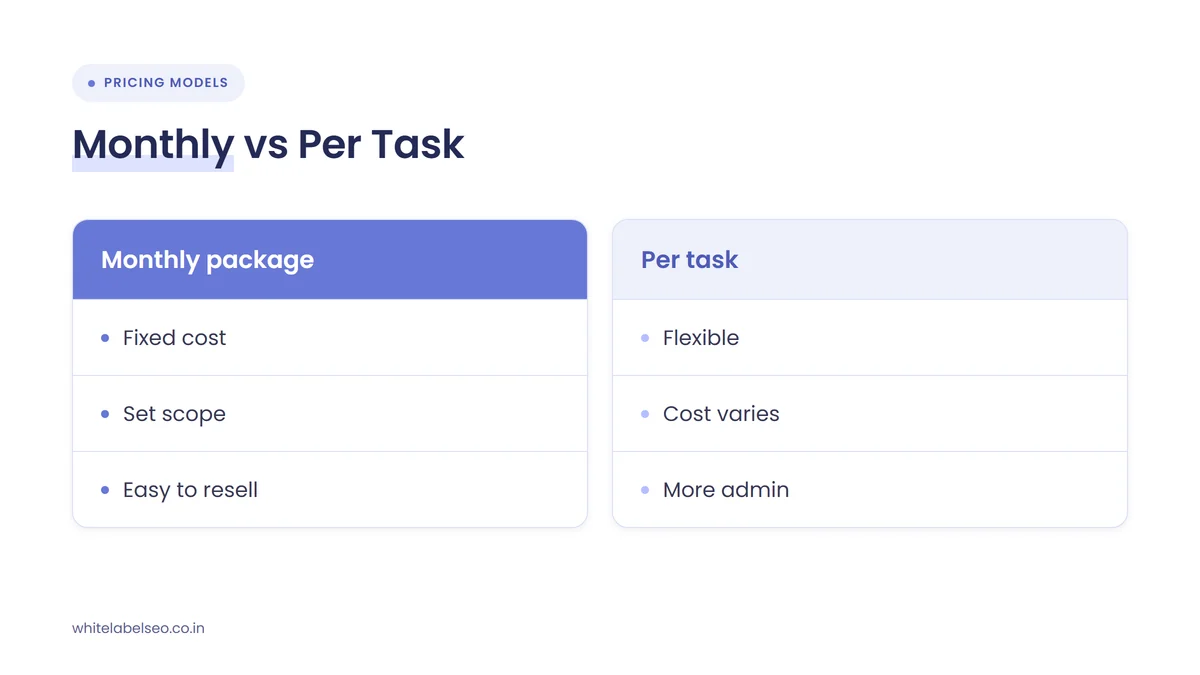
White-label SEO partners charge in four main ways: a fixed monthly package per client, a set price per task, a price per business location, or an hourly rate. Many partners mix them, for example a monthly package plus one-time location fixes, so read every line of a quote to see which model applies to which work.
Monthly package per client
You pay a fixed fee each month for a defined scope on one client site. SEOReseller, for example, notes that its monthly prices are based on a single site and that multiple sites need a separate quote. This model is the easiest to resell because your cost per client is known before you sign the client.
Per task
You pay for each deliverable: a link, an article, a content refresh, an audit. It suits agencies that want to add one service at a time or top up a client’s plan. The risk is cost drift, because the bill depends on how much work each client needs that month.
Per location
Local SEO work is often priced per business location, because each location needs its own Google Business Profile, citations and local pages. The HOTH’s Citation Cleanup at $399 per location is one published example. For multi-location clients, ask whether the price is per location, per site or per account.
Hourly
Hourly billing is more common in consulting than in white-label fulfillment. In Ahrefs’ survey, 34.8% of SEO providers charged hourly, with agencies averaging $98.90 an hour and freelancers $71.59. Hourly suits strategy or migration work with an unclear scope, but it is hard to resell at a fixed client price.
| Model | Best for | Your cost is | Watch out for |
|---|---|---|---|
| Monthly package | Ongoing retainers for single-site clients | Fixed per client | Vague scope that hides how much work is done |
| Per task | Adding one service, or topping up a plan | Variable each month | Bills that grow faster than the client’s fee |
| Per location | Local and multi-location clients | Fixed per location | One-time fixes billed as if they were recurring |
| Hourly | Strategy, audits, migrations | Open-ended | No cap on hours, hard to price for the client |
What changes the price of white-label SEO?
Six things move the price most: how much of the site is in scope, how competitive the client’s market is, how much content is produced each month, whether link building is included, how detailed and branded the reporting is, and whether AI search visibility work is part of the plan. Each one adds hours, specialist time or third-party cost.
- Scope. A ten-page local service site needs far less work than an ecommerce store with thousands of product pages. SEOReseller’s tiers, for example, step up mainly by the number of pages written and optimized each month.
- Competition. A plumber in a small town and a personal injury lawyer in a large city need very different effort to move. Competitive markets need more content and more authority work every month.
- Content volume. Writing, editing and publishing pages is usually the largest recurring cost. Ask how many pages or articles each month includes, and their length.
- Link building. Earned links take outreach time, and some providers price them per link by the linking site’s authority. Link work is often the line that separates cheap packages from real ones.
- Reporting. White-label reports carry your branding and need someone to explain them. Monthly reports cost less than weekly ones, and dashboards connected to your own tools can add setup work.
- AI search work. Tracking and improving how a client appears in AI answers is now sold as its own line by some providers. The HOTH’s AI Discover tiers, from $775 to $5,000 a month, are one example of how widely that work is priced.
If you want to see what this work looks like in practice, our breakdown of what a white-label SEO partner does each month walks through a typical month of deliverables.
How should resellers think about markup and margin?
Resellers should set the client price from their total cost to serve the client, not from the wholesale fee alone. Add the partner’s fee, your account management time, sales cost and tools, then apply your target margin. Check the result against what clients in that market already pay before you send a proposal.
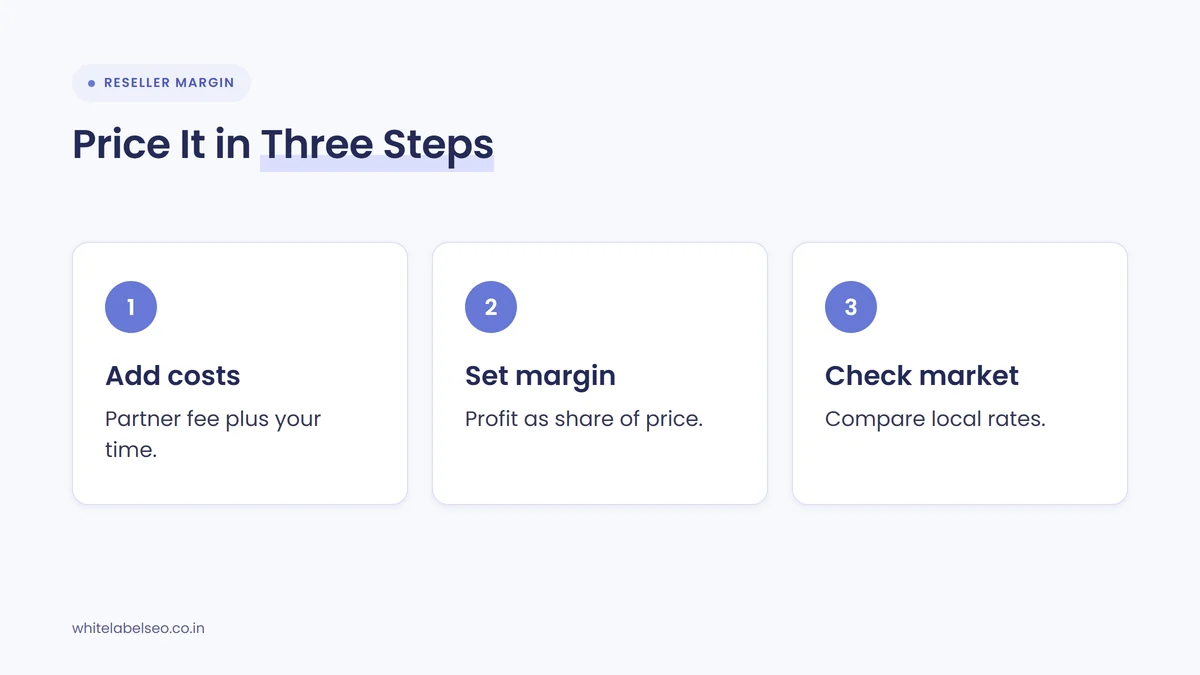
- Add up your true cost. Take the wholesale fee and add the hours you spend on calls, emails, reviewing reports and selling, multiplied by what those hours cost you. Add a share of your tools.
- Choose a margin, not a markup. Margin is profit as a share of the price; markup is profit as a share of cost. A partner fee of $600 sold at $1,200 is a 100% markup but a 50% gross margin, before your own time.
- Check it against the market. Compare your price with what clients in that niche and city already pay. Ahrefs’ survey is one reference point for retail retainers, though it is now two years old.
- Price against the client’s return. The HOTH advises pricing a package against the client’s expected return rather than your wholesale cost. A dentist or lawyer with high-value clients can justify a higher fee than a low-ticket local business.
- Separate one-time work. Charge setup, audits and location cleanups as one-time fees so the monthly retainer reflects steady work.
On margins themselves, the only figures we found are provider-published. The HOTH says most of its resellers land between 40 and 60 percent, with managed monthly products at the higher end. Treat that as one provider’s view, not a market standard. For a worked approach to margins, see our guide to pricing white-label SEO for healthy agency margins, and if you are weighing a hire instead, compare the real cost of an in-house SEO team versus a white-label partner.
Should you publish prices to your own clients?
Showing clear prices, or at least clear starting prices, usually helps agencies close faster. Business owners compare options online before they call, and hidden pricing reads as expensive or evasive. If your partner gives you fixed wholesale costs, publishing your own retail tiers becomes simple, because your margin per tier is already known.
Buyers say this openly. In a post on X this week, one user put it simply:
“If your website says “call for pricing,” you’ve already lost me.”
@Salvx12 on X, November 11, 2026 (source)
The same applies when you shop for a partner. Ask for a written price per deliverable before you sign anything, so you can turn it into client tiers. Our guide to packaging SEO into tiered retainers clients understand shows how to present those tiers, and our post on writing an SEO proposal that wins retainers covers where the price belongs in the proposal.
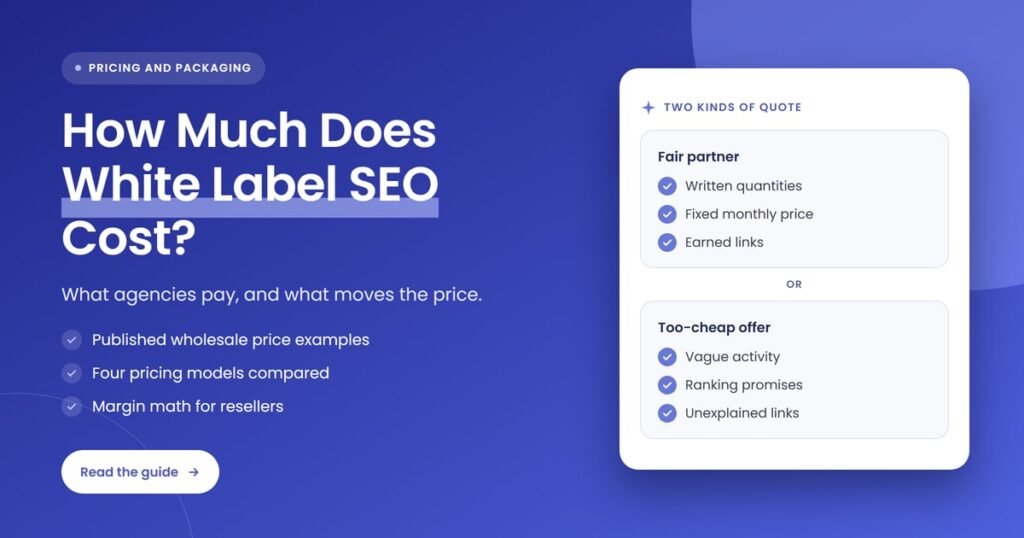
What are the red flags of a too-cheap white-label SEO offer?
A white-label offer is too cheap when the price cannot cover the work it claims to include. Common signs are no written quantities, ranking promises, unexplained link packages, automated reports with no analysis, and no access to the client’s own Search Console or analytics. Cheap work that fails costs you the client, which is far more expensive.
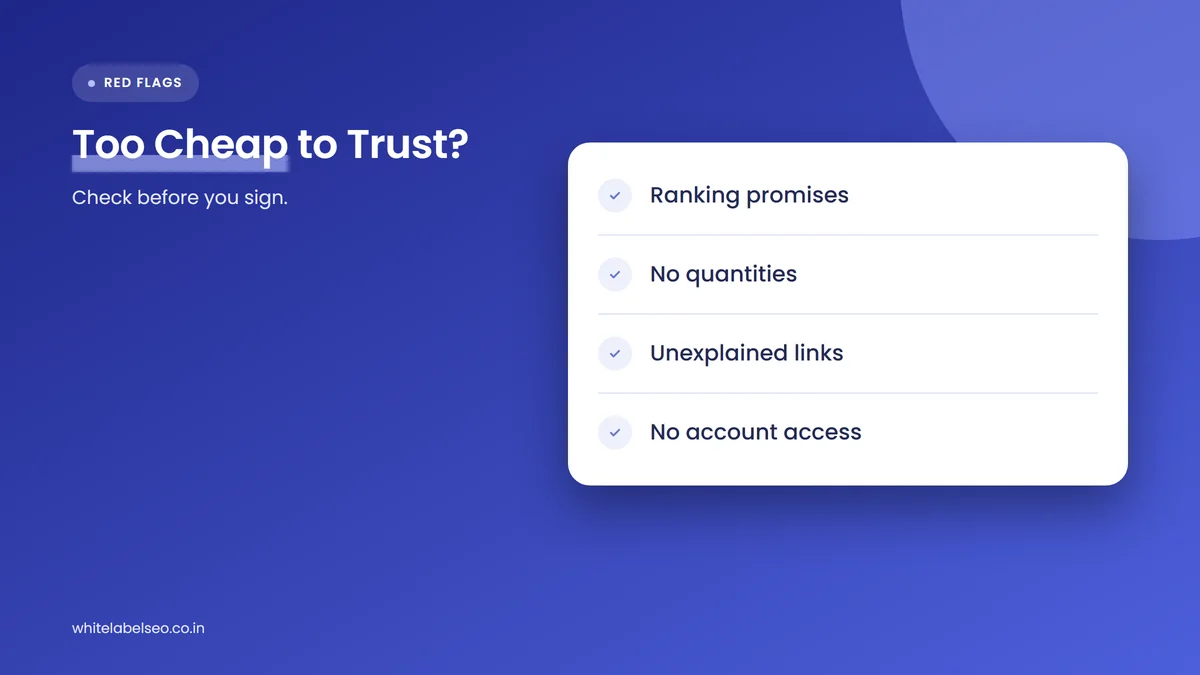
- Ranking promises. Google’s own guidance on hiring an SEO says to find someone else if a provider promises first place in search results. A partner that promises rankings is promising something no one controls.
- No quantities. “Ongoing optimization” with no page, article or link counts makes it impossible to check what you paid for.
- Unexplained links. Ask how links are earned and where they appear. Google’s spam policies treat buying or selling links for ranking purposes as link spam, which can put your client’s site at risk.
- Secretive methods. Google also warns against SEOs who are secretive about what they do. Your partner should explain every change, even if your client never sees their name.
- Reports without analysis. A raw tool export each month is cheap to produce and says little. Our list of red flags in a white-label SEO report covers what to look for.
- No access for you. If the partner will not work inside the client’s own Search Console and analytics accounts, you cannot verify results, and you lose the data if you change partners.
Frequently asked questions
Is white-label SEO cheaper than hiring an in-house SEO specialist?
For most small and mid-sized agencies, yes, because you pay for the work clients need rather than a full salary, benefits and tools. The balance changes once you have enough steady SEO work to keep a full team busy. Compare the total monthly cost of both options against your current client load.
Do white-label SEO partners charge setup fees?
Some do and some do not. Setup or onboarding fees usually cover the first audit, tracking setup and technical fixes, which take more work than later months. Ask whether a setup fee exists, what it covers, and whether the first month’s retainer already includes that work.
Are white-label SEO contracts long term?
It depends on the provider. Some ask for a minimum term on certain services, such as the three-month minimum on The HOTH’s AI Discover tiers, while others work month to month. Match your partner’s terms to the terms you offer clients so you are never locked in longer than they are.
How much should I charge clients for white-label SEO?
Charge enough to cover the partner’s fee, your own account management and sales time, and tools, plus your target margin. Then check that number against what businesses in that niche and city already pay. Price higher for clients whose customers are worth more, since SEO returns more for them.
Why do white-label SEO quotes vary so much?
Quotes cover different amounts of work. One package may include ten pages of new content and earned links each month, while another covers only metadata updates and an automated report. Compare quotes line by line on quantities, link methods and reporting, not on the monthly total alone.
What should you do next?
Gather the quotes you have, or the wholesale prices you pay today, and lay them side by side with the quantities each one includes. Work out your true cost per client, choose the margin you need, and check the result against your market. Then turn it into two or three client tiers with clear prices. At White Label SEO, we work on fixed monthly pricing with no long-term contracts, so you can set your own margins with confidence. See what is included in our white-label SEO services.
Want a fixed wholesale price you can build margins on?
We deliver SEO under your agency’s brand on fixed monthly pricing, with a written scope and reporting you can put in front of clients. Tell us about your clients, and we will send a clear quote you can turn into your own tiers.
Sources
- Ahrefs, “SEO Pricing: How Much Does SEO Cost? 439 People Polled”, updated August 15, 2024. https://ahrefs.com/blog/seo-pricing/
- SEOReseller, “Monthly SEO: Packages and Services”, accessed November 14, 2026. https://www.seoreseller.com/monthly-seo-packages/
- The HOTH, “SEO Reseller Packages: How to Build Them and What They Cost You”, August 6, 2026. https://www.thehoth.com/blog/seo-reseller-products/
- Google Search Central, “Do you need an SEO?”, last updated June 5, 2026. https://developers.google.com/search/docs/fundamentals/do-i-need-seo
- Google Search Central, “Spam policies for Google web search”, last updated August 28, 2026. https://developers.google.com/search/docs/essentials/spam-policies
- @Salvx12 on X, November 11, 2026. https://x.com/Salvx12/status/2120516918750626270