Quick answer: Google’s John Mueller said in early November 2026 that AI systems build on traditional SEO, so technical SEO stays important for AI search. Tell clients that AI features can only use pages they can crawl, index and read, then scope crawl access, indexing and text content as named deliverables and report them every month.
Key takeaways
- Mueller said AI systems build on SEO and that technical SEO in particular will stay very relevant, as reported by Search Engine Journal on November 2, 2026.
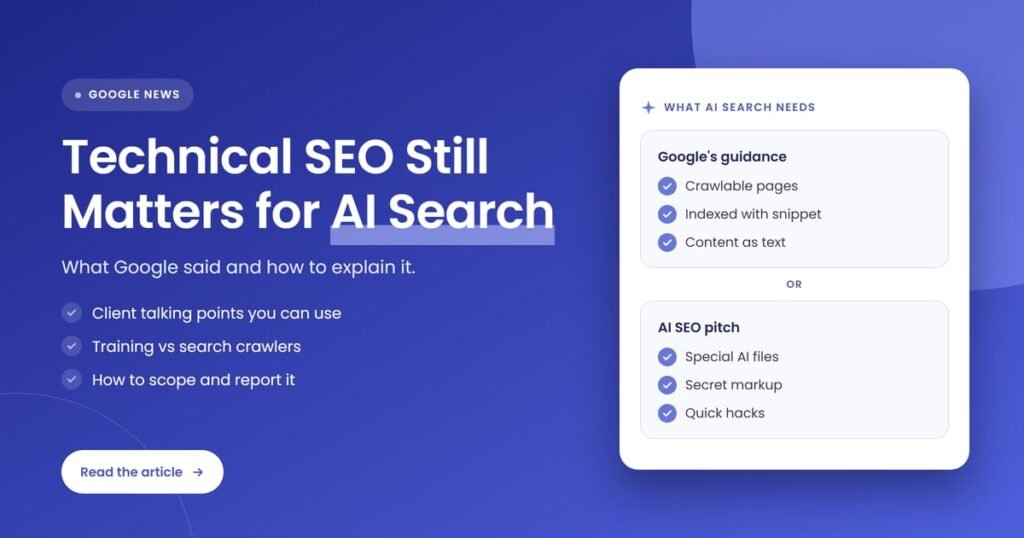
- Google’s own documentation says a page must be indexed and eligible for a snippet to appear as a supporting link in AI Overviews or AI Mode, with no extra AI-specific requirements.
- AI crawlers can behave differently from search crawlers, for example crawling for model training versus fetching fresh content. Mueller called this another flavor of technical SEO.
- Clients will hear pitches for special AI files and secret markup. Google says neither is needed, so give clients a simple way to check vendor claims.
- Scope technical work for AI visibility as crawl access, indexing, rendering and text content, and report each one in plain language.
What did Google say about technical SEO and AI search?
In an interview with David Iwanow, covered by Search Engine Journal on November 2, 2026, Google’s John Mueller said many AI systems build on SEO, so technical SEO will stay relevant. He added that AI crawlers may crawl differently, and that small businesses should question what their SEO vendors are doing.
Search Engine Journal’s Roger Montti reported several points from the interview. The ones that matter most for technical work are these:
- AI builds on SEO. Mueller said “a lot of the AI systems, they build on SEO,” and that “especially technical SEO is going to remain very relevant.”
- AI crawling has different intents. He said AI systems likely crawl slightly differently, depending on whether they want content for training or the freshest content, and described that as another flavor of technical SEO rather than a break from it.
- Foundations beat tactics. He said short-term tactics tend to stop working, while a stable, high-quality foundation lasts.
- Check your vendors. He said businesses should question what their vendors are doing instead of taking an SEO company’s word for it.
The interview also covered listicles, which other outlets are writing about. Here we focus on the part agencies have to sell and explain: the technical work.
What does Google’s documentation say about AI features?
Google’s “AI features and your website” page says there are no additional requirements to appear in AI Overviews or AI Mode. A page needs to be indexed and eligible to show in Search with a snippet. No special files, AI text files or special schema markup are needed, so standard technical SEO is the entry ticket.
The same page lists best practices that read like a technical SEO checklist:
- Allow crawling in robots.txt and in any CDN or hosting setup.
- Make content easy to find through internal links.
- Provide a good page experience.
- Keep important content available as text.
- Make sure structured data matches what is visible on the page.
- Verify the site in Search Console to find and fix technical issues.
Google also notes that traffic from AI Overviews and AI Mode is counted in the Search Console Performance report under the “Web” search type. Mueller’s comments and Google’s documentation point the same way: if a page fails basic technical checks, AI features have nothing to work with.
What is technical SEO for AI search?
Technical SEO for AI search is the work that lets search engines and AI systems reach, render, index and understand a site’s pages. It covers crawl access, indexing, site structure, rendering, page experience and structured data. It is the same discipline as classic technical SEO, with extra attention to how different AI crawlers are allowed in.
The “AI” part mostly adds one layer: there are now more crawlers to manage, and they do different jobs. A site that blocks the wrong one, or hides its main content behind scripts a crawler cannot render, can drop out of answers even if it ranks well in classic results.
How do AI crawlers differ from search crawlers?
Some AI crawlers collect content to train models, while others fetch pages to answer a question or power a search feature. Each one is controlled separately. Blocking a training crawler is a business decision that usually leaves search visibility alone, but blocking a search or fetching crawler can remove a client from AI answers.
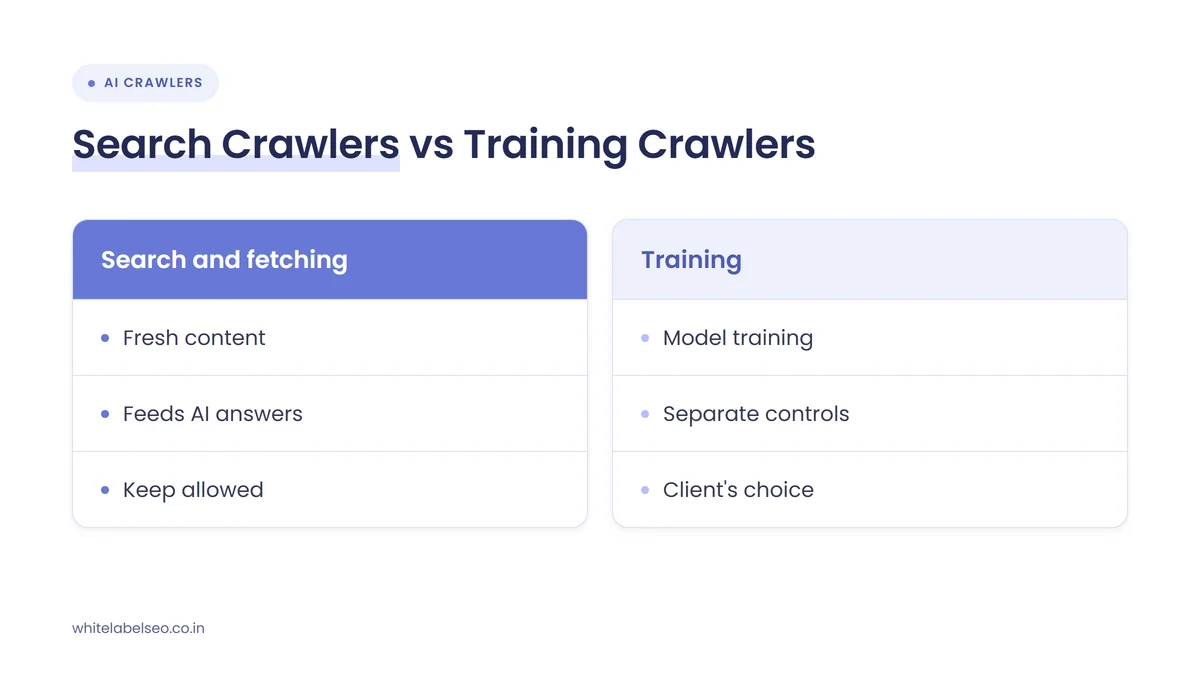
Two official sources show the split clearly:
- Google. Google-Extended is a robots.txt token that controls whether content Google crawls may be used to train future Gemini models and for grounding in Gemini. Google states that Google-Extended does not affect a site’s inclusion in Google Search and is not used as a ranking signal. AI Overviews and AI Mode are controlled through normal Googlebot rules and snippet controls such as
nosnippet. - OpenAI. OpenAI lists separate crawlers. OAI-SearchBot surfaces websites in ChatGPT search, GPTBot crawls content that may be used for model training, and ChatGPT-User handles some user-initiated actions. OpenAI says each robots.txt setting is independent of the others.
| Crawler or control | What it does | If the client blocks it | What to tell the client |
|---|---|---|---|
| Googlebot | Crawls for Google Search, including AI Overviews and AI Mode | Pages drop out of Search and its AI features | Never block it on pages you want found |
Snippet controls (nosnippet, max-snippet) |
Limit what Google shows from a page in Search | Less of the page can appear in results and AI features | Use only where content truly must not be quoted |
| Google-Extended | Controls use of content for Gemini training and grounding | No effect on Google Search inclusion or ranking, per Google | A business choice about AI training, not an SEO setting |
| OAI-SearchBot | Surfaces sites in ChatGPT search features | The site may not appear in ChatGPT search answers | Allow it if ChatGPT visibility matters to the business |
| GPTBot | Crawls content that may be used to train OpenAI models | Signals content should not be used for training | Separate from ChatGPT search visibility, per OpenAI |
This is what Mueller meant by another flavor of technical SEO. The audit now includes checking robots.txt, firewall and CDN rules for each of these agents, and agreeing with the client which ones they want to allow.
Who is affected by this?
Every agency and freelancer selling SEO is affected, because clients now ask whether SEO still matters in an AI world. Clients most at risk are those with recent site migrations, heavy JavaScript builds, aggressive bot protection, or a vendor selling “AI SEO” as a separate service with no technical work behind it.
- Agencies reselling SEO. You need a clear answer when a client asks why they should keep paying for technical work if AI answers are taking clicks.
- Clients behind a CDN or bot protection. Security settings can block crawlers without anyone on the marketing side noticing.
- JavaScript-heavy sites. Important text that only appears after scripts run is harder for crawlers to read, and Google advises keeping important content available as text.
- Clients being pitched “AI SEO” shortcuts. Mueller’s advice to question vendors applies directly here.
What should agencies tell clients about technical SEO and AI search?
Tell clients that AI search has not replaced SEO; it sits on top of it. AI features in Google can only cite pages that are indexed and eligible for a snippet, and other AI tools need to crawl a page before they can use it. Technical SEO is how the business stays eligible for both.
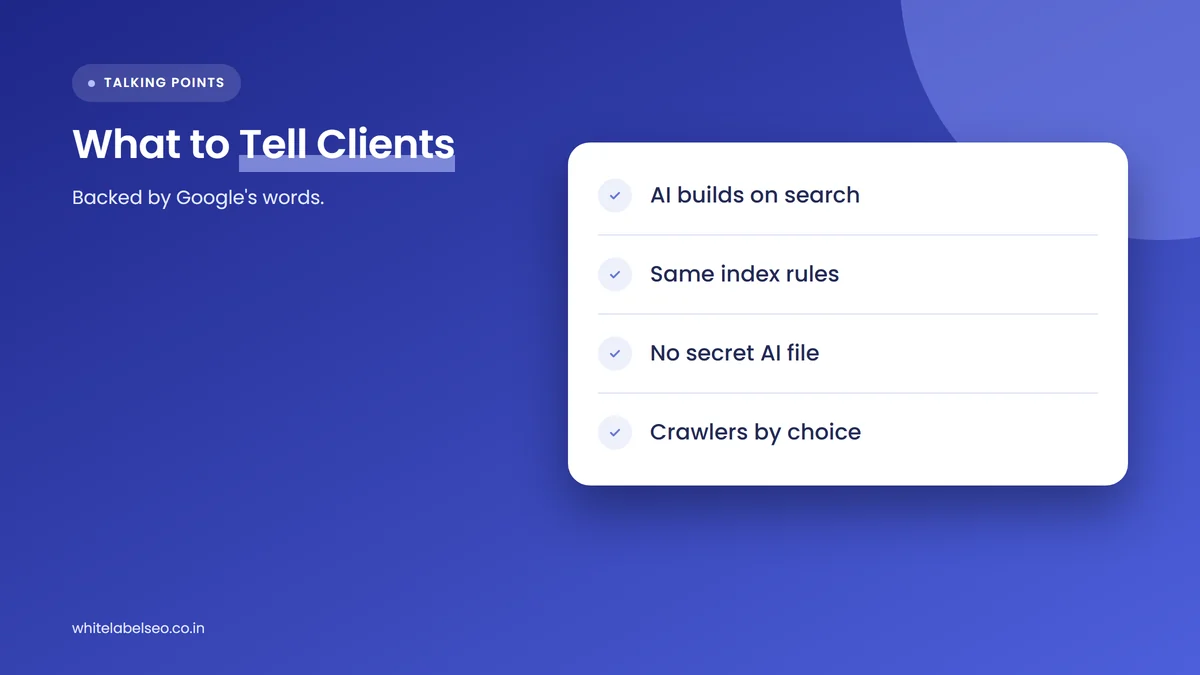
Use these talking points on calls and in monthly reports. Each one is backed by a public source, so you are not asking the client to take your word for it:
- “AI answers are built on search.” Google’s John Mueller said AI systems build on SEO and that technical SEO will stay very relevant.
- “Google’s AI features use the same index.” Google says a page must be indexed and eligible for a snippet to appear as a link in AI Overviews or AI Mode.
- “There is no secret AI file.” Google says no new machine-readable files, AI text files or special schema markup are needed for its AI features.
- “We manage AI crawlers on purpose.” Training crawlers and search crawlers are controlled separately, and we agree with you which ones to allow.
A short message you can adapt for clients who ask:
“Google confirmed this month that AI search builds on traditional SEO, and that technical SEO stays important. Google’s AI features can only link to pages that are indexed and eligible for a snippet, so the crawl, indexing and site health work in your plan is what keeps you eligible. We are also checking which AI crawlers can reach your site, and we will confirm with you which ones you want to allow.”
How should agencies scope technical SEO work for AI visibility?
Scope technical work for AI visibility as named, checkable deliverables: crawl access for search and AI crawlers, indexing coverage of key pages, rendering of important content as text, internal linking, structured data that matches the page, and page experience. Then state how often each is checked and what the client will see in the report.
| Deliverable | What we check | How often | What the client sees |
|---|---|---|---|
| Crawl access | robots.txt rules, CDN and firewall settings for Googlebot and the AI crawlers the client allows | Monthly, and after any site or hosting change | A short list of allowed and blocked crawlers, with any changes |
| Indexing coverage | Search Console page indexing for priority pages, noindex tags, canonicals | Monthly | Priority pages indexed, plus issues fixed |
| Rendering and text content | Whether key content and links are present in the HTML a crawler sees | Quarterly and after redesigns | Pages fixed and what changed |
| Internal linking | Orphan pages and links to key service pages | Quarterly | New links added to priority pages |
| Structured data | Markup errors and mismatches with visible text | Monthly | Errors found and resolved |
| Page experience | Core Web Vitals field data in Search Console | Monthly | Status by page group, with trends |
Two scoping habits keep this work sellable. First, name it in the client’s language: “make sure Google and AI tools can read your service pages” lands better than “crawl budget optimization”. Second, separate the one-off audit from the monthly checks, so the client sees a defined project followed by ongoing upkeep. Our guide to white-label technical SEO audits covers how to sell the audit as the first step.
What should agencies do now?
This week, check every client’s robots.txt and CDN settings for search and AI crawlers, confirm priority pages are indexed and readable as text, add AI crawler access to your audit template, and send clients a short note explaining that technical SEO is what keeps them eligible for AI answers.
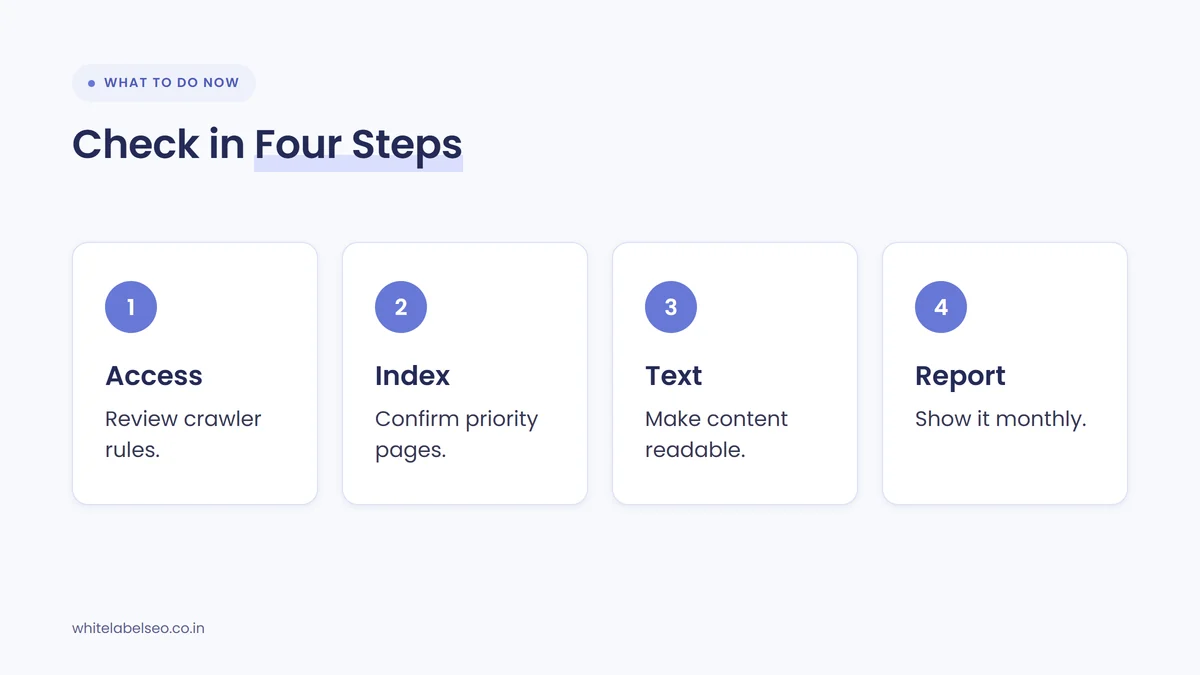
- Check crawler access. Review robots.txt and any CDN, firewall or bot protection settings. Confirm Googlebot is allowed on every page you want found, and list which AI crawlers are allowed or blocked.
- Agree an AI crawler policy with each client. Explain the difference between training and search crawlers, then record the client’s choice. Some will want to block training while staying visible in AI search.
- Confirm indexing of priority pages. Use the Search Console page indexing report and URL Inspection on key service and location pages, and fix stray noindex tags and wrong canonicals first.
- Check that important content is text. Make sure key service details, prices or FAQs are not locked inside images, tabs that never load, or scripts a crawler cannot render.
- Update your audit and report templates. Add a crawl access line and an indexing line to the monthly report, so the technical work stays visible.
- Send the client note. Use the message above, adapted to each client’s situation.
How should clients check AI SEO vendor claims?
Clients should ask any vendor to show which Google or platform documentation supports each claim. If a pitch depends on special AI files, secret markup or a promised spot in AI answers, it conflicts with what Google has published. Real AI visibility work starts with crawl access, indexing and useful content.
Mueller’s advice to question vendors is useful to agencies, because it gives you a neutral way to help clients filter pitches. Share these questions with clients who forward you an “AI SEO” offer:
- Which official documentation supports this tactic?
- What happens to the result if the tactic stops working?
- Does this need changes to the site’s crawl access or indexing, and who checks them?
- How will results be reported, and can we verify them in Search Console?
If the client wants AI visibility as a reported deliverable, our post on why AI search visibility is becoming a core white-label SEO deliverable explains how to package it, and our guide on explaining Search Console’s AI report to clients covers what the data can and cannot show.
How do we handle technical SEO for AI search with partner agencies?
At White Label SEO, we treat AI visibility as part of the technical scope rather than a separate add-on. Crawl access, indexing and rendering checks run on a fixed schedule, and the results go into reports under the partner agency’s brand, written so the client can follow them without a technical background.
When a partner agency onboards a client, we record which AI crawlers the client wants to allow and recheck that list after any hosting, CDN or redesign change, since those are the moments settings tend to change without notice. We also keep the explanation consistent with Google’s published guidance, so the agency never has to defend a claim it cannot source.
What is likely to happen next?
This section is our reading of the sources, not a forecast from Google. More AI systems are likely to keep separate crawlers for training and for fetching, which means more agents to manage in robots.txt and CDN settings. That makes crawler access a recurring check, not a one-time setting.
Google’s crawler documentation already says it plans to support an AI training preference signal in early 2027. If that ships, agencies will have another control to explain to clients, and the clearest way to handle it is the same as today: record each client’s choice and report it.
Frequently asked questions
Does technical SEO still matter for AI search?
Yes. Google’s John Mueller said AI systems build on SEO and that technical SEO will stay very relevant. Google’s documentation also says pages must be indexed and eligible for a snippet to appear as links in AI Overviews or AI Mode, which depends on crawl access and indexing.
Do clients need an llms.txt file or special markup for Google’s AI features?
No. Google says there are no additional requirements to appear in AI Overviews or AI Mode, and that no new machine-readable files, AI text files or special schema markup are needed. Standard technical SEO and helpful content are what Google points to.
Will blocking AI training crawlers hurt a client’s Google rankings?
Google says Google-Extended, its control for Gemini training and grounding, does not affect inclusion in Google Search and is not a ranking signal. OpenAI also says its training and search crawlers are controlled independently. Blocking a search crawler is different, because it can remove the site from that platform’s answers.
How do AI crawlers differ from Googlebot?
Googlebot crawls for Google Search, including AI Overviews and AI Mode. Other AI crawlers may collect content for model training or fetch fresh pages to answer questions, and each is controlled by its own robots.txt token. Mueller described managing these differences as another flavor of technical SEO.
How should agencies report technical SEO for AI visibility?
Report it as plain checks the client can follow: which crawlers can reach the site, whether priority pages are indexed, what technical issues were fixed, and how page experience is trending. Include AI Overviews and AI Mode traffic from the Search Console Performance report, which Google counts under the Web search type.
What should you do next?
Start with crawler access and indexing for your top clients this week, add both to your audit and reporting templates, and send clients a short note built on Google’s own words. That turns a news story into proof that the technical work in your retainer still matters. If you want a fulfillment team that runs these checks under your brand, see our white-label SEO services at White Label SEO.
Want technical SEO your clients can understand?
At White Label SEO, we deliver technical SEO under your agency’s brand, with crawler access, indexing and AI visibility checks reported in plain language. Tell us about your clients, and we’ll show you how our process fits your agency.
Sources
- Search Engine Journal, “Google Says Technical SEO Remains Key For AI SEO”, November 2, 2026. https://www.searchenginejournal.com/google-says-technical-seo-remains-key-for-ai-seo/595550/
- Google Search Central, “AI features and your website”, last updated December 10, 2025. https://developers.google.com/search/docs/appearance/ai-features
- Google for Developers, “Google’s common crawlers”, last updated October 30, 2026. https://developers.google.com/crawling/docs/crawlers-fetchers/google-common-crawlers
- OpenAI, “Overview of OpenAI Crawlers”, accessed November 8, 2026. https://developers.openai.com/api/docs/bots