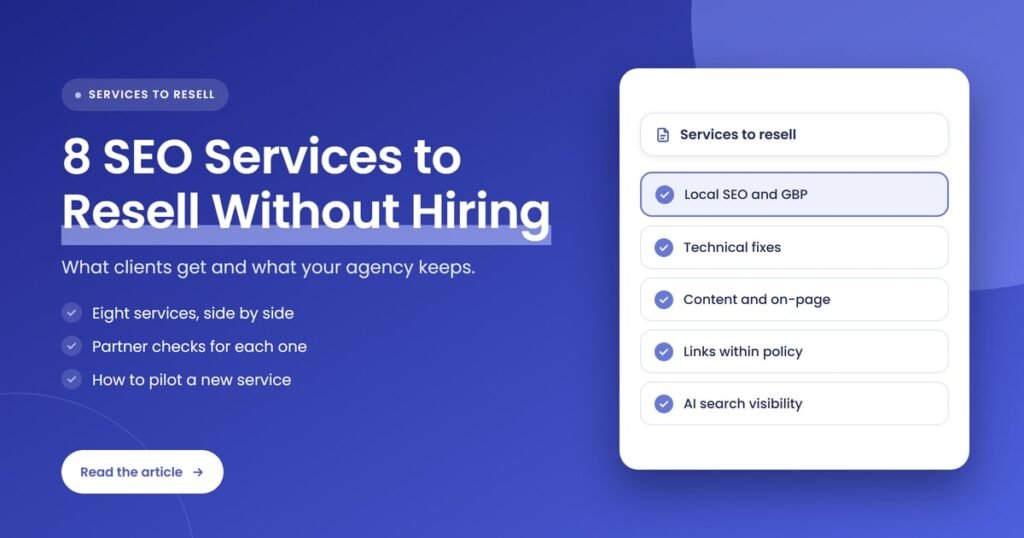
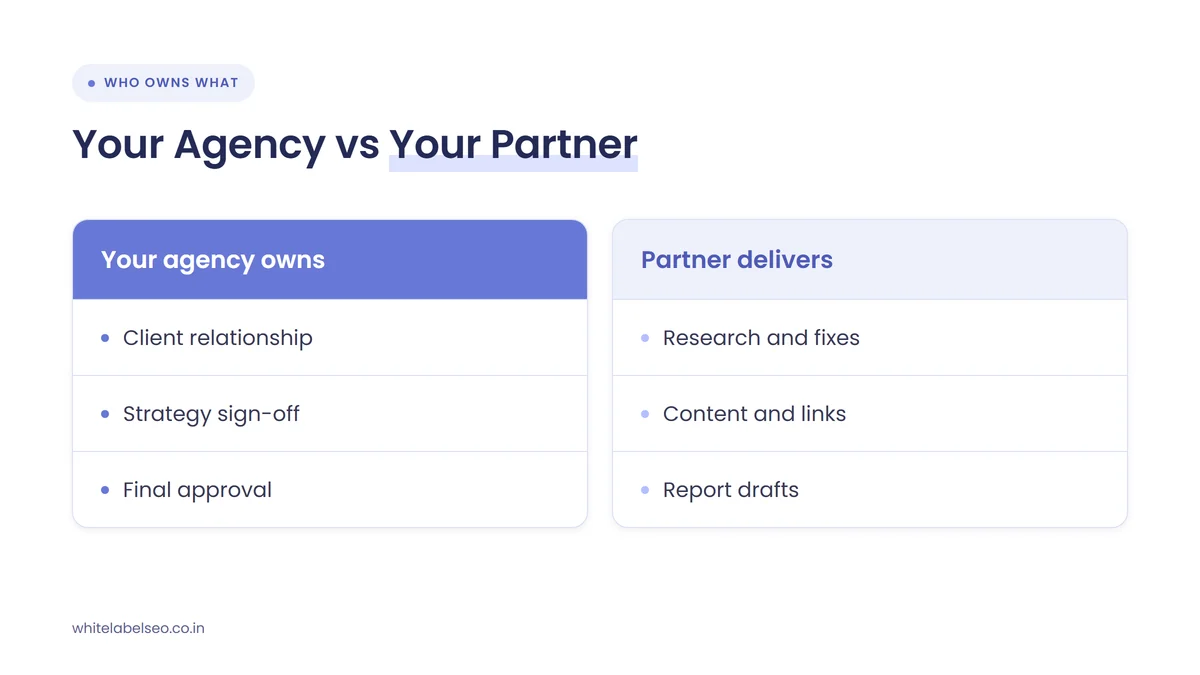
Quick answer: Agencies can add eight SEO services through a white-label partner without hiring: local SEO and Google Business Profile management, technical audits and fixes, on-page optimization, content writing, link building within Google’s spam policies, AI search visibility, website design and development, and branded reporting. The partner does the work, while your agency keeps the client relationship and signs off on strategy.
Key takeaways
- Most SEO work can be delivered by a partner, but the client relationship, strategy sign-off and final approval should stay with your agency.
- Start with services your clients already ask for, such as local SEO or technical fixes, before adding newer ones like AI search visibility.
- Keep ownership of client accounts: the client or your agency should own the Google Business Profile and Search Console property, with the partner added as a manager or user.
- Link building is the service where partner quality varies most. Check every placement against Google’s spam policies.
- AI search visibility now has its own Search Console data, so it can be reported like any other service instead of sold as a mystery add-on.
What does it mean to resell SEO services without hiring?
Reselling SEO without hiring means your agency sells SEO services under its own brand while a white-label partner does the delivery work behind the scenes. You price, package and present the service. The partner researches, writes, fixes and reports, and the client sees only your agency’s name on everything.
The model works because SEO is made of distinct, repeatable services. Each one can be scoped, delivered and checked on its own, so you can add one service at a time rather than building a full in-house team. If you want a closer look at the monthly rhythm, our guide to what a white-label SEO partner does each month walks through it.
How did we choose these 8 services?
We picked services that clients ask agencies for, that a partner can deliver without daily contact with the client, and that produce work you can check yourself. Each one has a clear deliverable, such as a fixed profile, a published page or a verified link, so you can review it before it reaches the client.
For each service below, we cover three things:
- What the client gets: the deliverables they see and pay for.
- What your agency still owns: the decisions and relationships that should never move to the partner.
- What to check in a partner: the questions that separate a reliable partner from a risky one.
Which SEO services can an agency add through a white-label partner?
An agency can add local SEO and Google Business Profile management, technical audits and fixes, on-page optimization, content writing, link building, AI search visibility, website design and development, and reporting through a white-label partner. Each is a defined service with checkable deliverables, which is what makes it suitable for delivery under your brand.
1. Local SEO and Google Business Profile management
Local SEO and Google Business Profile management covers the work that helps a business appear in Google Maps and local results: profile setup and optimization, categories, services, photos, posts, review responses and citation consistency. It is often the easiest first service to resell because almost every local client needs it.
- What the client gets: an accurate, complete profile that is kept current, regular posts and photos, review monitoring and response drafts, and consistent business details across directories.
- What your agency still owns: profile ownership and the client’s tone in public replies. Google Business Profile lets a profile have owners and managers, and managers can’t add or remove users. Keep the client (or your agency) as the primary owner and add the partner as a manager, so access can be removed at any time.
- What to check in a partner: whether they follow Google’s guidelines for representing a business. Those guidelines say the business name must match the real-world name and that adding unnecessary information, such as keywords, isn’t permitted. A partner that stuffs keywords into names puts the profile at risk.
We cover what this service looks like in practice on our Google Business Profile management page.
2. Technical SEO audits and fixes
Technical SEO audits find the issues that stop search engines from crawling, indexing and understanding a site, such as broken redirects, duplicate pages, slow templates or missing structured data. The fixes are what make the audit worth paying for, so resell the audit and the implementation together whenever you can.
- What the client gets: a prioritized issue list written in plain language, followed by the fixes themselves or clear tickets for the client’s developer.
- What your agency still owns: priority calls and anything that touches the live site. Decide with the client who is allowed to change what, and when.
- What to check in a partner: whether they document every change. Google’s own advice on hiring an SEO suggests asking whether they will share all the changes they make to the site, with the reasoning behind each recommendation. Apply the same test to your partner.
3. On-page optimization
On-page optimization improves individual pages so they match what people search for: title elements, headings, internal links, content structure and structured data. It is steady monthly work that fits well into a retainer because every client has more pages than they have time to improve.
- What the client gets: a set number of pages improved each month, with before and after notes for each page.
- What your agency still owns: which pages and services matter most to the client’s revenue. The partner can suggest targets, but your team knows the client’s business.
- What to check in a partner: whether their methods match current Google guidance. Google’s SEO Starter Guide says title links come mainly from the title element and headings, and that Google Search doesn’t use the keywords meta tag. A partner still selling meta keyword work is a warning sign.
4. Content writing
Content writing covers service pages, location pages, blog posts and page refreshes written to answer the questions a client’s customers ask. A partner can research, write and optimize at volume, but content is also where brand voice and accuracy matter most, so it needs the tightest review process of any service.
- What the client gets: a content plan, briefs, finished drafts and published pages that answer real customer questions.
- What your agency still owns: brand voice, client approval and the facts. Make sure someone who knows the client checks claims about their services before anything goes live.
- What to check in a partner: how they use AI tools. Google’s guidance on generative AI content says to fact-check output, because generative models don’t retrieve facts, and warns that producing many pages without adding value can break its scaled content abuse policy. Ask the partner to explain their review steps.
5. Link building within Google’s spam policies
Link building earns mentions and links from relevant websites so a client’s site gains authority. Done well, it comes from outreach, digital PR, local partnerships and content worth citing. Done badly, it relies on bought or swapped links that can hurt rankings, which makes partner choice more important here than anywhere else.
- What the client gets: a list of live links with the linking page, the anchor text and the date each one was placed.
- What your agency still owns: the risk decision. You decide what kinds of sites are acceptable for each client, and you should be able to explain every link if the client asks.
- What to check in a partner: whether any placements match what Google’s spam policies call link spam. The list includes buying or selling links that pass ranking credit, excessive link exchanges, and paid guest posts or advertorials with links that pass ranking credit.
This is a live concern, not a theoretical one. Google’s Search Status Dashboard shows its September 2026 spam update started on September 24 and took close to two weeks to roll out, its fourth spam update of the year. Google did not say what the update targeted, which is a good reason to keep every link you resell easy to defend.
6. AI search visibility (GEO)
AI search visibility, often called generative engine optimization or GEO, is the work of helping a client appear in AI answers such as Google’s AI Overviews and AI Mode. It builds on the same foundations as SEO: crawlable pages, clear answers to real questions, a strong local profile and mentions on trusted sites.
- What the client gets: answer-first content, technical checks that pages can be crawled and shown, and reporting on how often the site appears in AI features.
- What your agency still owns: expectations and the list of prompts you track. Nobody controls which sources an AI answer cites, so promise the work and the reporting, not a placement.
- What to check in a partner: whether they sell it as a secret method. Google says there are no additional requirements or special optimizations needed to appear in AI Overviews or AI Mode, so a credible partner will explain the work in plain SEO terms.
The reporting side has improved this year. Google introduced generative AI performance reports in Search Console on June 3, 2026, and says they reached all websites worldwide by August 31, 2026. The reports show impressions in AI features by page, country, device and date. Search Console also added a Search generative AI control under Settings, which lets a site owner include or exclude their content from AI Overviews, AI Mode and generative AI features in Discover. Inclusion is the default, and Google says the setting isn’t used as a ranking signal for other parts of Search. Changing it is a business decision for the client, not something a partner should do on its own. For a full walkthrough, read how your agency can sell generative engine optimisation without hiring experts.
7. Website design and development
Website design and development covers new builds, redesigns and ongoing maintenance, built with search in mind from the first wireframe. It pairs naturally with SEO because a redesign is when rankings are most often lost through broken redirects, removed pages or new templates that hide content.
- What the client gets: a site that loads well, is easy to crawl, keeps its existing rankings through launch, and is built around the services that bring in business.
- What your agency still owns: design sign-off, the client’s brand standards and the launch date. Make sure the domain and hosting are registered to the client, not the partner.
- What to check in a partner: how they handle redirects and launch checks. Google’s advice is that a redesign is a good time to bring in SEO, and that earlier is better, so SEO should be part of the build plan rather than a cleanup job afterwards.
8. White-label reporting and dashboards
White-label reporting turns the partner’s work into a branded monthly report or live dashboard that shows the client what was done, how visibility changed and what came in as leads. It is the service clients see most, so it shapes how they judge everything else you resell.
- What the client gets: a report in your agency’s branding with work completed, rankings and impressions, AI search visibility, leads, and the plan for next month.
- What your agency still owns: the commentary and the conversation. The partner can draft the report, but your account manager should explain it to the client.
- What to check in a partner: data access. Search Console lets owners add full users and restricted users, so your agency can stay owner while the partner gets the access it needs. If a partner sends only screenshots and won’t work from shared data, ask why.
Our post on a partner’s monthly workflow shows how reporting fits alongside the delivery work.
What does each service look like side by side?
Each resold service splits the same way: the partner delivers defined work, and your agency keeps the client relationship, the priorities and the final approval. The table below summarizes what the client receives, what stays with you and the single most useful check to run on a partner for each service.
| Service | What the client gets | What your agency owns | Key partner check |
|---|---|---|---|
| Local SEO and Google Business Profile | Optimized profile, posts, review replies, consistent citations | Profile ownership, public tone | Partner added as manager, not owner; follows Google’s naming rules |
| Technical audits and fixes | Prioritized issues and implemented fixes | Priorities and live-site changes | Every change documented with reasons |
| On-page optimization | Set number of pages improved each month | Which pages matter to revenue | Methods match Google’s current guidance |
| Content writing | Plans, briefs and published pages | Brand voice, facts, client approval | Clear human review of AI-assisted drafts |
| Link building | Verified list of live links | Risk tolerance for each client | No placements that match Google’s link spam examples |
| AI search visibility | Answer-first content and AI feature reporting | Expectations and tracked prompts | Explains the work in plain SEO terms |
| Website design and development | Search-ready site, redirects handled at launch | Design sign-off, domain and hosting in client’s name | SEO built into the plan from the start |
| Reporting and dashboards | Branded monthly report or dashboard | Commentary and client conversation | Works from shared data, not screenshots |
Can you resell SEO for a specific industry like dental or healthcare?
Yes. Industry-focused SEO is a bundle of the services above, adapted to one type of client. Dental and healthcare are common choices because practices rely on local search and need careful, accurate content. Your agency still owns the client relationship and any compliance review the industry requires.
A niche package usually combines local SEO, service-page content, technical fixes and reporting, with content reviewed for claims the industry restricts. If you serve practices, our guide on reselling SEO to dental and healthcare clients covers the extra checks.
How do you add a new service through a partner, step by step?
Add a new white-label service by choosing one your current clients already ask for, defining the deliverables in writing, running it with one client first, and only then packaging it for the rest of your list. Adding one service at a time keeps quality visible and lets you fix the process before it scales.
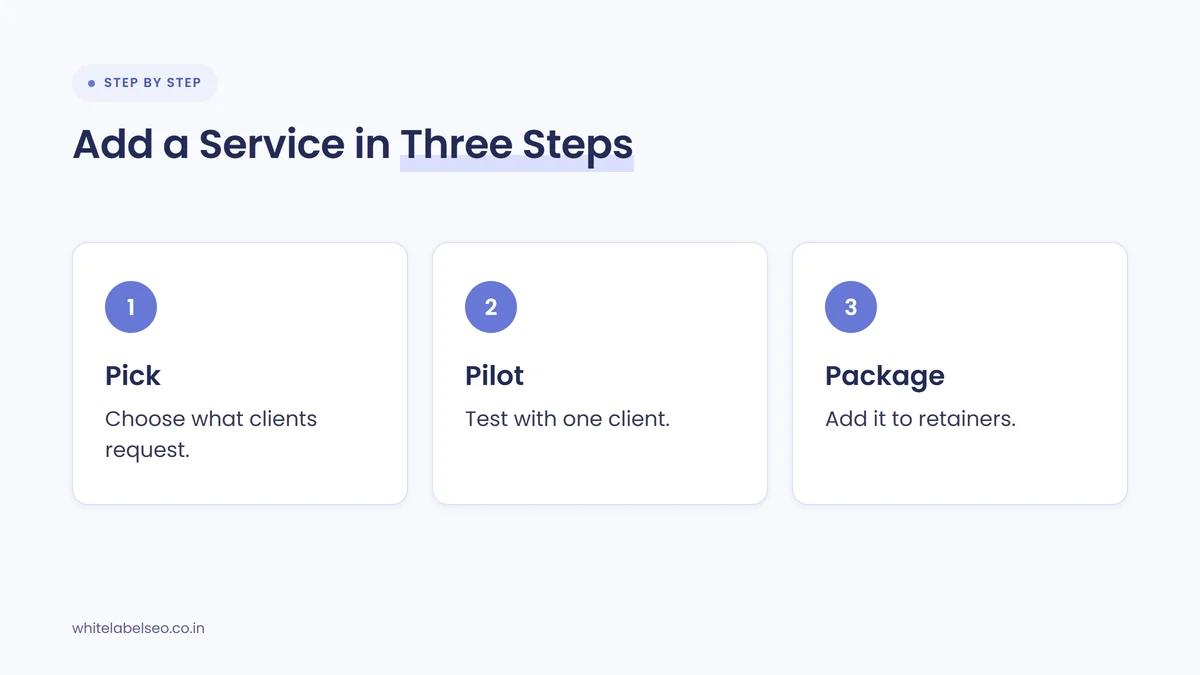
- Pick the service clients already request. Look at the last few months of client questions. Requests for help with a Google Business Profile or a slow site point to an easy first service.
- Write the scope down. List monthly quantities, what is excluded, who approves what and how changes reach the live site.
- Set up access correctly. Keep the client or your agency as owner of every account, and add the partner with the lowest access level that still lets them do the work.
- Pilot with one client. Review every deliverable yourself for the first cycle. Note where your review caught problems.
- Agree on a reporting format. Decide what the monthly report shows and who explains it to the client.
- Package and price it. Once the pilot runs cleanly, add the service to your proposals and retainer tiers.
What should you check before trusting a partner with a new service?
Before trusting a partner with a new service, check that they will document their work, use methods that follow Google’s policies, give you access to real data, and accept that your agency keeps account ownership. A partner who resists any of these will be hard to work with once clients start asking questions.
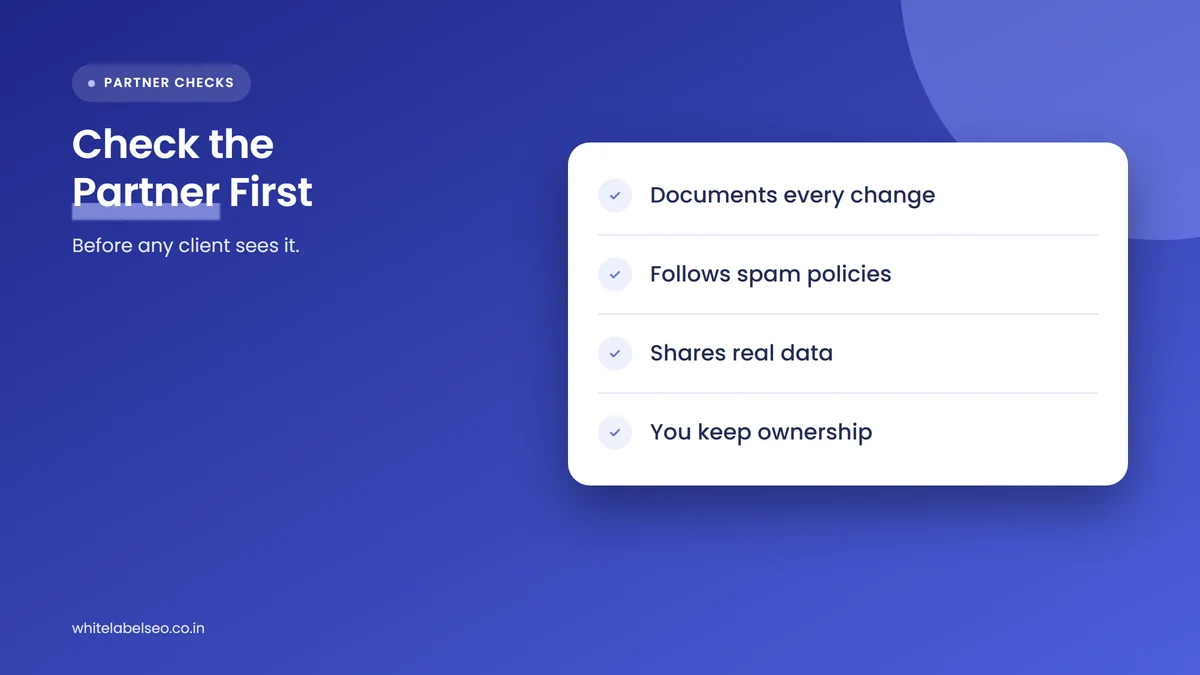
- Documentation: every change, page and link is listed with dates and URLs.
- Policy fit: methods follow Google Search Essentials and the spam policies, with no secret tactics.
- Data access: reports are built from shared Search Console and analytics data.
- Account ownership: the partner works as a manager or user, never as the sole owner.
- Honest expectations: no promises of specific rankings or AI placements.
Google’s own list of questions for hiring an SEO is a good starting script. It includes asking about experience in the client’s industry and location, how the SEO measures success and how you can expect to communicate with them.
Frequently asked questions
What is the easiest SEO service for an agency to resell first?
Local SEO and Google Business Profile management is usually the easiest first service. Most local clients need it, the deliverables are easy to see, and the client can check their own profile. Technical audits are a close second because they give a clear, documented starting point for other work.
Does the client know a partner is doing the work?
Not unless you tell them. In a white-label setup, reports, emails and deliverables carry your agency’s brand. Some agencies choose to tell clients they work with specialist teams without naming them. What matters is that your agency stays accountable for the quality of everything the client receives.
Who should own the client’s Google Business Profile and Search Console?
The client, or your agency on the client’s behalf. Add the partner as a manager on the Business Profile and as a user in Search Console. That way access can be removed at any time, and the client never loses control of accounts that belong to their business.
Is AI search visibility a separate service from SEO?
It is sold separately by some agencies, but the work overlaps heavily with SEO. Google says there are no special optimizations needed to appear in AI Overviews or AI Mode. The difference is mostly in reporting, since Search Console now shows impressions in generative AI features.
How many services should an agency resell at once?
Start with one or two, run each with a single client first, and add more once the process is clean. Adding several services at the same time makes it hard to spot which one is causing quality problems or client complaints.
What should you do next?
Look at what your clients asked for in the last few months and match those requests to the eight services above. Pick one, write the scope, set up account access the right way, and pilot it with a single client before you package it. At White Label SEO, our white-label SEO services cover technical audits and implementation, on-page optimization, content, link building, local SEO and Google Business Profile management, web design and development, and reporting under your brand, so you can add services one at a time.
Want to add SEO services without adding headcount?
We deliver white-label SEO under your agency’s brand while you keep the client relationship and sign off on strategy. Tell us which service your clients ask for most, and we’ll help you scope a pilot you can check line by line.
Sources
- Google Business Profile Help, “Manage your Business Profile owners & managers”, accessed November 6, 2026. https://support.google.com/business/answer/3403100?hl=en
- Google Business Profile Help, “Guidelines for representing your business on Google”, accessed November 6, 2026. https://support.google.com/business/answer/3038177?hl=en
- Google Search Central, “Do you need an SEO?”, last updated June 5, 2026. https://developers.google.com/search/docs/fundamentals/do-i-need-seo
- Google Search Central, “SEO Starter Guide: The Basics”, last updated December 10, 2025. https://developers.google.com/search/docs/fundamentals/seo-starter-guide
- Google Search Central, “Google Search’s guidance on using generative AI content on your website”, last updated October 1, 2026. https://developers.google.com/search/docs/fundamentals/using-gen-ai-content
- Google Search Central, “Spam policies for Google web search”, last updated August 28, 2026. https://developers.google.com/search/docs/essentials/spam-policies
- Google Search Status Dashboard, “Ranking incidents history” (September 2026 spam update), accessed November 6, 2026. https://status.search.google.com/products/rGHU1u87FJnkP6W2GwMi/history
- Google Search Central, “AI features and your website”, last updated December 10, 2025. https://developers.google.com/search/docs/appearance/ai-features
- Google Search Central Blog, “Introducing Search Generative AI performance reports in Search Console”, June 3, 2026. https://developers.google.com/search/blog/2026/06/gen-ai-performance-reports
- Search Console Help, “Search generative AI control”, accessed November 6, 2026. https://support.google.com/webmasters/answer/16908024?hl=en
- Search Console Help, “Managing owners, users, and permissions”, accessed November 6, 2026. https://support.google.com/webmasters/answer/7687615?hl=en