Quick answer: Agencies can resell SEO to dentists and clinics by treating health as a higher-risk niche: clinician-reviewed content that meets Google’s YMYL standards, Google Business Profiles that follow the practitioner rules, review requests that follow FTC and Google policy, analytics checked against HHS tracking guidance, and reporting tied to booked appointments rather than rankings.
Key takeaways
- Health content is a “Your Money or Your Life” topic, so Google gives more weight to trust, expertise and clear authorship. Plan for a clinician to review every clinical page.
- Google Business Profile has specific rules for practices and individual practitioners. Many dental listing problems come from ignoring them, not from weak optimization.
- Reviews carry legal risk on two fronts: the FTC rule on fake and incentivized reviews, and HIPAA when a practice replies to a patient’s review.
- Tracking pixels on appointment and contact pages can disclose patient information. HHS guidance still applies to much of that, even after a 2024 court ruling narrowed it.
- AI Overviews now appear for most health questions in recent research, so clinic content needs to answer real patient questions clearly and accurately.
What does reselling SEO to dental and healthcare clients mean?
Reselling SEO to dental and healthcare clients means your agency sells SEO to dentists, clinics and other practices under your own brand, while a white-label partner does some or all of the delivery. The client relationship, pricing and reporting stay with you. The partner handles audits, content, local SEO, links and technical fixes behind the scenes.
Two terms come up again and again in this niche. YMYL, short for “Your Money or Your Life”, is Google’s label for topics that could significantly affect a person’s health, finances or safety. E-E-A-T stands for experience, expertise, authoritativeness and trustworthiness, the qualities Google says its systems look for, with trust as the most important. Every dental and medical site you resell SEO to sits inside that YMYL category, which shapes how the work should be done.
If you are still deciding which niches to add, our guide on choosing the right white-label SEO niche for your growth stage covers the trade-offs. This post assumes you have picked healthcare and want to sell it without creating problems for the practice or for your agency.
How is SEO for dentists and clinics different from other local SEO?
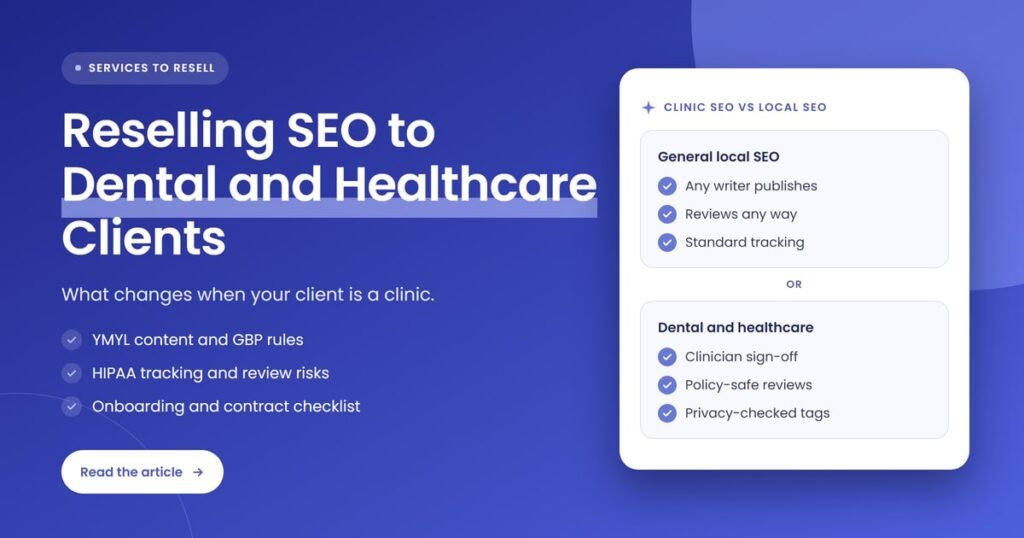
SEO for dentists and clinics uses the same building blocks as other local SEO: a strong website, a Google Business Profile, reviews and links. The difference is the rules around each block. Health content needs expert review, listings follow practitioner rules, reviews touch patient privacy, and tracking can expose health information, so shortcuts that work elsewhere become risks.
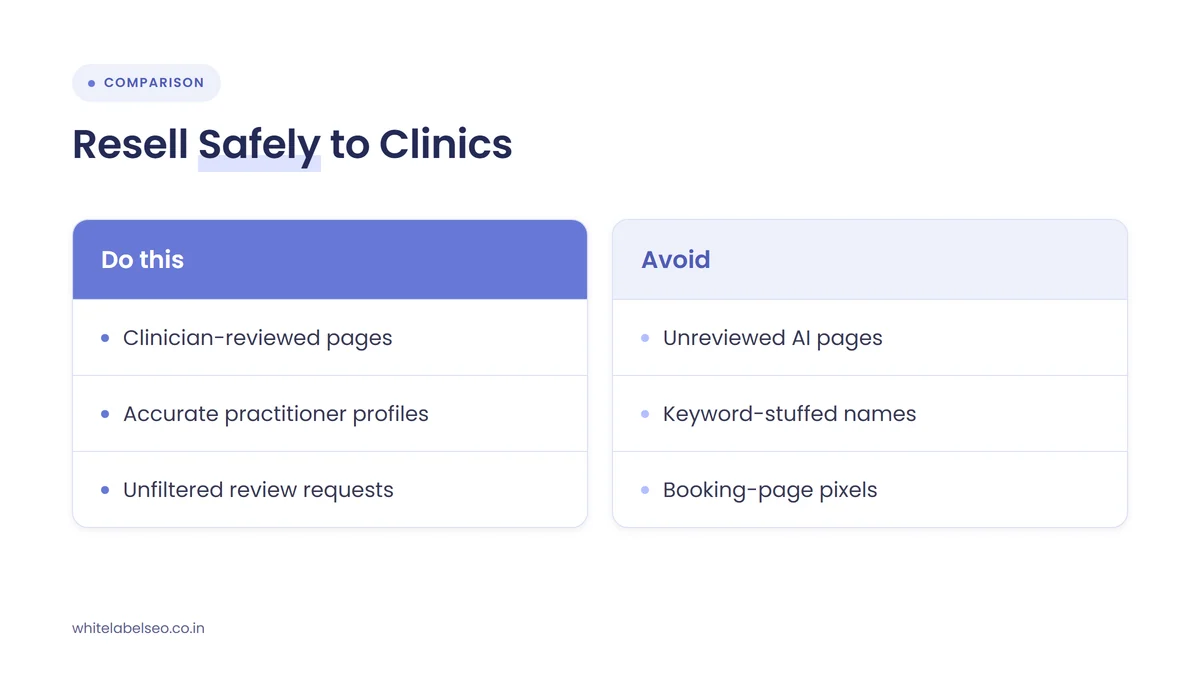
The table below shows where the work changes and which rule sits behind each change.
| Area | What changes for healthcare | Rule behind it | What your delivery team should do |
|---|---|---|---|
| Website content | Clinical pages must be accurate and consistent with expert consensus | Google’s helpful content guidance on YMYL topics | Write in plain English, then send every clinical page to a named clinician for sign-off |
| Authorship | Readers should be able to see who wrote or reviewed the page | Google’s “Who, How and Why” questions | Add accurate bylines and reviewer details, and never invent author profiles |
| Google Business Profile | Practices and individual dentists or doctors can each have profiles, under set conditions | Guidelines for representing your business on Google | Audit every location and practitioner listing before you promise local results |
| Reviews | No incentives, no selective asking, no fake or insider reviews | FTC rule on consumer reviews and Google’s content policy | Ask every patient the same way, and keep staff out of the review count |
| Review replies | Replies can’t confirm someone is a patient or discuss their care | HIPAA Privacy Rule, as enforced by HHS OCR | Use short, general reply templates approved by the practice |
| Analytics and pixels | Third-party tags on booking or contact forms may send patient data to vendors | HHS guidance on online tracking technologies | Map every tag and flag risky ones to the practice before launch |
| Claims and testimonials | Health claims need evidence, and a testimonial doesn’t replace it | FTC Health Products Compliance Guidance | Avoid outcome promises such as “pain-free” or “permanent” unless the practice can support them |
What does Google expect from dental and medical content?
Google expects health content to be helpful, accurate and clearly trustworthy. Its guidance says YMYL topics get more weight on E-E-A-T signals, that trust matters most, and that content should match established expert consensus. In practice, that means expert review, clear authorship, honest use of AI and pages that answer the patient’s actual question.
Google’s page on creating helpful, people-first content was last updated on October 5, 2026, and the core advice is unchanged. It asks site owners to make it self-evident who created the content, to add accurate bylines where readers expect them, and to make any use of automation or AI clear to visitors. It also warns that any form of deception, such as made-up author profiles, makes a page untrustworthy.
For a reseller, this turns into a few working rules:
- Clinician sign-off on clinical pages. Writers can draft a page about dental implants or gum disease, but a dentist at the practice should approve it before it goes live. Record who approved what and when.
- Real bylines and reviewer notes. Show the reviewing dentist or doctor by name with their credentials, using details the practice confirms.
- Local, practical answers. Patients search for cost, recovery, insurance, sedation and what happens at the first visit. Pages that answer those questions for that practice are more useful than generic encyclopedia-style articles.
- AI as a drafting tool, not an author. If AI helps with drafts, a human editor and a clinician still check every clinical statement.
We cover the wider compliance side of medical, legal and finance work in our post on white-label SEO for regulated industries.
How should you handle Google Business Profiles for practices and practitioners?
Handle Google Business Profiles for practices by following Google’s rules for individual practitioners. Dentists and doctors can have their own profiles if they are public-facing and can be reached at the verified location. The practice should have its own separate profile. Names must match the real world, with no added keywords, and virtual offices are not eligible.
Google’s guidelines name doctors and dentists as examples of individual practitioners. A few rules matter most when you take on a dental client:
- Practice plus practitioners. Where several dentists work at one location, the organization should have its own profile, and each practitioner’s profile name should include only the practitioner’s name. Practitioner titles such as Dr. or DDS are allowed.
- Solo practitioners share a profile. If one dentist is the only public-facing practitioner at a branded location, Google recommends a single shared profile in the format “[brand]: [practitioner name]”.
- No profiles for support staff, and no extra profiles to cover each specialty a dentist offers.
- Departments need distinct identities. A hospital or large clinic can list public-facing departments separately, but each name must differ from the main business.
- Real addresses only. Mailboxes and virtual offices are not eligible, and a co-working office needs clear signage.
Listing clean-up is often the first month’s work on a new dental account. Duplicate practitioner listings, old addresses after a move and names stuffed with “implants” or “emergency dentist” all need fixing before any local ranking work is worth reporting. Our post on white-label GMB management for local clients explains how we split that work with agencies.
How do HIPAA rules affect tracking on clinic websites?
HIPAA rules affect tracking because analytics tags, ad pixels and session tools can send information that patients type or select to third-party vendors. HHS says regulated entities must make sure those disclosures are permitted and, where a vendor receives protected health information, have a business associate agreement in place. Booking and contact forms carry the most risk.
The HHS guidance on online tracking technologies gives a direct example: if a patient books an appointment on a clinic’s website and the site uses third-party tracking, the site might send information about that appointment to the tracking vendor. The guidance lists details such as email addresses, appointment dates, IP addresses and device IDs among the information that can be disclosed this way.
The guidance has also been narrowed. On June 20, 2024, a federal court in Texas vacated the part saying that HIPAA applies when a tool links a person’s IP address to a visit to a public, unauthenticated page about health conditions or providers. HHS withdrew its appeal in August 2024. The rest of the guidance remains on the HHS site, and legal commentators still advise covered entities to review their tracking under HIPAA and state law.
We are SEO people, not lawyers, so the line we hold on healthcare accounts is simple:
- Map every tag on the site during onboarding, including pixels added by past agencies.
- Flag tags on forms, booking flows and patient portals to the practice in writing, and let its compliance lead or counsel decide.
- Don’t add new ad pixels or session recording to patient-facing forms without the practice’s written approval.
- Measure leads with privacy in mind. Count form submissions and calls without passing form contents to third parties.
Settle one question before you sign: does the practice consider your agency, or your partner, a business associate? If anyone on the delivery side will see patient information, the practice may need a business associate agreement, and that decision belongs to the practice.
What review and testimonial rules apply to dental clients?
Dental clients have to follow three sets of review rules. The FTC bans fake reviews, insider reviews without disclosure and incentives tied to positive sentiment. Google’s policy bans paying for reviews and asking only happy patients. HIPAA stops practices from revealing patient information in replies, even when a patient posts a negative review first.
The FTC announced its final rule on consumer reviews and testimonials on August 14, 2024. It covers fake reviews, including AI-generated ones, reviews bought for a particular sentiment, undisclosed reviews from staff or managers, review suppression through threats, and fake social media indicators. The rule allows civil penalties against knowing violators, and in December 2025 the FTC sent warning letters to 10 companies about possible violations.
Google’s own policy is stricter in one important way. It prohibits offering any incentive, including discounts or free services, for posting a review, and it bans selectively asking for positive reviews. So a “review us for 10% off your next cleaning” card breaks Google’s policy even if the patient’s review is honest. Review gating, where only happy patients get the link, breaks it too.
Replies are where HIPAA comes in. In December 2022, HHS announced that a California dental practice paid $23,000 and agreed to a corrective action plan after disclosing patient information in responses to online reviews. Train every practice you work with on short, general replies that thank the reviewer and invite them to call the office, without confirming they are a patient. Our post on white-label review management as a local SEO upsell covers how to package this work.
Testimonials on the website follow the same logic. The FTC’s Health Products Compliance Guidance says an honest testimonial is not enough on its own: the advertiser also needs evidence for the claim it implies. Treat lines such as “completely painless” or “results last forever” as claims that need support from the practice.
What is changing in AI search for health queries?
AI answers now appear for most health questions in recent research, and they don’t always cite the pages that rank organically. Google says no special optimization is needed to appear in AI Overviews or AI Mode, so the same fundamentals apply: accurate, expert-reviewed content, clear authorship, a complete Business Profile and pages that answer specific patient questions.
Two preprints from the last 60 days are worth knowing, with the caveat that neither has been peer reviewed:
- A preprint posted on October 29, 2026 tested 3,611 benchmark health questions. AI Overviews appeared for 96.4% of them, cited 44.4% of the top five organic results, and leaned toward commercial health publishers over academic and government sources. The authors used benchmark questions, not real patient searches.
- A September 6, 2026 preprint audited 1,920 health queries across 12 countries and four languages. It found that Google and Baidu tend to send users to their own company platforms in AI Overviews rather than to a varied set of primary sources.
For your clients, the takeaway is practical. Ranking alone no longer tells the full story, so your reports should show whether the practice appears in AI answers for a short list of agreed questions, alongside calls and booked appointments. If you want a reporting format for this, our breakdown of what a white-label SEO partner does each month includes AI search tracking as a standard workstream.
How do you onboard a dental or healthcare client step by step?
Onboard a dental or healthcare client by checking privacy and tracking first, then auditing listings and reviews, then agreeing a content sign-off process with a named clinician. Only after those three are settled should you start content, links and local ranking work. The order protects the practice and stops your team from building on a risky setup.
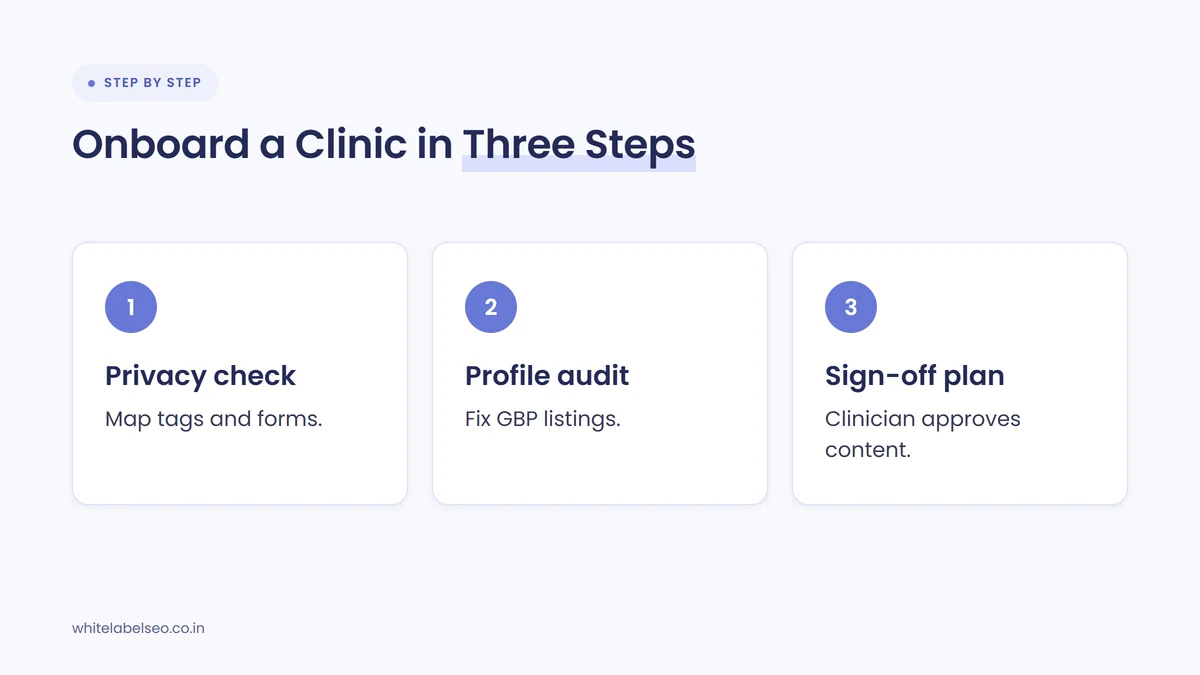
- Run a tracking and privacy check. List every analytics tag, ad pixel, chat tool and form on the site. Flag anything that touches booking, contact or portal pages, and send the list to the practice’s compliance lead.
- Audit every Google Business Profile. Check the practice profile, each practitioner profile, duplicates, names, categories, hours and addresses against Google’s guidelines.
- Review the review process. Find out how the practice asks for reviews, who replies and whether any incentive or gating is in place. Fix those before you scale review requests.
- Agree clinical sign-off. Name the clinician who approves clinical pages, the turnaround time and how approvals are recorded.
- Set a claims policy. Agree which treatment claims, before-and-after images and testimonials the practice can support, and keep a short list of phrases to avoid.
- Build the content plan around patient questions. Prioritize the services that matter to the practice, then answer cost, recovery, insurance and first-visit questions for each one.
- Agree what success looks like. Report calls, form leads and booked appointments where the practice can share them, plus AI answer visibility for agreed questions, alongside rankings.
Clear ownership keeps this from falling between teams. Here is the split we use with partner agencies:
| Task | Your agency | White-label partner | The practice |
|---|---|---|---|
| Client relationship and pricing | Owns | Supports with scope | Approves budget |
| Tracking and privacy check | Shares findings | Runs the tag audit | Decides with counsel |
| Business Profile clean-up | Gets access | Does the fixes | Confirms names and addresses |
| Clinical content | Sets deadlines | Researches and drafts | Clinician reviews and approves |
| Reviews and replies | Trains the front desk | Writes reply templates | Posts replies and asks every patient |
| Monthly reporting | Presents under your brand | Builds the report | Shares lead and booking data |
What should you agree with a clinic before you sign?
Before you sign a clinic, agree in writing who approves clinical content, whether a business associate agreement is needed, how reviews will be requested and answered, what tracking is allowed, which claims the practice can support and how results will be measured. Settling these at the proposal stage avoids disputes and stalled work later.
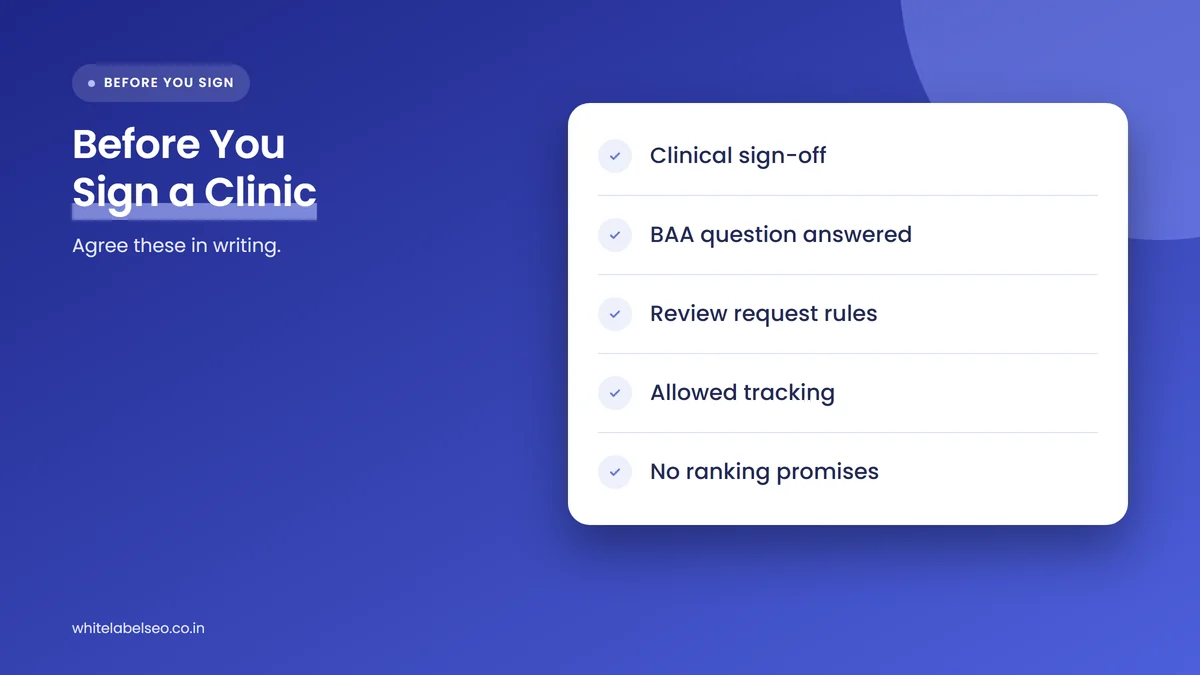
- Clinical sign-off: the named reviewer and turnaround time.
- Business associate question: whether anyone on the delivery side will handle patient information, and what agreement the practice wants.
- Review rules: no incentives, no gating and approved reply templates.
- Tracking: which tools are allowed on which pages, and who approves changes.
- Claims: phrases to avoid and how testimonials and before-and-after images are approved.
- Expectations: no ranking promises. Google itself says no one can promise a top ranking, so commit to the work, the reporting and the communication instead.
If a prospect pushes for a ranking promise anyway, our guide on answering clients who ask for ranking promises has wording you can use.
Frequently asked questions
Do agencies need healthcare experience to resell SEO to dentists?
Your agency doesn’t need clinical expertise, but your delivery team needs to know the healthcare rules and the practice needs a clinician who reviews clinical content. Many agencies start by pairing their account management with a white-label partner that already follows a healthcare process, then learn the niche as accounts grow.
Is a dental SEO agency a HIPAA business associate?
It depends on whether the agency creates, receives, maintains or sends protected health information for the practice. Most SEO work, such as content, links and listings, doesn’t require patient data. Tracking setups, call recordings or review replies that handle patient details can change that, so the practice and its counsel should decide.
Can dental clients offer discounts for Google reviews?
No. Google’s policy prohibits offering incentives such as payment, discounts or free services in exchange for posting a review, and reviews posted because of incentives can be removed. The FTC rule also bans incentives tied to a positive or negative sentiment. Ask every patient for an honest review the same way instead.
Can AI write content for dental and medical websites?
AI can help draft content, but Google’s guidance asks that clinical content be accurate, consistent with expert consensus and clear about who created it. Treat AI drafts as a starting point. A human editor should check them, and a clinician at the practice should approve every clinical page before it goes live.
How should dental SEO results be reported to clients?
Report calls, form leads and booked appointments where the practice shares them, then show the leading indicators behind them: Business Profile actions, rankings for priority services, organic traffic and AI answer visibility for agreed questions. Keep patient information out of reports and use totals rather than individual patient details.
What should your agency do next?
Start with your current dental and healthcare clients, or the next one you plan to pitch. Run the tracking check, audit the Business Profiles, look at how reviews are requested and answered, and agree a clinician sign-off process. Then add the contract terms above to your proposal template. If you want a partner who already follows this process, see how our white-label SEO services work at White Label SEO.
Want to add dental and healthcare SEO to your services?
At White Label SEO, we deliver SEO under your agency’s brand, with clinician sign-off steps, Business Profile clean-up and reporting built for practices. Tell us about your healthcare clients and we’ll help you scope a package you can resell with confidence.
Sources
- Google Search Central, “Creating helpful, reliable, people-first content”, last updated October 5, 2026. https://developers.google.com/search/docs/fundamentals/creating-helpful-content
- Google Search Central, “AI features and your website”, last updated December 10, 2025. https://developers.google.com/search/docs/appearance/ai-features
- Google Search Central, “Do you need an SEO?”, last updated June 5, 2026. https://developers.google.com/search/docs/fundamentals/do-i-need-seo
- Google Business Profile Help, “Guidelines for representing your business on Google”, accessed November 4, 2026. https://support.google.com/business/answer/3038177
- Google Maps User Generated Content Policy Help, “Prohibited & restricted content”, accessed November 4, 2026. https://support.google.com/contributionpolicy/answer/7400114
- U.S. Department of Health and Human Services, “Use of Online Tracking Technologies by HIPAA Covered Entities and Business Associates”, last reviewed June 26, 2024. https://www.hhs.gov/hipaa/for-professionals/privacy/guidance/hipaa-online-tracking/index.html
- National Law Review (Epstein Becker Green), “OCR Withdraws Appeal of District Court Order Declaring Unlawful and Vacating the ‘Proscribed Combination’ Portion of Its HIPAA Online Tracking Technologies Guidance”, October 7, 2024. https://natlawreview.com/article/ocr-withdraws-appeal-district-court-order-declaring-unlawful-and-vacating
- U.S. Department of Health and Human Services, “HHS Civil Rights Office Enters Settlement with Dental Practice Over Disclosures of Patients’ Protected Health Information”, December 14, 2022. https://www.hhs.gov/hipaa/for-professionals/compliance-enforcement/agreements/new-vision/index.html
- Federal Trade Commission, “Federal Trade Commission Announces Final Rule Banning Fake Reviews and Testimonials”, August 14, 2024. https://www.ftc.gov/news-events/news/press-releases/2024/08/federal-trade-commission-announces-final-rule-banning-fake-reviews-testimonials
- Greenberg Traurig, “FTC Warns 10 Companies About Possible Violations of New Consumer Review Rule”, December 31, 2025. https://www.gtlaw.com/en/insights/2025/12/ftc-warns-10-companies-about-possible-violations-of-new-consumer-review-rule
- Federal Trade Commission, “Health Products Compliance Guidance”, December 2022. https://www.ftc.gov/business-guidance/resources/health-products-compliance-guidance
- Agnoli, Reilly, Barna and Horvát, “Does the Citation Matter? Quality, Grounding, and Physician-Rubric Accuracy of Google’s AI Overviews for Medical Information”, arXiv preprint, October 29, 2026. https://arxiv.org/abs/2610.39339
- Zha and Chang, “Who Anchors AI Overviews in Health? Baidu, Google, and the Geography of Authority”, arXiv preprint, September 6, 2026. https://arxiv.org/abs/2609.06798