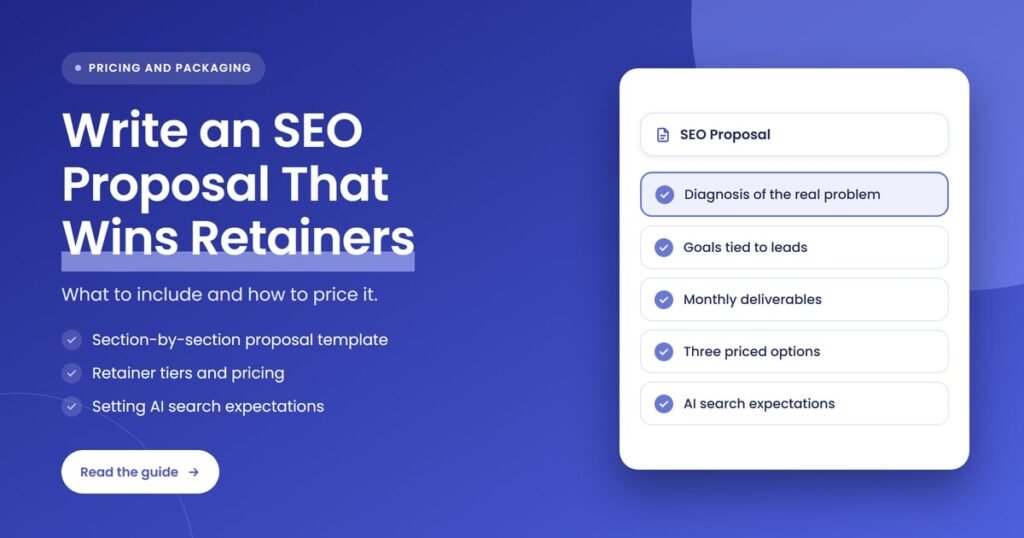
Quick answer: An SEO proposal that wins retainers diagnoses the client’s real problem, ties goals to leads and revenue, lists monthly deliverables with quantities, offers two or three priced options, and sets honest expectations, including how AI Overviews and ChatGPT now change clicks. It explains the reporting, contract terms and next step in plain language.
Key takeaways
- Most of the selling happens before the proposal. A discovery call that covers goals, budget and decision makers makes the document a confirmation, not a pitch.
- Specific scope wins trust. “Four service pages optimized per month” closes better than “ongoing optimization”, and it protects your margins later.
- Three priced options turn a yes-or-no decision into a choice between packages.
- Clients now see fewer clicks when AI summaries appear, so the proposal should promise visibility, leads and clear reporting rather than traffic alone.
- Never guarantee rankings or AI Overview placement. Guarantee the work, the reporting cadence and how you communicate.
What is an SEO proposal?
An SEO proposal is the document an agency or freelancer sends a prospective client to explain what is holding their search visibility back, what work will fix it, what it costs each month, and how progress will be reported. For a retainer, it is also the first draft of the working relationship.
A retainer is a recurring monthly fee for an agreed scope of ongoing work. For agencies, retainers are what make SEO worth selling: predictable revenue, predictable fulfillment and room to plan staffing. Ahrefs found that 78.2% of the 439 SEO providers it surveyed charge through a monthly retainer, so the format your clients expect is already set.
Why do so many SEO proposals fail to close?
SEO proposals usually fail because they arrive too early or say too little that is specific. A prospect who has not agreed on goals or budget will judge the document on price alone. Vague deliverables, hidden pricing, padded audits and promises the agency cannot control all make the client hesitate, compare quotes and stall.
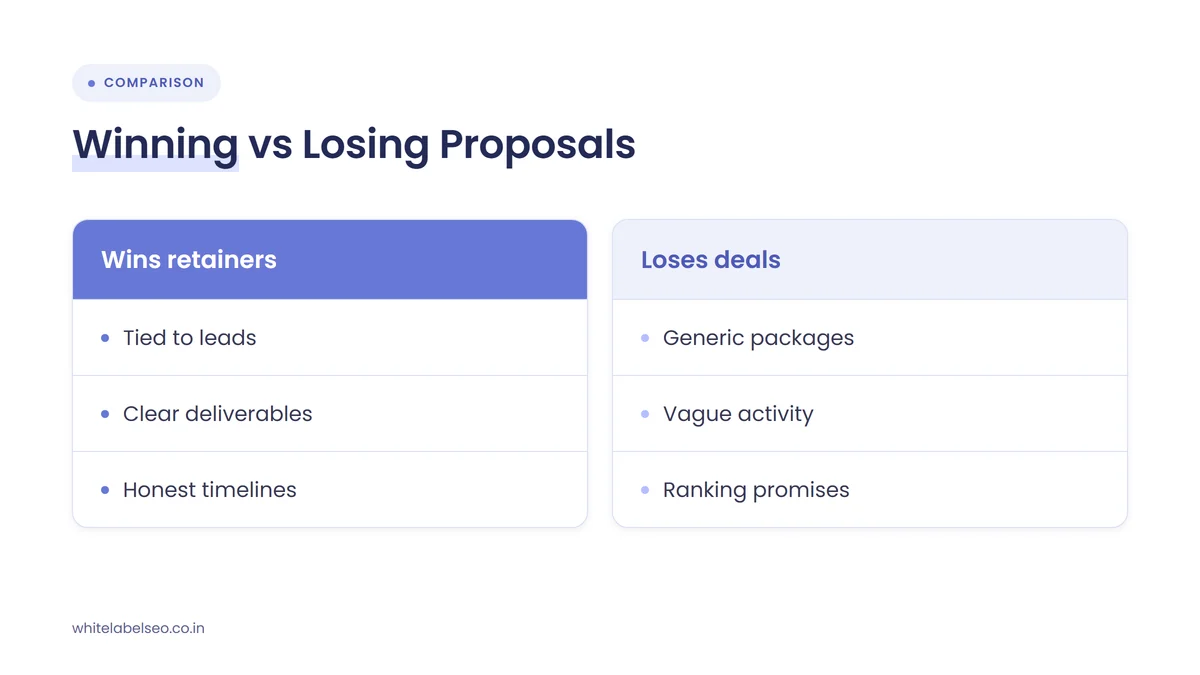
The most common causes are easy to spot once you look for them:
- No discovery first. The proposal guesses at goals instead of confirming them.
- A templated audit. Forty pages of automated warnings bury the three issues that matter.
- Vague scope. “Content and link building” tells the client nothing about volume or quality.
- Price on the last page. Clients look for the number first. Making them hunt for it reads as evasive.
- Outcomes you can’t control. Ranking or traffic guarantees win some deals and lose most retainers within months.
Length is part of the problem too. Designer and consultant Dan Mall put it bluntly on X in September 2026:
“Stop sending 30-page proposals to your clients.”
Dan Mall (@danmall) on X, September 15, 2026 (source)
His format of one page with three options comes from project work, but the principle carries over to SEO: the client should be able to read the problem, the plan and the price in one sitting.
What should an SEO proposal include?
A winning SEO proposal includes a short summary of the client’s situation, the three to five findings that matter most, goals tied to leads or revenue, a monthly scope with quantities, two or three priced options, a timeline, a reporting plan that covers AI search, contract terms and one clear next step. Everything else belongs in an appendix.
| Section | What it covers | Why it helps you close | Common mistake |
|---|---|---|---|
| Situation summary | The client’s business goal and current search position, in their own words from discovery | Shows you listened before you sold | Opening with your agency’s history |
| Key findings | Three to five issues from a light audit, each with its business impact | Makes the problem concrete and urgent | Pasting a full tool export |
| Goals and measures | Targets such as qualified leads, calls or sales, plus the leading indicators you will track | Connects SEO spend to outcomes the owner cares about | Goals based only on rankings or traffic |
| Monthly scope | Deliverables with quantities, for example pages optimized, articles published, links earned, technical fixes | Lets the client see what they pay for and protects your margins | “Ongoing optimization” with no numbers |
| Options and pricing | Two or three tiers with monthly fees and any setup fee | Turns “yes or no” into “which one” | One take-it-or-leave-it price |
| Timeline | What happens in month 1, months 2 to 3 and months 4 to 6 | Sets patience before results are expected | Implying results in weeks |
| AI search and reporting | How AI Overviews and ChatGPT affect clicks, and what the monthly report will show | Heads off the “traffic is down” conversation later | Reporting traffic alone |
| Terms | Minimum term, notice period, what the client must provide, and what is out of scope | Removes surprises that kill renewals | Leaving scope boundaries unwritten |
| Next step | One action: sign, book a call or approve a start date | Keeps momentum after the presentation | Ending with “let us know your thoughts” |
How do you write an SEO proposal step by step?
Write an SEO proposal by qualifying the prospect first, auditing only enough to find the issues that matter, agreeing goals in business terms, scoping work you can deliver at a healthy margin, packaging it into options, setting AI search expectations, and presenting it live. Each step makes the next one easier and shortens the time to signature.
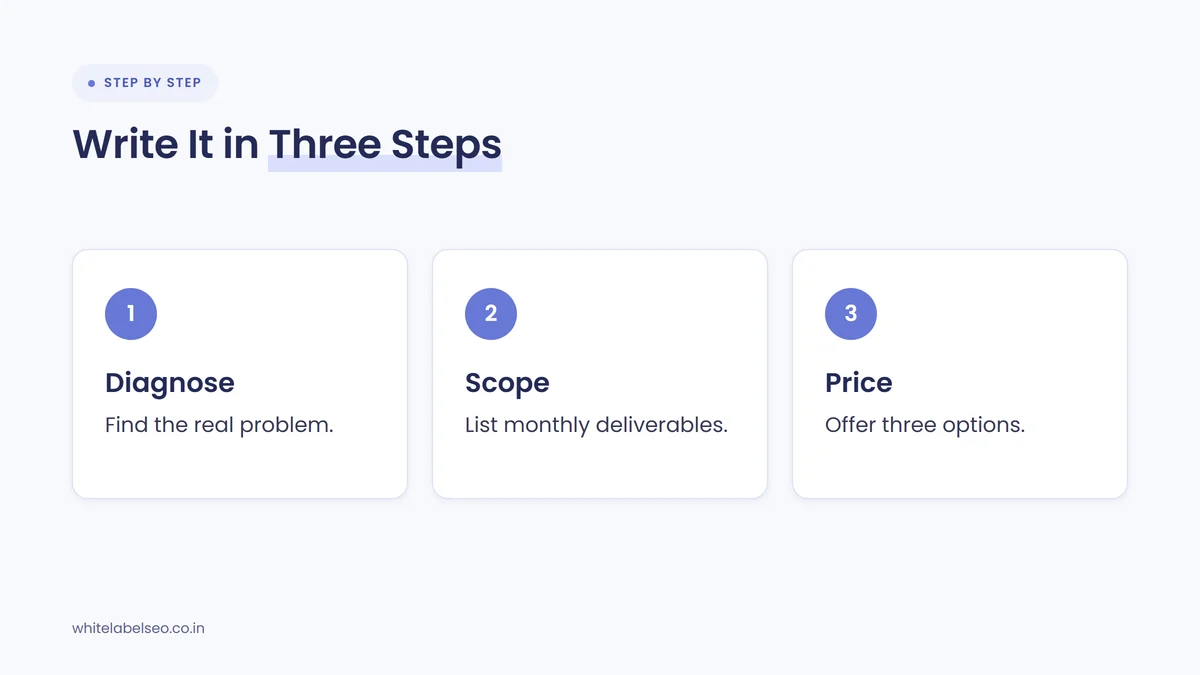
- Run a discovery call before writing anything. Confirm the business goal, the services or products that make the most money, the service area, the budget range, who signs, and what went wrong with any previous SEO provider. If the budget is far below what the work needs, say so now.
- Do a light audit, not a full one. Check indexing, site speed, core service pages, the Google Business Profile for local clients, and the competitors who win the searches that matter. Pick the three to five findings with the clearest business impact. Save the full audit for onboarding, or sell it as a paid first step.
- Set goals the owner cares about. Write targets as qualified leads, booked calls, quote requests or sales, then list the leading indicators you will report on the way there, such as impressions, rankings for priority terms and AI search visibility.
- Scope deliverables with quantities. State how many pages, articles, links and fixes each month includes, plus what is excluded. A tight scope is how you protect margins when the client asks for “one quick extra thing”.
- Build two or three options. Map each tier to a stage of growth, not a random task list. Put the option you recommend in the middle and say why it fits.
- Price from delivery cost up. Add up fulfillment, account management, reporting and tools, then apply your target margin. Check the result against what the market pays.
- Set expectations for AI search in writing. Explain that AI Overviews and ChatGPT answer some questions without a click, and show how your reporting will capture visibility and leads, not just sessions.
- Present it live and close on one next step. Walk the client through the document on a call, answer objections in real time, and agree on a start date before you hang up.
How should you structure retainer tiers in the proposal?
Structure retainer tiers around the client’s stage of growth. An entry tier fixes foundations and covers local visibility, a middle tier adds steady content and authority building, and a top tier adds digital PR, AI search visibility work and strategy reviews. Each tier should list monthly quantities so the client can compare options at a glance.
| Tier | Best for | Typical monthly scope | Reporting |
|---|---|---|---|
| Foundation | Single-location or new sites with technical and on-page gaps | Technical fixes, core page optimization, Google Business Profile management | Monthly summary of work done, rankings, impressions and leads |
| Growth | Businesses ready to compete for more searches | Everything in Foundation, plus a set number of articles or pages and link acquisition each month | Monthly report plus AI search visibility checks on agreed prompts |
| Authority | Competitive markets, multi-location or ecommerce clients | Everything in Growth, plus digital PR, brand mentions and quarterly strategy reviews | Monthly report, quarterly review call and AI citation tracking |
For a deeper walkthrough of naming, positioning and upgrading tiers, see our guide to packaging SEO into tiered retainers clients understand.
How much should you charge for an SEO retainer?
Charge enough to cover delivery, account management, reporting and tools, plus your target margin, then check that number against market rates. Published surveys show a wide spread: the most common SEO retainer band is $501 to $1,000 a month, while agencies average far higher, so your price should follow scope and market, not a template.
The best public benchmark is still the Ahrefs survey of 439 SEO providers, last updated in August 2024. It found:
- $501 to $1,000 a month was the most popular retainer band, charged by 20.4% of respondents.
- Agencies averaged $3,209 a month, consultancies $3,250 and freelancers about $1,349. Ahrefs notes these averages assume respondents charge the upper end of their pricing tier, so treat them as ceilings rather than midpoints.
Those figures are two years old and global, so use them as a sense check, not a price list. What matters more is your own cost to deliver. If fulfillment runs through a white-label partner, the wholesale fee becomes a fixed line in that calculation, which makes each tier’s margin predictable before you send the proposal. Our guide to pricing white-label SEO for healthy agency margins walks through markup and account management costs in detail.
Two pricing details make proposals easier to sign:
- Separate setup from the retainer. A one-time setup or audit fee covers the heavy first month, so the monthly fee reflects steady-state work.
- Show the price early. Put the options table near the top. A client who cannot find the number stops reading.
How do you set expectations for AI search in an SEO proposal?
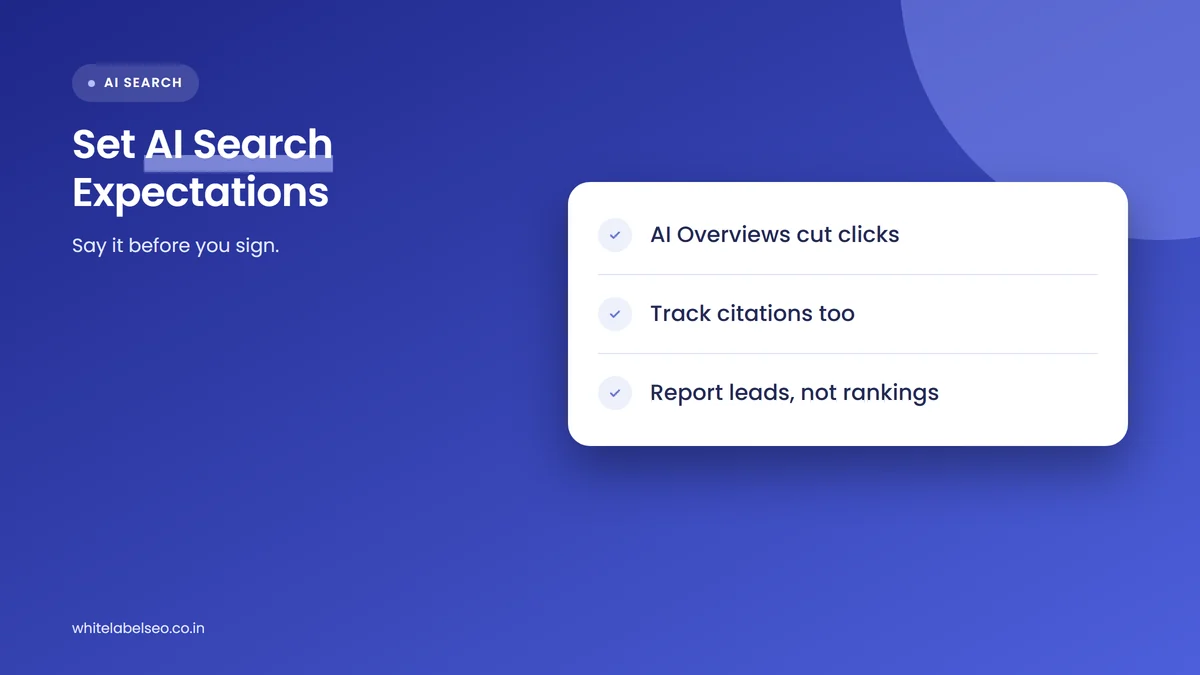
Set AI search expectations by telling the client, in writing, that AI Overviews and assistants like ChatGPT now answer some questions without a click, so traffic may fall even when visibility improves. Then promise what you can control: quality work, visibility tracking across Google and AI tools, and reporting that ties search activity to leads.
The click data is clear enough to put in front of clients:
- Pew Research Center analyzed 68,879 Google searches by 900 US adults in March 2025. Users clicked a traditional result in 8% of visits when an AI summary appeared, compared with 15% when none did. Links inside the summary were clicked in just 1% of visits.
- Ahrefs found in February 2026 that an AI Overview correlates with a 58% lower average clickthrough rate for the top-ranking page, based on 300,000 keywords compared between December 2023 and December 2025.
Agencies are already feeling this. In the AgencyAnalytics 2026 Marketing Agency Benchmarks Report, 64% of agencies named Google’s AI Overviews as their top concern, 66% reported increased client demand for AI search services, and nearly half said they can’t track users who discover brands through AI tools.
The good news for your proposal is that AI search does not need a separate, mysterious service. Google’s own documentation says there are no additional requirements or special optimizations needed to appear in AI Overviews or AI Mode. Jake Ward made the same point on X in June 2026:
“Too many people are treating AI search as a different channel”
Jake Ward (@jakezward) on X, June 15, 2026 (source)
So write AI search into the existing scope and reporting rather than bolting on a vague extra. A short expectations paragraph in the proposal can cover four points:
- What is changing: some searches now end in an AI answer, so clicks per ranking position are lower than they used to be.
- What you will measure: impressions, rankings for priority terms, leads and conversions, plus whether the brand appears in AI answers for an agreed list of prompts.
- Where the data comes from: Google launched Search Console reports for generative AI features in June 2026 and rolled them out to all sites worldwide by August 31, 2026. They show impressions in AI Overviews and AI Mode, not clicks, so pair them with lead tracking.
- What you will not promise: a specific ranking, a set traffic number or placement in any AI answer.
That last point matters. Google’s own hiring guidance warns that “No one can guarantee a #1 ranking on Google.” If a prospect pushes for guarantees, our guide on how to answer clients who ask you to guarantee SEO rankings gives you language to use.
What should the reporting section of an SEO proposal promise?
The reporting section should promise a fixed cadence, a named contact, and a report that shows work completed, visibility in Google and AI search, and leads or sales from organic search. Show the client a sample report page in the proposal so they know exactly what will arrive each month and how to read it.
- Work completed: every deliverable from the scope, so the client sees the retainer being used.
- Visibility: impressions, priority rankings and AI search appearances, with Search Console’s generative AI report where available.
- Outcomes: calls, forms, bookings or sales attributed to organic search.
- Next month: what is planned and anything you need from the client.
If you resell SEO, make sure every report carries your agency’s branding and that your fulfillment team can produce it on the same schedule each month. Our post on what to report differently in a zero-click world covers the metrics in more depth.
What mistakes cost agencies the retainer after the proposal is signed?
Most lost retainers trace back to the proposal: scope that was never written down, goals measured only in traffic, no plan for the slow first months, and reporting that hides the work. Fix these in the document and the renewal conversation becomes a review of progress instead of a defense of the fee.
- Selling a tier you can’t deliver at margin. If the fee doesn’t cover fulfillment and account time, quality slips by month three.
- No defined exclusions. Website rebuilds, paid ads and copy rewrites creep in unless the proposal says they are separate work.
- Silence in months one to three. Plan visible early wins, such as technical fixes and profile updates, and report them.
- Traffic as the only goal. With fewer clicks per ranking, a traffic-only goal can make good work look like failure.
Frequently asked questions
How long should an SEO proposal be?
Long enough to show the problem, the plan, the options and the price, and no longer. For most small and mid-sized clients, a few pages plus an appendix for audit detail is enough. If the client can’t find the price and the recommended option within a minute, the proposal is too long.
Should you include a free audit in an SEO proposal?
Include a light audit with the three to five findings that matter most, because it proves you understand the site. Keep the full audit for onboarding or sell it as a paid first step. Giving away a complete audit often hands the prospect a to-do list they take to a cheaper provider.
How long should an SEO retainer contract be?
Many agencies set a minimum term so the client stays long enough for SEO work to show results, followed by a rolling monthly agreement with a notice period. Whatever you choose, state the term, the notice period and what happens at renewal clearly in the proposal so there are no surprises later.
Can you guarantee a client will appear in AI Overviews or ChatGPT?
No. Google says no one can guarantee a top ranking, and no one controls which sources an AI answer cites. You can promise the work that improves the odds, such as answer-first content, a strong Google Business Profile and brand mentions, plus honest tracking of whether the client appears for agreed prompts.
Should you show prices in the first proposal?
Yes. Discuss the budget range on the discovery call, then show clear prices for each option near the top of the proposal. Hiding the price until a second call slows the deal and makes clients suspect the number is higher than it is.
What should you do next?
Take your current proposal template and check it against the section table above. Cut the audit to the findings that matter, add quantities to every deliverable, build two or three priced options, and add an AI search expectations paragraph with a sample report page. Then use it on your next discovery call and refine it from what clients ask. To see what we deliver behind proposals like this, read about our white-label SEO services at White Label SEO.
Need reliable fulfillment behind your SEO proposals?
At White Label SEO, we deliver white-label SEO services under your agency’s brand, with fixed scopes and reporting you can put in front of clients. Talk to us about white-label SEO for your agency, and we’ll help you scope tiers you can deliver at a healthy margin.
Sources
- Ahrefs, “SEO Pricing: How Much Does SEO Cost? 439 People Polled”, updated August 15, 2024. https://ahrefs.com/blog/seo-pricing/
- Pew Research Center, “Google users are less likely to click on links when an AI summary appears in the results”, July 22, 2025. https://www.pewresearch.org/short-reads/2025/07/22/google-users-are-less-likely-to-click-on-links-when-an-ai-summary-appears-in-the-results/
- Ahrefs, “Update: AI Overviews Reduce Clicks by 58%”, February 4, 2026. https://ahrefs.com/blog/ai-overviews-reduce-clicks-update/
- AgencyAnalytics, “AgencyAnalytics releases 2026 Marketing Agency Benchmarks Report”, June 30, 2026. https://agencyanalytics.com/company/newsroom/press-release-agency-benchmarks-report-2026
- Google Search Central, “AI features and your website”, last updated December 10, 2025. https://developers.google.com/search/docs/appearance/ai-features
- Google Search Central Blog, “Introducing Search Generative AI performance reports in Search Console”, June 3, 2026. https://developers.google.com/search/blog/2026/06/gen-ai-performance-reports
- Search Engine Journal, “Google Search Console AI Reports Rolled Out Worldwide”, August 31, 2026. https://www.searchenginejournal.com/google-search-console-ai-reports-rolled-out-worldwide/587836/
- Google Search Central, “Do you need an SEO?”, last updated June 5, 2026. https://developers.google.com/search/docs/fundamentals/do-i-need-seo
- Dan Mall (@danmall) on X, September 15, 2026. https://x.com/danmall/status/2099890999468413394
- Jake Ward (@jakezward) on X, June 15, 2026. https://x.com/jakezward/status/2066505305664418266