Quick answer: Communication between an agency and its white label partner should run on a written communication plan: one named contact on each side, one shared channel, a weekly check-in and a monthly review, a clear escalation path with response times, and a reporting handoff the agency controls. Client-facing communication stays with the agency.
Key takeaways
- White label partner communication is the agreed set of contacts, channels, meetings and rules between an agency and the partner that delivers its SEO.
- A communication plan should cover 6 things: point of contact, shared channel, cadence, escalation path, reporting handoff and client-facing rules.
- Each side needs 1 named contact and 1 backup, so no question depends on a single person’s inbox.
- A 30-minute weekly check-in and a monthly review keep the agency informed without daily chasing.
- Escalation should have 3 steps with a response time for each, written before the first problem.
- The agency owns client-facing communication, and the reporting handoff gives the agency every report before the client sees it.
What is white label partner communication?
White label partner communication is the agreed way an agency and its white label partner exchange information: who talks to whom, on which channel, how often, how problems are raised and how reports move from the partner to the agency. It covers the working relationship behind the scenes, not what the agency says to its own clients.
The reason it needs a plan is simple. The agency’s client sees only the agency, so every delay, unclear answer or missed deadline at the partner becomes the agency’s problem. Google Search Central’s guide “Do you need an SEO?” lists “How can I expect to communicate with you?” as a question to ask any SEO before hiring one, which shows how basic the question is. A white label partner communication plan answers it in writing, once, for the whole relationship.
What should a white label partner communication plan cover?
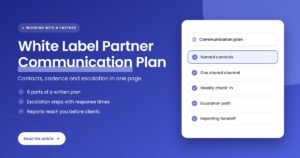
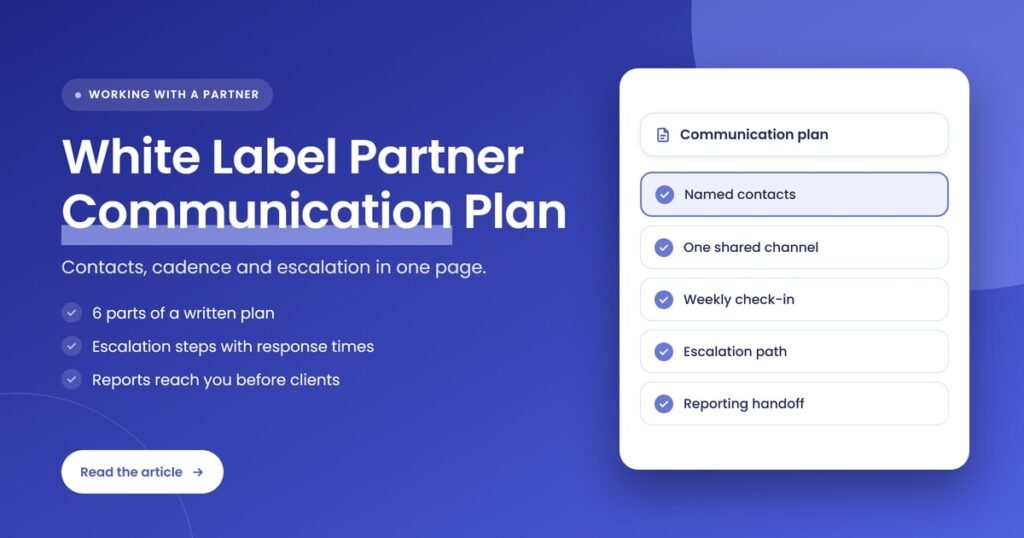
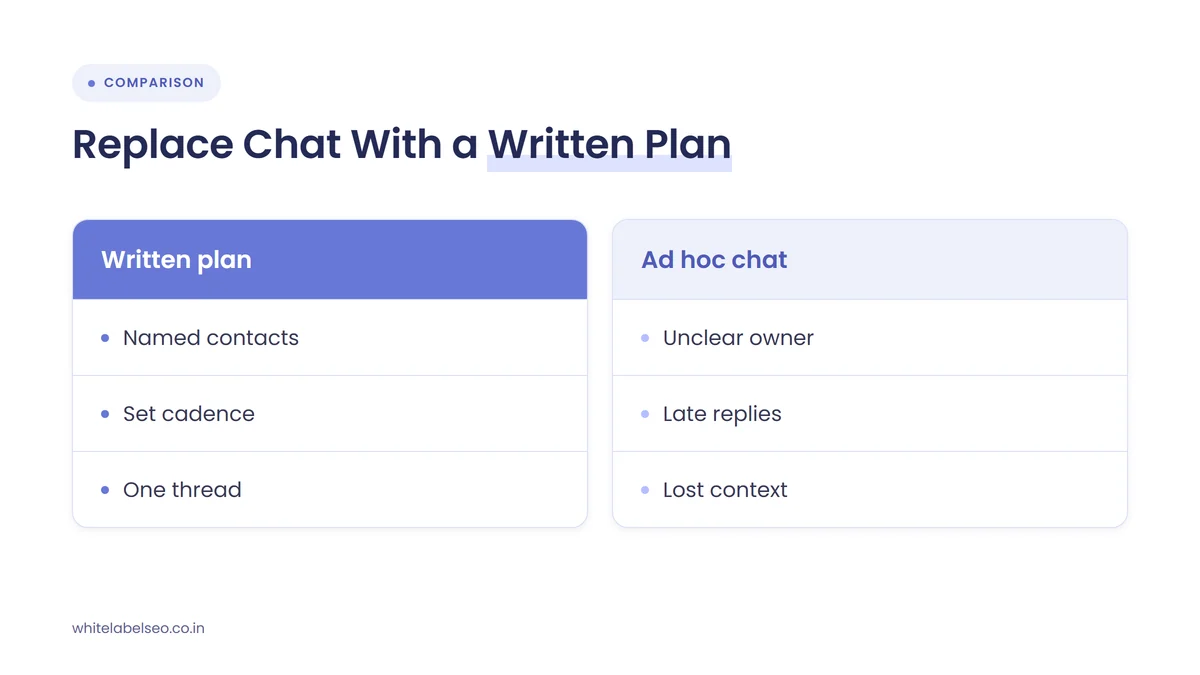
A white label partner communication plan should cover 6 things: point of contact, shared channel, cadence, escalation path, reporting handoff and client-facing rules. A plan with all 6 fits on one page, and an agency can write it in an afternoon and attach it to the partner agreement.
The 6 parts of a white label partner communication plan are listed below, in the order we recommend writing them.
- Point of contact. Name one contact and one backup on each side, with their role and working hours.
- Shared channel. Choose one channel for day-to-day questions and one for formal records, so nothing important lives in a private message.
- Cadence. Set the weekly check-in, the monthly review and the date each status update arrives.
- Escalation path. Define what counts as urgent, who is told first and how fast the partner must respond.
- Reporting handoff. Agree when the partner delivers each report, in what format and how the agency reviews it.
- Client-facing rules. State that the agency speaks to the client and the partner does not, unless the agency invites it.
The agency that offers the partnership usually drafts the plan, because the agency carries the client relationship. Our own white label SEO services start from the same one-page plan, so agencies know the contacts and the rhythm before the first task begins.
Who should be the point of contact between an agency and a white label partner?
The point of contact between an agency and a white label partner should be one named person on each side, plus one backup. On the agency side this is usually the account manager. On the partner side it is the delivery lead or strategist who sees the work, not a sales contact.
A named contact matters because a shared inbox hides ownership. When 3 people can answer, none of them feels responsible, and a client question can sit for days. Write each contact’s name, role, email, chat handle and working hours into the communication plan. Add the backup’s details too, and say when the backup takes over: for example, when the main contact is off for more than 1 working day.
Keep the agency-side contact close to the client. This person translates the partner’s updates into client language, which is why the partner never needs to speak to the client at all.
Which channels should an agency use with a white label partner?
An agency should use one shared channel for daily questions and email for formal records with its white label partner. Slack, Google Chat or a similar chat tool suits quick answers. Email or a project tool suits approvals, scope changes and anything the agency may need to show later.
The channel matters less than the rule that goes with it. The communication plan should say which messages belong where, so a scope change agreed in chat is confirmed in writing the same day. Looker Studio gives agencies a delivery tool for reports as well. Google’s Looker Studio documentation says scheduled email delivery runs at most once per day without Looker Studio Pro and up to hourly with Pro, and that Pro also adds Google Chat and Slack delivery.
Looker Studio also caps recipients. According to the same documentation, an individual account can email 200 recipients a day and 800 a month, a Google Workspace account 500 a day and 3,000 a month, and Pro has no quota. A weekly status update to 2 or 3 agency staff sits far below those limits.
How often should an agency and a white label partner meet?
An agency and a white label partner should meet weekly for 30 minutes and monthly for a review. The weekly check-in covers work in progress, blockers and next week’s tasks. The monthly review covers results, the next month’s plan and any change to scope. The weekly check-in can move to chat for stable accounts.
DashClicks, a white label vendor, recommends weekly tactical check-ins, monthly strategic reviews and quarterly strategy reviews in its August 15, 2025 guide to building a white label SEO partnership. That rhythm is a vendor suggestion rather than a standard, and we use a similar one. The 3 meeting types are listed below.
- Hold a weekly check-in. Spend 30 minutes on tasks done, tasks due and blockers, and end with a written status update from the partner.
- Hold a monthly review. Walk through the month’s results, compare them with the plan and agree the next month’s task list.
- Hold a quarterly review. Check the working relationship itself: response times, report quality and whether the scope still fits the agency’s clients.
Sitechecker’s “2026 SEO agency growth report”, published March 11, 2026 and based on 73 SEO agencies, found that 19.2% of agencies said clients want closer collaboration with in-house marketing teams, and that clients also require more communication about what agencies do and why. A steady cadence with the partner gives the agency the facts it needs to answer those questions.
How should escalation work between an agency and a white label partner?
Escalation between an agency and a white label partner should follow 3 steps: flag the issue, get a response inside the agreed time, and log the fix and cause. Write the response time for each urgency level into the communication plan before the first problem, because no one negotiates well during one.
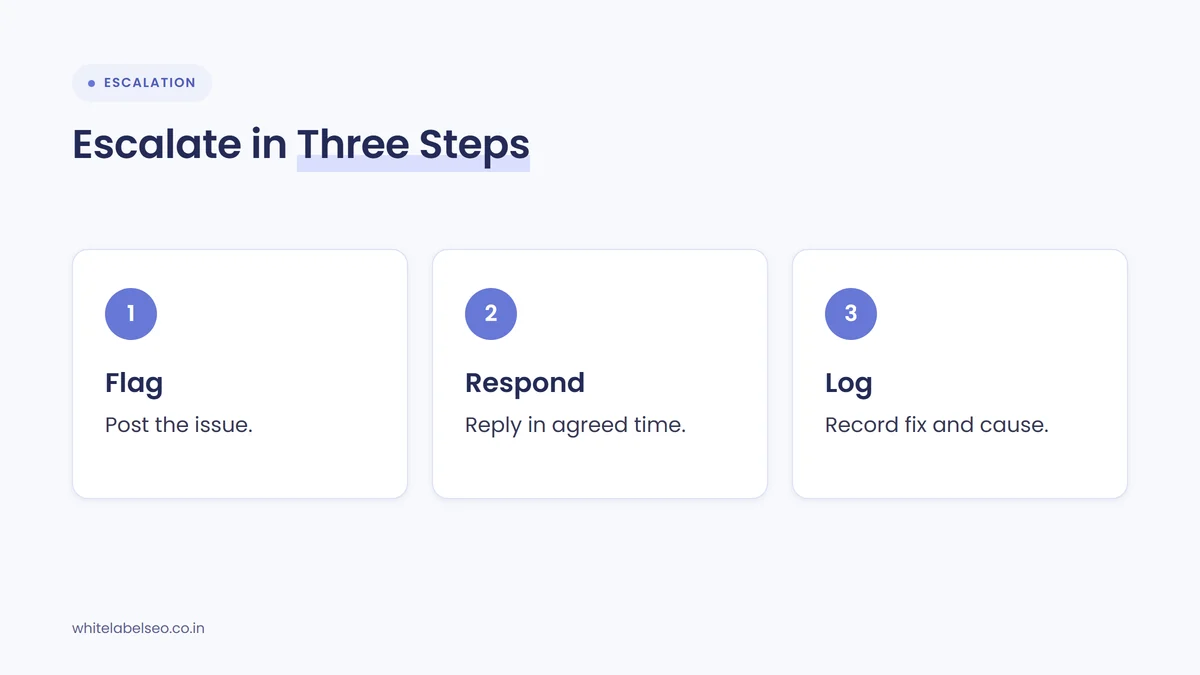
The 3 escalation steps are listed below.
- Flag the issue. Post it in the shared channel with the client name, the task and the deadline at risk, and mark it urgent only if a client deliverable or access is affected.
- Respond within the agreed time. Set 1 response time for normal questions and a shorter one for urgent issues, for example the same working day and 2 working hours, and name the person who answers.
- Log the fix and the cause. Record what went wrong, what was done and what changes next time, so the same problem does not return in the monthly review.
If the partner misses the response time twice in 1 month, treat it as an agenda item for the monthly review. Service terms such as turnaround and remedies belong in the agreement itself, which we cover in what SLAs a white label SEO partner should offer.
How should the reporting handoff work with a white label partner?
The reporting handoff with a white label partner should deliver every report to the agency first, in an agreed format, a set number of days before the client date. The agency then reviews, brands and sends it. The client never sees an unreviewed partner report.
The handoff also needs account access that keeps the agency in control. Google Search Console Help says an owner has full control of a property, a full user can view all data and take some actions, a restricted user has simple view rights, and a property can have a maximum of 100 non-owners. The agency should stay the owner and give the partner a full user role. For Google Business Profile, Google’s help page says managers have mostly the same access as owners but cannot add or remove users or remove the profile, and new owners and managers wait 7 days before they can manage some features. Add the partner as a manager at least 7 days before the work starts.
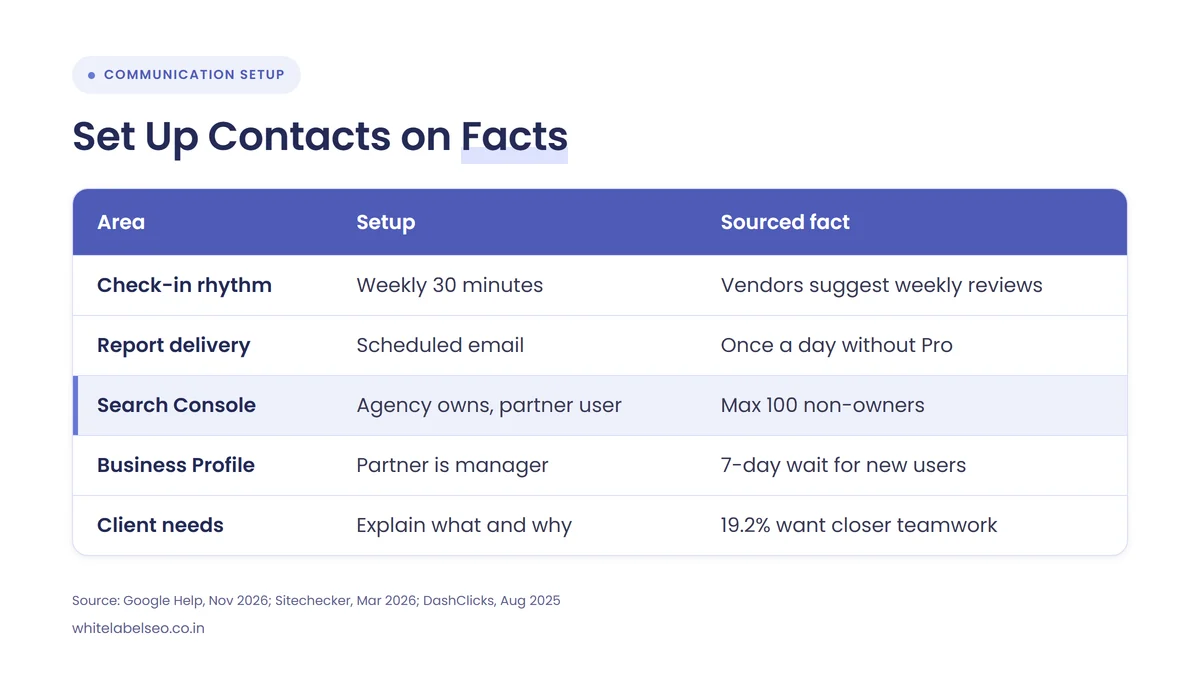
| Area | Setup | Sourced fact |
|---|---|---|
| Named contact | 1 contact and 1 backup on each side | Google Search Central lists “How can I expect to communicate with you?” as a question to ask an SEO (accessed Nov 25, 2026) |
| Check-in rhythm | 30-minute weekly check-in, monthly review | DashClicks recommends weekly, monthly and quarterly reviews (Aug 15, 2025) |
| Report delivery | Scheduled Looker Studio email to the agency | Once per day without Pro, hourly with Pro (Google Cloud, accessed Nov 25, 2026) |
| Search Console access | Agency is owner, partner is full user | Maximum 100 non-owners per property (Google, accessed Nov 25, 2026) |
| Business Profile access | Partner added as manager 7+ days early | 7-day wait for new owners and managers (Google, accessed Nov 25, 2026) |
| Client expectations | Agency explains what is done and why | 19.2% of 73 agencies say clients want closer collaboration with in-house teams (Sitechecker, Mar 11, 2026) |
The table shows that 4 of the 6 setup rows rest on Google’s own documentation, and the other 2 rest on a vendor guide and an industry survey, so each row can be checked.
Sitechecker’s report also found that 93.2% of the 73 agencies use Google Search Console and 67.1% use Looker Studio, so most agencies already have the tools to receive a partner’s reports. Report quality is a separate topic: compare each report against the 10 red flags in a white label SEO report before it goes to a client.
How do you present a white label partner’s work to the client?
You present a white label partner’s work to the client as your agency’s work, in your agency’s voice, through your agency’s named contact. The partner supplies the facts and the agency turns them into the client update, so the client hears 1 voice and 1 point of contact.
This is the border between partner communication and client communication. The partner should not email the client, join client calls or answer client questions unless the agency invites it. If the client asks for detail the agency lacks, the agency contact asks the partner in the shared channel and replies with the answer. The full approach is covered in how to present white label SEO results to clients without revealing who did the work.
How do you write the communication plan into the white label partner agreement?
You write the communication plan into the white label partner agreement as a one-page schedule attached to the contract. The schedule names the contacts, the channels, the meeting rhythm, the response times and the reporting dates, and either side can update it with 1 written notice.
The 5 items to write into the schedule are listed below.
- List the named contacts. Add each person’s role, backup and working hours.
- State the channels. Say which channel carries daily questions and which carries approvals.
- Fix the cadence. Give the weekly check-in day, the monthly review date and the status update deadline.
- Set the response times. Give one for normal questions and one for urgent issues.
- Forbid direct client contact. Allow it only when the agency asks in writing.
Google Search Central also warns, in “Do you need an SEO?”, to be careful if a company is secretive or won’t clearly explain what it intends to do. A partner that resists a written communication plan is giving the agency the same warning. The same document suggests asking whether the SEO will share all the changes it makes, and a good schedule adds a line for that. For more questions to settle before you sign, see questions to ask a white label SEO partner before signing.
Frequently asked questions
Should a white label partner ever contact your client directly?
No, a white label partner should not contact your client directly unless you ask in writing. Client-facing communication belongs to the agency, so the client hears 1 voice. If the client needs technical detail, the agency contact asks the partner in the shared channel and sends the answer in its own words.
Is Slack or email better for working with a white label partner?
Slack, or a similar chat tool, is better for daily questions, and email is better for approvals and records. Use 1 channel for each purpose and confirm any scope change by email the same day. That way quick answers stay quick and decisions stay on record.
What is a good response time from a white label partner?
A good response time from a white label partner is the one you agreed in writing, and a common starting point is the same working day for normal questions and 2 working hours for urgent ones. Agree the numbers with the partner, then review them in the quarterly review.
What should you do if a white label partner goes silent?
If a white label partner goes silent, use the escalation path: flag the issue in the shared channel, then contact the backup contact and email the partner’s lead if the agreed response time passes. If the silence repeats, record it in the monthly review and decide whether the partner still fits your clients.
How do time zones change white label partner communication?
Time zones change when the weekly check-in and the response times fall, not whether you need a plan. Pick a check-in time that suits both teams and count response times in working hours.
A time difference can also help. Our guide to follow-the-sun SEO delivery covers how it can speed up turnaround.
What should you do next?
Write the 1-page communication plan this week: name 1 contact and 1 backup on each side, pick the shared channel, set the weekly check-in and monthly review, add the escalation path with response times and agree the reporting handoff dates. Then keep client-facing communication with your agency, and review the plan every quarter.
If you want a partner that works from a written communication plan, see our white label SEO services, or start from the White Label SEO homepage. To see how the monthly work itself is organised, read what a white label SEO partner does each month.
Want a white label partner that works from a written plan?
At White Label SEO, we set the contacts, channel, check-in rhythm, escalation path and reporting handoff with every agency before the first task starts. Tell us how you work today, and we’ll draft the one-page plan with you.
Sources
- Google Search Central, “Do you need an SEO?”, accessed November 25, 2026. https://developers.google.com/search/docs/fundamentals/do-i-need-seo
- Google Search Console Help, “Managing owners, users, and permissions”, accessed November 25, 2026. https://support.google.com/webmasters/answer/7687615
- Google Business Profile Help, “Manage your Business Profile owners & managers”, accessed November 25, 2026. https://support.google.com/business/answer/3403100
- Google Cloud, Looker Studio documentation, “Schedule automatic report delivery”, accessed November 25, 2026. https://docs.cloud.google.com/looker/docs/studio/schedule-automatic-report-delivery
- Sitechecker (Ivan Palii), “The 2026 SEO agency growth report”, March 11, 2026. https://sitechecker.pro/seo-agency-growth-data-study-2026/
- DashClicks, “How to Build a Successful Partnership with Your White Label SEO Agency”, August 15, 2025. https://www.dashclicks.com/blog/how-to-build-a-successful-partnership-with-your-white-label-seo-agency