
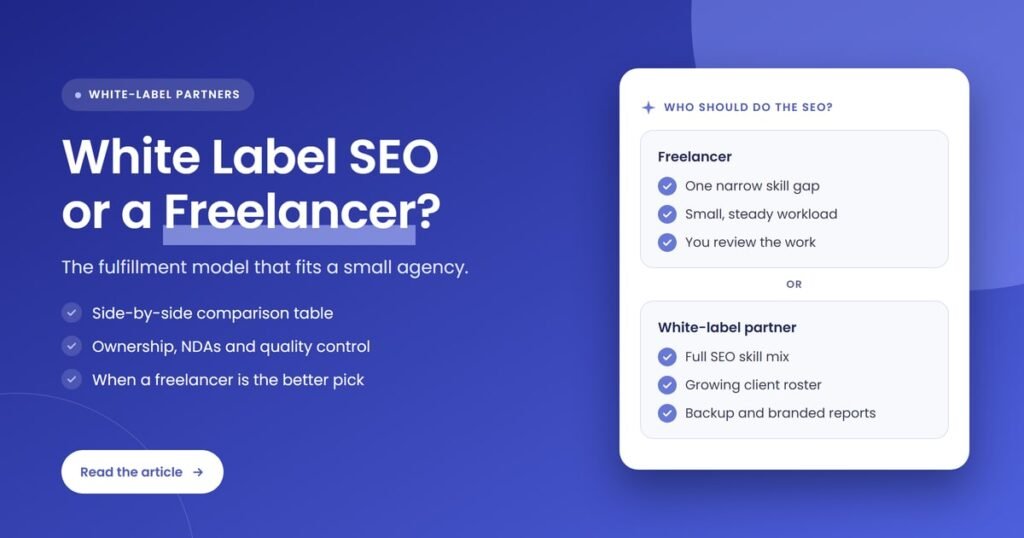
Quick answer: A small agency should hire an SEO freelancer when it needs one specific skill, has a small and steady workload, and can review the work itself. It should choose a white-label partner when clients need technical, content, local, link and AI search work together, when capacity must flex, and when delivery cannot depend on one person.
Key takeaways
- The real choice is between one person’s skills and a team’s process. A freelancer can be excellent, but coverage and continuity end where that person’s time and expertise end.
- A white-label partner suits agencies that resell SEO across several clients and need technical, content, local, link and AI search work under one roof.
- A freelancer is often the better pick for a single, well-defined gap, such as technical audits or local listings, when you can check the work yourself.
- Whichever you choose, keep client accounts, data and the client relationship in your agency’s name, and put confidentiality and non-solicitation terms in writing.
- Compare cost structures, not just rates: a freelancer usually bills time, while a white-label partner usually sells packaged deliverables at a wholesale fee you mark up.
What is the difference between a white-label SEO partner and a freelancer?
A white-label SEO partner is a company that delivers SEO work for your clients under your agency’s brand, with its own team, processes and unbranded reports. An SEO freelancer is an independent specialist who works for you as a subcontractor. Both stay invisible to the client, but they differ in scale, coverage and backup.
White label means the provider does the work and you put your name on it. The client sees your agency, your reports and your account manager. A partner like this typically runs fixed monthly packages, assigns several specialists to each account and handles quality checks before anything reaches you. Our guide to what a white-label SEO partner does each month covers that cycle in detail.
A freelancer is one person, sometimes with a small network of their own, who you brief, pay and manage directly. Many freelancers can also work unbranded, so the client never sees them either. The difference is less about who stays hidden and more about what sits behind the work: one person’s calendar or a team’s process.
Why are small agencies weighing this choice now?
Small agencies are revisiting how they fulfill SEO because the scope of the work has widened. Clients now ask about AI Overviews and ChatGPT visibility on top of rankings, local and content, and agency labor costs keep rising. That makes it harder for one specialist to cover every request, so fulfillment choices are back on the table.
The demand shift is measurable. In the AgencyAnalytics 2026 Marketing Agency Benchmarks Report, published in June 2026, 66% of agencies reported increased client demand for AI search services and 64% named Google’s AI Overviews as their top concern. Nearly half said they can’t track users who discover brands through AI tools.
The staffing model is also being questioned openly. An October 2026 press release from one white-label provider described how many small and midsize agencies still rely on a mix of employees, freelancers and specialized contractors, and said that model can bring inconsistent delivery standards and unpredictable costs. It is a vendor’s announcement, not independent research, but it reflects a conversation agency owners are having right now.
There is a newer question too: who, or what, is actually doing the work. Both freelancers and white-label teams now use AI tools in delivery. That is fine when it is disclosed and reviewed, and a problem when it is not, so ask either option how they use AI and who checks the output before it reaches your client.
How do a freelancer and a white-label partner compare?
A freelancer gives you direct access to one specialist, flexible terms and often a lower entry cost. A white-label partner gives you broader skill coverage, backup when people are away, standard branded reporting and a set quality process. The right pick depends on how many SEO clients you have and how many skills they need.
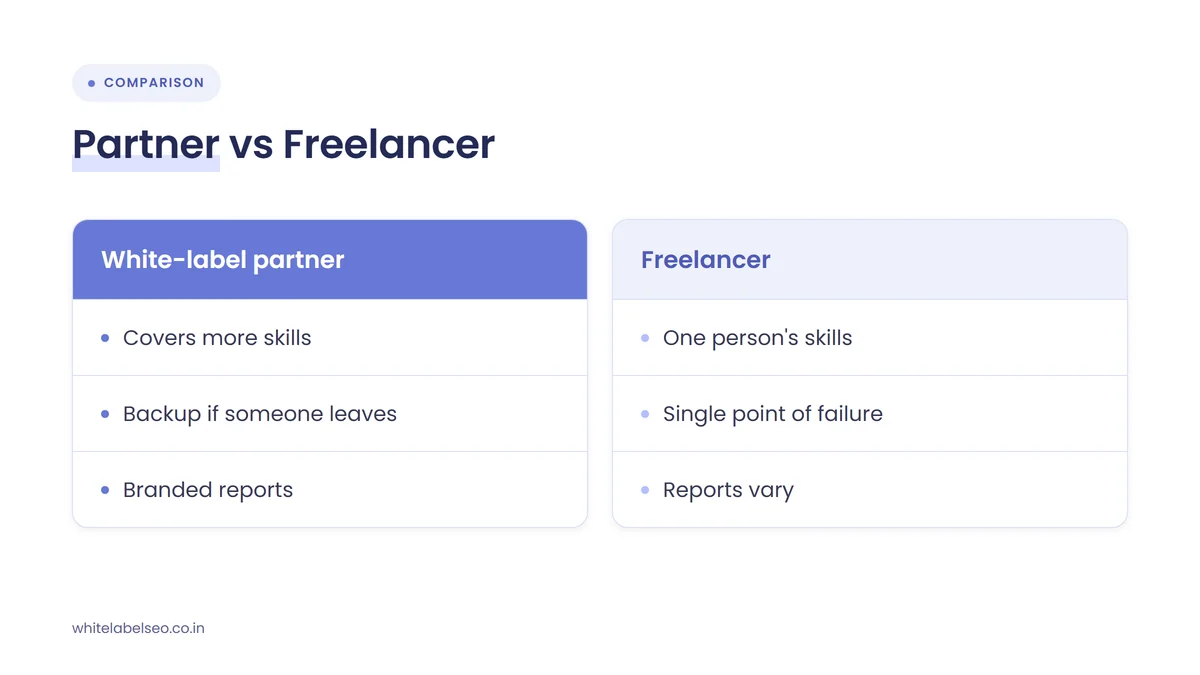
| Factor | SEO freelancer | White-label SEO partner |
|---|---|---|
| Capacity | Limited to one person’s hours; busy months compete with their other clients | Team-based, so it can usually absorb new clients and spikes in work |
| Skill coverage | Deep in one or two areas, thinner elsewhere | Technical, content, local, links and AI search handled by different specialists |
| Continuity | Illness, holidays or a new full-time job can pause delivery | Work is documented and can move to another team member |
| Branded reporting | Depends on the freelancer’s tools and habits | Usually a standard unbranded or white-labeled report each month |
| Quality control | Mostly falls on you | An internal review step before delivery, plus your own spot checks |
| Cost structure | Usually hourly, per project or a small monthly fee | Usually fixed wholesale packages you resell at a markup |
| Management time | You brief, chase and review each task | One point of contact and a set delivery schedule |
| Best fit | One narrow skill gap and a small, steady workload | Several SEO clients needing ongoing, multi-skill retainers |
Which option covers more SEO skills?
A white-label partner usually covers more skills, because it staffs different specialists for technical SEO, content, local search, link building and AI search visibility. A freelancer may be stronger in one of those areas than any generalist team, but few individuals do all five well every month across several client accounts.
Map what your current and likely clients need before you decide:
- Technical SEO: crawling, indexing, site speed, migrations and structured data. This is where many specialist freelancers shine.
- Content: service pages, blog posts and content refreshes written to a consistent standard each month.
- Local SEO: Google Business Profile management, citations, reviews and location pages for service businesses.
- Links and digital PR: outreach and brand mentions, which take steady time and relationships to do safely.
- AI search: answer-first content, entity and brand signals, and tracking whether the client appears in AI answers for agreed prompts.
If your clients only need one or two of these, a freelancer can cover them. If they need four or five, you either manage several freelancers or use one partner. Our list of SEO services agencies can resell breaks down what each service involves.
What happens to capacity and continuity if someone leaves?
With a freelancer, your SEO delivery has a bus factor of one: if that person gets sick, takes a full-time job or drops your account, work stops until you find and brief someone new. A white-label partner spreads work across a team, so delivery can continue when one person is away.
Capacity is the quieter version of the same risk. A freelancer who takes on two new clients in the same month you sign two new clients has to choose whose work slips. A partner still has limits, but it plans staffing across many agencies and can usually add capacity faster.
You can reduce the risk with either option:
- Keep a written process for each client: goals, logins held in your name, keyword lists and the monthly plan.
- Ask for a notice period in the contract, so a departure gives you time to hand over.
- Keep a backup option warm, such as a second freelancer or a partner you have already tested on a small project.
How does reporting under your agency’s brand work?
A white-label partner normally sends reports with no branding of its own, or with your logo applied, on a fixed date each month. A freelancer can do the same, but the format, tools and timing depend on the individual. Either way, the report the client sees should come from your agency.
Check three things before you commit. First, ask for a sample report and confirm it can carry your branding with no trace of the provider. Second, check it shows work completed, visibility and leads, not just rankings. Third, confirm who explains the numbers when the client asks a hard question. If you inherit reports that pad activity or hide drops, our post on red flags in a white-label SEO report shows what to look for.
How do you protect client ownership and confidentiality?
Protect client ownership by keeping every account, such as Search Console, analytics, Google Business Profile and the CMS, owned by your agency or the client, and giving the freelancer or partner user-level access only. Back that up with a written agreement covering confidentiality, non-solicitation of your clients and ownership of the work produced.
Google’s Search Console permissions make this practical. An owner has full control over a property, including adding and removing users, while a full user can view all data and take some actions but cannot manage users. Give outside help full or restricted user access, never ownership, and remove it the day the work ends.
The written side matters just as much. Whether you hire a freelancer or a partner, the agreement should cover:
- Confidentiality: client names, data and strategy stay private, during the work and after it ends.
- Non-solicitation: the provider will not pitch or accept work directly from your clients for an agreed period.
- Ownership of work: content, audits and reports belong to your agency or your client once paid for.
- No direct contact: the provider does not contact the client unless you approve it.
- Handover: what files and access are returned if the arrangement ends.
Have a lawyer review the template once, then reuse it. Established white-label partners usually expect these terms, while some freelancers may not have signed them before, so raise them early.
How do you control quality with each option?
With a freelancer, quality control mostly sits with you: you check each deliverable before it reaches the client. A good white-label partner adds its own review step, but you still need spot checks. In both cases, set written standards first, then review a sample of work every month against those standards.
A simple quality routine works for both:
- Agree standards in writing: content guidelines, link quality rules and what “done” means for technical fixes.
- Check a sample monthly: read one article, open a few new links and confirm technical fixes are live.
- Ask about methods: Google suggests asking any SEO whether they follow Google Search Essentials, how they measure success and how they will communicate. Be cautious of anyone who won’t clearly explain what they intend to do.
- Start with a pilot: test on one client before moving your whole roster. Our guide to running a pilot project before you commit explains how to set one up.
How do the costs compare?
Freelancers usually charge by the hour, by the project or a modest monthly fee, while white-label partners usually charge fixed wholesale prices per package that you resell at a markup. The cheaper option on paper is not always cheaper in practice, because your own management and review time is part of the cost.
Public price data is limited, and most of it shows what providers charge end clients rather than agencies. The best-known benchmark is the Ahrefs survey of 439 SEO providers, last updated in August 2024. It found freelancers averaged $71.59 an hour against $98.90 for agencies, and about $1,349 a month on retainer against $3,209 for agencies. Ahrefs notes those averages assume respondents charge the top of their pricing range, and they are two years old, so treat them as a rough sense of scale only.
When you compare real quotes, add up the full cost of each option:
- Direct fees: hourly or project fees for a freelancer, the wholesale package price for a partner.
- Your time: briefing, chasing, reviewing and rewriting. This is often higher with freelancers.
- Tools: who pays for rank tracking, crawlers and reporting software.
- Risk cost: what a missed month or a lost client would cost you if delivery stopped.
Then work back from the price you charge the client to the margin each option leaves. A predictable wholesale fee makes that calculation easier; a variable hourly bill makes it harder.
When is a freelancer the better pick?
A freelancer is the better pick when you need one narrow skill, your SEO workload is small and steady, you have the in-house knowledge to review the work, or the budget does not support a full package. In those cases a trusted specialist can be faster, more flexible and better value than a partner.
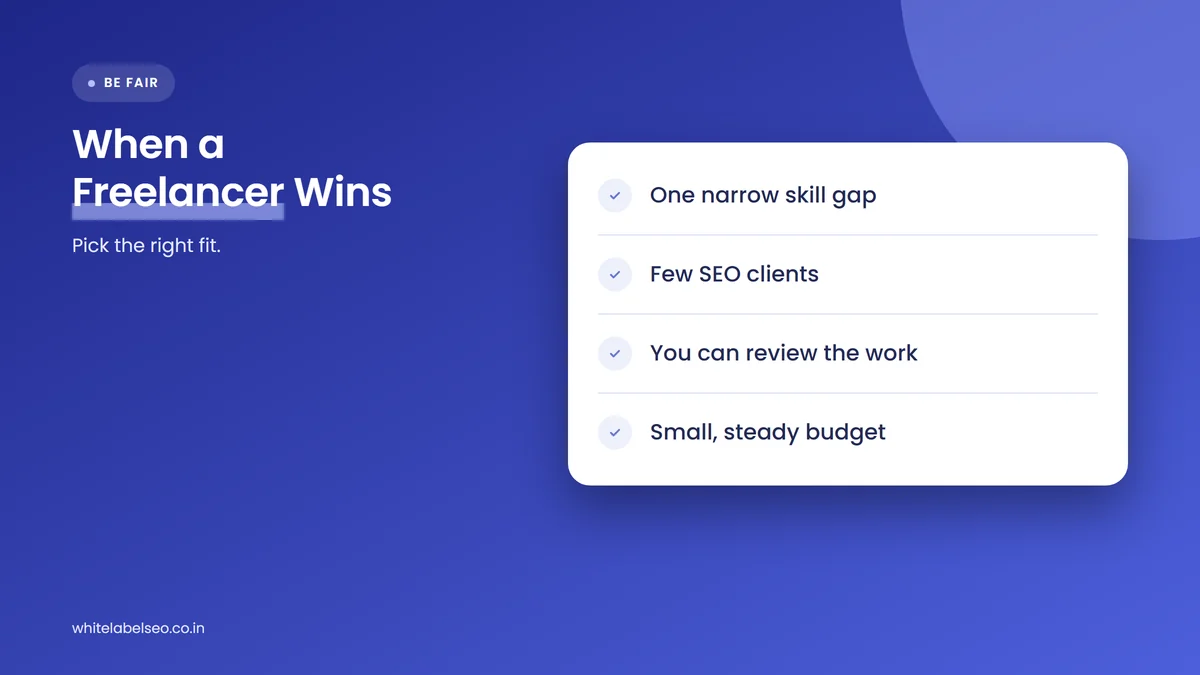
Being fair to freelancers matters here. Many of the best technical SEOs work independently, and a specialist who has handled dozens of site migrations may outperform a generalist team on that job. Freelancers also tend to be easier to reach directly and more flexible about one-off projects.
Common situations where a freelancer fits well:
- A one-off technical audit or site migration for a single client.
- A small agency with one or two SEO clients and no plans to grow the service soon.
- An agency owner who knows SEO well and wants extra hands, not extra expertise.
- A niche skill, such as international SEO or a specific CMS, where a specialist has deeper experience.
Many agencies end up with a mix: a partner for ongoing retainers and a trusted freelancer for specialist projects.
How should a small agency decide?
Decide by listing the skills your clients need, scoring each option on capacity, continuity and quality control, testing your preferred option on one client, and keeping ownership of every account. If more than two skills are needed every month across several clients, a white-label partner is usually the safer base.
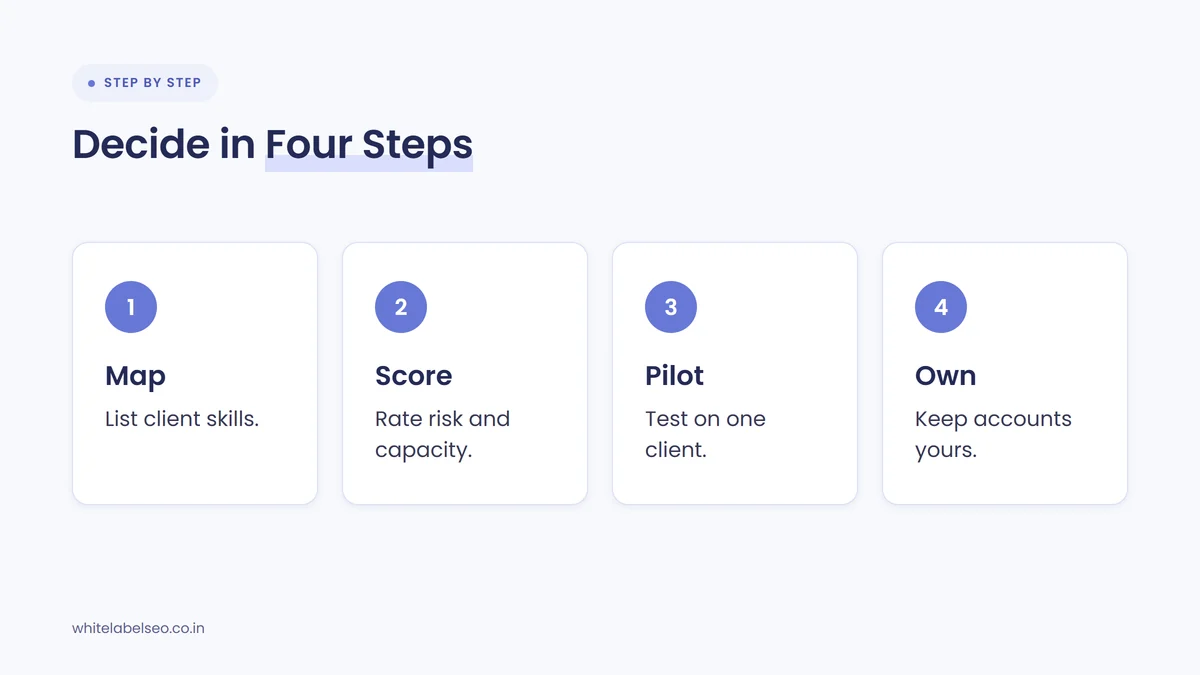
- Map the skills. List every SEO service your current clients use and the ones prospects ask about, including AI search.
- Score the options. Rate each candidate on capacity, skill coverage, continuity, reporting and quality control, using the table above, then price the full cost, including your own management time and tools.
- Run a pilot. Give one client’s work to your preferred option for two or three months and review the output closely.
- Lock down ownership. Keep accounts in your name, sign the confidentiality and non-solicitation terms, and document the process so you can switch if needed.
Frequently asked questions
Is white-label SEO more expensive than hiring a freelancer?
Not always. A freelancer’s hourly rate can look lower, but you usually spend more of your own time briefing and reviewing the work. A white-label partner charges a fixed wholesale fee per package, which makes margins easier to predict. Compare the full cost, including your time and tools, not just the headline rate.
Can a freelancer work under my agency’s brand?
Yes. Many freelancers work unbranded and never contact the client directly. Put that in writing, along with confidentiality and non-solicitation terms, and make sure the reports they produce can carry your branding. Keep the client’s accounts owned by your agency or the client, with the freelancer as a user only.
What is the biggest risk of using a freelancer for client SEO?
Continuity. If the freelancer gets sick, takes a full-time job or drops your account, delivery can stop with little notice. Reduce the risk with a notice period in the contract, documented processes for each client, accounts held in your name and a backup option you have already tested.
Can I use both a freelancer and a white-label partner?
Yes, and many agencies do. A common setup is a white-label partner for ongoing monthly retainers and a specialist freelancer for one-off projects such as migrations or international SEO. Keep one person on your side responsible for coordinating both, so the client gets one consistent plan and report.
How do I stop a freelancer or partner from taking my clients?
Use a written agreement with confidentiality and non-solicitation clauses, keep all client accounts owned by your agency or the client, and do not allow direct client contact without your approval. Give outside help user-level access only and remove it as soon as the work ends.
What should you do next?
List the SEO skills your clients need this year, then score a freelancer and a white-label partner against the comparison table above. If you need one narrow skill and can review the work yourself, a trusted freelancer may be enough. If you resell ongoing, multi-skill SEO to several clients, test a partner on one account first. To see how we handle that work, read about our white-label SEO services at White Label SEO.
Want SEO fulfillment that doesn’t depend on one person?
At White Label SEO, we deliver technical, content, local, link and AI search work under your agency’s brand, with unbranded reports and accounts that stay in your name. Tell us what your clients need, and we’ll help you work out whether a partner fits.
Sources
- AgencyAnalytics, “AgencyAnalytics releases 2026 Marketing Agency Benchmarks Report”, June 30, 2026. https://agencyanalytics.com/company/newsroom/press-release-agency-benchmarks-report-2026
- WhiteLabel.Digital via MarketersMedia, “WhiteLabel.Digital Expands Agency Capabilities and Reduces Fulfillment Costs Through AI Agent Implementation”, October 21, 2026. https://www.financialcontent.com/article/marketersmedia-2026-10-21-whitelabeldigital-expands-agency-capabilities-and-reduces-fulfillment-costs-through-ai-agent-implementation
- Ahrefs, “SEO Pricing: How Much Does SEO Cost? 439 People Polled”, updated August 15, 2024. https://ahrefs.com/blog/seo-pricing/
- Google Search Console Help, “Managing owners, users, and permissions”, accessed November 7, 2026. https://support.google.com/webmasters/answer/7687615
- Google Search Central, “Do you need an SEO?”, accessed November 7, 2026. https://developers.google.com/search/docs/fundamentals/do-i-need-seo