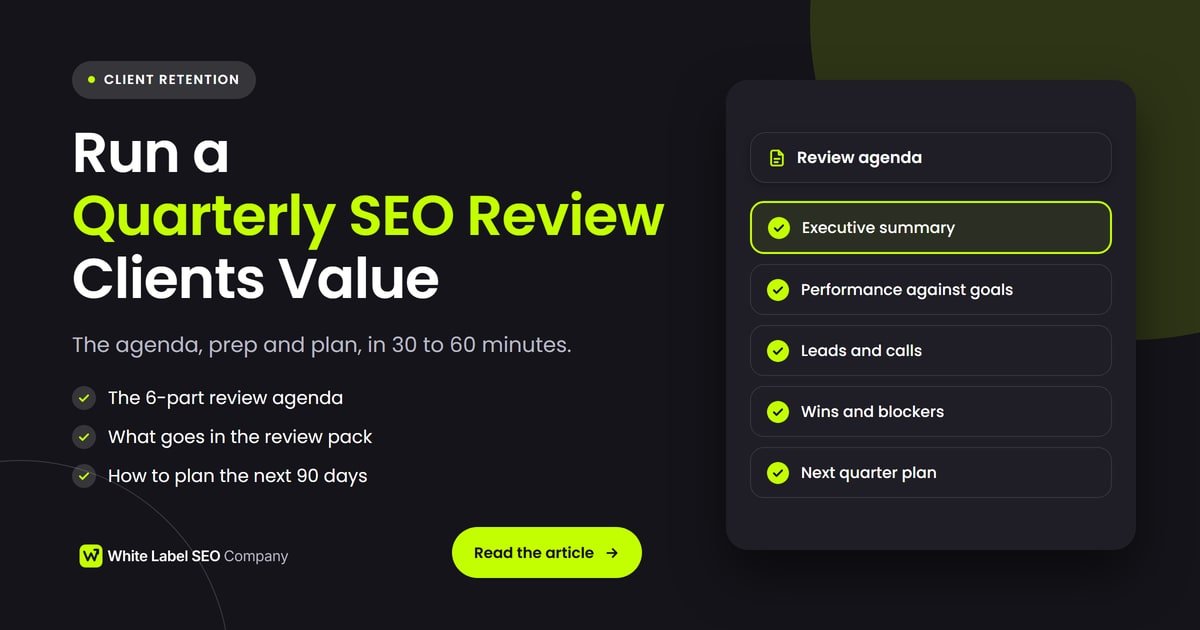
Quick answer: A quarterly SEO review should cover 6 things in 30 to 60 minutes: an executive summary, performance against goals, leads and calls, wins and blockers, a plan for the next quarter, and open discussion. Send a review pack first, lead with business outcomes, agree 2 to 3 client goals for the next 90 days and follow up within 48 hours.
Key takeaways
- A quarterly SEO review is a live meeting, held every 3 months, where the agency shows what the SEO work achieved and agrees the next quarter with the client.
- The agenda has 6 blocks: executive summary, performance against goals, leads and calls, wins and blockers, next quarter and open discussion.
- The review pack goes out before the meeting and compares the quarter with the last quarter and with the same quarter last year.
- A quarterly SEO review lasts 30 to 60 minutes, with the account manager and the client’s marketing lead as the core attendees.
- Lead with leads and calls, explain a flat or down quarter first, and keep AI feature impressions separate from clicks.
- Leave with 2 to 3 client goals, 3 to 4 action items and a written follow-up within 24 to 48 hours.
What is a quarterly SEO review?
A quarterly SEO review is a live meeting, held every 3 months, in which an agency shows an SEO client what the work achieved and agrees the plan for the next quarter. It is the SEO version of a quarterly business review: the agency reports against the goals set at the start and the client confirms what matters next.
A quarterly SEO review is different from a monthly report. A monthly report is a document that tracks movement. The review is a conversation that turns three months of movement into a decision. Agencies that resell SEO need it most, because the client’s contact is your agency and the work is often done by a white label SEO partner behind the scenes. We built our white label SEO services so that the partner prepares the data and the agency stays the voice in the room.
The review also answers the question Google Search Central suggests every client should ask an SEO: what kind of results to expect, in what timeframe, and how success is measured. Once a quarter, you answer it with data.
What should a quarterly SEO review cover?
A quarterly SEO review should cover 6 agenda blocks, in this order: executive summary, performance against goals, leads and calls, wins and blockers, the next quarter and open discussion. AgencyAnalytics, in its December 2025 guide to the quarterly business review, uses the same flow of summary, goals, wins and blockers, recommendations and open discussion.
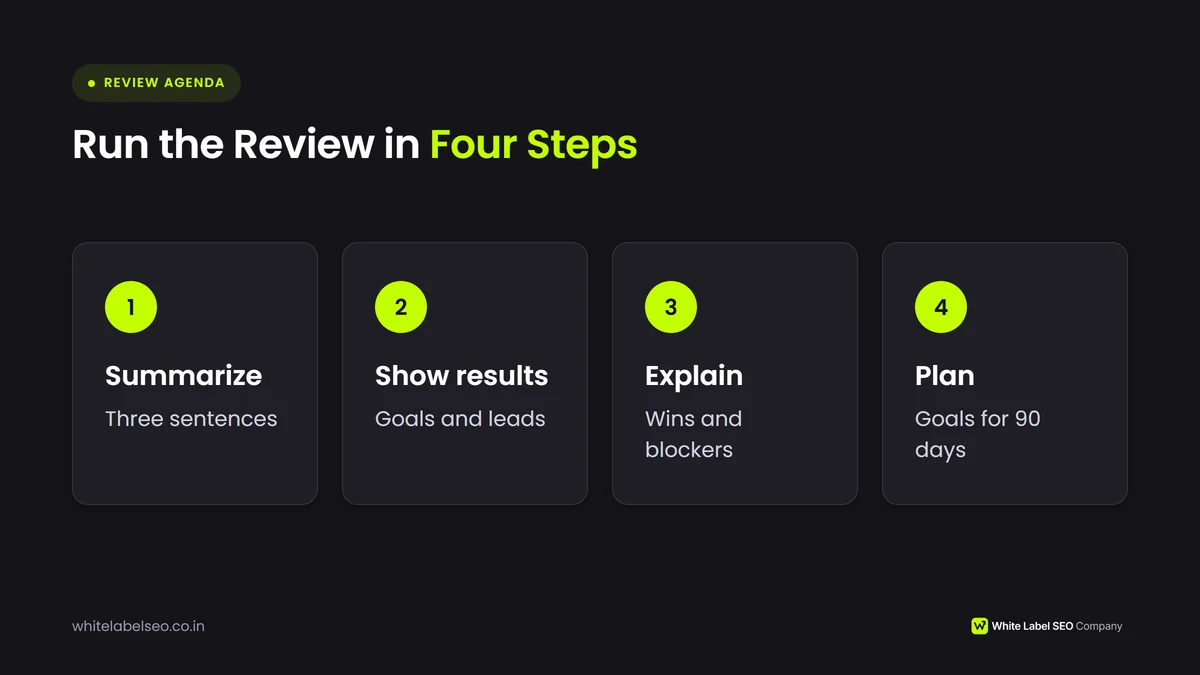
The 6 agenda blocks of a quarterly SEO review are listed below, in meeting order.
- Executive summary. Open with 3 sentences: what the goal was, what happened to leads and calls, and what the next quarter will change. Everything else in the quarterly SEO review supports these 3 sentences.
- Performance against goals. Show each goal agreed last quarter beside its result. Use the same measures every quarter, so the client sees a trend and not a new chart each time.
- Leads and calls. Show the business outcomes first: form fills, phone calls and bookings from organic search and from the Google Business Profile, then the visibility numbers behind them.
- Wins and blockers. List the work shipped, the results it produced and anything that slowed progress, such as slow client approvals, a Google update or a site change.
- Next quarter. Present 2 to 3 client goals and the 3 to 4 action items that serve them, with an owner and a date on each action.
- Open discussion. Leave time for the client’s questions, budget concerns and business changes, because they decide what the next quarter should focus on.
Keep the metric list itself short. Our guide to the 9 metrics agencies should report to SEO clients in 2026 covers which numbers belong in the monthly report, so the quarterly SEO review can focus on what they mean.
What should you prepare before a quarterly SEO review?
Before a quarterly SEO review, you should prepare a review pack that reaches the client 2 to 3 days before the meeting, with the quarter’s numbers already compared with the last quarter and with the same quarter last year. A review pack lets the meeting spend its 30 to 60 minutes on decisions, not on reading charts aloud.
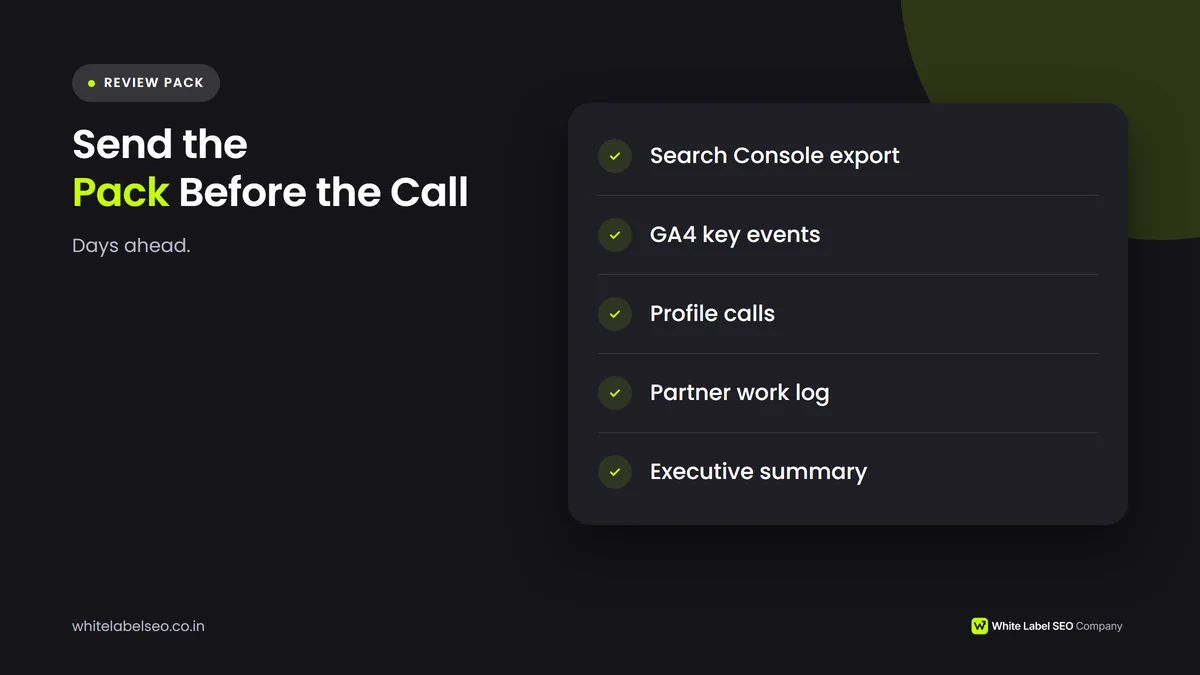
The steps for building a review pack are listed below, in the order to do them.
- Pull the quarter from Google Search Console. Export clicks, impressions, click-through rate and average position for the quarter, and for the same quarter last year. Google Analytics Help states that Search Console keeps data for the last 16 months, so a same-quarter-last-year comparison is available only if you export it within that window.
- Pull outcomes from Google Analytics 4. Report the key events the client cares about, such as form submissions, calls and bookings. Google defines a key event as an event that measures an action particularly important to the success of the business.
- Pull profile actions from Google Business Profile. Add calls, website clicks and direction requests. Google counts a call as a click on the call button, so manual dials are not included.
- Collect the partner’s work log. Ask your white label SEO partner for a list of every fix, page and link delivered in the quarter, grouped by goal.
- Write the executive summary last. Draft the 3 sentences once the numbers are final, and check that every figure matches the dashboard.
- Hold an internal review first. Walk your own team and the partner through the pack, so no result surprises you in front of the client.
The pack draws on the same work log as the monthly report, so what a white label SEO partner does each month shows what the partner should already be sending you. In the Sitechecker 2026 agency growth report, 93.2% of 73 agencies named Google Search Console as a reporting tool and 67.1% named Looker Studio, so these two sources are the usual base of a review pack.
How long should a quarterly SEO review last?
A quarterly SEO review should last 30 to 60 minutes, according to AgencyAnalytics. Shorter works when the pack is sent in advance and the numbers are simple. Go to 60 minutes when a goal was missed, a budget is under review or a new service is on the table.
The core attendees are the agency account manager and the client’s marketing lead, who can act on tactical changes. Bring a senior stakeholder from the client side when the next quarter involves budget or a change in scope. Your white label SEO partner can join as a silent specialist for technical questions, but the agency should present: the client hired the agency, and the review is where that relationship is renewed.
Book the next quarterly SEO review at the end of this one. A recurring invitation 90 days ahead makes the review a routine, not a reaction to bad news.
How do you present results in a quarterly SEO review?
You present results in a quarterly SEO review by leading with leads and calls, then showing the visibility that produced them, then the work that caused it. Clients judge SEO by whether the business got more enquiries, so the outcome comes before the chart of impressions.
Keep each type of number in its own place. Search Console reports clicks, impressions, click-through rate and average position. The Search Console generative AI reports, announced on June 3, 2026 and rolled out to all websites worldwide as of August 31, 2026, show impressions only for AI Overviews and AI Mode, with no clicks. Show those impressions as a separate line called AI feature visibility, and never add them to organic clicks. For more on reading reports honestly, see the 10 red flags in a white label SEO report.
Show the work beside each result. A result with no named cause is a coincidence to the client, so link every change to the fix, page or content update that produced it.
What if the quarter was flat or down?
If the quarter was flat or down, say so in the first sentence of the executive summary, then give the likely cause, the evidence for it and the fix. The client already sees the numbers in their own analytics, and hearing it from you first protects trust.
Check the causes in this order: a Google update during the quarter, seasonality seen in the same quarter last year, a site change, a tracking change and a lost page or link. Google’s SEO Starter Guide says changes can take effect in a few hours or take months, and suggests waiting a few weeks to assess whether work helped. State that timing and show the leading indicators that did move. The guide on proving SEO ROI to clients when results take months covers how to frame them.
How do you plan the next quarter in a quarterly SEO review?
You plan the next quarter in a quarterly SEO review by agreeing 2 to 3 client goals and 3 to 4 action items for the next 90 days, with an owner and a date on each. AgencyAnalytics recommends these limits so the plan stays focused and the client can remember it.
Build the plan from the review itself. Take the goal that moved least, the blocker that cost most time and the opportunity with the clearest lead potential, and turn each into an action. Add what you need from the client, such as approvals, photos, service updates or access, because late client input slows every action on the list. Write the plan on one slide so the client can approve it in the meeting.
What are the rules for a quarterly SEO review?
The rules for a quarterly SEO review are 6 sourced limits on length, data, outcomes, AI reporting, goals and follow-up. Each rule rests on a published fact, so the format can be checked instead of argued.
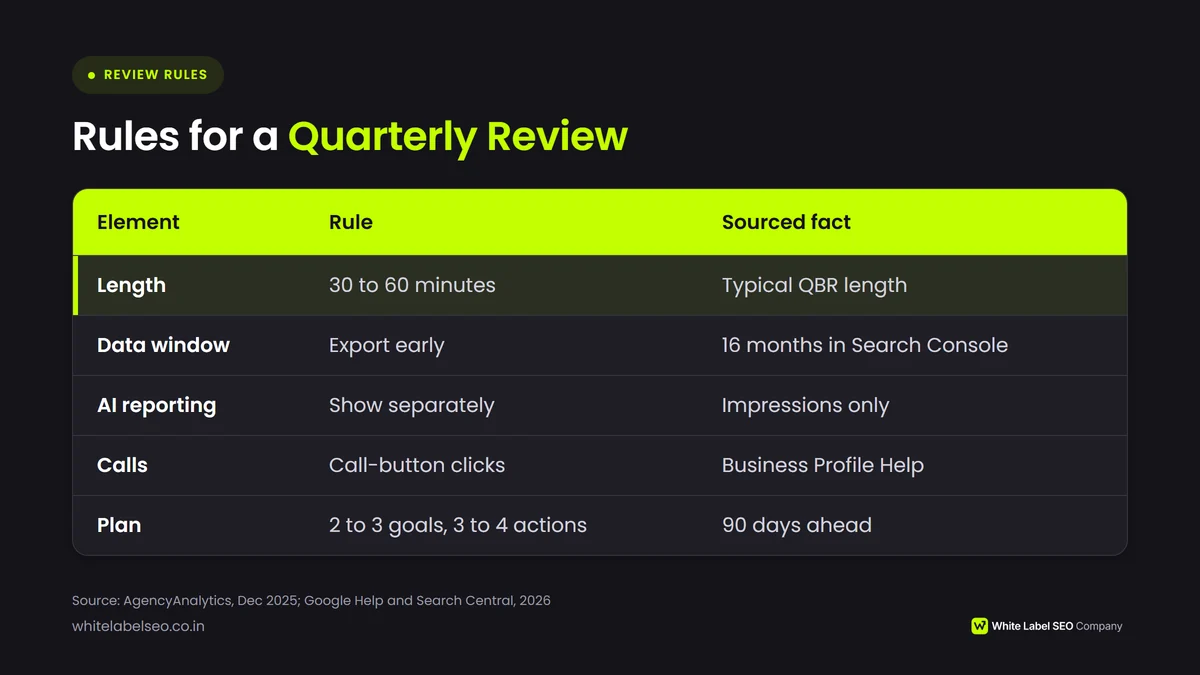
The table below lists the 6 rules in the order of this guide, each with the fact behind it.
| Review element | Rule | Sourced fact | Source |
|---|---|---|---|
| Meeting length | Book 30 to 60 minutes | QBRs typically run 30 to 60 minutes | AgencyAnalytics, December 2025 |
| Data window | Export the same quarter last year early | Search Console keeps data for the last 16 months | Google Analytics Help, accessed November 2026 |
| Search view | Set the date range yourself | Performance report defaults to the past 3 months | Google Search Console Help, accessed November 2026 |
| AI reporting | Show AI impressions separately | AI feature reports show impressions only | Google Search Central Blog, June 2026 |
| Profile outcomes | Report calls as call-button clicks | Calls count clicks on the call button | Google Business Profile Help, accessed November 2026 |
| Goals and follow-up | 2 to 3 goals, 3 to 4 actions, follow up in 24 to 48 hours | Plan for the next 90 days | AgencyAnalytics, December 2025 |
The table shows that 3 of the 6 rules rest on Google documentation about data and 3 rest on agency practice, so only the length and goal limits are conventions you can adjust.
What happens after a quarterly SEO review?
After a quarterly SEO review, you send a written recap within 24 to 48 hours, with the agreed goals, the 3 to 4 action items, their owners and their dates. A recap turns the meeting into a record the client can approve and your partner can work from.
Then track the actions between reviews. A short mid-quarter check-in, about 6 weeks into the 90 days, shows progress and catches a blocker before the next quarterly SEO review. Ahrefs notes that its example enterprise client received a quarterly business review in person on top of weekly and monthly reporting, which is a reminder that the review adds to regular reporting and does not replace it. Sitechecker found that 17.8% of 73 agencies name client churn as a growth constraint, and a quarter that is never reviewed gives a client room to doubt the work. The first six months are the highest-risk period, covered in our guide to reducing SEO client churn in the first six months.
Frequently asked questions
Is a quarterly SEO review the same as a monthly SEO report?
No, a quarterly SEO review is not the same as a monthly SEO report. The report is a document sent every month that tracks numbers. The review is a live meeting every 3 months that explains what the numbers mean and agrees the next 90 days.
Should your white label SEO partner join the quarterly SEO review?
Yes, your white label SEO partner can join when the client has technical questions, but your agency should lead the meeting. Brief the partner beforehand, agree who answers what, and keep the partner’s role to specialist answers so the client relationship stays with you.
What if the client skips the quarterly SEO review?
If the client skips the quarterly SEO review, send the review pack with a 5-minute video summary and book a shorter 15-minute call to confirm the next quarter. Record the client’s reply in writing, because a client who never sees the results is more likely to question the invoice.
Should you hold a quarterly SEO review when there are no leads yet?
Yes, hold the review even when leads have not moved, and show the leading indicators and the work completed. Google’s SEO Starter Guide says some changes take months to show, so the review should compare impressions, indexed pages and shipped fixes against the plan, and say when you expect leads to follow.
Can you run a quarterly SEO review by video call?
Yes, a quarterly SEO review works well by video call when the pack goes out in advance and the call stays within 30 to 60 minutes. Share one screen with the plan, record the call if the client agrees, and send the recap within 48 hours.
What should you do next?
Book your next quarterly SEO review today, then build the review pack in the order above, and write the executive summary last. If you resell SEO, ask your white label SEO partner to deliver the work log and the same-quarter-last-year export 5 days before each review.
At White Label SEO, we prepare the data and the work log so your agency can run the review with confidence. Our white label SEO services cover the monthly delivery that feeds every quarterly SEO review.
Want a partner that prepares your review pack?
At White Label SEO, we deliver the monthly work and the data your agency needs to run a clear quarterly SEO review under your own brand. Tell us how many clients you have, and we’ll scope the reporting with you.
Sources
- AgencyAnalytics, “Quarterly business review (QBR)”, December 13, 2025. https://agencyanalytics.com/blog/quarterly-business-review-qbr
- Ahrefs, “SEO reporting for agencies”, June 28, 2024. https://ahrefs.com/blog/seo-reporting-for-agencies/
- Google Search Central, “Do you need an SEO?”, accessed November 26, 2026. https://developers.google.com/search/docs/fundamentals/do-i-need-seo
- Google Search Central, “SEO Starter Guide”, accessed November 26, 2026. https://developers.google.com/search/docs/fundamentals/seo-starter-guide
- Google Search Central Blog, “Generative AI performance reports in Search Console”, June 3, 2026. https://developers.google.com/search/blog/2026/06/gen-ai-performance-reports
- Google Analytics Help, “Search Console reports”, accessed November 26, 2026. https://support.google.com/analytics/answer/13682862
- Google Analytics Help, “Key events and conversions”, accessed November 26, 2026. https://support.google.com/analytics/answer/9267568
- Google Search Console Help, “Performance report (Search results)”, accessed November 26, 2026. https://support.google.com/webmasters/answer/7576553
- Google Business Profile Help, “Understand your Business Profile performance and insights”, accessed November 26, 2026. https://support.google.com/business/answer/9918094
- Sitechecker, “The 2026 SEO agency growth report”, March 11, 2026. https://sitechecker.pro/seo-agency-growth-data-study-2026/
