Quick answer: Prove SEO ROI in the first months by agreeing the outcome before work starts, reporting leading indicators such as impressions and indexed pages every month, tracking organic leads in Google Analytics, and holding a review meeting at 90 days. Revenue lags, so show the signals that come before it.
Key takeaways
- SEO ROI is the revenue and leads an SEO retainer produces compared with its cost, and it arrives after the spend begins.
- Google says some changes take a few hours and others take months, so a client who expects proof in 30 days is expecting something Google does not offer.
- In Sitechecker’s 2026 survey of 73 agencies, 45.2% named hard-to-measure revenue impact as their top worry, so proof of SEO ROI is a shared problem.
- Agree the goal, the baseline and the review date at kickoff, in writing, before the first invoice.
- Track organic leads with key events in Google Analytics, so the monthly report shows inquiries and not only traffic.
- Show progress in 4 stages across 6 months: baseline, signals, demand, revenue.
- Ask your white label SEO partner for a branded monthly report you can repeat to the client.
What is SEO ROI?
SEO ROI is the return a client receives from an SEO retainer, measured as the leads, bookings or revenue that organic search produces compared with what the client pays. SEO ROI is a ratio of outcome to cost, so it needs both a measured outcome and an agreed time frame.
A client usually reads SEO ROI as one number on one date. A retainer works differently: the cost starts in month one, while the revenue builds as pages get indexed, impressions rise and rankings improve. Proving SEO ROI therefore means showing the chain of evidence between the invoice and the revenue, link by link.
Agencies that resell SEO carry this conversation themselves, because the client sees one brand. Our white label SEO services are built so that the evidence for each link in the chain arrives in your reports on a fixed date.
Why is proving SEO ROI hard when results take months?
Proving SEO ROI is hard in the first months because search results change slowly and revenue is the last metric to move. Google’s SEO Starter Guide says some changes take effect in a few hours while others can take months, and suggests waiting a few weeks to assess whether a change helped.
Ahrefs puts a number on the delay. In a 2025 study of 1 million random pages, Ahrefs found that only 1.74% of newly published pages reached Google’s top 10 within a year. The same study found that 72.9% of pages in the top 10 are more than 3 years old. A page that ranks in 6 months is doing well, and a client who expects a lead per week from a new page is measuring against the wrong clock.
The cost side is just as clear. Sitechecker’s 2026 agency report says 45.2% of agencies name revenue impact that is hard to measure as their top 2026 worry, and 37% cite client doubts about ROI as a barrier to pricing. Only 20.6% track closed deals attributed to search through user polls. The result is a retainer paid every month and a proof gap that grows until someone fills it.
Fill the gap before the client notices it. Our post on how to explain SEO progress before rankings move gives the wording for the first conversation.
Which metrics do agencies use to show SEO ROI?
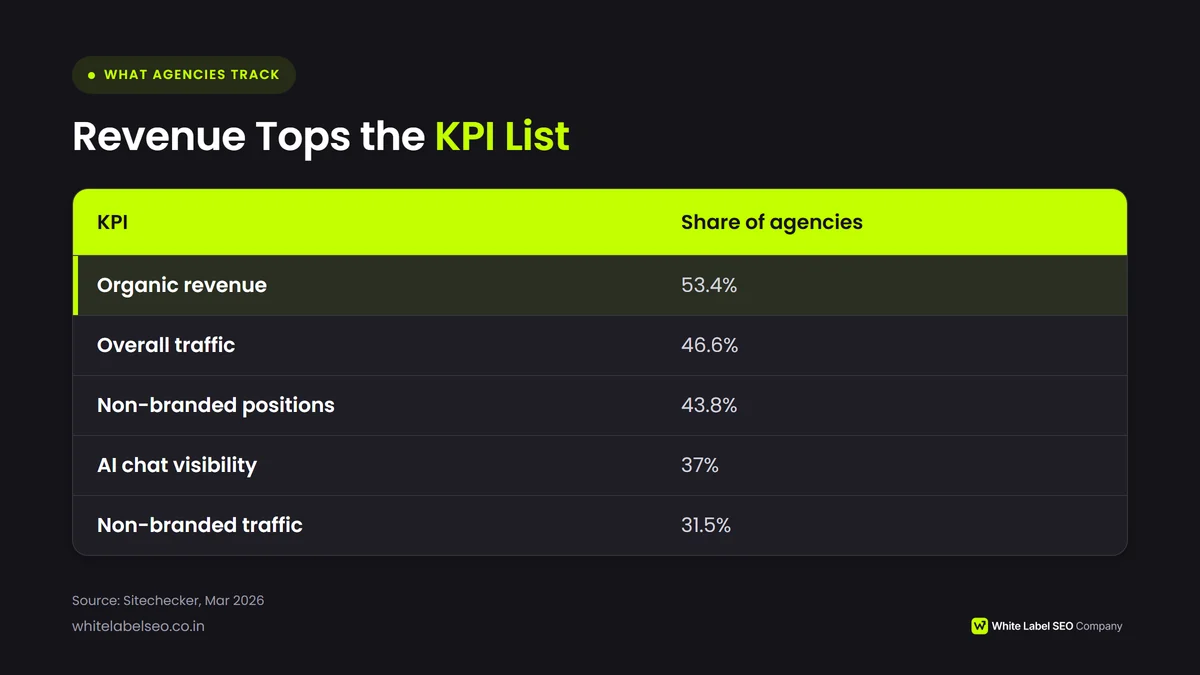
Agencies show SEO ROI with a mix of outcome metrics and early signals. In Sitechecker’s 2026 survey of 73 agencies, the most used key performance indicator is revenue from organic search and AI chats at 53.4%, followed by overall traffic at 46.6% and non-branded positions at 43.8%.
| KPI agencies use | Share of agencies | Type of signal |
|---|---|---|
| Revenue from organic search and AI chats | 53.4% | Outcome, arrives last |
| Overall traffic | 46.6% | Mid-term signal |
| Non-branded SERP positions | 43.8% | Early signal |
| Brand visibility in AI chats | 37% | Early signal |
| Non-branded organic traffic | 31.5% | Mid-term signal |
The table shows that no single metric carries the whole story, which is why a monthly report should pair one outcome metric with 2 or 3 leading indicators. The signal type column is our reading of when each metric tends to move, not a figure from Sitechecker. Source: Sitechecker, “The 2026 SEO agency growth report”, March 11, 2026.
How do you agree on SEO ROI before the work starts?
You agree on SEO ROI before the work starts by writing down the outcome the client wants, the baseline today and the date of the first review. A shared definition turns month-four doubts into a check against a document instead of an argument about feelings.
The kickoff agreement needs 4 items, listed below.
- The primary outcome: qualified calls, form inquiries, bookings or online sales, chosen by the client and tied to a value per lead.
- The baseline: organic clicks, impressions and leads for the 3 months before the retainer, taken from Google Search Console and Google Analytics.
- The leading indicators: the 2 or 3 signals you will report each month before revenue moves.
- The review date: a review meeting at 90 days, with a second one at 6 months.
Put the 90-day review in the proposal itself. A review meeting with a date turns “when will this work?” into a scheduled answer. Our guide to setting SEO expectations with new clients covers the kickoff questions in more detail.
How do you track SEO ROI from organic lead to revenue?
You track SEO ROI by recording every organic inquiry as a key event in Google Analytics and matching it to a lead value from the client’s records. Google defines a key event as an event that measures an action particularly important to the success of the business, and it appears in the Landing pages and User acquisition reports.
Set up tracking in the first week, because a baseline cannot be rebuilt later. The setup has 3 parts: key events for form submissions, calls and bookings; a source tag on each lead so organic inquiries are identifiable; and a monthly lead count that the client confirms against their own records.
Google Search Console covers the part before the click. Its Performance report shows clicks, the number of times a user clicked your site from Google Search results, and impressions, the number of times your site appeared in search results. Together with Google Analytics, it links an impression to a click to a lead.
Tie each lead to a value. Ask the client for the average value of a new customer and the share of inquiries that close, then multiply. Mark that figure as an estimate based on the client’s own numbers, so the SEO ROI you report is traceable to them. Our guide to the SEO metrics to report to clients lists the metrics to put beside it.
How do you show SEO ROI in the first six months?
You show SEO ROI in the first 6 months in 4 stages: baseline, signals, demand and revenue. Each stage gives the client something real to look at, so the retainer stays visible while the revenue builds.
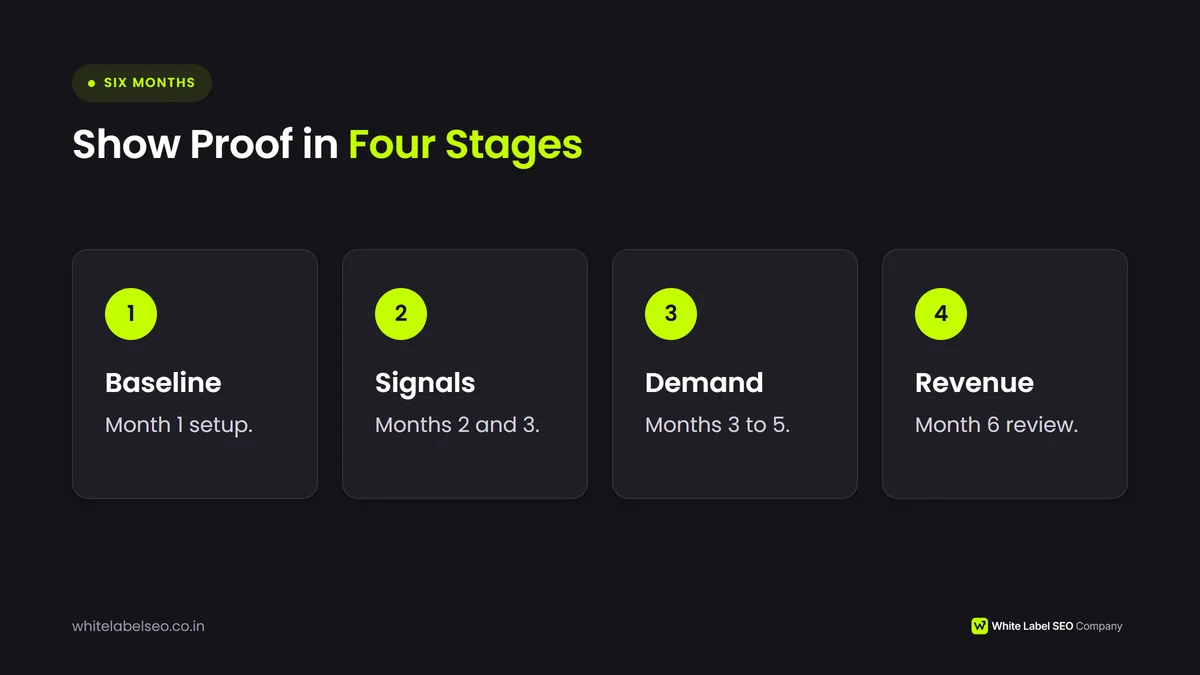
The 4 stages for showing SEO ROI over the first 6 months are listed below.
- Set the baseline (month 1). Record organic clicks, impressions and leads, and confirm that every key event fires. Report the fixes made and the pages indexed.
- Report the signals (months 2 and 3). Show impressions, indexed pages and non-branded positions from Google Search Console. These are leading indicators: they move before leads do.
- Show the demand (months 3 to 5). Report organic clicks and the first organic leads from Google Analytics, next to the baseline from step 1.
- Present the revenue (month 6). Report organic leads, their estimated value and the cost of the retainer, then agree the plan for the next 6 months.
The timing above is a working plan, not a promise, because Google says changes can take hours or months. If a stage runs late, say so in the report and say why. A client who hears about a delay from you, with evidence, trusts the next report more.
The same approach protects client retention. Our post on how to reduce SEO client churn in the first six months covers the check-ins that keep the client engaged between reports.
What should a monthly SEO ROI report say?
A monthly SEO ROI report should say what changed, what it means for leads and what happens next month. Lead with the outcome metric the client chose at kickoff, then show 2 or 3 leading indicators and the next action, so the report defends the retainer instead of listing tasks.
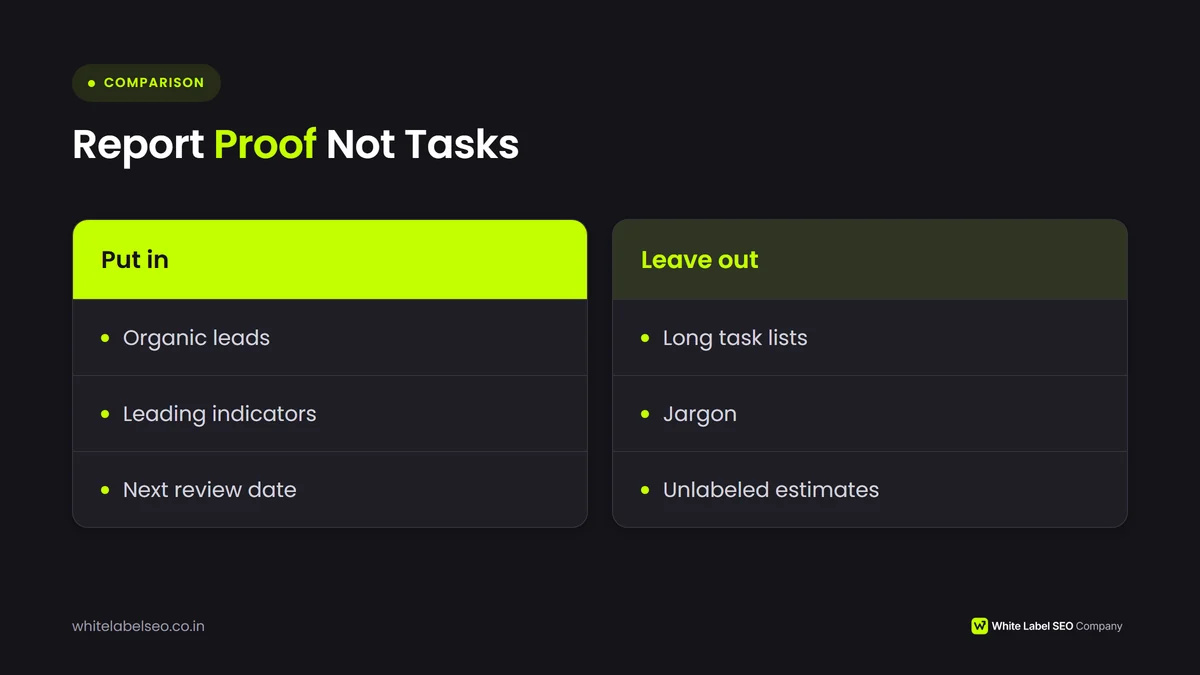
The parts of a monthly SEO ROI report are listed below.
- The outcome: organic leads this month against the baseline, with the estimated value.
- The leading indicators: impressions, clicks and non-branded positions, each against the previous month.
- The work done: 3 to 5 lines on the pages, fixes and links delivered.
- The next review date: the date of the next review meeting and what you will cover.
Keep the report to one page for the client and move the detail to an appendix. Sitechecker’s survey shows only 20.6% of agencies track closed deals through user polls, so a simple lead count the client confirms already puts you ahead of that group.
How does a white label SEO partner support SEO ROI reporting?
A white label SEO partner supports SEO ROI reporting by delivering the monthly data, the report and the explanation under your brand. You present the numbers and own the client relationship, while the partner supplies the tracking setup, the leading indicators and the report on a fixed date.
Ask a prospective partner for 3 things before you sign: a sample report in your branding, the date each month the report arrives and a plain list of the metrics it includes. Our white label SEO reports page shows the format, and our post on the quarterly SEO review with a client covers the meeting that follows it.
Frequently asked questions
How long does it take for SEO to show ROI?
SEO can take months to show ROI, and the timing varies by site and market. Google says some changes take a few hours while others take months. Ahrefs found that only 1.74% of newly published pages reached the top 10 within a year, so set the first review at 90 days and report signals until revenue arrives.
What leading indicators should you report before revenue shows?
Report impressions, clicks, indexed pages and non-branded positions from Google Search Console, plus the first organic leads from Google Analytics. These leading indicators usually move before revenue does, and each one links to the next stage: an impression leads to a click, and a click leads to an inquiry.
How do you track organic leads for SEO ROI?
Mark form submissions, calls and bookings as key events in Google Analytics, tag the source of each inquiry and confirm the monthly lead count with the client. Google defines a key event as an event that measures an action particularly important to the success of the business.
What if the client wants to cancel before results arrive?
Show the baseline, the leading indicators and the review date from the kickoff agreement, then ask what evidence the client needs to continue. Cost is the most reported reason for stopping: 27.4% of agencies in Sitechecker’s 2026 survey said clients stop SEO to cut costs, so tie the answer to value.
Can a white label SEO partner produce the SEO ROI report for my client?
Yes, a white label SEO partner can produce the report under your branding and deliver it on a fixed date each month. Check the sample report, the metrics included and the delivery date before you commit, and confirm that you can repeat every line to your client.
What should you do next about proving SEO ROI?
Add the kickoff agreement from this post to your next proposal: the outcome, the baseline, 2 or 3 leading indicators and a 90-day review date. Then build the 4-stage report so that month one already shows the client something real.
If you want a delivery partner that supplies the data and the branded report each month, see how our white label SEO services work behind your brand at White Label SEO.
Want a report your clients can read?
Book a free strategy call and we will show you the monthly report, the leading indicators and the delivery dates we can supply behind your brand.
Sources
- Sitechecker, “The 2026 SEO agency growth report”, March 11, 2026. https://sitechecker.pro/seo-agency-growth-data-study-2026/
- Ahrefs, “How Long Does It Take to Rank in Google?”, May 15, 2025. https://ahrefs.com/blog/how-long-does-it-take-to-rank/
- Google Search Central, “SEO Starter Guide”, accessed November 28, 2026. https://developers.google.com/search/docs/fundamentals/seo-starter-guide
- Google Search Console Help, “Performance report (Search)”, accessed November 28, 2026. https://support.google.com/webmasters/answer/7576553
- Google Analytics Help, “About key events”, accessed November 28, 2026. https://support.google.com/analytics/answer/9267568
