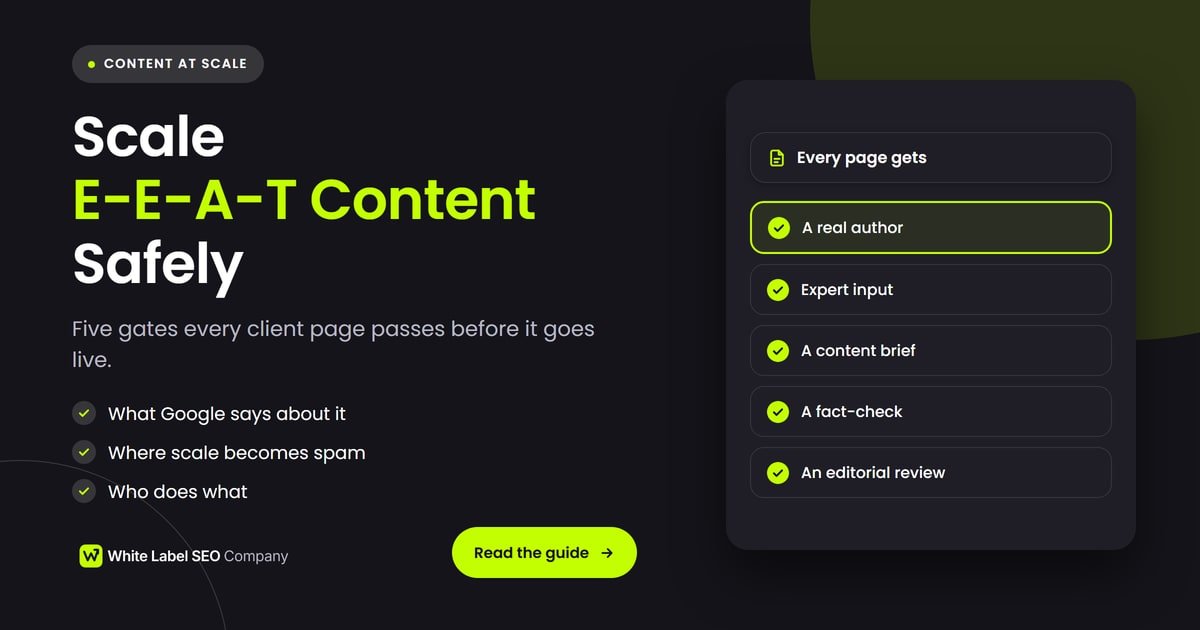
Quick answer: You produce E-E-A-T content at scale by giving a white label SEO partner a repeatable system: a named author, a content brief with the expert’s own input, a fact-check and an editorial review for every page. Google says trust is the most important part, and it treats mass-produced pages that add no value as spam.
Key takeaways
- E-E-A-T content is content that shows experience, expertise, authoritativeness and trust, and Google’s documentation says trust is the most important of the four.
- Google states that E-E-A-T itself is not a specific ranking factor, so you sell the quality work, not a score.
- Volume without value is scaled content abuse under Google’s spam policies, no matter how the pages are created.
- Ahrefs found AI-generated content on 74.2% of 900,000 newly detected pages in April 2025, so the question for your clients is oversight, not whether tools were used.
- Five steps make E-E-A-T content repeatable: assign an author, capture expert input, write to a content brief, fact-check, then run an editorial review.
- Your agency owns the client relationship and expert access, and your white label SEO partner owns production and review.
What is E-E-A-T content?
E-E-A-T content is content that demonstrates experience, expertise, authoritativeness and trustworthiness. The letters stand for Experience, Expertise, Authoritativeness and Trust, and Google’s helpful content guidance says that of these four, trust is the most important.
Google added the first E in December 2022. Its Search Central blog post from December 15, 2022 describes experience as content produced with some degree of real experience, such as actual use of a product. The idea matters to agencies that resell SEO because a client’s page about a service reads differently when the person who performs that service has shaped it.
A white label SEO partner can produce this kind of content behind your brand, but only if the client’s real knowledge reaches the writer. Our white label content writing work starts from that input, not from a keyword list alone.
What does Google say about E-E-A-T content?
Google says E-E-A-T content is something its systems look for, but that E-E-A-T itself is not a specific ranking factor. The helpful content guidance on Google Search Central states that automated systems prioritize content that demonstrates experience, expertise, authoritativeness and trustworthiness.
The same page asks 3 questions, Who, How and Why. Who asks whether the reader can see who created the content, and Google strongly encourages accurate authorship information, such as a byline, where readers would expect one. How asks whether readers can learn how the content was produced. Why asks whether the content exists primarily to help people or primarily to attract search visits, and Google calls this perhaps the most important question to answer.
The page also says that fabricating creator profiles is a form of deception. That sentence is a direct instruction for agencies: every author name you place on a client page must belong to a real person who agreed to it. Google’s Search Quality Rater Guidelines shape how raters assess content quality, but Google says they do not directly influence ranking.
Where does E-E-A-T content at scale become scaled content abuse?
E-E-A-T content at scale becomes scaled content abuse when many pages are generated for the primary purpose of manipulating search rankings and not helping users. Google’s spam policies define it that way, and add that it typically means large amounts of unoriginal content that gives users little to no value, no matter how it is created.
The policy lists examples. They include using generative AI tools to generate many pages without adding value for users, scraping and transforming other sites’ content, and stitching together content from different pages without adding value. Google’s guidance on generative AI content adds that you should manually fact-check and review AI-generated content for accuracy and trustworthiness before publishing.
The policy judges purpose and value, not the tool. A partner that uses software to speed up drafting and then adds expert input, review and original detail is working inside the policy. A partner that publishes 100 near-identical pages for 100 clients is not. Ask any partner which of those two it does before you put your brand on the output.
How much new web content already mixes AI and human writing?
Most new web content already mixes AI and human writing. Ahrefs analyzed 900,000 English-language pages that its crawler detected in April 2025 and found that 74.2% contained AI-generated content, while only 25.8% were pure human writing. The table below shows the split.
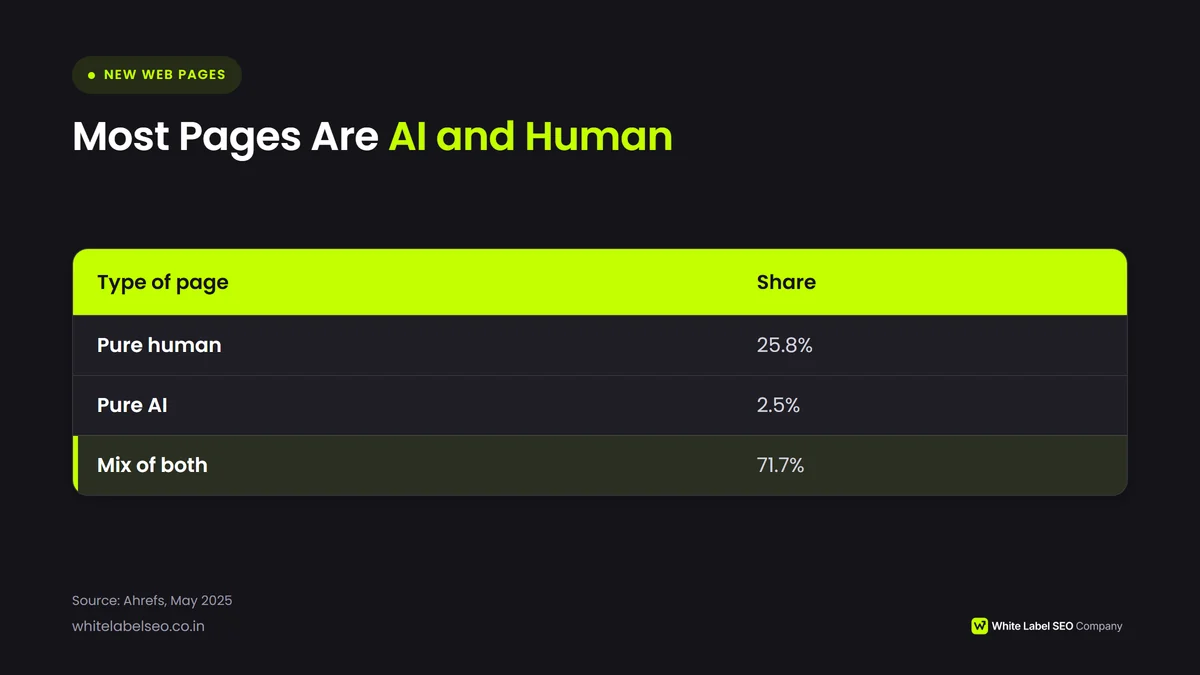
| Type of page (Ahrefs, April 2025) | Share of 900,000 pages | What it means for your E-E-A-T content |
|---|---|---|
| Pure human | 25.8% | A minority of new pages |
| Pure AI | 2.5% | Rare, and the riskiest to publish unreviewed |
| Mix of AI and human | 71.7% | The norm, so review and original input set pages apart |
| Mix, moderate AI (11% to 40%) | 25.86% | Part of the 71.7% mix |
| Mix, substantial AI (41% to 70%) | 20.50% | Part of the 71.7% mix |
| Mix, dominant AI (71% to 99%) | 15.51% | Part of the 71.7% mix |
The table shows that using AI tools is common, so a client who asks whether your content uses them deserves a straight answer about your review process. Source: Ahrefs, “What Percentage of New Content Is AI-Generated?”, May 19, 2025. Ahrefs did not report how these pages ranked, so the study says nothing about whether AI use helps or hurts rankings.
How do you produce E-E-A-T content at scale?
You produce E-E-A-T content at scale in 5 steps: assign a real author, capture expert input, write to a content brief, fact-check every claim and run an editorial review. Each step is a fixed gate, so the 20th client page goes through the same checks as the first.
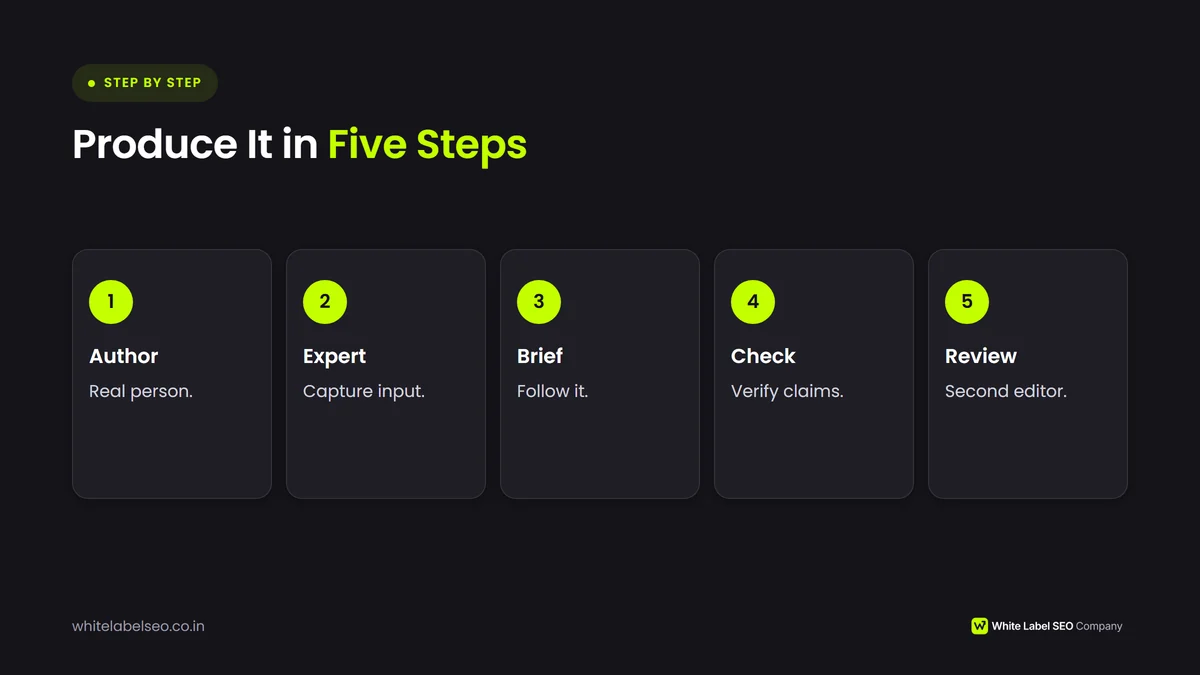
The 5 steps for producing E-E-A-T content are listed below.
- Assign a real author. Name one person with a real connection to the topic, add an accurate bio and use the same byline on every page they inform. Never invent a profile.
- Capture the subject matter expert’s input. Take 20 to 30 minutes of the expert’s time per topic batch, by call or written answers, and record real examples, customer questions and the expert’s own opinion.
- Write to a content brief. The content brief states the reader’s question, the entity and attributes to cover, the expert’s points and the sources to cite, so a writer cannot fill the page with generic text.
- Fact-check every claim. Check each number, date and rule against a primary source, such as Google Search Central or an official body, and drop any claim you cannot verify.
- Run an editorial review. A second person checks that the page answers the question, shows the expert’s input, reads in your client’s voice and adds something a competing page does not.
The order matters because expert input is the raw material that makes first-hand experience visible. Without step 2, a writer can only rearrange what other pages already say, which is the pattern Google’s spam policies describe. Our guide to white label content writing for SEO clients covers how briefs and revisions fit into a monthly workflow.
What should your agency own and what should a white label SEO partner handle?
Your agency should own the client relationship, the expert access and the final approval, and your white label SEO partner should own production, fact-checking and editorial review. Splitting the work this way keeps the client’s voice in your hands and the repeatable labor in your partner’s.
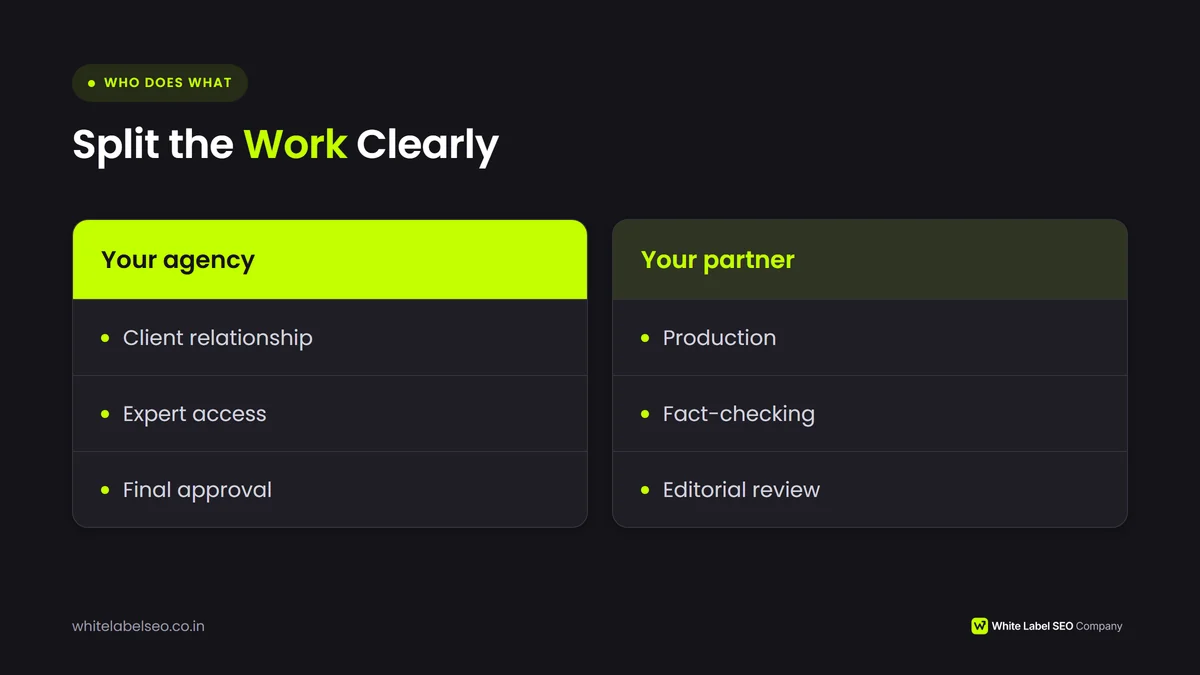
The split matters because the one input a partner cannot invent is the client’s own knowledge. Only you can book the call with the client’s electrician, dentist or accountant, and only the client can confirm that an author profile is accurate. The partner can then turn that input into pages, check the facts and run the review on a schedule.
Ask your partner for a written description of its review process before you rely on it. Our overview of SEO services agencies can resell shows where content sits next to the technical, local and link work you may already sell, and a good content plan should connect to those services rather than stand alone.
Should you tell readers how E-E-A-T content was made?
Yes, you should tell readers how content was made wherever they might ask. Google’s helpful content guidance says AI or automation disclosures are useful for content where someone might think, “How was this created?”, and that explaining the process helps readers understand the role automation played.
Disclosure is a choice you make per client and per page type. A plain line such as “Written by our editorial team from an interview with the owner and reviewed by a second editor” meets the How question without exposing which vendor did the drafting. It also fits the Google guidance to review metadata, including title elements, meta descriptions, structured data and image alt text, before you publish.
Write down your rule once and apply it to every client. The border of this topic is policy: our post on AI content governance for white label SEO partnerships covers what to put in the agreement with your partner.
Frequently asked questions
Is E-E-A-T a ranking factor?
No, E-E-A-T is not a specific ranking factor, according to Google’s helpful content guidance. Google says its systems prioritize content that shows experience, expertise, authoritativeness and trustworthiness, and that trust is the most important. Treat E-E-A-T as a quality standard to meet, not a score to report.
Can a white label SEO partner use AI tools for client content?
Yes, but with oversight. Google’s spam policies judge content by its value to users, not by how it was made, and the generative AI guidance says to manually fact-check and review AI-generated content before publishing. Ask your partner to describe its review steps in writing.
How many pages can a partner produce for one client each month?
There is no number that Google sets. Scaled content abuse depends on whether pages are generated mainly to manipulate rankings and add no value for users. Plan the number of pages around how much real expert input and review time the client’s topics can support, and add pages only as that input grows.
Do author bylines help E-E-A-T content?
Yes, when they are accurate. Google strongly encourages accurate authorship information, such as a byline, where readers would expect it, and calls fabricated creator profiles a form of deception. Use a real person with a real bio, and get that person’s agreement first.
How do you check whether E-E-A-T content is working?
Track impressions, clicks and queries for the pages in Google Search Console, and review them against the goal the client named. Because Google says E-E-A-T is not a specific ranking factor, no single score tells you the content works. Compare pages before and after publishing and look for patterns over months, not days.
What should you do next about E-E-A-T content?
Pick one client and run the 5 steps on a single page this month: name the author, capture the expert’s input, write to a brief, fact-check and review. Then document what that page took so you can plan the next batch.
If you want a delivery partner that can run those gates behind your brand, see how our white label SEO services work at White Label SEO.
Want E-E-A-T content for every client?
Book a free strategy call and we will walk through how our content process can run behind your brand.
Sources
- Google Search Central, “Creating helpful, reliable, people-first content”, accessed November 28, 2026. https://developers.google.com/search/docs/fundamentals/creating-helpful-content
- Google Search Central, “Spam policies for Google web search”, accessed November 28, 2026. https://developers.google.com/search/docs/essentials/spam-policies
- Google Search Central, “Google Search’s guidance about using generative AI content on your website”, accessed November 28, 2026. https://developers.google.com/search/docs/fundamentals/using-gen-ai-content
- Google Search Central Blog, quality rater guidelines update adding Experience to E-A-T, December 15, 2022. https://developers.google.com/search/blog/2022/12/google-raters-guidelines-e-e-a-t
- Ahrefs, “What Percentage of New Content Is AI-Generated?”, May 19, 2025. https://ahrefs.com/blog/what-percentage-of-new-content-is-ai-generated/
