Quick answer: AI content governance for a white label SEO partnership is a written policy that says where AI may help, who reviews the work, how facts are checked and what the client approves before anything goes live. Google allows AI-assisted content but warns against bulk pages with no added value, so your rules protect the account.
Key takeaways
- AI content governance is the written policy that sets where AI may be used, who reviews the output and what the client approves before publication.
- Google does not ban AI-generated content; it treats bulk pages made without added value as scaled content abuse, however they are made.
- 74.2% of 900,000 new pages Ahrefs analyzed in April 2025 contained AI-generated content, so your partner almost certainly uses AI somewhere.
- A good policy has 6 rules: define where AI is used, name a human editor, fact-check every claim, review metadata, agree disclosure and keep an approval record.
- Health, legal and finance pages, local business claims and outreach articles need the strictest review.
- Check a partner’s process with 5 questions before you sign, and put the policy into your scope of work in 4 steps.
What is AI content governance in a white label SEO partnership?
AI content governance in a white label SEO partnership is the written policy that sets where AI tools may be used in client content, who reviews the output, how facts and sources are checked and what the client approves before publication. It sits between your agency, your white label SEO partner and the client’s website.
The policy matters to you because the client sees your brand, not ours. We work to your brief and your approval, so you decide how AI may be used, and we deliver branded reports and a dashboard you can show the client. Our white label SEO services follow the brief you set. The key distinction in any policy is between AI-assisted drafting, where a person reviews and owns the result, and AI-published content, where output goes live unreviewed.
What does Google say about AI-generated content?
Google says AI-generated content is allowed when it helps people, and it judges the page, not the tool. Google Search Central’s spam policies describe scaled content abuse as creating large amounts of unoriginal content that gives users little value, “no matter how it’s created.”
Google Search Central’s guidance on generative AI content adds that models do not retrieve facts, so output can include errors. Google’s guidance asks site owners to review AI-generated content for accuracy before publishing. The 4 points from Google’s guidance that a policy should reflect are listed below.
- Accuracy: fact-check and review all AI-generated content manually before it is published.
- Metadata: review title elements, meta descriptions, structured data and image alt text too, because they can appear in Search results.
- Context: explain how automation was used where a reader would reasonably ask how the content was created.
- Purpose: do not use automation mainly to manipulate rankings, because Google lists that as a violation of its spam policies.
For health, finance and other topics where mistakes can harm readers, Google’s helpful content guidance says the content must be highly accurate and consistent with established expert consensus. The same page tells publishers to avoid fabricated authors, such as AI-generated headshots or made-up names.
How common is AI-assisted content, and what do the numbers show?
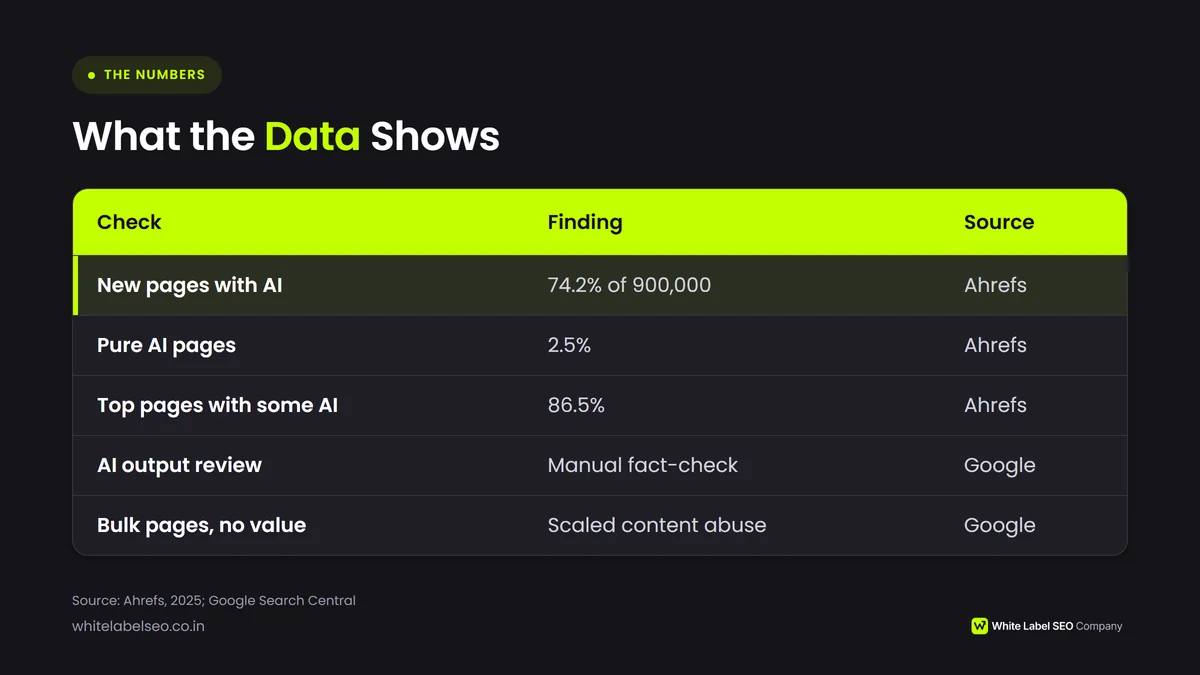
AI-assisted content is now the norm: Ahrefs found that 74.2% of 900,000 newly created web pages it analyzed in April 2025 contained some AI-generated content. Only 2.5% were pure AI and 25.8% were pure human, so most pages mix the two.
| Check | Finding | What it means for AI content governance | Source |
|---|---|---|---|
| New pages with AI content | 74.2% of 900,000 pages (April 2025) | Your partner probably uses AI somewhere, so ask where | Ahrefs, May 2025 |
| Pure AI, pure human, mix | 2.5%, 25.8%, 71.7% | Most content is mixed, so the human review step carries the quality | Ahrefs, May 2025 |
| Top-ranking pages with some AI | 86.5% | AI use alone is not what holds a page back | Ahrefs, July 2025 |
| AI share vs order of AI Overviews citations | Correlation of 0.017, “effectively zero” | The human-or-AI label does not decide which source is cited | Ahrefs, July 2025 |
| Review before publishing | Manual fact-check of all AI output | Make the check a named step with an owner | Google Search Central, accessed November 2026 |
| Bulk pages without added value | Counts as scaled content abuse | Cap volume to what a person can review | Google Search Central, accessed November 2026 |
The table shows that 4 of the 6 checks come from Ahrefs’ own detector, which Ahrefs says is not 100% accurate, and 2 from Google’s documentation, so treat the percentages as estimates and the Google rules as the fixed points.
What are the 6 rules of an AI content governance policy?
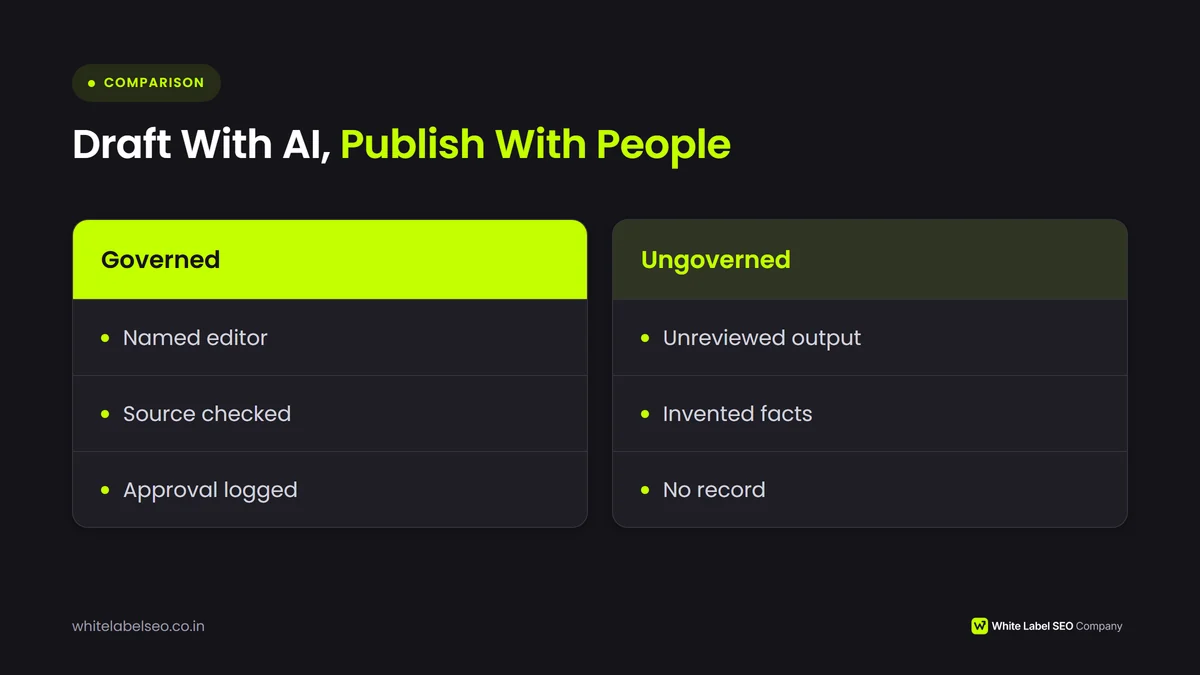
An AI content governance policy needs 6 rules, listed below, and each rule should name a person who owns it, so a missed step has an owner and a date.
- Define where AI may be used in research, outlines and first drafts, and where it may not.
- Name a human editor for every deliverable before it leaves the partner.
- Fact-check every claim against a named source with a year.
- Review metadata and structured data as carefully as body text.
- Agree disclosure and bylines with the client in writing.
- Keep an approval record that shows the brief, the version and the client approval.
1. Define where AI may be used in client content
A policy should list the tasks where AI may help, such as research, outlines and first drafts, and the tasks where it may not, such as final claims, quotes and local business facts. Google says generative AI is useful for research and for adding structure to original content, so that is a sensible starting line.
Write the list down as a one-page table with 3 columns: task, AI allowed or not, and the reviewer. The client can read it in a minute.
2. Name a human editor for every deliverable
Every deliverable needs one named human editor who reads it end to end before delivery. That person owns accuracy and brand voice, so questions from the client have one place to land.
The editor should not be the same tool or process that wrote the draft. A second pair of eyes is the point of the rule. Our guide to producing E-E-A-T content at scale with a white label SEO partner shows how review fits into volume.
3. Fact-check every claim against a named source
Every statistic, quote and product or service claim should carry a named source and a year that the editor has opened. Google says generative models do not retrieve facts, so a smooth sentence can still be wrong.
Source citation also protects you later. If a client or a journalist checks a number, you can show where it came from in one click, and a claim with no source gets removed before delivery.
4. Review metadata and structured data as carefully as body text
Metadata gets the same review as the body, because Google’s guidance names title elements, meta descriptions, structured data and image alt text as content that can appear in Search results. Validate structured data before it goes live.
These fields are short, which makes a wrong claim easy to miss. Put them on the editor’s checklist as their own line.
5. Agree disclosure and bylines with the client in writing
Disclosure should be agreed with each client before the first deliverable. Google’s helpful content guidance says to make authorship clear and to explain how automation was used where readers would reasonably wonder how a page was made.
Some clients want a note on the page, others want nothing beyond a real, named author. Record the choice per client, and never invent an author, a headshot or credentials.
6. Keep an approval record
An approval record is a simple log for each deliverable that shows the brief, the version that went out and the client approval. It turns a later dispute into a short lookup instead of an argument.
Because we work to your brief and your approval, the record can start from your brief and end with your sign-off. Keep it in the place where your team already tracks client work.
Which deliverables need the strictest AI content governance?
Health, legal and finance pages, local business claims and outreach articles on third-party sites need the strictest AI content governance, because mistakes there cost the most to fix. Google asks for high accuracy on topics that can affect a reader’s health or money.
Local pages and Google Business Profile posts often state awards, licenses, service areas and opening hours. Ask the partner to verify each local claim against a source list that the client supplies before publishing. Outreach and guest articles carry your client’s name to another publisher’s site, so an error there is slower to correct than one on the client’s own site. Our article on white label SEO for regulated industries covers the extra checks for those sectors.
How do you put AI content governance in place in 4 steps?
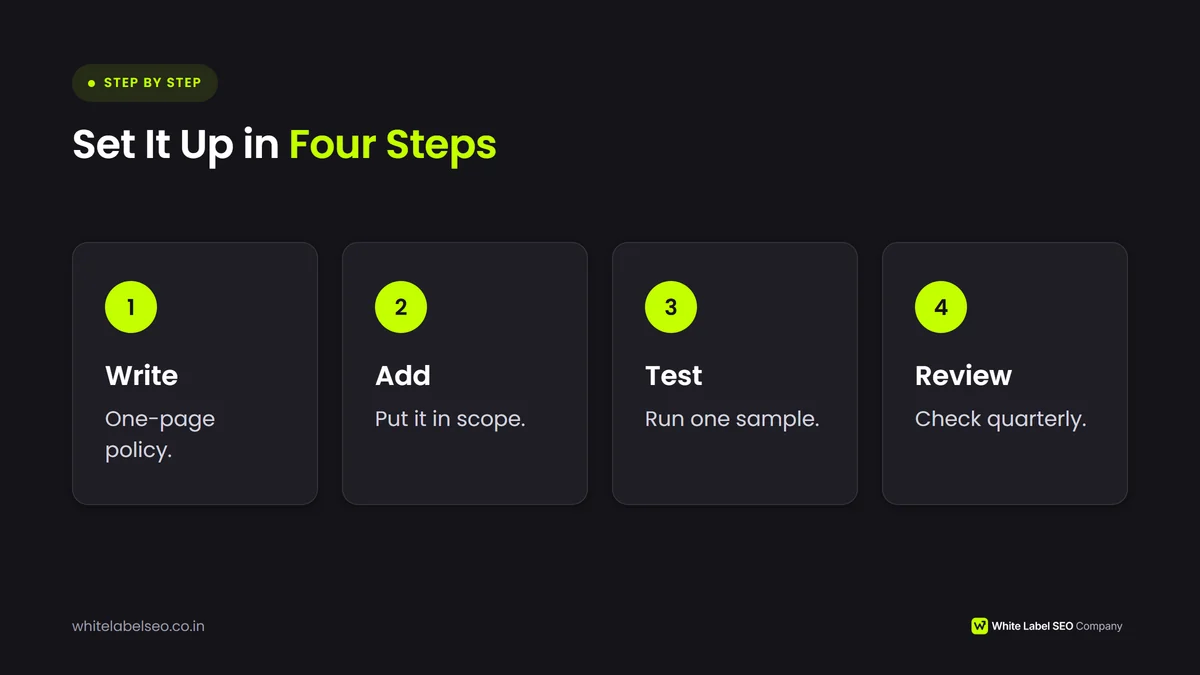
You put AI content governance in place in 4 steps: write the one-page policy, add it to your scope of work, test it on one sample deliverable and review it every quarter.
The 4 steps are listed below.
- Write the one-page policy. Cover the 6 rules in plain language, with an owner for each.
- Add it to your scope of work. State that deliverables follow the policy and that the client approval step comes before publication.
- Test it on one sample. Run one article through the full process and note where the editor lost time or missed something.
- Review it every quarter. Update the policy when Google changes its guidance or a client changes its rules.
If you resell content as part of a retainer, our white label content writing page explains how we work from your brief.
How do you check a white label SEO partner’s AI content governance before you sign?
You check a white label SEO partner’s AI content governance by asking for its process in writing and testing it on a small paid sample. Ask the 5 questions below and judge the answers on detail, not confidence.
- Where do you use AI in research, outlines and drafts?
- Who reviews each deliverable, and what do they check?
- How do you verify statistics, quotes and local claims?
- How do you handle disclosure and authorship when a client asks?
- Who fixes an error after publication, and how fast?
Our checklist of questions to ask a white label SEO partner before signing covers the rest of the vetting.
Frequently asked questions
Should agencies disclose AI use to their clients?
Yes, agencies should tell each client how AI is used and agree the wording in writing, because Google’s guidance encourages explaining how automation was used where readers would wonder. A short description of the AI step plus the human review step builds more trust than silence.
Does Google penalize AI-generated content?
No, Google does not penalize content only because AI helped produce it. Its spam policies target bulk pages with no added value, and Ahrefs found that 86.5% of top-ranking pages contain some AI-generated content, so quality and review decide the outcome.
Do we need an AI detector to run this policy?
No, you do not need a detector, and Ahrefs notes that no detector is 100% accurate. A named editor, a source check and an approval record give you more reliable evidence than a percentage score.
Who is responsible when published content contains an error?
Your agency answers to the client, so your agreement with the partner should say who corrects an error and how quickly. Put the correction time in the scope of work next to the approval step, so both sides know it before the first deliverable.
Does AI content governance slow delivery?
A review step adds time, so schedule it into the delivery calendar instead of squeezing it in at the end. Writing the editor’s time into the scope from the start avoids the late rush that causes missed checks.
What should you do next with AI content governance?
Write the one-page policy this week, send it to your partner and ask for a written reply on each of the 6 rules. Then test it on one deliverable before you add it to your client contracts.
If you want a delivery partner who works to your brief and approval, see how our white label SEO services run behind your brand at White Label SEO.
Want to talk through your content process?
Book a free strategy call and we’ll walk through how we work to your brief and approval, with branded reports and a dashboard for your clients.
Sources
- Google Search Central, “Google Search’s guidance on using generative AI content on your website”, accessed November 28, 2026. https://developers.google.com/search/docs/fundamentals/using-gen-ai-content
- Google Search Central, “Spam policies for Google web search” (scaled content abuse), accessed November 28, 2026. https://developers.google.com/search/docs/essentials/spam-policies
- Google Search Central, “Creating helpful, reliable, people-first content”, accessed November 28, 2026. https://developers.google.com/search/docs/fundamentals/creating-helpful-content
- Ahrefs (Ryan Law), “74% of New Webpages Include AI Content (Study of 900k Pages)”, May 19, 2025. https://ahrefs.com/blog/what-percentage-of-new-content-is-ai-generated/
- Ahrefs (Si Quan Ong), “AI Overviews cite AI-generated content more than human writing”, July 14, 2025. https://ahrefs.com/blog/ai-overviews-cite-ai-generated-content-more-than-human-writing/
