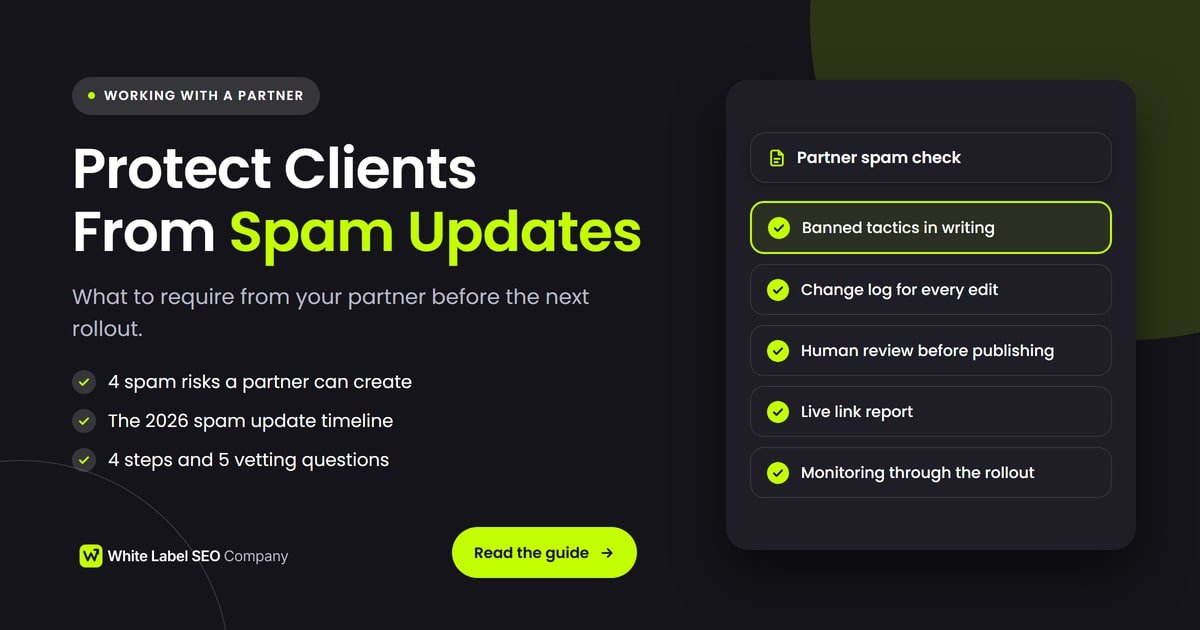
Quick answer: A white label SEO partner protects clients from Google spam updates by avoiding the tactics Google’s spam policies name, keeping a change log of every edit, reviewing AI-assisted content, earning links instead of buying them, and monitoring client sites through the whole rollout. As the agency, you should require all five in writing before a client is handed over.
Key takeaways
- A Google spam update is a notable improvement to Google’s automated spam detection, and Google’s AI-based system for it is SpamBrain.
- A white label SEO partner can create 4 spam risks: scaled content abuse, link spam, doorway abuse, and expired domain abuse or borrowed site reputation.
- Google ran 4 spam updates in 2026, from 19 hours 30 minutes to 13 days 16 hours, so monitoring has to cover the full rollout.
- Four steps protect clients: ban the named tactics in the agreement, keep a change log, review before publishing, and monitor every rollout.
- Ask 5 questions before you hand a client to any partner, and expect evidence, not reassurance.
- When an update hits, send the client a short factual note and a plan, not a recovery date.
What is a Google spam update, and why does it matter to a white label SEO partner?
A Google spam update is a notable improvement to Google’s automated spam detection, announced when it starts rolling out, that can lower or remove pages that break Google’s spam policies. Google’s AI-based spam-prevention system is called SpamBrain. A white label SEO partner matters here because its work sits on your client’s site under your brand.
Your client never sees the partner, only you. A fulfilment partner such as the team behind our white label SEO services produces the pages, links and profile edits that appear in your reports, so its methods carry your name. Google’s own guidance on hiring an SEO makes the same point from the site owner’s side: the owner is ultimately responsible for the actions of any company it hires, and a site that breaks the rules could be removed entirely from Google’s index.
That is why the useful question is not “will a spam update happen?” It will. The useful question is whether your partner’s methods stay inside Google Search Central’s spam policies, and whether you can prove it.
What are the 4 spam risks a white label SEO partner can create for clients?
The 4 spam risks a white label SEO partner can create for clients are listed below, each matched to a policy in Google Search Central’s spam policies.
- Scaled content abuse: large batches of unreviewed pages, including AI-written ones.
- Link spam: bought, automated or keyword-anchored links built to manipulate rankings.
- Doorway abuse: near-identical city or service pages that funnel visitors to one place.
- Expired domain abuse and borrowed site reputation: reused domains and third-party content placed on a strong host site.
1. Scaled content abuse from unreviewed AI pages
Scaled content abuse is the spam risk most likely to come from a partner’s content line, because Google defines it as pages generated in large numbers mainly to manipulate search rankings instead of helping users. The method does not matter: automation, AI tools or people can all produce it.
Google’s guidance on generative AI says that using AI tools to generate pages in bulk without adding value for users may violate this policy, and that it is critical to manually fact-check and review AI-generated content. Pair these rules with our guide to AI content governance for white label SEO partnerships, and ask for a named human editor on every page.
2. Link spam from bought or automated links
Link spam is creating links to or from a site mainly to manipulate rankings, and Google’s policy lists buying or selling links for ranking purposes, using automated programs to create links, and optimized anchor text in guest posts or press releases distributed on other sites. Paid links are acceptable when they carry a rel=”nofollow” or rel=”sponsored” attribute.
Link spam is harder to undo than a content mistake. Google says that when spammy links stop counting, any ranking benefit they gave a site cannot be regained. Ask your partner for the live URL of every link, as described in our overview of white label link building.
3. Doorway abuse from near-identical city pages
Doorway abuse is building pages or sites to rank for similar searches while funneling users to a less useful destination. Google’s examples include pages aimed at specific regions or cities that send users to one page, and substantially similar pages that sit closer to search results than to a clearly defined, browsable hierarchy.
Agencies meet this risk when a partner clones a service page across 50 towns and swaps the place name. A partner should build a location page only where the client serves customers, with content that differs on each page. Our page on white label local SEO shows the location work an agency can resell.
4. Expired domain abuse and borrowed site reputation
Expired domain abuse is buying a lapsed domain name and repurposing it primarily to manipulate search rankings, according to Google’s spam policies. The site reputation policy covers third-party content published on a host site mainly because of that host’s established ranking signals, and Google says pages that fall under it may receive a manual action.
Both show up when a partner promises a shortcut: an aged domain that “already ranks”, or a sponsored section on a strong publisher that exists mainly to borrow its authority. Ask where every domain came from and who controls it.
How long did the 2026 Google spam updates run?
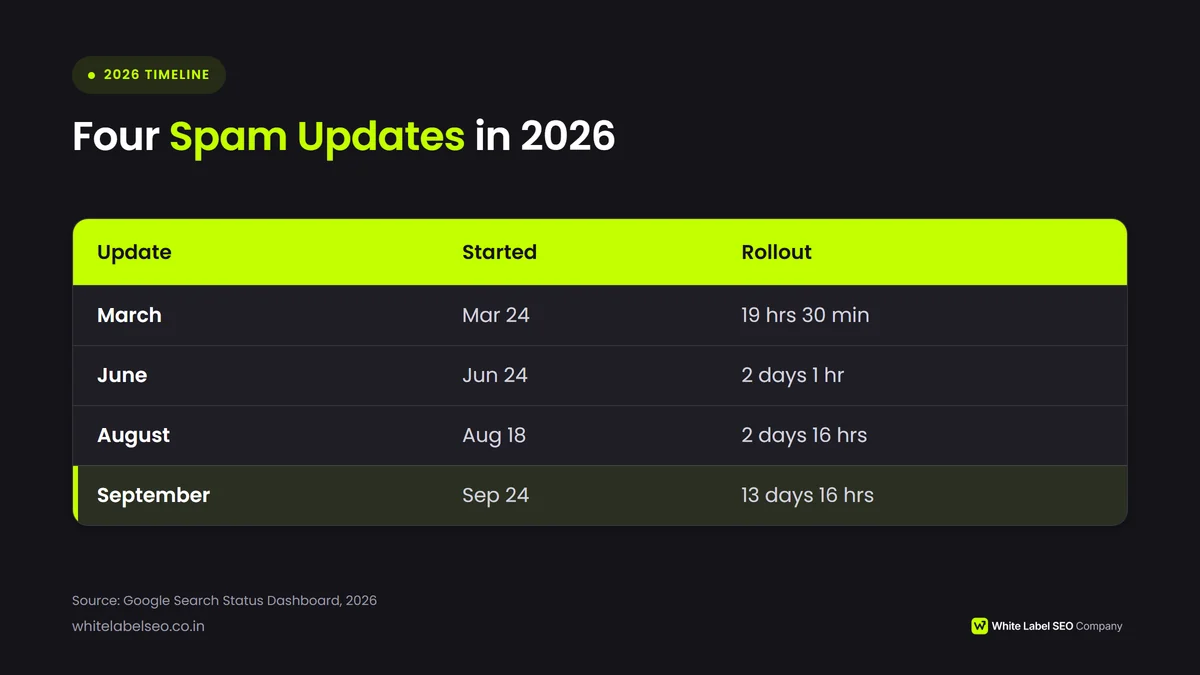
The 4 Google spam updates of 2026 ran for 19 hours 30 minutes, 2 days 1 hour, 2 days 16 hours and 13 days 16 hours, according to Google’s Search Status Dashboard. A rollout can end in under a day or last almost 2 weeks, so a partner that checks client sites only on the announcement day will miss later drops.
| Spam update | Started (Pacific time) | Rollout length | Source |
|---|---|---|---|
| March 2026 spam update | March 24, 2026 | 19 hours 30 minutes | Google Search Status Dashboard |
| June 2026 spam update | June 24, 2026 | 2 days 1 hour | Google Search Status Dashboard |
| August 2026 spam update | August 18, 2026 | 2 days 16 hours | Google Search Status Dashboard |
| September 2026 spam update | September 24, 2026 | 13 days 16 hours | Google Search Status Dashboard |
The table shows that the 4 updates added up to about 19 days of rollout in 2026, and that the September update alone took 13 days 16 hours.
Recovery takes longer than the rollout. Google says changes can help a site improve if its automated systems learn over a period of months that the site complies with the spam policies. Google advised after the September 2026 update that recovery can take months, according to Search Engine Roundtable. A partner who promises a fix in 2 weeks is guessing.
How should a white label SEO partner protect your clients from spam updates?
A white label SEO partner should protect your clients from spam updates in 4 steps: ban the named tactics in the agreement, keep a change log, review everything before it goes live, and monitor each rollout from the first day to the last.
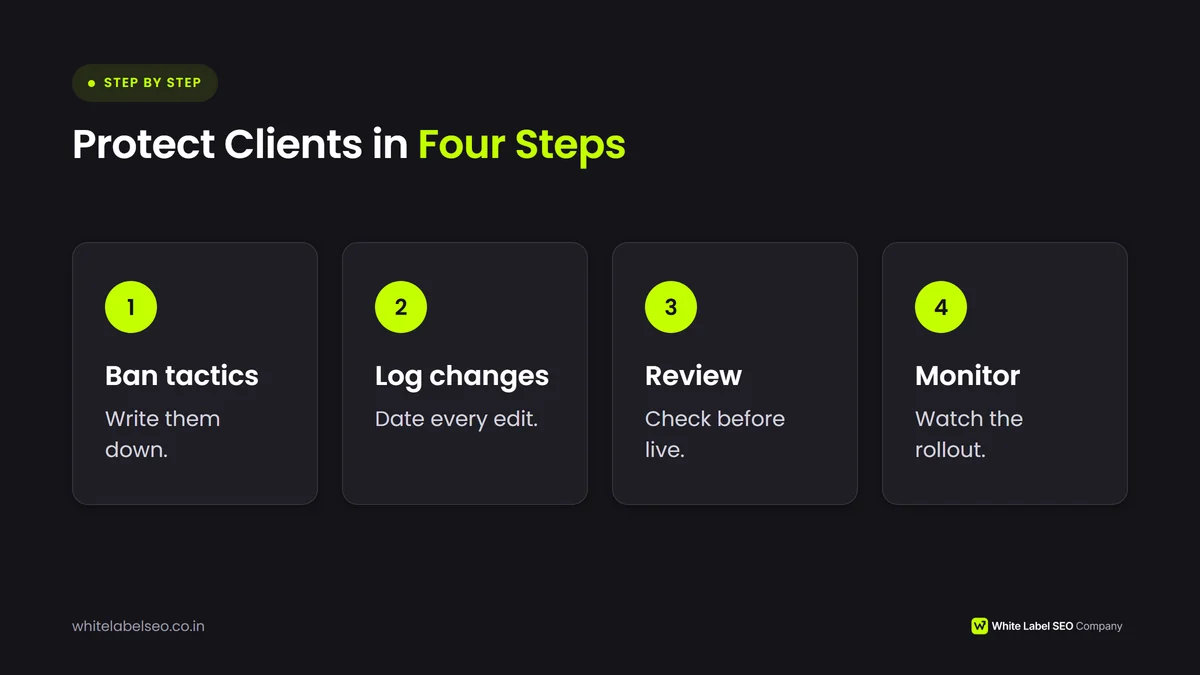
The 4 protection steps are listed below.
- Ban the named tactics in the agreement. List scaled content abuse, link spam, doorway abuse and expired domain abuse as prohibited, and add a clause that the partner funds the clean-up if its work triggers a manual action or a drop.
- Keep a change log for every client. Google’s hiring guidance says to ask whether an SEO will share all the changes made to your site, so require a dated log of every page, link and profile edit.
- Review before publishing. Put a named editor on AI-assisted content, check each new link for a live URL and relevant host, and approve location pages only for areas the client serves.
- Monitor each rollout to the end. Check Google Search Console clicks and the Manual actions report for each client from the start date on the Search Status Dashboard until Google marks the update complete, then send you a status note.
Give the partner read-only access wherever you can. Google’s hiring guidance advises granting only read access to Google Search Console at the audit stage, and the same habit keeps unreviewed edits off client sites.
Which questions should you ask a white label SEO partner about spam updates?
Ask a white label SEO partner 5 questions about spam updates, and expect a document, a report or a live example for each answer. A partner that answers with reassurance and no evidence has told you what you needed to know.
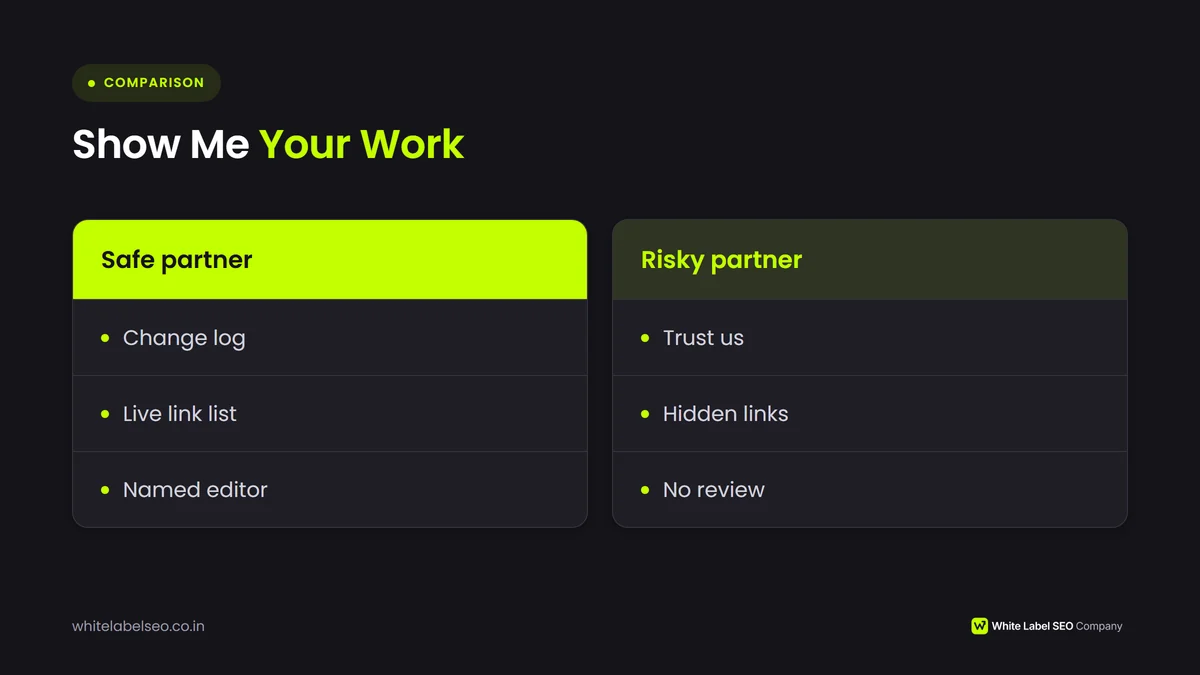
The 5 questions to ask a white label SEO partner are listed below.
- Who reviews every AI-assisted page before it is published, and can you show a sample edit history?
- Can you send the live URL and host site of every link you build, each month?
- How do you decide how many location pages a client needs?
- Where do your domains come from, and who owns them?
- What do you check during a spam update rollout, and when do I hear from you?
These sit alongside the broader checks in our list of questions to ask a white label SEO partner before signing.
What should you tell a client when a spam update hits?
Tell the client what changed, what you checked and what happens next, in a short written note sent once the rollout has ended. Keep it factual: Google says recovery depends on its automated systems learning over months that a site complies, so promise a plan, not a date.
Your partner’s monitoring supplies the facts for that note. For wording and a call script, see our guide to what to tell clients after a ranking drop.
Frequently asked questions
Can your agency be blamed for a white label SEO partner’s tactics?
Yes, in practice, because the client sees only your brand. Google’s hiring guidance says the site owner is ultimately responsible for the actions of any company it hires, and clients apply that logic to you. Put prohibited tactics and a clean-up clause in your partner agreement.
Is AI-written content against Google’s spam policies?
No, AI-written content is not against the policies by itself. Google’s guidance on generative AI says to focus on accuracy, quality and relevance, and to fact-check AI output. The risk is scaled content abuse: generating pages in bulk with AI tools without adding value for users.
How do you tell whether a client site was hit by a spam update?
Compare Google Search Console clicks and impressions before and after the rollout dates on the Search Status Dashboard, and check the Manual actions report. A drop that starts inside the rollout window and touches pages of one type points to the update.
How long does recovery from a spam update take?
Recovery takes months, not days. Google says improvement can follow once its automated systems learn over a period of months that a site complies, and Google said the same of the September 2026 update. Link spam is the exception, because lost link benefits cannot be regained.
Do spam updates always target link spam?
No, not every spam update targets link spam. Google describes link spam updates separately, and Search Engine Roundtable reports that Google said the September 2026 update does not target link spam. Check the dashboard note for each update before you diagnose.
What should you do next to protect your clients?
Pick your busiest client and ask your partner for the change log, the live link list and the content review record for the last 90 days. Then add the 4 protection steps to your agreement.
If you want a delivery partner that works to these rules behind your brand, see our white label SEO services and our team at White Label SEO.
Book a free strategy call
Tell us how you resell SEO today, and we’ll walk through how a partner can work behind your brand with clear records on every client.
Sources
- Google Search Central, “Spam policies for Google web search”, accessed November 28, 2026. https://developers.google.com/search/docs/essentials/spam-policies
- Google Search Central, “Spam updates”, accessed November 28, 2026. https://developers.google.com/search/updates/spam-updates
- Google Search Status Dashboard, “Ranking” incident summary, accessed November 28, 2026. https://status.search.google.com/summary
- Google Search Central, “Do you need an SEO? Tips for hiring an SEO”, accessed November 28, 2026. https://developers.google.com/search/docs/fundamentals/do-i-need-seo
- Google Search Central, “Google Search’s guidance on using generative AI content on your website”, accessed November 28, 2026. https://developers.google.com/search/docs/fundamentals/using-gen-ai-content
- Search Engine Roundtable, “Google September 2026 Spam Update Is Done Rolling Out”, October 8, 2026. https://www.seroundtable.com/google-september-2026-spam-update-done-42235.html
