Quick answer: White label link building delivers results clients can see when every placement is logged, tied to a target page and reported next to the metrics clients care about. Follow Google’s spam policies, give the work 3 to 12 months and show the proof every month.
Key takeaways
- White label link building means a partner builds links behind your brand while you own the client relationship and the report.
- In BuzzStream’s Link Building Trends Report, only 40% of link builders say their reports effectively show value, so visible proof is the gap to close.
- Search Engine Journal’s 2022 case examples show a first visible change anywhere from 2 months to nearly 12 months.
- Google’s spam policies list buying or selling links for ranking, excessive link exchanges and automated links as link spam.
- A useful link building report shows each placement, its target page and the organic visibility change for that page.
- Set up the work in 5 steps: pick target pages, agree the log, follow the link rules, report monthly and review quarterly.
What is white label link building?
White label link building is a service in which a partner researches, builds and documents backlinks for your client’s site under your agency’s brand. The client sees one team and one invoice. The partner stays invisible and hands you the work and the data.
The service covers outreach, content placements and link reporting. It differs from a one-off bulk link package because each placement has a source page, an anchor text and a target page that you can show to the client. That record is what turns a link into evidence.
The model works best on a monthly retainer, where link building runs next to content and technical work. Our white label SEO services follow that pattern: the partner delivers, you report and the client keeps dealing with you.
Why do clients not see results from link building?
Clients do not see results from link building because links are hard to see and slow to show an effect. A link sits on a third-party site, and its effect arrives as a gradual lift in organic visibility. Without a clear record, the invoice looks like a cost with no output.
BuzzStream’s Link Building Trends Report, last updated April 17, 2025, gives the reporting side of the problem. Of the link builders surveyed, 53% say their reports are easy to understand, and 40% say their reports effectively show value. About 50% want to improve how well their reports show value. If the people building links doubt their own reports, a client reading the same report is unlikely to be convinced.
The fix is not more links. It is a visible chain from link to target page to metric. Our white label link building service logs that chain for each placement, so the report your client reads is the same record your partner keeps.
How long does white label link building take to show results?
White label link building usually takes 3 to 12 months to show a visible change in organic traffic. Search Engine Journal’s article “How Long Does It Take To See Results From Link Building?”, published June 16, 2022, gives that range. The range depends on site authority, niche competition, page type and budget.
The author, Alexandra Tachalova, backs it with 5 of her own client campaigns, using Ahrefs screenshots from May 2022. They are examples, not a formal study, but they show the spread clients should expect. A home improvement site built 58 links on a budget under $20,000 and saw a change in under 5 months. A new B2B CRM brand built 40 links on $15,000 and saw a change after about 3 months. A digital marketing site with no authority built more than 250 links on about $100,000 and saw traffic flat for 8 months, with results after nearly 12 months.
These figures are from 2021 and 2022, so use them as a spread, not a forecast. Tell clients the range up front and agree a review date. A client who knows the first 90 days produce placements and the later months produce movement will read a flat month differently.
Which links count as link spam?
Link spam is the practice of creating links to or from a site primarily to manipulate search rankings, according to Google Search Central’s spam policies. Google states that sites that violate its policies may rank lower in results or not appear in results at all.
The spam policies name 4 practices that matter to a link building partner. The 4 practices Google names as link spam are listed below.
- Buying or selling links for ranking purposes, including exchanging money, goods or services for links.
- Excessive link exchanges, such as reciprocal links and partner pages made only for cross-linking.
- Large-scale article marketing or guest posting campaigns, including paid advertorials and press releases with optimized anchor text.
- Using automated programs or services to create links to your site.
Google makes one allowance. Links that are ads or paid placements are acceptable when they carry the sponsored attribute (rel=”sponsored”) or rel=”nofollow”, according to Google Search Central’s guide to qualifying outbound links. Google also advises descriptive, concise and relevant anchor text in its link best practices.
Ask your white label link building partner how each link is earned and which of these practices it avoids. Our guide to the types of backlinks explains the link types your partner may name in a proposal.
What should a link building report show?
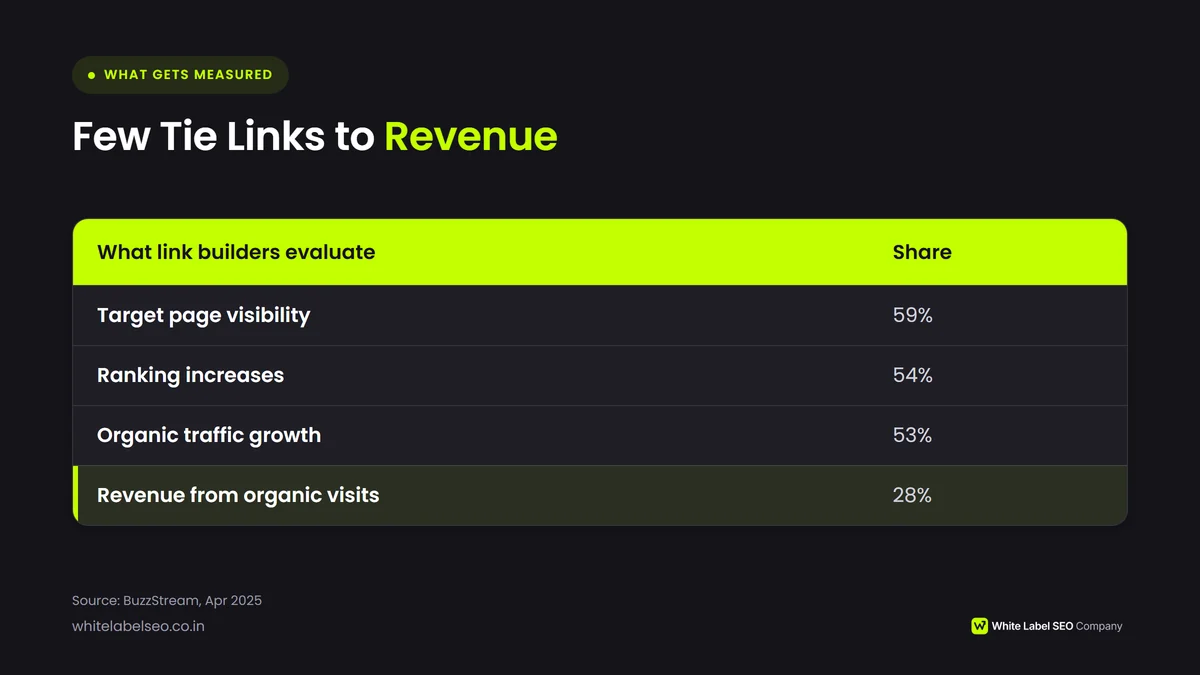
A link building report for white label link building should show every placement, the page it points to and the change in organic visibility for that page. BuzzStream’s report lists what link builders measure: 59% evaluate organic visibility for the target page, 54% ranking increases, 53% organic traffic growth and 28% revenue from organic visits.
| What link builders evaluate | Share of link builders | What to show the client |
|---|---|---|
| Organic visibility for the target page | 59% | Impressions and clicks for each linked page in Google Search Console |
| Ranking increases | 54% | Position change for the page’s main queries |
| Organic traffic growth | 53% | Monthly organic sessions to the target page |
| Revenue from organic visits | 28% | Leads or sales from the same pages, if the client shares them |
The table shows a clear gap: 59% of link builders look at target page visibility, but only 28% connect links to revenue. A report that adds a lead or sales column for the same page goes further than most. Our guide to the SEO metrics to report to clients covers which numbers to pair with it.
Keep a placement log alongside the report. Each row holds the date, the source page, the anchor text, the target page and the link type. The log is the evidence; the metrics are the outcome.
How do you set up white label link building so clients see results?
You set up white label link building in 5 steps: choose the target pages, agree the placement log, apply the link rules, report monthly and hold a quarterly review. Each step makes the work easier for the client to see and for you to defend.
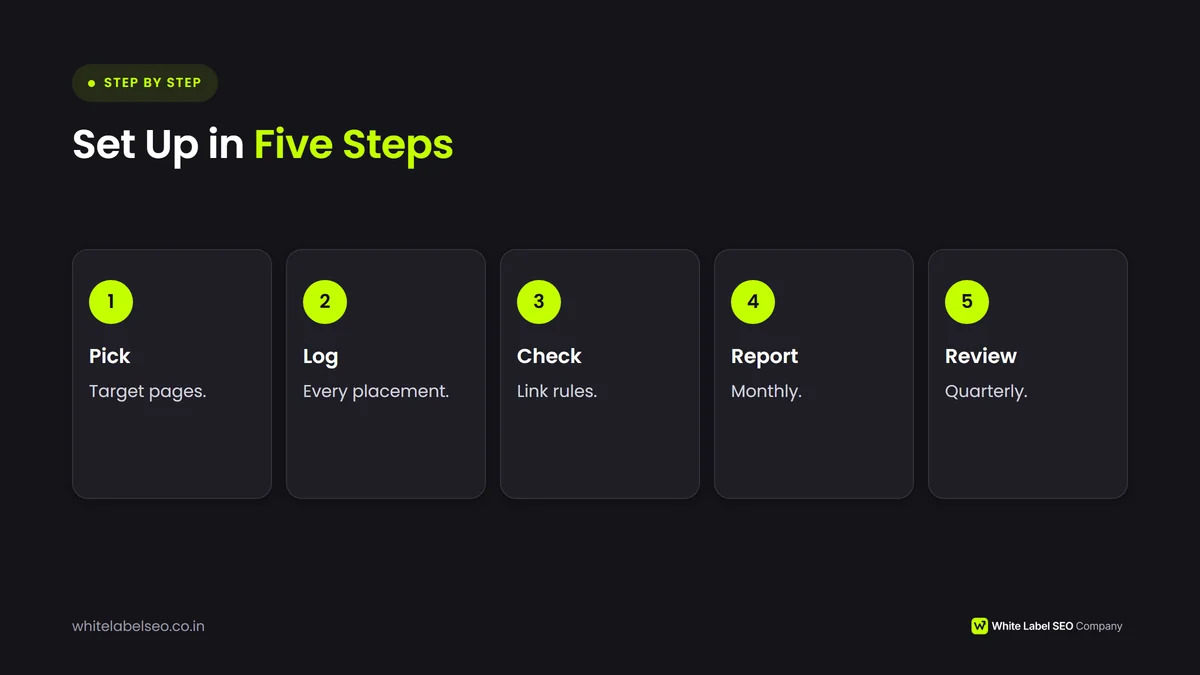
The 5 setup steps are listed below in the order to run them.
- Choose the target pages. Point white label link building at the pages that earn leads, such as service and category pages, and write the list down with the client.
- Agree the placement log. Ask your partner for a log with the source page, anchor text, target page and date for every link, and share it in the same format each month.
- Apply the link rules. Check each link type against Google’s spam policies, and require the sponsored attribute on paid placements.
- Report monthly. Show the new placements and the organic visibility of each target page. Our white label SEO reports are built for this layout.
- Hold a quarterly review. Compare 3 months of placements with 3 months of target page data, and decide which pages to keep building toward.
The 5 steps change what the client sees from “links were built” to “these pages gained visibility after these placements”.
What separates a reportable link from a risky one?
In white label link building, a reportable link is one you can name, place and explain: it has a known source page, a descriptive anchor text, a target page you chose and a method that fits Google’s spam policies. A risky link fails at least one of those tests, usually the last.
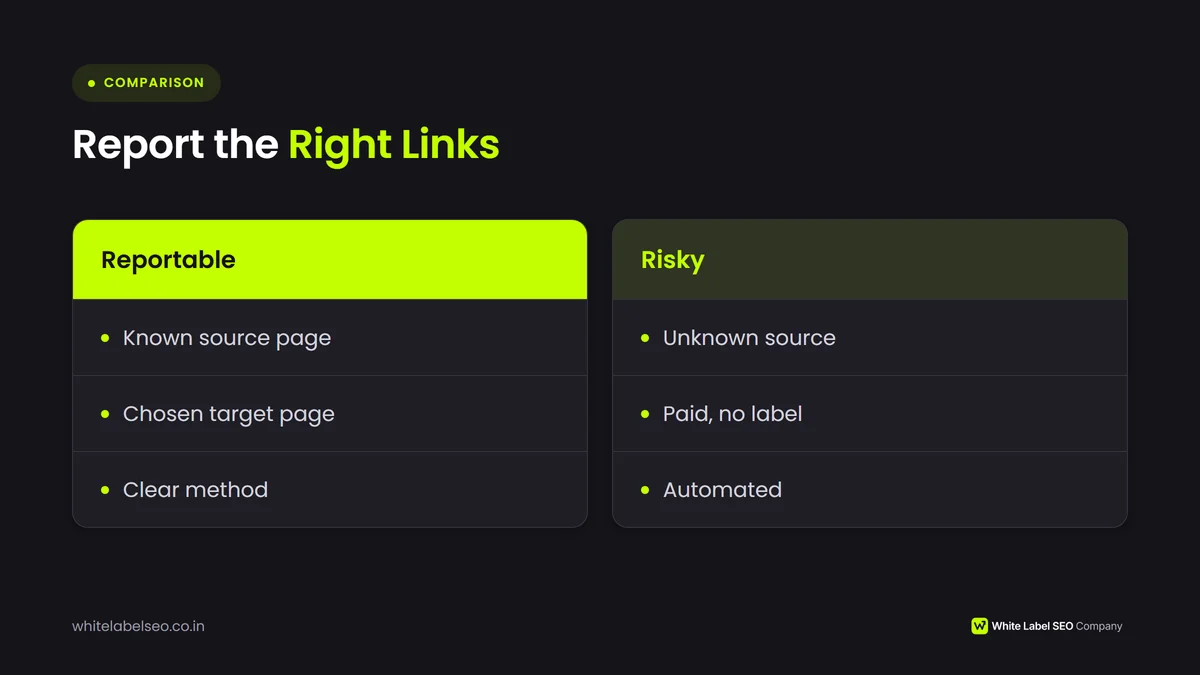
Use the comparison in your proposal and in every review. If your partner cannot fill in the first column for a link, treat that link as risky until it can. Anchor text deserves the same care: Google’s link best practices ask for descriptive anchor text and warn against keyword stuffing in it.
A weak white label link building report also hides risk. A report that lists only totals cannot show whether a link came from a paid placement without the sponsored attribute. The placement log can.
How should a partner protect client links from spam updates?
A white label link building partner protects client links from spam updates by building only links that fit Google’s spam policies and by keeping a log that lets you audit the work after any update. A log that records the method for each link makes an audit a matter of reading rows.
Google says sites that violate its spam policies may rank lower or not appear at all, so an audit that finds a risky link early is cheaper than one after a drop. Our guide on how your white label SEO partner should protect clients from Google spam updates covers the checks and the questions to ask.
Frequently asked questions
What is the difference between white label link building and buying links?
White label link building is a service with research, outreach and reporting behind your brand, while buying links is paying for placements. Google’s spam policies list buying or selling links for ranking as link spam, so a white label partner should explain how each link is earned and flag paid placements with the sponsored attribute.
How long does white label link building take to work?
White label link building usually takes 3 to 12 months to show a change in organic traffic, according to Search Engine Journal’s 2022 article. The 5 campaigns it describes saw a first change from about 2 months to nearly 12 months, depending on authority, niche and budget.
What should a white label link building report include?
A white label link building report should include each placement’s date, source page, anchor text and target page, plus organic visibility and traffic for the target page. BuzzStream’s report found that 59% of link builders evaluate organic visibility for the target page and 53% evaluate organic traffic growth.
Do nofollow links count in a link building report?
Yes, report them, but label them. Google Search Central says paid placements should carry the sponsored attribute or nofollow, and these attributes generally stop Google from following the link. A nofollow link can still bring referral visits and brand exposure, so keep it in the log with its type.
Can a client check the links you report?
Yes, and they should be able to. A placement log with source page, anchor text and target page lets a client open each link and confirm it. This is the simplest way to turn a monthly retainer line into something the client can verify without trusting a summary.
What should you do next about link building proof?
Pick 3 target pages for your next white label link building client, ask your partner for a placement log in the format above and put a quarterly review in the calendar before the first link goes live. Those 3 actions give the client something to see from month one.
If you want a partner that logs each placement behind your brand, see how White Label SEO works with agencies, and read about our white label SEO services for the full list of what you can resell.
Want link building proof your clients can see?
Book a free strategy call and we will show you the placement log and report layout we use behind your brand.
Sources
- Google Search Central, “Spam policies for Google web search”, accessed November 28, 2026. https://developers.google.com/search/docs/essentials/spam-policies
- Google Search Central, “Qualify your outbound links to Google”, accessed November 28, 2026. https://developers.google.com/search/docs/crawling-indexing/qualify-outbound-links
- Google Search Central, “Link best practices for Google”, accessed November 28, 2026. https://developers.google.com/search/docs/crawling-indexing/links-crawlable
- BuzzStream, “Link Building Trends Report”, last updated April 17, 2025. https://www.buzzstream.com/blog/link-building-trends
- Search Engine Journal, “How Long Does It Take To See Results From Link Building?”, June 16, 2022. https://www.searchenginejournal.com/link-building-time-to-results/448340/
