Quick answer: Present white label SEO results under your own brand by branding every touchpoint, leading with business outcomes, and sending one monthly report on a fixed date. Control who holds access to the data, and answer honestly if a client asks who does the work. Your name goes on the report, and your accountability goes with it.
Key takeaways
- White label SEO results are the reports, dashboards and updates your partner produces and you deliver to clients under your own name.
- The report file is only one touchpoint: the dashboard address, email sender, support contact and access lists also carry a brand.
- In AgencyAnalytics’ 2026 benchmarks, 69% of agencies report to clients monthly, so a monthly report on a fixed date is the norm to match.
- Present in 4 steps: check touchpoints, lead with outcomes, brief your account manager and send on the same date every month.
- Lead with outcomes such as organic revenue and traffic, the two most tracked measures in Sitechecker’s 2026 survey of 73 agencies.
- Give each person the lowest Google Search Console permission level that does the job, and never deny using a partner if a client asks directly.
What does it mean to present white label SEO results under your own brand?
Presenting white label SEO results under your own brand means delivering reports, dashboards and updates that your white label SEO partner produced as if your agency issued them, with your logo, colors, sender address and voice. The client sees one brand, and that brand answers for every number.
It is a normal subcontracting arrangement, not a trick. Google tells site owners that they are responsible for the actions of the companies they hire, according to its Search Central page “Do you need an SEO?”. The same logic applies to you: when your name is on the report, you answer for the work behind it. Our white label SEO services are built for exactly this setup, with the work done in the background and the reporting under your brand.
Good presentation has 2 jobs. It removes anything that makes the report look like a raw export, and it turns the data into a story the client can act on.
Which parts of white label SEO results carry your brand?
Five parts of white label SEO results carry a brand: the report file, the dashboard address and login page, the email sender, the support contact and the access lists in your analytics tools. A single leftover logo or filename in any of them shows the client who built the report.
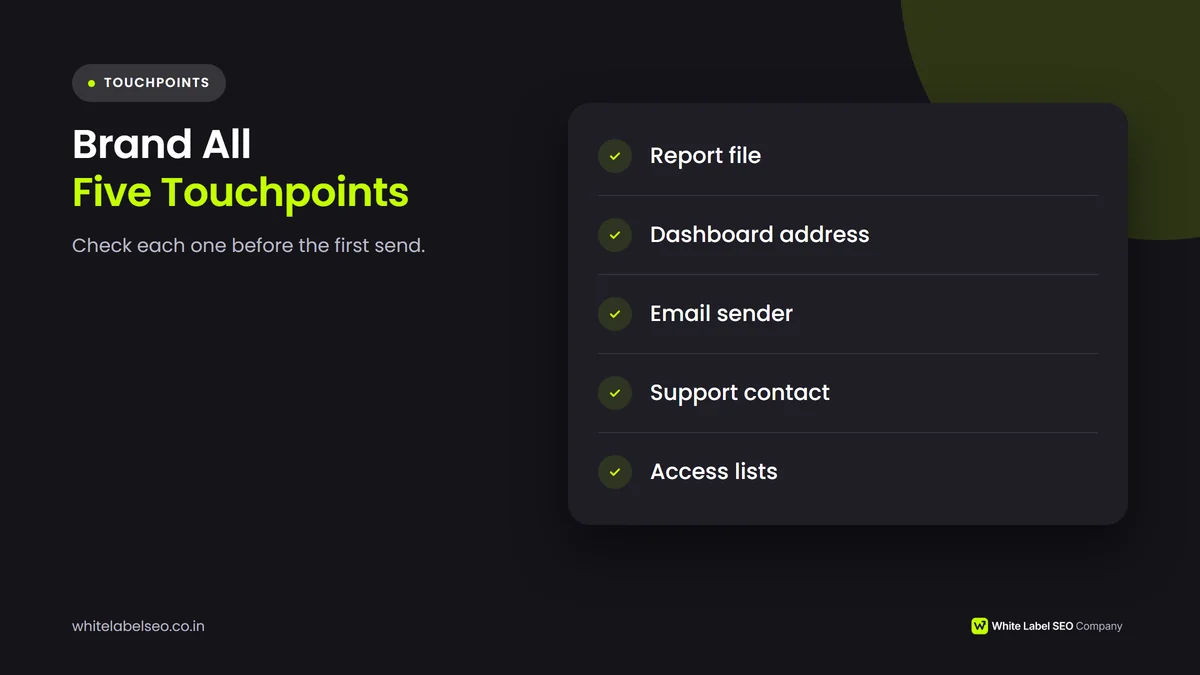
The 5 branded touchpoints to check before every rollout are listed below.
- The report file: cover, footer, chart exports, watermarks, the file name and the PDF title in the document properties.
- The client dashboard: the web address, the login page, the browser tab title and the colors.
- The email sender: the from name, the from address and the signature on scheduled report emails.
- The support contact: the help link, the reply-to address and any “powered by” line.
- The access lists: the users added to Google Search Console and Google Analytics, covered in a later section.
Tool settings differ, so test them as a client would. DashThis lists a custom domain such as reports.yourcompany.com, removal of its own branding and sending reports from your own email address. BrightLocal lets each white-label profile have its own logo, colors and email settings, but its FAQ says reports cannot be hosted on your own domain, so external report links stay generic. Both pages were read in November 2026, and vendors change features. Open a sample report from a clean browser before you promise a client anything. Our page on white label SEO reports shows what a client-ready format looks like.
How often should you send white label SEO results?
Send white label SEO results monthly, because 69% of agencies report to clients monthly, according to AgencyAnalytics’ 2026 Marketing Agency Benchmarks Report. Weekly reports suit launches and large accounts, and a live dashboard works as a supplement to a monthly written summary.
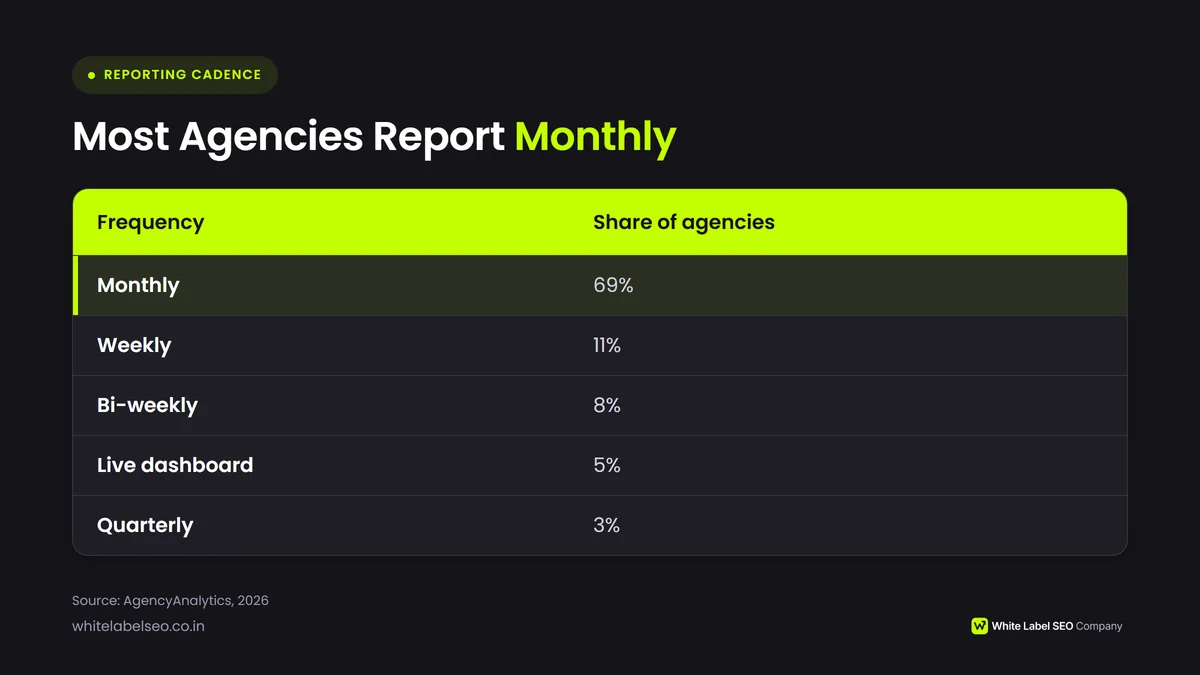
| Reporting frequency | Share of agencies | How to use it with a partner |
|---|---|---|
| Monthly | 69% | Agree one delivery date with your partner and add a buffer before the client date |
| Weekly | 11% | Use short updates for launches or large accounts |
| Bi-weekly | 8% | Keep a fixed day and a short template |
| Ongoing live dashboard | 5% | Pair it with a written monthly summary |
| Quarterly | 3% | Add a monthly note so the client never goes 90 days without news |
The table shows that most agencies settle on a monthly rhythm, which is why a missed report date stands out. AgencyAnalytics surveyed 494 marketing agency professionals from February to April 2026 and also reports that 97% rate accurate reporting as important or extremely important for retention. The company sells reporting software, so its sample reflects its own audience rather than the whole industry.
How do you present white label SEO results in 4 steps?
You present white label SEO results in 4 steps: check every touchpoint, lead with outcomes in plain language, brief your account manager before the meeting and send the report on the same date every month. The sequence takes about a day to set up and then repeats.
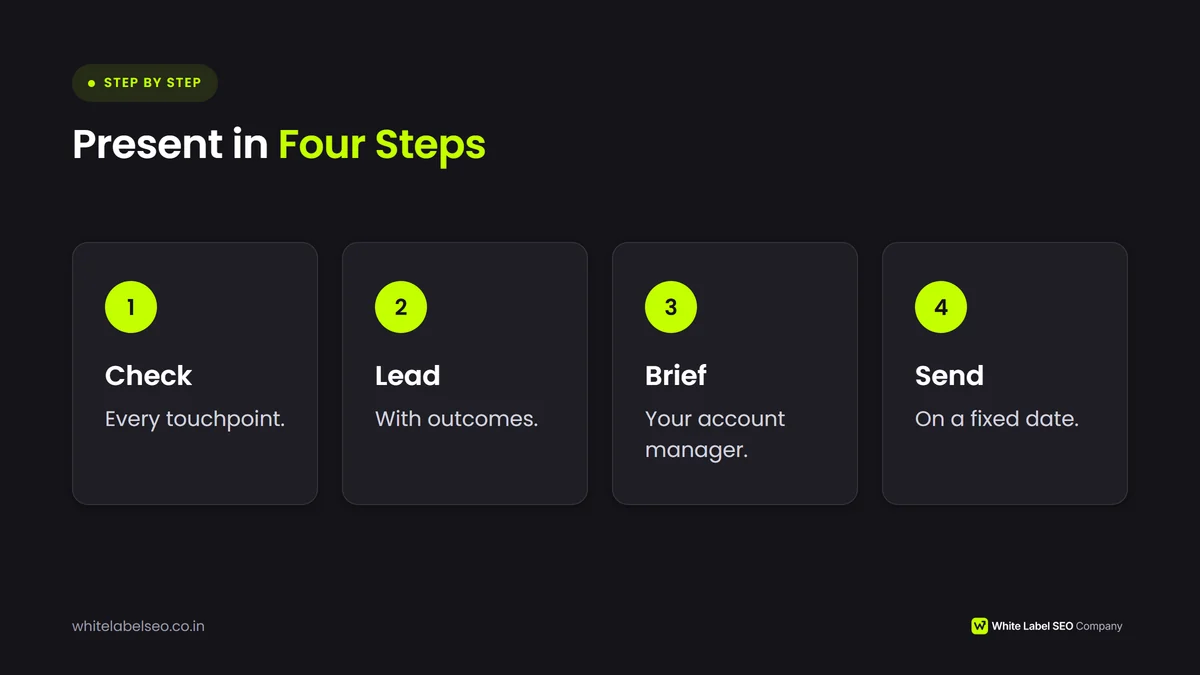
The 4 steps for presenting white label SEO results are listed below.
- Check every touchpoint. Run the 5-part checklist on the report file, dashboard, email sender, support contact and access lists before the first send.
- Lead with outcomes in a plain-language summary. Write 2 or 3 sentences at the top that say what changed, why it matters to the client’s business and what happens next.
- Brief your account manager. Ask your partner for a short note on the story behind the numbers, and give it to the person who will take the client’s questions before the meeting.
- Send on the same date every month. Agree the delivery date with your partner, add a buffer and keep the format identical, so the report arrives like a routine rather than a surprise.
Include bad months in the same format. A dip explained with its likely cause and a plan reads as honest, while a dip left out reads as evasive when the client finds it alone. Our guide to the SEO metrics to report to clients lists what to include each month.
Which metrics should white label SEO results lead with?
White label SEO results should lead with outcomes the client can connect to the business, such as organic revenue, overall traffic and non-branded rankings, before technical detail. Sitechecker’s 2026 survey of 73 agencies found that 53.4% track organic revenue including AI chats and 46.6% track overall traffic.
The same survey reports that 43.8% track non-branded search positions, 37% track brand visibility in AI chats and 31.5% track non-branded organic traffic. Treat these as a picture of what agencies measure, not a rule. Pick the 3 or 4 measures that match the goal the client named at the start, and put the rest in an appendix.
Keep Google Search Console and Google Analytics numbers consistent from month to month. Search Console’s Performance report can show preliminary data for the most recent period, according to Google Search Console Help, so report on complete periods and note the date range on every chart. For live panels, our post on dashboard integration and direct CMS push for white label SEO partners covers how to connect a partner’s output to your own dashboard.
How do you share access to white label SEO results without exposing the partner?
Share access to white label SEO results by giving each person the lowest Google Search Console permission level that does the job, and by adding partner staff through an address on your own domain. Google Search Console Help defines 3 levels: Owner, Full user and Restricted user.
An Owner has full control of a property and can add and remove users. A Full user has view rights to all data and can take some actions but cannot add or remove users. A Restricted user has simple view rights on most data. The client should own the property, your agency should hold the access it needs to manage it, and partner staff should hold the lowest level that lets them work.
Check the Users list in every property before you send the first report, and again whenever a partner team member leaves. Google’s own advice on hiring an SEO is to start with read access to Search Console and to ask for an explanation of every change. Our post on client data security and access control in white label SEO partnerships covers permissions, shared logins and offboarding in more detail.
What should you say when a client asks who produces the white label SEO results?
If a client asks directly who produces the white label SEO results, answer truthfully: your agency owns the strategy and the relationship, and specialist partners carry out part of the work under your quality control. Never deny using a partner, because a false answer costs far more than the question.
Most clients ask about outcomes, not org charts, so the question seldom comes up. When it does, check your partner contract first, since some agreements limit what you may say about the partner. Then keep the answer short and factual, and move straight to what the client cares about: who is accountable, how fast you respond and what the next report will show.
Your partner should protect the same line from its side. Our post on protecting your agency brand when you work with a white label SEO partner covers the confidentiality terms to ask for.
Frequently asked questions
Can a white label dashboard use my own domain?
Some tools can and some cannot. DashThis lists a custom domain such as reports.yourcompany.com, while BrightLocal’s FAQ says reports cannot be hosted on your own domain. Check the current features of your tool, then test the login page and links from a clean browser.
How often should I send a white label SEO report?
Send it monthly unless the client has agreed another rhythm. AgencyAnalytics’ 2026 benchmarks report that 69% of agencies report monthly. Pick one delivery date, agree it with your partner and keep a buffer before the date you promise the client.
What should the top of a white label SEO report say?
The top should hold a 2 or 3 sentence plain-language summary: what changed, why it matters to the client’s business and what happens next. Charts and tables follow below it. Many busy clients read only that summary, so it should carry the whole story.
Do I have to tell clients that a partner does the work?
You do not have to announce your delivery model in every report, but you should never deny it when a client asks directly. Read your partner contract for confidentiality terms, answer truthfully and stress that your agency stays accountable for the results.
How do I give a partner access to Search Console without exposing them?
Add partner staff with the lowest permission level that lets them work, using an address on your own domain where your contract allows it. Google Search Console Help lists Owner, Full user and Restricted user levels. Review the Users list before each report and when staff change.
What should you do next about white label SEO results?
Run the 5-part touchpoint checklist on your current report today, then agree one monthly delivery date with your partner and write the 2 or 3 sentence summary template. These 3 changes cost little and make every later report look like it came from one team.
If you want a delivery partner whose reports are ready to carry your brand, see how our white label SEO services work behind your name at White Label SEO.
Want reports your clients will trust?
Book a free strategy call and we will walk through how our reports and dashboards fit under your brand.
Sources
- AgencyAnalytics, “2026 Marketing Agency Benchmarks Report”, 2026. https://agencyanalytics.com/agency-benchmarks-2026
- Sitechecker, “The 2026 SEO agency growth report”, March 11, 2026. https://sitechecker.pro/seo-agency-growth-data-study-2026/
- Google Search Central, “Do you need an SEO?”, accessed November 28, 2026. https://developers.google.com/search/docs/fundamentals/do-i-need-seo
- Google Search Console Help, “Managing owners, users, and permissions”, accessed November 28, 2026. https://support.google.com/webmasters/answer/7687615
- DashThis, “White Label Marketing Dashboard for Agencies”, accessed November 28, 2026. https://dashthis.com/white-label/
- BrightLocal, “White-label Local SEO Tools”, accessed November 28, 2026. https://www.brightlocal.com/white-label-seo-tools-reports/
