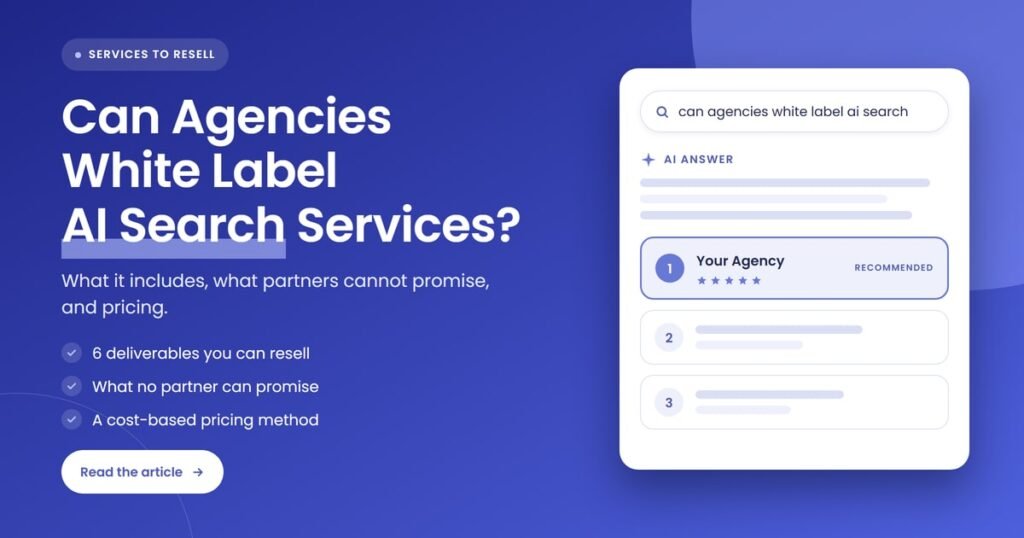
Quick answer: Yes, agencies can white label AI search optimization, because most of it is SEO work a partner can do under your brand: an AI search audit, crawler access, answer-ready content, structured data, brand mentions and citation tracking. No partner can promise AI citations. Sell scoped deliverables, report what can be measured, and price it as a monthly add-on.
Key takeaways
- White label AI search optimization is SEO work aimed at AI search visibility in Google AI Overviews, Google AI Mode, ChatGPT search and Microsoft Copilot, delivered by a partner under your agency’s brand.
- Agencies can resell it because Google says no special optimizations are needed to appear in AI Overviews or AI Mode, so most of the work is strong SEO foundations.
- It includes 6 deliverables: an AI search audit, crawler access checks, answer-ready content, structured data, brand mentions and citation tracking with reports.
- It cannot include a promise of citations, because the AI platforms control what they show.
- You can measure it with Google Search Console, the Bing Webmaster Tools AI Performance report and crawler access checks, each with known limits.
- Price it from your partner cost and a target margin, packaged as a scoped add-on, a monthly retainer line or a one-time audit.
What is white label AI search optimization?
White label AI search optimization is SEO work that improves a site’s visibility in AI search, delivered by a partner and sold under the agency’s own brand. AI search means Google AI Overviews, Google AI Mode, ChatGPT search and Microsoft Copilot, which answer a question in text and name the pages they drew from. Providers also call it GEO or AEO.
The agency owns the client relationship, the price and the reports. The partner does the audit, the edits and the tracking in the background. That is the same model we use for our white label SEO services, applied to a newer set of search surfaces.
AI search visibility is the plain-language target. It means a client’s brand or pages appear as a source or a named option when someone asks an AI search tool a question about the client’s topic. It is a goal you can work toward and track, not a rank you can buy.
Can agencies white label AI search optimization?
Yes, agencies can white label AI search optimization, and they do not need an in-house AI team to do it. Google Search Central states that no additional requirements or special optimizations are needed to appear in AI Overviews or AI Mode, so the work rests on SEO foundations a partner already delivers.
Google’s documentation adds 3 conditions. A page must be indexed and eligible to be shown in Google Search with a snippet, important content should be in text form, and structured data should match the visible text. Google also says you do not need new machine-readable files, AI text files or special schema.org markup for these features.
Agencies are already moving in this direction. Sitechecker’s 2026 agency report, which surveyed 73 SEO agencies, found that 58.9% improve on-page content for AI search and that only 9.6% do not actively optimize for AI chats. Reselling is a practical response when your team has no capacity for the extra work. For the technical side, read why technical SEO still matters for AI search.
What does white label AI search optimization include?
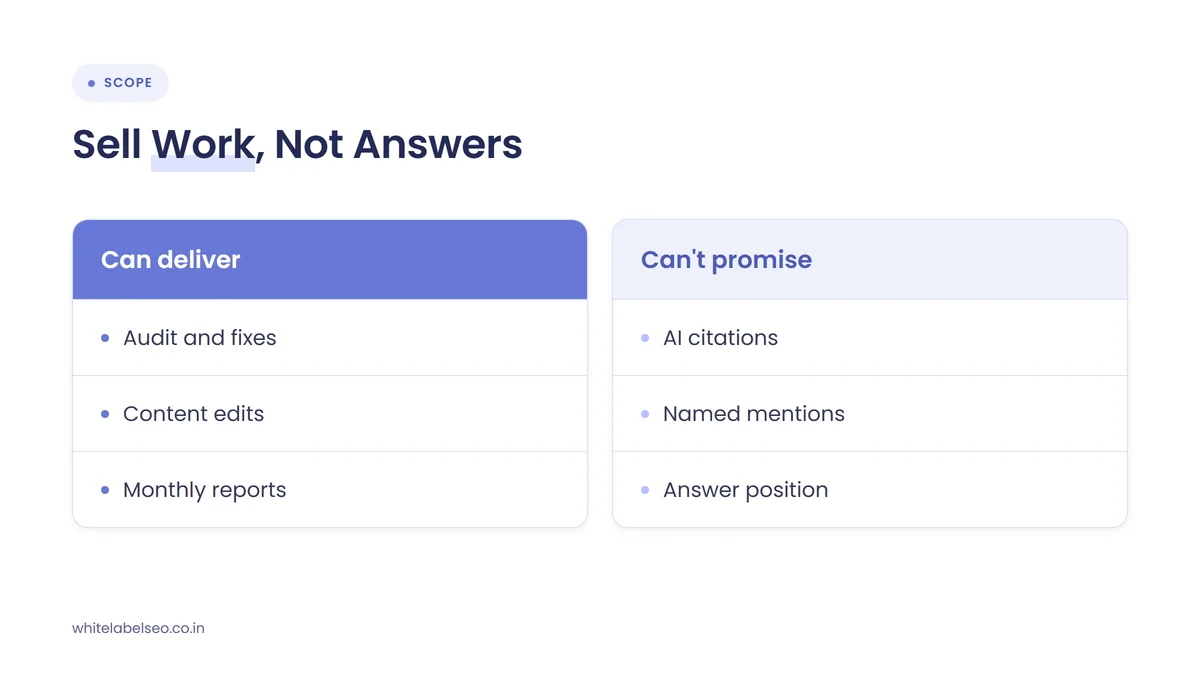
White label AI search optimization includes 6 deliverables, and the AI search audit comes first because it decides what the other 5 should fix. Every item below can be done, checked by you and written into a scope, which is what separates a real offer from a vague promise.
The 6 deliverables of white label AI search optimization are listed below, in delivery order.
- AI search audit. A review of whether the client’s key pages are indexed and eligible to show with a snippet, which questions the site answers, and where competitors are named in AI answers.
- Crawler access checks. A review of the client’s robots.txt and server settings so OAI-SearchBot, which OpenAI uses for ChatGPT search, and Google’s crawlers can reach the pages meant to be found.
- Answer-ready content. Edits and new pages that open each section with a direct answer, use plain headings and put facts in tables or lists.
- Structured data. Markup that matches the visible text on the page, checked for errors. It supports search understanding without being a special AI requirement.
- Brand mentions. Work to earn accurate mentions on sites the client’s audience already reads. Our post on white label digital PR and brand mentions for AI search visibility covers that task in detail.
- Citation tracking and reports. A recurring check of where the client appears in AI answers, summarized in branded reports under your logo.
Ask any partner, including us, to put the AI-specific tasks in writing before you sell them. Our listed services already cover technical audits, schema, content optimization, local SEO and branded monthly reports, and the AI-specific scope should be agreed on a call, not assumed.
What can’t white label AI search optimization promise?
White label AI search optimization can’t promise citations, named mentions or a position in any AI answer, because Google, OpenAI and Microsoft decide what their systems show. A partner can promise work: audits finished, pages edited, access fixed and reports sent on dates you agree.
Search behavior is also shifting under clients. Ahrefs analyzed 300,000 keywords in 2025 and found that results with an AI Overview had a 34.5% lower average click-through rate for the top-ranking page. Ahrefs describes this as a correlation, not proof of cause, and it measured desktop data only. Clients may see fewer clicks even when their visibility improves, so your scope should say what will be reported.
Can a partner promise AI citations?
No, a partner can’t promise AI citations, and an agency that sells one is taking on a risk it can’t control. Google says indexing and serving are never assured even when a page meets every condition. Write deliverables, report dates and tracked prompts into the contract instead of outcomes.
How do you measure white label AI search optimization?
You measure white label AI search optimization with 4 sources: Google Search Console, the Bing Webmaster Tools AI Performance report, crawler access checks and a citation tracking routine. None gives a complete picture, so state each limit in your client reports.
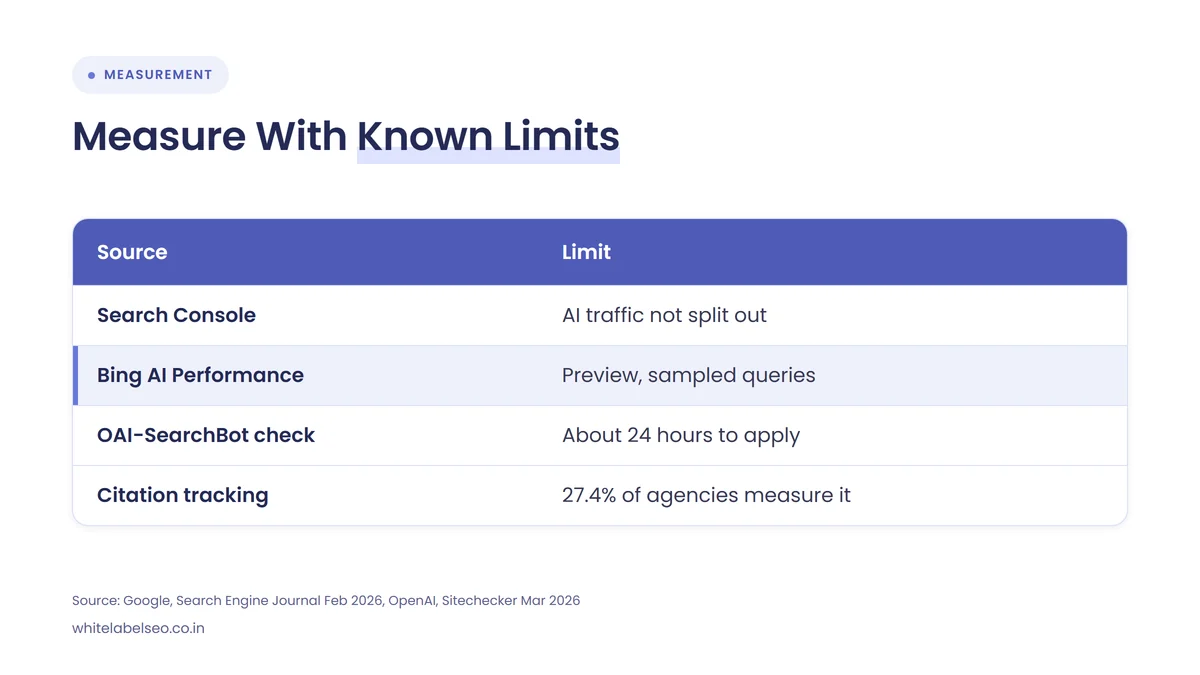
The table below lists the 4 measurement sources, what each one shows and the limit to disclose.
| Measure | What it shows | Limit to disclose | Source |
|---|---|---|---|
| Google Search Console | Traffic from AI features, inside the Web search type of the Performance report | AI traffic is counted in overall search traffic, not split out | Google Search Central, accessed Nov 2026 |
| Bing Webmaster Tools AI Performance | Total citations, average cited pages, page-level activity and grounding queries for Microsoft Copilot and Bing AI summaries | Public preview since Feb 9, 2026; grounding queries are a sample | Search Engine Journal, Feb 2026 |
| Crawler access check | Whether OAI-SearchBot is allowed in robots.txt for ChatGPT search | Changes take about 24 hours to apply; allowed does not mean cited | OpenAI, accessed Nov 2026 |
| Citation tracking routine | Where the brand appears across AI answers for a fixed list of prompts | Only 27.4% of agencies measure citations, and 37% track brand visibility as a KPI | Sitechecker, Mar 2026 |
The table shows that only 2 of the 4 sources report real platform data and the other 2 depend on your own checks, so the reports should name the method each time.
How should agencies price white label AI search optimization?
Agencies should price white label AI search optimization by adding a target margin to the partner cost, then packaging it in a form clients understand. Ahrefs polled 439 SEO providers and found that 78.2% charge a monthly retainer, with $501 to $1,000 the most common band at 20.4%. That is the general SEO market, not an AI-specific price list.
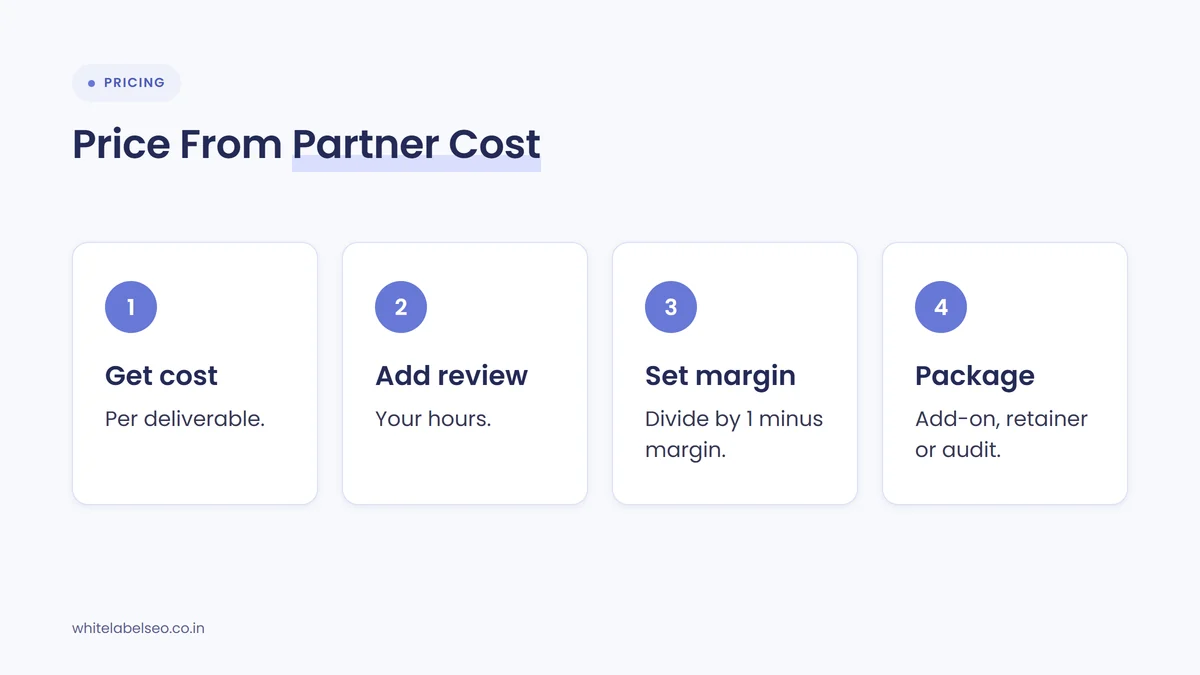
We do not publish package prices on our services page, and we have not found a neutral source for AI search pricing, so this guide gives a method instead of a number. The 4 steps for pricing white label AI search optimization are listed below.
- Get the partner cost for each deliverable in writing, including reporting.
- Add your review hours, because you will read every audit and report before a client sees it.
- Set a target margin and divide: client price = partner cost divided by (1 minus target margin). A 40% margin means dividing by 0.6.
- Package the result in one of the 3 formats below and state what is excluded.
The 3 formats for selling white label AI search optimization are listed below.
- A scoped add-on. A fixed list of deliverables added to an existing SEO retainer, easiest for current clients.
- A monthly retainer line. A recurring line in the proposal covering content updates and citation tracking.
- A one-time AI search audit. A paid audit that leads into ongoing work if the client acts on it.
Margins deserve attention. Sitechecker found that 41.1% of the 73 agencies it surveyed run gross margins under 30%, and 42.5% charge retainers under $1,000 a month. Pricing on partner cost keeps the add-on from shrinking a margin that is already thin. See how much white label SEO costs for the base retainer, and how to package white label SEO into tiered retainers for tier design.
How do you explain AI search to clients before they buy?
You explain AI search to clients by describing the work, the report and the limits in the same meeting. Say what will be done each month, show a sample report page, and state that no one controls what AI platforms show. Clients accept limits that are stated before signing and resent them when found later.
Keep the pitch to 3 points: what you will fix, how you will report it and when the first report arrives. Traditional SEO usually shows improvement in 3 to 6 months, so give AI search work the same patience. For proposal wording, see how to write an SEO proposal that wins retainers.
Frequently asked questions
Is white label GEO the same as white label AI search optimization?
Yes, white label GEO is the same service as white label AI search optimization, sold under a different name. GEO stands for generative engine optimization, and AEO means answer engine optimization. Providers use the terms interchangeably, so define the deliverables in the contract rather than relying on the label.
Do clients need a separate AI search retainer?
No, clients don’t need a separate retainer, because most of the work overlaps with technical SEO and content. A scoped add-on to an existing monthly retainer is simpler to sell. Use a separate one-time AI search audit when a client has no SEO retainer yet.
Can you track ChatGPT citations reliably?
No, ChatGPT citations can’t be tracked completely today. Check that OAI-SearchBot is allowed, run a fixed list of prompts on a schedule and record the answers with dates. Report the result as a sample, not a total, so the client knows what the numbers represent.
Does Google need special markup for AI Overviews?
No, Google doesn’t need special markup for AI Overviews or AI Mode. Google Search Central says no special schema.org structured data or AI text files are required. Pages must be indexed and eligible to show with a snippet, and any structured data should match the visible text.
Should freelancers resell AI search optimization too?
Yes, freelancers can resell it, starting with a one-time AI search audit. A freelancer has less review time, so a small fixed scope protects the margin. Add citation tracking only after the first audit shows which pages and questions matter for the client.
What should you do next?
Write the 6 deliverables into a one-page scope, get the partner cost for each, set your target margin and choose one of the 3 formats. Then add a limits paragraph that says no citations are promised, and test the offer on one existing client before selling it widely.
If you want a partner to scope this with you, see our white label SEO services at White Label SEO.
Want a partner behind your AI search offer?
At White Label SEO, we deliver SEO work under your agency’s brand, with reporting you can put in front of clients. Tell us which AI search deliverables you want to sell, and we’ll scope them with you before you quote a client.
Sources
- Google Search Central, “AI features and your website”, accessed November 19, 2026. https://developers.google.com/search/docs/appearance/ai-features
- OpenAI, “Overview of OpenAI crawlers”, accessed November 19, 2026. https://developers.openai.com/api/docs/bots
- Ahrefs, “AI Overviews Reduce Clicks by 34.5%”, April 17, 2025. https://ahrefs.com/blog/ai-overviews-reduce-clicks/
- Search Engine Journal, “Bing Webmaster Tools Adds AI Citation Performance Data”, February 9, 2026. https://www.searchenginejournal.com/bing-webmaster-tools-adds-ai-citation-performance-data/566874/
- Sitechecker, “The 2026 SEO agency growth report”, March 11, 2026. https://sitechecker.pro/seo-agency-growth-data-study-2026/
- Ahrefs, “SEO Pricing: How Much Does SEO Cost? 439 People Polled”, updated August 15, 2024. https://ahrefs.com/blog/seo-pricing/