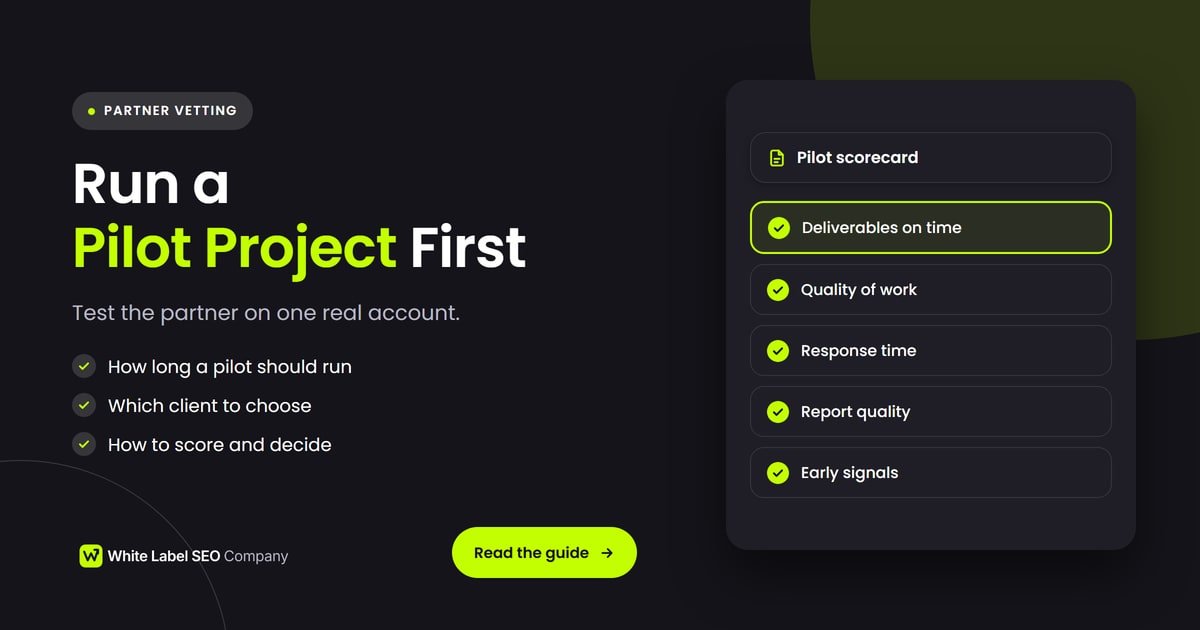
Quick answer: A pilot project is a short, paid trial in which a white label SEO partner works on one real client account before you sign a long agreement. Run it for 60 to 90 days, write the success criteria first, and score delivery, communication and early signals, then decide.
Key takeaways
- A pilot project tests how a white label SEO partner delivers on one real account, so you judge evidence instead of a sales deck.
- Google’s SEO Starter Guide says some changes take effect in a few hours and others take months, so score delivery and early signals, not rankings alone.
- Choose a stable, typical client as your pilot client, not your hardest account.
- Run the pilot project in 5 steps: define success criteria, give limited access, brief the partner, review the work, then decide.
- In Sitechecker’s 2026 survey, 63% of agencies changed their SEO KPIs because of AI Overviews, so build the pilot scorecard around the KPIs you report today.
- Agree the commercial terms of the pilot project in writing before work starts.
What is a white label SEO pilot project?
A white label SEO pilot project is a short, paid trial in which a white label SEO partner delivers real SEO work for one of your clients, under your brand, against success criteria you wrote in advance. It ends with a decision to scale, adjust or stop.
The pilot project differs from a sales call and from a free sample. A sales call shows how a partner sells. A pilot project shows how the partner works: how it handles a brief, a deadline, a question and a problem. It also differs from a full engagement, because it has a fixed length, a small scope and a clear exit.
A good pilot project follows the same shape as the work you plan to resell. If you resell a monthly retainer, which 78.2% of the 439 providers polled by Ahrefs in 2024 charge, the pilot should mirror one or two months of that retainer: the same deliverable types, the same report and the same contact points.
Why run a pilot project before you commit to a white label SEO partner?
You run a pilot project because a wrong partner choice puts your client relationship and your margin at risk, and only real work reveals delivery quality. A pilot project shows what arrives, when it arrives and how clearly it is explained.
The financial case is straightforward. In Sitechecker’s 2026 survey of 73 SEO agencies, 41.1% reported gross margins under 30% and 39.7% reported margins between 30% and 50%. With margins that thin, a partner who misses deadlines or sends reports you must rewrite costs you real money. A pilot project limits that exposure to one account and one short period.
Competition adds pressure. Sitechecker’s survey found that 48% of agencies name competition as their biggest pricing barrier. When clients compare you with other agencies, one weak deliverable can tip the decision. Testing a partner before it touches your larger accounts protects those relationships. Our guide to white label SEO services shows the deliverables a partner should be able to show you before a pilot begins.
How long should a pilot project run?
A pilot project should run for 60 to 90 days. That window is long enough for two monthly report cycles and the first signals in Google Search Console, and short enough to keep your risk small. This is our recommendation, based on how Google describes SEO timing.
Google’s SEO Starter Guide states that some changes might take effect in a few hours, while others could take months, and that you likely want to wait a few weeks to assess whether your work had beneficial effects. That timing explains why a 30-day pilot project is too short to judge outcomes and why a pilot should be judged mainly on delivery quality and leading indicators.
Plan the pilot project in three phases: month one covers onboarding and the first deliverables, month two covers the first full monthly report and a mid-point review, and the final weeks cover the decision meeting.
Which client should you use as your pilot client?
Use a stable, typical account as your pilot client: a client with reasonable expectations, a clean site and a scope close to what you sell most often. The pilot client should give the partner a fair test, not a stress test.
The checklist below lists what a good pilot client looks like.
- Typical scope: choose a pilot client whose needs match the services you plan to resell, such as on-page work, content and a monthly report.
- Good relationship: pick a client who trusts you and will answer questions quickly during the pilot project.
- Clean access: choose a site where you control the CMS and Google Search Console, so the partner is not blocked for weeks.
- No renewal pressure: avoid a client who is mid-renewal or unhappy, because any delay lands on a fragile relationship.
- Measurable goals: pick a client with a defined goal, such as leads from a service page, so early signals have meaning.
Before the pilot project starts, agree with the client who will send access and answer questions, because a slow login can stall the first month. Our onboarding page explains how a partner takes in a new account.
How do you run a pilot project in 5 steps?
You run a pilot project in 5 steps: define success criteria, give limited access, brief the partner, review the work against the scorecard and decide. Each step has an owner and a date, so the pilot ends with a clear answer instead of a vague impression.
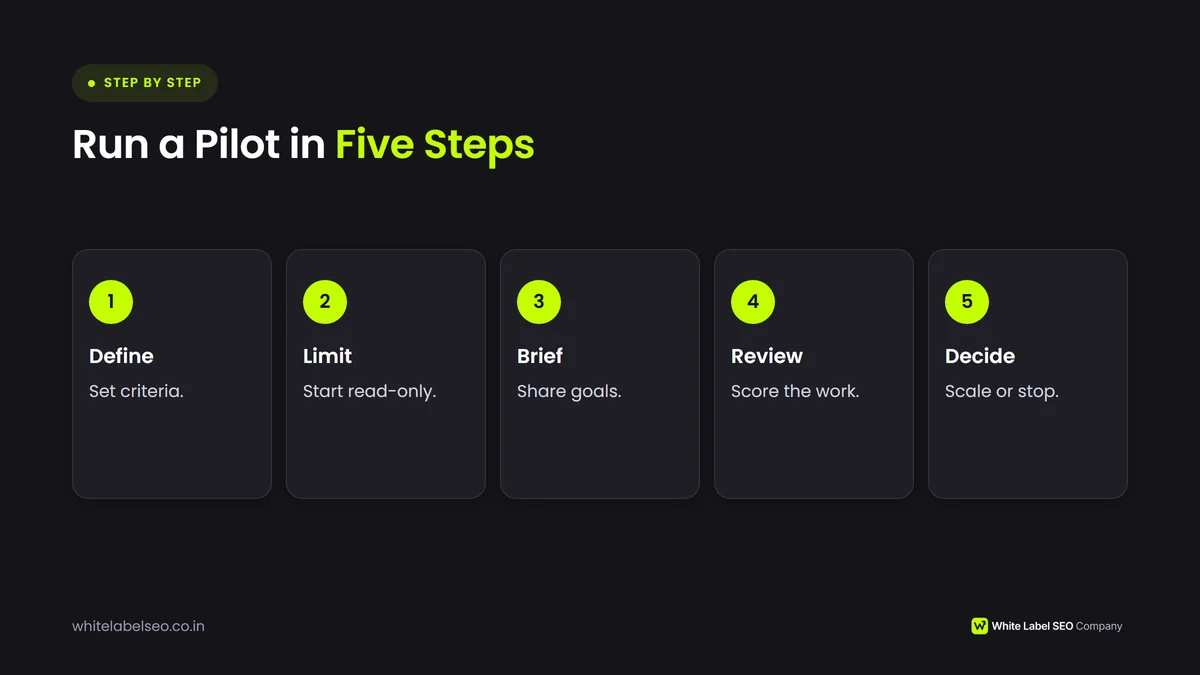
The 5 steps of a white label SEO pilot project are listed below.
- Define the success criteria in writing. List the deliverables, due dates, quality bar and early signals the pilot project must show. Share the list with the partner before work starts.
- Give limited access. Share only what the partner needs, starting with read-only access, and record who holds each login.
- Brief the partner as you would brief any client work. Send the goal, the target pages, the brand rules and your preferred report format.
- Review every deliverable against the scorecard. Score each audit, content draft, on-page change and report within a few days of receiving it.
- Hold a decision meeting. Compare the scores with your success criteria and choose to scale, adjust or stop.
Our post on what a white label SEO partner does each month gives you a reference list for step 1.
What should a pilot scorecard measure?
A pilot scorecard should measure delivery first and results second: deliverables on time, quality of work, response time, report clarity and leading indicators. Rankings alone are a weak test over 60 to 90 days, so the scorecard should reflect the KPIs your agency already reports.
Sitechecker’s 2026 survey shows what agencies track now. The table below lists the KPIs agencies reported and how each one fits a pilot scorecard.
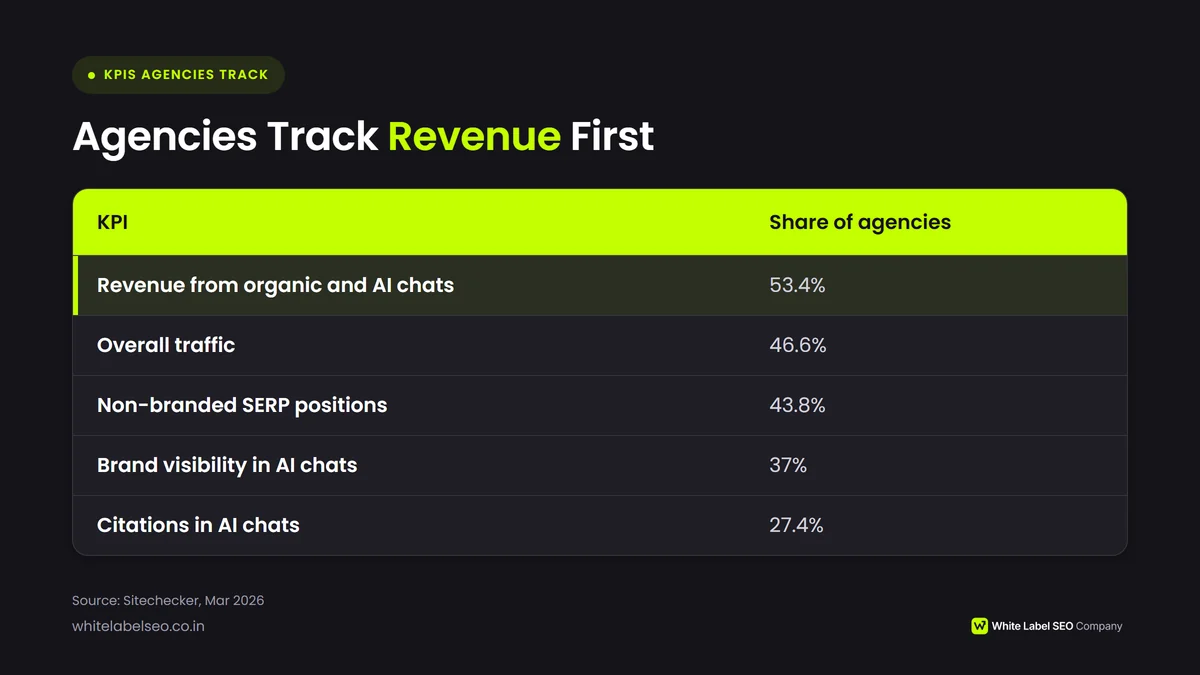
| KPI agencies report | Share of agencies | Use in the pilot scorecard |
|---|---|---|
| Revenue from organic search and AI chats | 53.4% | Track only if the pilot client shares lead or sales data |
| Overall traffic | 46.6% | Compare the pilot months with the 3 months before |
| Non-branded SERP positions | 43.8% | Report as a trend for the target pages |
| Brand visibility in AI chats | 37% | Check a fixed set of questions at the start and the end |
| Non-branded organic traffic | 31.5% | Read in Google Search Console as clicks and impressions |
| Website citations in AI chats | 27.4% | Note citations of the target pages, if any |
The table shows that agencies now mix traffic, positions and AI visibility, and that 63% of the surveyed agencies changed their KPIs because of AI Overviews. Source: Sitechecker, “The 2026 SEO agency growth report”, March 11, 2026.
Add the delivery lines below to the outcome lines above. The scorecard lines are listed below.
- Deliverables on time: the share of agreed deliverables that arrived on the agreed date.
- Quality of work: your team’s score for each audit, content draft and on-page change.
- Response time: the number of business days the partner took to answer a question or change request.
- Monthly report quality: whether you could send the report to the client with light edits.
- Leading indicators: indexed pages, impressions and clicks for the target pages.
Use our guide to SEO metrics to report to clients to choose which indicators fit your pilot client.
What access should the partner get during a pilot project?
During a pilot project, the partner should get the lowest level of access that lets it do the agreed work, starting with read-only access to Google Search Console. You can raise the access level later, once the partner has shown how it handles your data.
Google Search Console Help describes four permission types. Owners have full control and can add or remove users. Full users can view all data and take actions such as submitting sitemaps. Restricted users have view rights on most data, and associates can take certain actions without opening the account. For an audit, Google Search Central’s advice is to grant read-only access and withhold write access at that stage.
The access rules for a pilot project are listed below.
- Start with a restricted user in Google Search Console for the audit stage of the pilot project.
- Move to a full user only when the agreed deliverables need actions such as sitemap submission.
- Keep ownership with your agency for every property, so ending the pilot never costs you access.
- Ask for a change note for every edit the partner makes to the site, as Google Search Central advises when an SEO has server access.
How do you decide after a pilot project?
You decide after a pilot project by comparing the scorecard with the success criteria you wrote before it began. Scale the partnership if deliverables, communication and reports met the bar, adjust the scope if one area fell short, and stop if 2 or more areas failed.
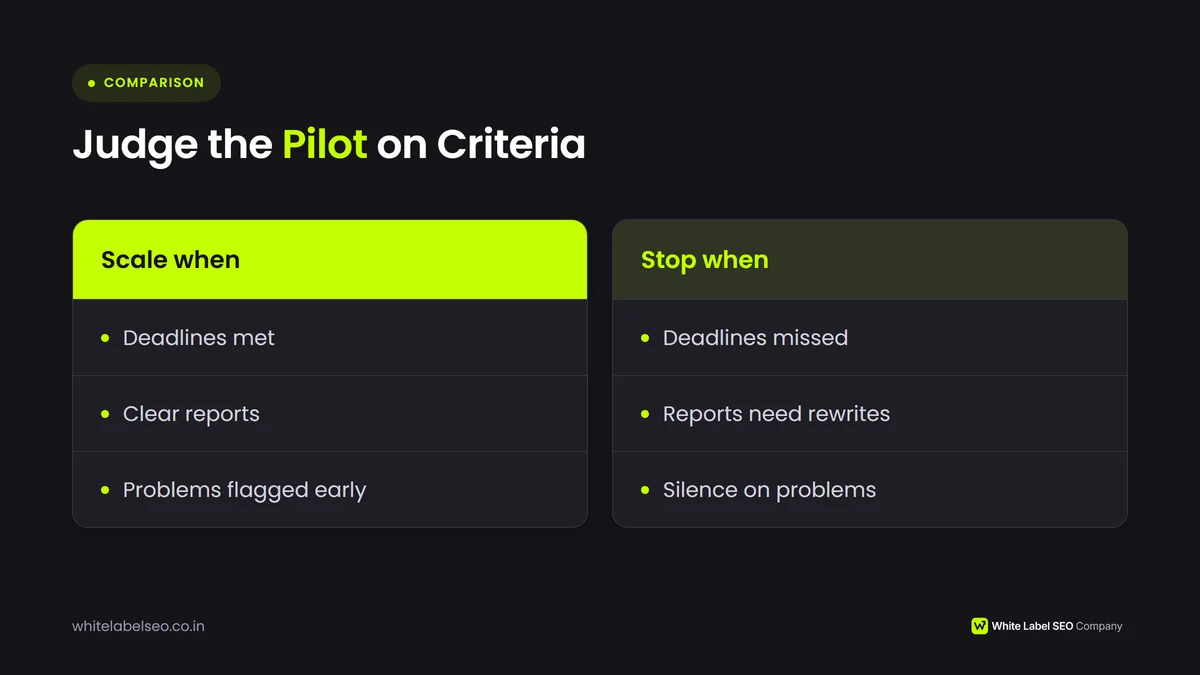
Read the problems as closely as the wins. Every campaign hits a snag, such as a late client login or a Google update, so note how the partner reacts: whether it flags the issue early, explains the cause in plain language and proposes a fix. A partner who goes quiet during a 60-day pilot project is unlikely to speak up on your biggest account.
If you scale, turn the pilot into a rollout plan. List which clients move next, which services you add, who owns each client conversation and which pilot lessons go into your internal checklist.
What should the terms of a pilot project cover?
The terms of a pilot project should cover its length, its scope, its price and its exit. Put a fixed period of 60 to 90 days in writing, with no lock-in beyond it, and ask the partner to state its wholesale price for the pilot and for the volume you plan to reach.
We suggest a paid pilot project rather than a free trial. Paid work gets the partner’s regular team and the same process as any client. Set your client price first, then confirm that the partner’s wholesale price leaves you a healthy margin at scale. The wider list of contract questions belongs in our guide to questions to ask a white label SEO partner before signing, and the generic test of a partner sits in our post on how to test a white label SEO partner.
Check that no one promises a ranking inside the pilot project. Google Search Central states that no one can guarantee a first-place ranking, and it lists a promised top position among the warning signs when you hire an SEO. A partner who commits to deliverables and dates is making a promise it can keep.
Frequently asked questions
How long should a white label SEO pilot last?
Plan for 60 to 90 days. That window covers two monthly report cycles and the first signals in Google Search Console. Google’s SEO Starter Guide says changes can take a few hours to months, so weigh delivery quality alongside early results.
Should I tell my client they are part of a pilot?
You do not need to describe the arrangement as a pilot. Tell the client who owns the relationship, what will be delivered and when, as you would on any project. Keep your scorecard internal, and review it with the partner, not with the client.
Is a free trial better than a paid pilot project?
No, a paid pilot project is the better test. Unpaid work rarely gets a partner’s regular team and process, so a free trial shows you a best-case sample. A paid pilot project shows you the delivery you would receive at scale.
What if the pilot project shows mixed results?
Adjust the scope instead of ending it immediately. If delivery was strong but reports were weak, extend the pilot for 30 days with a fixed report format. If 2 or more scorecard lines failed, stop and test another partner under the same criteria.
Can I run a pilot project with two partners at once?
Yes, if you use similar clients and identical success criteria. Give each partner the same brief and score both on the same scorecard. Never split one client’s site between two partners, because overlapping changes make the results impossible to read.
What should you do next about your pilot project?
Write your success criteria and scorecard this week, pick one stable account as the pilot client and book the decision meeting before the pilot starts. A pilot project with written criteria turns a risky vendor choice into a short, low-cost test.
If you want to test a delivery partner under your own brand, see how our white label SEO services work at White Label SEO, and bring your scorecard to the first call.
Want to test us with one account?
Book a free strategy call and we will talk through a pilot project that fits one of your clients.
Sources
- Sitechecker, “The 2026 SEO agency growth report”, March 11, 2026. https://sitechecker.pro/seo-agency-growth-data-study-2026/
- Google Search Central, “SEO Starter Guide”, accessed November 28, 2026. https://developers.google.com/search/docs/fundamentals/seo-starter-guide
- Google Search Central, “Do you need an SEO?”, accessed November 28, 2026. https://developers.google.com/search/docs/fundamentals/do-i-need-seo
- Google Search Console Help, “Add, remove, and change owners and users”, accessed November 28, 2026. https://support.google.com/webmasters/answer/7687615
- Ahrefs, “SEO Pricing: How Much Does SEO Cost? 439 People Polled”, updated August 15, 2024. https://ahrefs.com/blog/seo-pricing/
