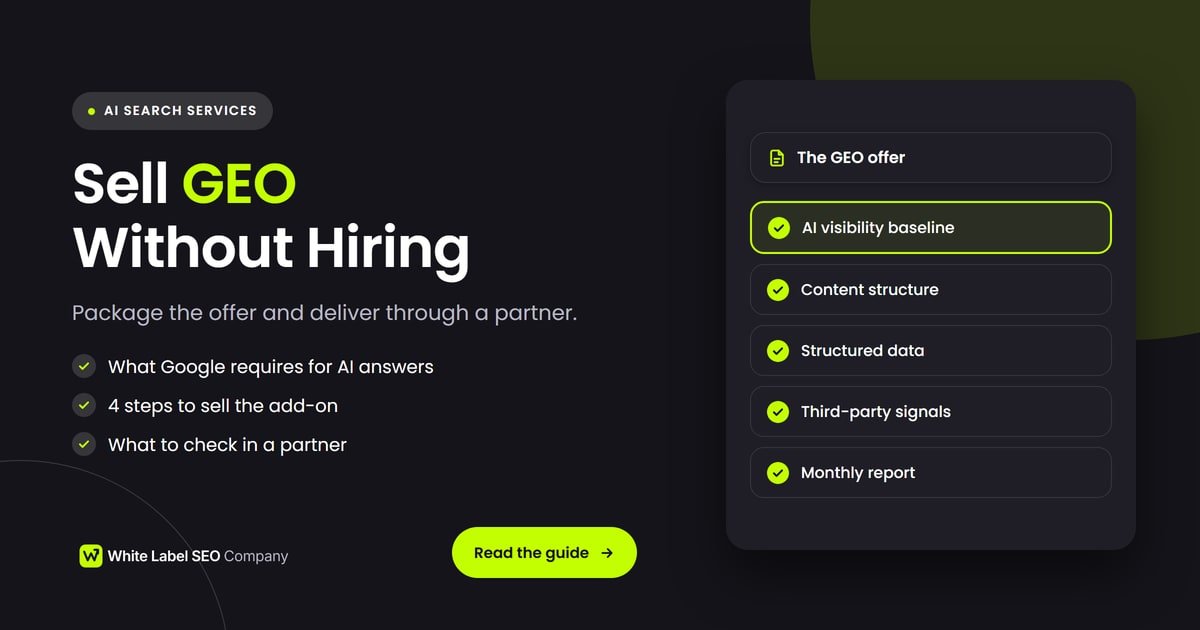
Quick answer: Sell generative engine optimization by packaging it as a fixed add-on to your SEO retainers and delivering it through a white label SEO partner. Google says AI features need no special markup or files, so the work builds on SEO your team already sells: a baseline audit, content structure, structured data and a monthly report.
Key takeaways
- Generative engine optimization (GEO) is the work of getting a brand cited in AI answers, and it rests on the same pages, links and structured data as SEO.
- Ahrefs reported in February 2026 that position-one click-through rate on AI Overview keywords fell from 0.073 to 0.016 between December 2023 and December 2025, so clients are asking about AI search for a reason.
- Google Search Central says there are no additional requirements to appear in AI Overviews or AI Mode, so you do not need a new kind of specialist to start.
- Sell it in 4 steps: audit the AI answers a client cares about, package a fixed offer, brief a partner, report every month.
- An offer needs 5 parts: an AI visibility baseline, content structure, structured data, third-party signals and a monthly report.
- Choose a white label SEO partner by asking for a sample report, a delivery date and a list of what is included.
What is generative engine optimization?
Generative engine optimization is the practice of improving how often and how accurately a brand appears in AI-generated answers, such as Google AI Overviews, Google AI Mode and ChatGPT. Generative engine optimization, shortened to GEO, covers the pages, entities and signals an AI answer draws on.
GEO overlaps with SEO more than it differs. An AI answer is built from pages the engine can find, read and trust, which is the same job SEO has always done. The new part is measurement: instead of a ranking position, you check whether the brand is mentioned and cited when a buyer asks a question. Other names for the same work are AI search optimization and AI visibility work.
For an agency, GEO is a service line that sits next to SEO. Our white label AI SEO service covers the delivery side, so your team can sell the outcome without building the machinery.
Why are clients asking about generative engine optimization?
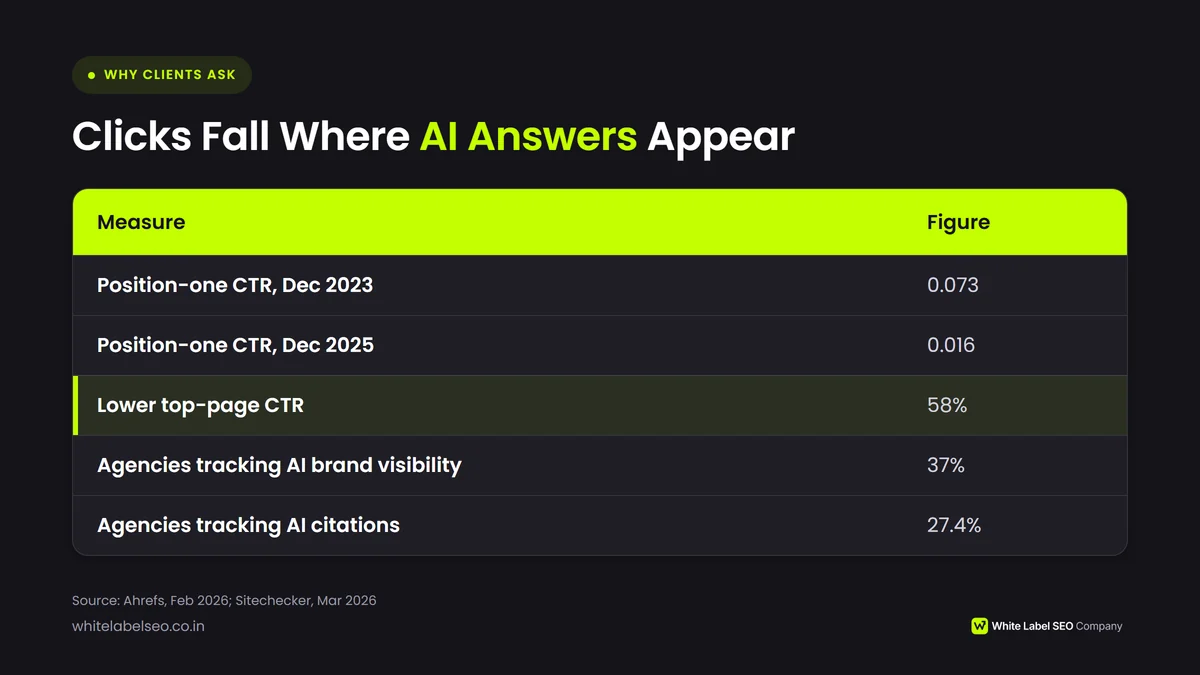
Clients ask about generative engine optimization because AI answers are changing how many clicks reach their sites. Ahrefs reported in February 2026 that the presence of an AI Overview correlates with a 58% lower average click-through rate for the top-ranking page, based on 300,000 keywords.
| Measure | Figure | Source |
|---|---|---|
| Position-one click-through rate on AI Overview keywords, December 2023 | 0.073 | Ahrefs, 2026 |
| Position-one click-through rate on AI Overview keywords, December 2025 | 0.016 | Ahrefs, 2026 |
| Lower average click-through rate for the top page with an AI Overview | 58% | Ahrefs, 2026 |
| Agencies tracking brand visibility in AI chats | 37% | Sitechecker, 2026 |
| Agencies tracking website citations in AI chats | 27.4% | Sitechecker, 2026 |
The table shows a fall in clicks and an early move by agencies to measure AI visibility. Ahrefs describes its 58% figure as a correlation, not proof that AI Overviews caused the drop, and its method compares actual results with a forecast. Sitechecker’s figures come from a 2026 survey of 73 agencies. Sources: Ahrefs, “Update: AI Overviews Reduce Clicks by 58%”, February 4, 2026; Sitechecker, “The 2026 SEO agency growth report”, March 11, 2026.
Our post on why AI search visibility is becoming a core white label SEO deliverable covers the client-side argument in more depth.
What does generative engine optimization require from your team?
Generative engine optimization requires the same foundations as SEO and no new file types. Google Search Central’s guide to AI features says there are no additional requirements to appear in AI Overviews or AI Mode, and that you do not need new machine-readable files, AI text files or markup.
The same page says there is no special schema.org structured data to add, and that indexing and serving are not guaranteed. Google’s structured data guidelines add that structured data must be a true representation of the page content, so markup has to match what a reader sees.
This changes the hiring question. A team that already handles technical SEO, content and Google Search Console can learn the GEO measurement layer. What it lacks is usually time and a tracking process, not a new discipline. That gap is what a white label SEO partner covers.
How do you sell generative engine optimization without hiring experts?
You sell generative engine optimization without hiring experts in 4 steps: audit the AI answers a client cares about, package a fixed offer, brief a white label SEO partner and report every month. The partner delivers the work, and you keep the client relationship.
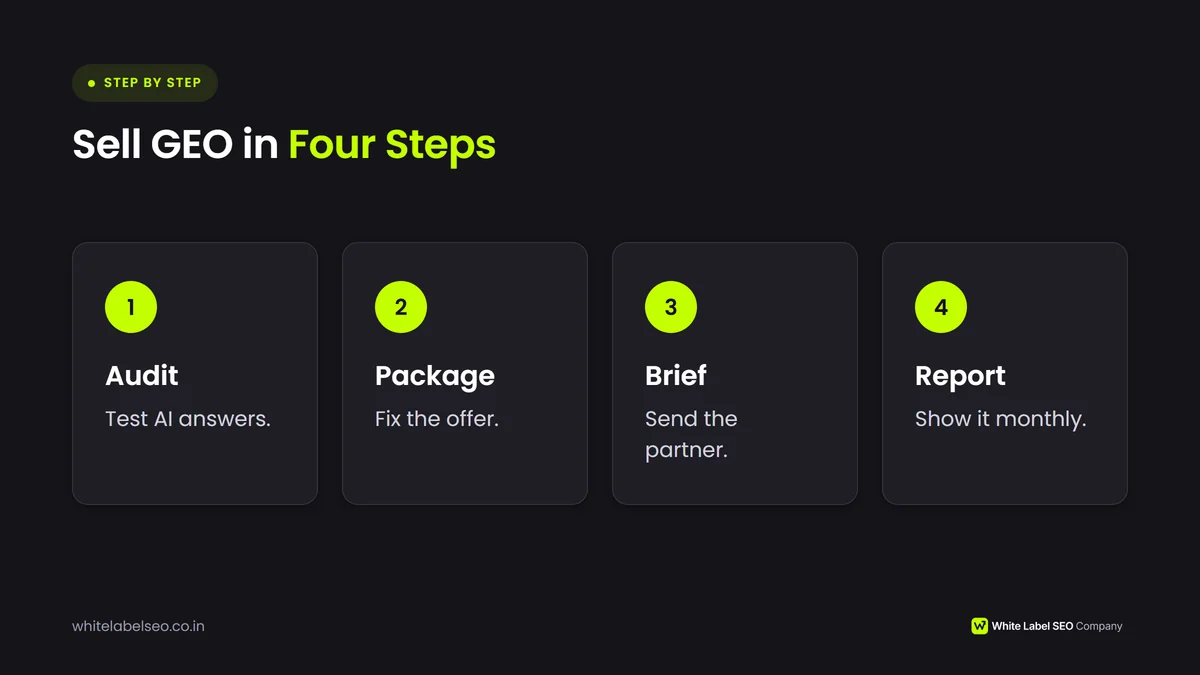
The 4 steps for selling generative engine optimization are listed below.
- Audit the AI answers. Pick 10 questions a client’s buyers ask, run them in ChatGPT and Google AI Mode, and record whether the client is mentioned or cited. Show the client the result.
- Package a fixed offer. Sell GEO as an add-on to an existing SEO retainer, with a defined list of monthly deliverables and a named report date.
- Brief the partner. Send the client’s questions, competitors and goals to your white label SEO partner, and agree the delivery dates in writing.
- Report every month. Show the baseline next to the current answers, plus the work done, in your branded monthly report.
Start with clients who already trust you, because the audit in step 1 is the easiest sale you will make. A client who sees a competitor named in an AI answer, and their own brand missing, understands the offer without a pitch. Our guide to white label AI search optimization explains how the delivery side works.
What should a generative engine optimization offer include?
A generative engine optimization offer should include 5 parts: an AI visibility baseline, content structure, structured data, third-party signals and a monthly report. Each part maps to work an SEO team already recognizes, which keeps the offer easy to explain and to deliver.
The 5 parts of a generative engine optimization offer are listed below.
- AI visibility baseline: the 10 buyer questions, the answers across 2 or more AI tools and whether the brand is named or cited.
- Content structure: pages that answer one question each in the first sentence, with clear headings, so an AI answer can quote them cleanly.
- Structured data: markup that matches the visible text on each page, as Google’s guidelines require.
- Third-party signals: consistent business details and mentions on sources that AI answers cite for the client’s topic.
- Monthly report: the baseline against the current answers, the citations gained or lost and the next month’s plan.
Leave out any promise of a mention, because an AI engine decides what it cites. Promise the 5 parts and the report date. Our post on how to price white label SEO services for healthy agency margins helps you set a price that covers the partner cost and your own time.
How do you report generative engine optimization?
You report generative engine optimization by showing which AI answers mention the client, which pages are cited and how both changed since the baseline. Pair that with Google Search Console data, such as impressions and clicks, so the client sees AI visibility next to organic performance.
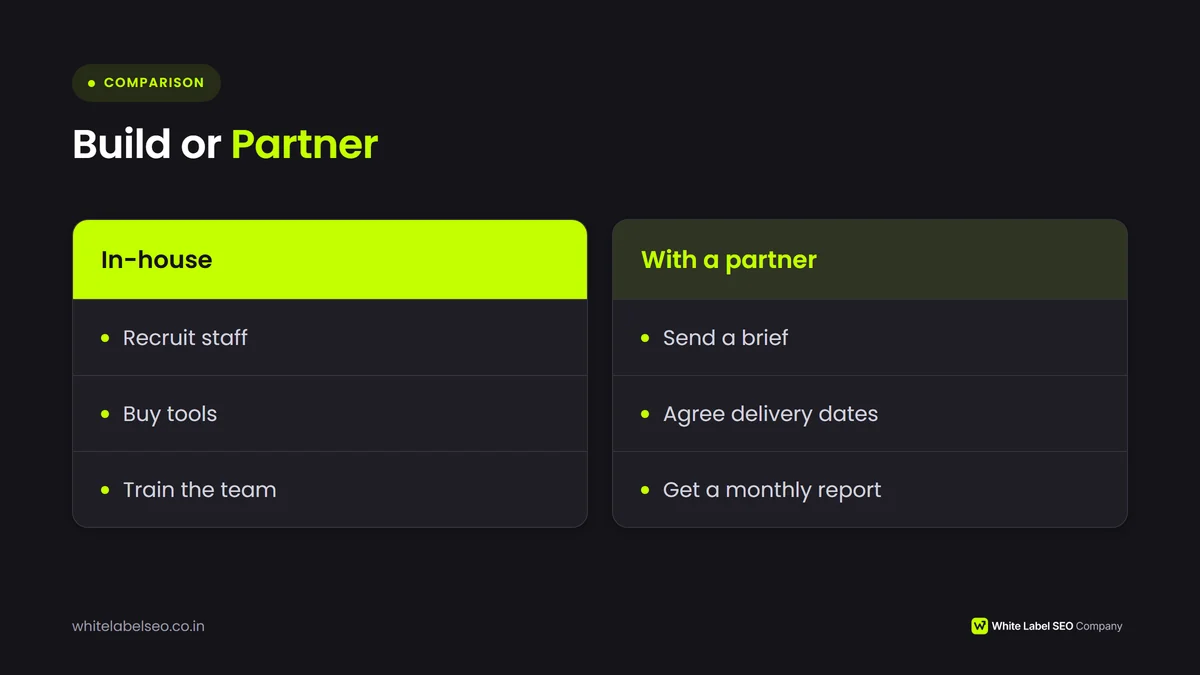
Reporting is where a partner saves the most time. The comparison above shows the difference in what your agency carries: an in-house build means recruiting, tool purchases and training before the first client report, while a partner route means a brief and a delivery date. Sitechecker’s 2026 survey found that 27.4% of agencies track website citations in AI chats and 37% track brand visibility in AI chats, so the metrics are still settling and a plain, repeated format works best.
Report the same 3 things each month: the questions tested, the brand’s mentions and citations, and the actions taken. Our guide to what white label SEO partners must report differently for AI Overviews covers the reporting changes in detail.
What should you check in a white label SEO partner before you sell generative engine optimization?
Before you sell generative engine optimization, check that your white label SEO partner gives you a sample report, a fixed delivery date and a written list of what the monthly work includes. Without those 3 items you cannot repeat the offer to a client with confidence.
Ask 4 more questions: how the partner tests AI answers, which AI tools it covers, how it handles structured data that must match the page, and whether reports carry your branding. Our list of questions to ask a white label SEO partner before signing covers the full set.
Frequently asked questions
Is generative engine optimization different from SEO?
Generative engine optimization builds on SEO and adds a measurement layer for AI answers. Google Search Central says there are no additional requirements to appear in AI Overviews or AI Mode, so pages that are crawlable, indexed and useful remain the base. The new work is testing AI answers and tracking mentions and citations.
Do you need to hire a specialist to sell GEO?
No, you do not need a full-time specialist to start. Package a fixed offer, run the baseline audit yourself and brief a white label SEO partner for delivery. Hire later if volume justifies it, once the offer has paying clients and a repeatable monthly report.
How do you measure GEO results?
Test a fixed set of 10 buyer questions each month in 2 or more AI tools, and record whether the brand is mentioned or cited. Add impressions and clicks from Google Search Console. Treat AI answers as variable, so report trends over repeated tests rather than one screenshot.
Can you promise a client that they will appear in AI answers?
No, you cannot promise a mention, because the AI engine decides what to cite and Google says indexing and serving are not guaranteed. Promise the work: the audit, the content and structured data changes, and a monthly report on a fixed date.
Should GEO be a separate retainer or an add-on?
Start with an add-on to an existing SEO retainer, because the same pages and tracking serve both services. A separate retainer fits clients who already have strong SEO and want a dedicated AI visibility plan. Either way, write the deliverables and the report date into the scope.
What should you do next about generative engine optimization?
Run the baseline audit for 3 existing clients this week: 10 buyer questions each, in ChatGPT and Google AI Mode. Use the results to open the conversation, then package the 5-part offer and brief a delivery partner.
If you want a partner that delivers the work behind your brand, see how our white label SEO services work at White Label SEO.
Ready to add AI search to your offer?
Book a free strategy call and we will walk through the deliverables, the report and the delivery dates we can supply behind your brand.
Sources
- Ahrefs, “Update: AI Overviews Reduce Clicks by 58%”, February 4, 2026. https://ahrefs.com/blog/ai-overviews-reduce-clicks-update/
- Sitechecker, “The 2026 SEO agency growth report”, March 11, 2026. https://sitechecker.pro/seo-agency-growth-data-study-2026/
- Google Search Central, “AI features and your website”, accessed November 28, 2026. https://developers.google.com/search/docs/appearance/ai-features
- Google Search Central, “General structured data guidelines”, accessed November 28, 2026. https://developers.google.com/search/docs/appearance/structured-data/sd-policies
