Quick answer: A white label SEO partner helps you control scope creep by working from a fixed list of deliverables and a wholesale price for each one. That list gives you a clear boundary, a price for every extra and visible margin. Write it into each client’s scope and report against it every month.
Key takeaways
- Scope creep in an SEO retainer is unbilled work that grows past the agreed deliverables, and it drains gross margin quietly.
- In Ignition’s 2025 survey of 273 agency leaders, 57% lose $1,000 to $5,000 a month to unbilled work and 30% lose more than $5,000.
- SEO retainers invite scope creep because the work has no natural end and “ongoing support” means something different to every client.
- A white label SEO partner with fixed monthly deliverables gives you a boundary you can point to and a wholesale price you can quote.
- Write the scope in 5 steps, turn repeat requests into paid add-ons and keep a small goodwill allowance for key accounts.
- Report against the scope every month so the client sees what the retainer already covers.
What is scope creep in an SEO retainer?
Scope creep in an SEO retainer is unbilled work that grows beyond the deliverables the client agreed to pay for. It starts as a quick favor, an extra page or a longer call, and it adds up until the retainer costs more to run than it earns.
Scope creep differs from a change the client pays for. A paid change has a quote, a date and an owner. Scope creep has none of those, so nobody tracks it. The cost sits in your team’s hours or in your partner’s invoices, while the client’s fee stays the same.
A retainer with a fixed list of deliverables, such as the work in our white label SEO services, gives scope creep a visible edge. A request either sits on the list or it does not.
How much does scope creep cost an agency?
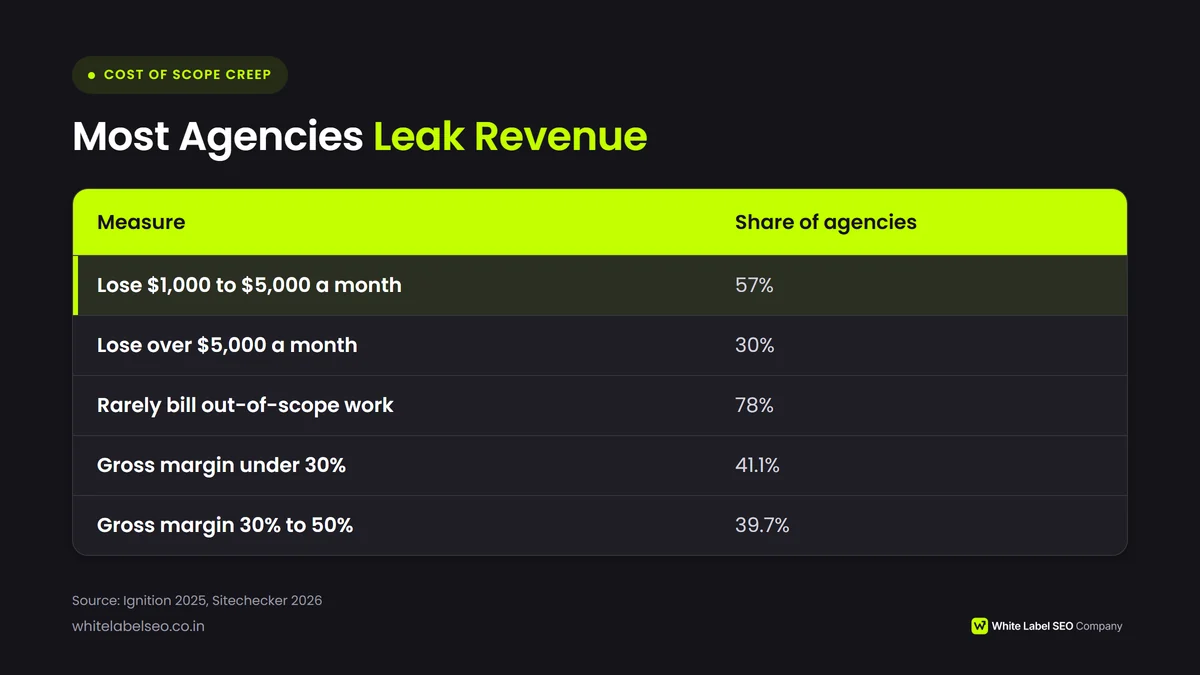
Scope creep costs most agencies between $1,000 and $5,000 a month in unbilled work, according to Ignition’s 2025 Agency Pricing and Cash Flow Report. The report surveyed 273 managers and executives of agencies and found that 57% fall in that range and another 30% lose more than $5,000 a month.
The same report found that 78% of agencies rarely or only sometimes charge for out-of-scope work. Margins leave little room for that habit. In Sitechecker’s 2026 survey of 73 SEO agencies, 41.1% reported gross margins under 30% and 39.7% reported margins between 30% and 50%. The table below puts the cost and margin figures side by side.
| Measure | Share of agencies | Source |
|---|---|---|
| Lose $1,000 to $5,000 a month to unbilled work | 57% | Ignition, 2025 |
| Lose more than $5,000 a month to scope creep | 30% | Ignition, 2025 |
| Rarely or only sometimes charge for out-of-scope work | 78% | Ignition, 2025 |
| Gross margin under 30% | 41.1% | Sitechecker, 2026 |
| Gross margin between 30% and 50% | 39.7% | Sitechecker, 2026 |
The table shows that most agencies leak revenue to unbilled work while running on margins that cannot absorb it. Ignition surveyed 273 agency leaders and Sitechecker surveyed 73 SEO agencies, so read the figures as survey results, not market-wide measurements. Our post on protecting agency margins as SEO tools and salaries keep rising covers the cost side of the same problem.
Why do SEO retainers invite scope creep?
SEO retainers invite scope creep because the work has no natural finish line and the scope is often written in vague terms. A client can always see one more page to improve, one more report to request or one more competitor to review.
Vague wording makes it worse. “Ongoing SEO support” means a different list of tasks to each client, so your account manager has no clear point at which to say that a request sits outside the agreement. Google Search Central’s advice for people who hire an SEO points the same way: it tells buyers to ask what results to expect and in what timeframe, which is only possible when the scope is specific.
Competition adds pressure to say yes. In Sitechecker’s 2026 survey, 48% of agencies named competition as their biggest pricing barrier, and 15.1% tried to raise prices without getting client buy-in. When a client might leave over price, a free extra feels like a cheap way to keep them.
How does a white label SEO partner help you control scope creep?
A white label SEO partner helps you control scope creep by delivering a fixed list of monthly deliverables at a known wholesale price. You resell exactly what you buy, so the boundary of the client’s scope matches the boundary of the partner’s work.
Three things change when you work with a partner. First, the deliverables are countable: audits, pages optimized, content pieces and links built each have a number and a type. Second, extras carry a visible cost, because a partner invoice for one more content piece shows the margin impact right away, while in-house hours blur together. Third, you gain a ready quote for common requests, since the partner can price them as separate line items.
A fixed scope is not a limit on service. It is the reference point that lets you say yes with a price. Our guide to what a white label SEO partner does each month lists the deliverables that belong on that reference list.
How do you write a fixed scope that stops scope creep in 5 steps?
You write a fixed scope in 5 steps: list the monthly deliverables by number and type, name what is excluded, set the report and meeting schedule, define the change request process and walk the client through it at onboarding. The result is a one-page scope the client can read in minutes.
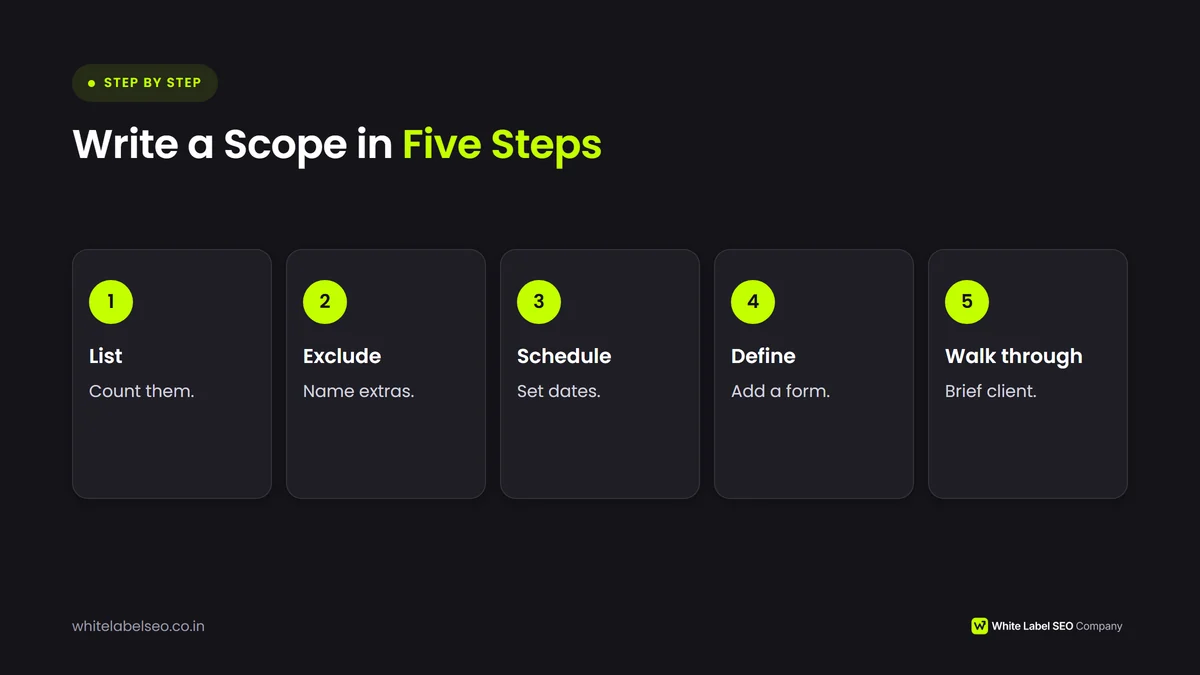
The 5 steps for writing a fixed scope are listed below.
- List the monthly deliverables by number and type. Write “2 optimized pages” instead of “on-page support”, and match each line to your partner’s monthly deliverables.
- Name what the scope excludes. State the out-of-scope work you see most often, such as extra content, new locations and one-off audits.
- Set the monthly report and meeting schedule. Give the report date, the number of calls and the response time for questions.
- Define the change request process. Use one form or email template, so every extra gets a quote and a delivery date before work begins.
- Walk the client through the scope at onboarding. Spend 15 minutes on included work, excluded work and how extras are priced.
The same list makes packaging easier. Our post on how to package white label SEO into tiered retainers clients understand shows how to turn deliverable lists into tiers.
Which extra requests should become paid add-ons instead of scope creep?
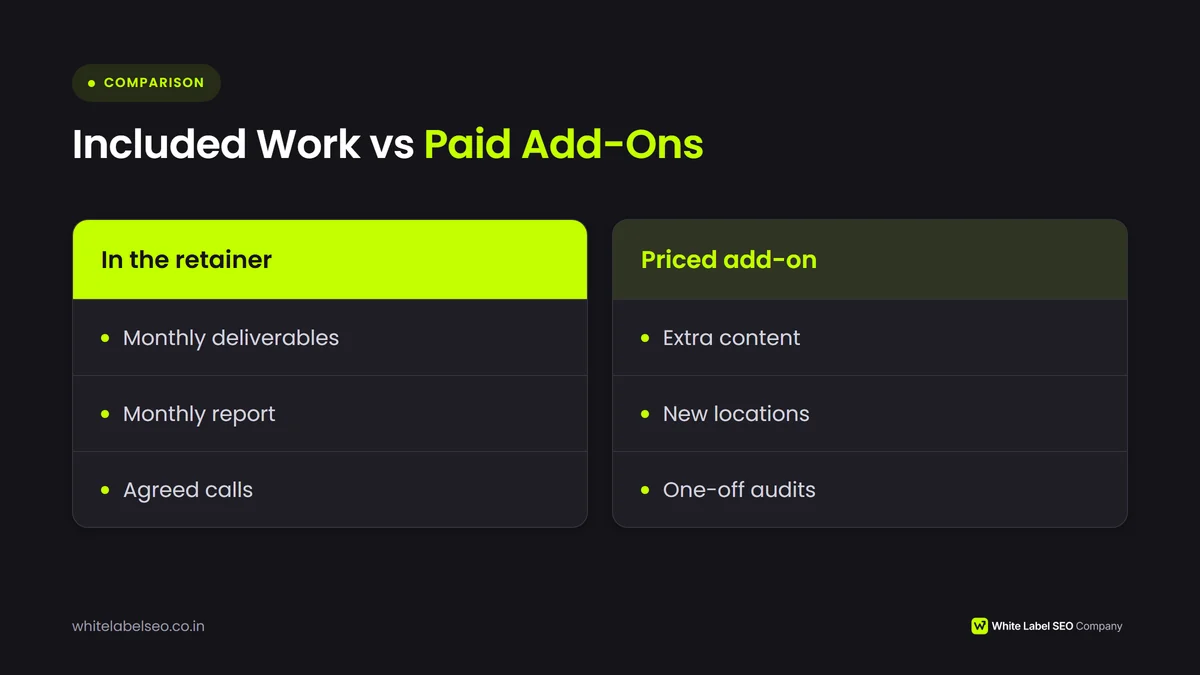
Any extra request that arrives from 2 or more clients should become a paid add-on. A repeated request shows real demand, and a priced add-on turns an unbilled interruption into revenue that your partner can fulfill as a separate line item.
The add-ons that agencies commonly package are listed below.
- Extra content pieces: landing pages or posts beyond the monthly allocation in the SEO retainer.
- Extra link placements: additional links for a competitive campaign, quoted per placement.
- Google Business Profile setup: profile creation and optimization for each new location a client opens.
- One-off technical audits: a fixed-price audit before a site redesign or migration.
- AI search reviews: a one-time review of how the client’s pages appear in AI Overviews and other AI answers.
Price each add-on from the partner’s wholesale price plus your target margin and your account management time. Keep the price list to one page, so an account manager can send a quote on the same day.
How do you hold the line on scope creep without hurting the client relationship?
You hold the line by saying yes to the goal and attaching a price to the extra, instead of refusing the request. A short written quote shows the client what is included, what the extra costs and when it will arrive, so the conversation stays about value.
Holding the scope does not mean refusing every favor. Give each key account a small monthly goodwill allowance, such as one hour, and log each use in the monthly report so the client sees it. Anything beyond the goodwill allowance goes through the change request process.
Update existing contracts at renewal with specific deliverables and a change request process. Present the change as clarity for the client, and be ready for questions, because 15.1% of the agencies in Sitechecker’s 2026 survey tried to raise prices without getting buy-in.
How should reports show what the client received?
Reports should list every deliverable, its status and the result it supports, and they should separate included work from paid add-ons. A client who sees the full list of work each month is less likely to ask for something already covered.
Structure each monthly report around the agreed scope. Open with a “delivered this month” table, then show the leading indicators from Google Search Console, such as clicks and impressions for the target pages. List any goodwill extras and any add-ons you billed. Our white label SEO reports page shows a client-ready format that follows this structure.
What should your partner agreement say about change requests?
Your white label SEO partner agreement should say how change requests are priced and how fast they are quoted, so your client scope never promises faster or broader work than your partner commits to. If your client terms are broader than the partner terms, you carry the gap.
Ask the partner for four items in writing: the monthly deliverable list, a price list for common add-ons, a turnaround time for quotes and a turnaround time for delivery. Then copy those items into your client scope. Ahrefs’ 2024 poll of 439 SEO providers found that 78.2% charge a monthly retainer, so a clear monthly scope is the standard format to match. The partner terms to ask for sit in our guide to what SLAs and guarantees to expect from a white label SEO partner.
Frequently asked questions
How do I tell a client that a request is out of scope?
Point to the agreed deliverables, confirm you can do the work and offer a price and a delivery date. Keep the tone helpful, not defensive. Most clients respond well when the request is presented as an option with a clear cost.
Will my white label partner do small extras for free?
Expect fixed pricing for defined deliverables and separate quotes for extras. That structure protects both sides and keeps delivery predictable. Ask your partner for an add-on price list that you can resell and quote quickly.
Should I rewrite existing contracts to stop scope creep?
Update them at renewal with specific deliverables and a change request process. Explain the change as added clarity for the client. Do not apply it mid-term without agreement from the client.
How do I price SEO add-ons for clients?
Start with your partner’s wholesale price, add your target margin and include your account management time for briefing and reporting. Keep add-on prices simple, so your account managers can quote them without a meeting.
How do I know which accounts suffer most from scope creep?
Compare each retainer’s fee with its true cost for one quarter, including partner invoices and your team’s hours. Accounts with a gross margin under 30%, the band that 41.1% of agencies in Sitechecker’s 2026 survey reported, are the first to review.
What should you do next about scope creep?
Review three retainers this week: list what each client receives, what they asked for beyond it and what that extra cost you. Then write a fixed scope for each one and price the two most common extras as add-ons.
If you want a delivery partner whose deliverable lists and add-on prices you can resell under your own brand, see how our white label SEO services work at White Label SEO.
Want a scope you can defend?
Book a free strategy call and we will walk through the monthly deliverables and add-ons we can fulfill behind your brand.
Sources
- Ignition, “2025 Agency Pricing and Cash Flow Report”, May 22, 2025. https://www.ignitionapp.com/news/2025-agency-pricing-cashflow-report
- Sitechecker, “The 2026 SEO agency growth report”, March 11, 2026. https://sitechecker.pro/seo-agency-growth-data-study-2026/
- Ahrefs, “SEO Pricing: How Much Does SEO Cost? 439 People Polled”, updated August 15, 2024. https://ahrefs.com/blog/seo-pricing/
- Google Search Central, “Do you need an SEO?”, accessed November 28, 2026. https://developers.google.com/search/docs/fundamentals/do-i-need-seo
