Quick answer: An agency can bundle 8 website fixes with white label SEO: title tags and headings, page speed, mobile content, redirects, internal links, structured data, images and sitemaps. Each fix changes the client’s existing site, follows a Google documentation rule and ends with a change log. Offer them through a white label SEO partner without hiring developers.
Key takeaways
- Bundling website fixes with white label SEO means the partner changes the client’s live site, instead of handing over a list of recommendations.
- The 8 fixes are title tags and headings, page speed, mobile content, redirects, internal links, structured data, images and sitemaps.
- Page speed has hard targets: LCP of 2.5 seconds or less, INP of 200 milliseconds or less and CLS of 0.1 or less.
- Each fix rests on a published Google rule, so a client can check the work against documentation.
- A partner should hand back a change log, before and after proof and a rollback note for every fix.
- Recurring fixes fit a monthly retainer, while redirect maps and speed rebuilds fit a one-off project.
What does it mean to bundle website fixes with white label SEO?
Bundling website fixes with white label SEO means adding hands-on changes to a client’s existing website to the SEO package you sell, with a white label SEO partner doing the work under your brand. The client gets pages that are corrected, not a report that lists problems.
The difference matters because agencies often find the issues and then wait on the client’s developer. One white-label provider, ZealousWeb, describes this as the gap between audit findings and implemented fixes. An agency that bundles the fixes closes that gap inside one package. Our white label SEO services work this way: the partner makes the change in the CMS or code, and your agency presents the result.
A website fix is a technical SEO change to an existing page or template that helps search engines crawl, understand or load it. A new site build or a migration is a different project and sits outside this list.
Which 8 website fixes can an agency bundle with white label SEO?
An agency can bundle 8 website fixes with white label SEO: title tags and headings, page speed, mobile content, redirects, internal links, structured data, images and sitemaps. These 8 are the fixes that a partner can make on an existing site without redesigning it, and each one is backed by Google documentation.
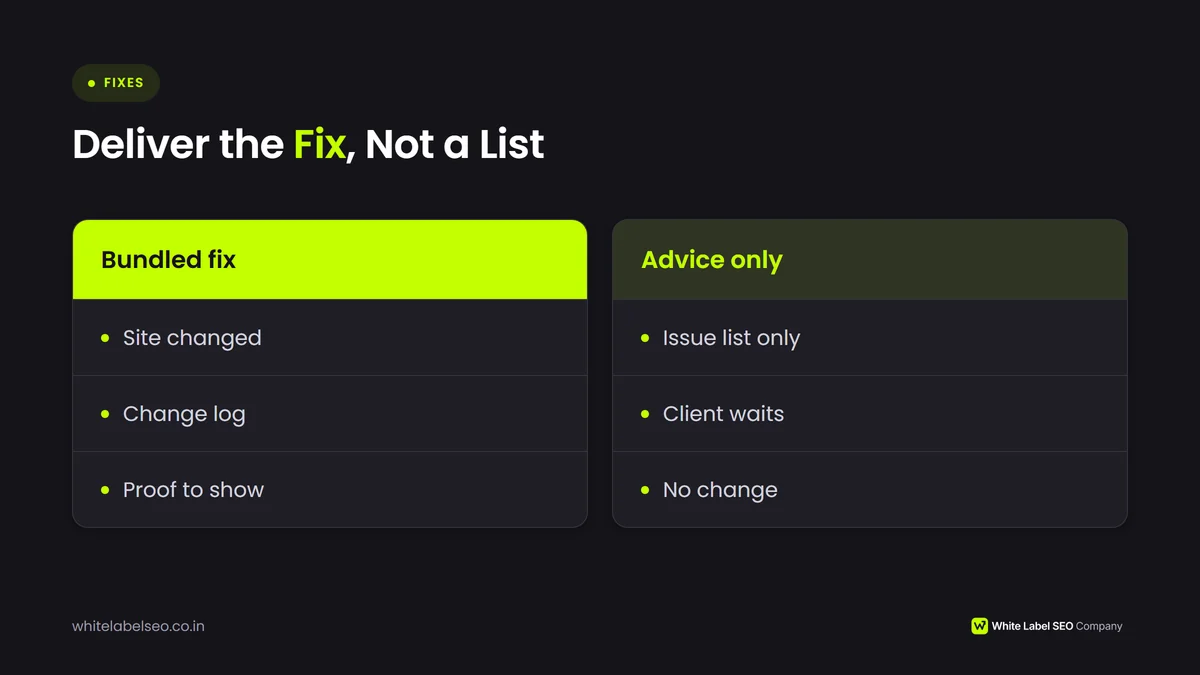
The 8 website fixes to bundle with white label SEO are listed below in the order a partner usually works through them.
1. Rewrite title tags and H1 headings
Rewriting title tags and H1 headings is the fix a partner can finish first, because Google asks for a title on every page and wants each one descriptive and distinct. Google’s title link guidance says there is no limit on how long a title element can be, and that titles are cut to fit the device width.
The partner replaces duplicate or vague titles such as “Home” with titles that describe the page, puts the brand at the start or end, and avoids repeating the same words. The deliverable is a sheet of old titles and new titles for every page changed.
2. Fix page speed and Core Web Vitals
Fixing page speed means bringing a page to the Core Web Vitals targets: LCP of 2.5 seconds or less, INP of 200 milliseconds or less and CLS of 0.1 or less, measured at the 75th percentile of page loads, according to web.dev. Most mobile sites still miss them. The HTTP Archive Web Almanac 2025 reports good Core Web Vitals on 48% of mobile websites and 56% of desktop websites.
A partner starts from the field data in Google Search Console and PageSpeed Insights, then fixes the heaviest causes on the template, such as oversized images and blocking scripts. Because Lighthouse scoring changed, tell clients which score you report. We explain that in what to tell clients about the PageSpeed Insights scoring change.
3. Match mobile and desktop content
Matching mobile and desktop content means the mobile page carries the same primary content, structured data, titles and meta descriptions as the desktop page, because Google uses the mobile version for mobile-first indexing. Google’s mobile-first indexing guidance says content hidden in tabs or accordions is fine if it stays equivalent.
The partner compares both versions of each template, restores any text, headings or markup missing on mobile, and checks that primary content does not wait for a tap or swipe to load. Google’s guidance says not to lazy-load primary content upon user interaction.
4. Repair redirects and broken pages
Repairing redirects means pointing every moved or deleted URL to its new page with a permanent server-side redirect, using status code 301 or 308. Google Search Central says to use a permanent server-side redirect whenever possible, and lists 302, 303 and 307 as the temporary codes.
The partner builds a redirect map in a sheet, replaces JavaScript redirects with server-side ones, and removes redirect chains. Google describes JavaScript redirects as a last option, because rendering can fail and Google might never see the redirect. The deliverable is the redirect map plus a list of dead URLs fixed.
5. Make internal links crawlable
Making internal links crawlable means every page you care about gets a link from at least one other page, built as an a element with an href. Google Search Central says most links in other formats are not parsed by its crawlers, and that descriptive anchor text helps people and Google understand the linked page.
The partner finds orphan pages, replaces click-handler links with normal links, and adds in-text links with descriptive anchors. Internal linking is also one of the SEO services an agency can resell, so it sits naturally inside this bundle.
6. Add structured data in JSON-LD
Adding structured data means marking up what is visible on the page in JSON-LD, the format Google recommends in most cases. Google Search Central says all 3 formats, JSON-LD, Microdata and RDFa, are fine if the markup is valid, and that markup should describe content users can see.
The partner adds the types that match the client’s pages, for example LocalBusiness, Service, FAQ or Article, and validates each page in Google’s Rich Results Test. Google says to supply fewer but complete and accurate properties rather than filling every optional field. After launch, the partner watches the rich result status reports in Search Console for breakage.
7. Optimize images and add alt text
Optimizing images means short descriptive file names, useful alt text and a format Google supports. Google Search supports 7 image formats in the img element: BMP, GIF, JPEG, PNG, WebP, SVG and AVIF.
The partner writes alt text that describes the image in plain words, without keyword stuffing, renames files such as IMG00023.JPG to descriptive names, and converts heavy images to WebP or AVIF where the CMS allows. Google also advises using the srcset attribute for different sizes with a src fallback. This fix helps page speed too, so the partner can report it under both items.
8. Clean up the XML sitemap and indexing
Cleaning up the XML sitemap means listing only the canonical, indexable pages and keeping each file within 50,000 URLs and 50 MB uncompressed. Google Search Central notes that a sitemap is only a hint and does not force Google to crawl the listed URLs.
The partner removes redirected, noindexed and deleted URLs from the sitemap, splits large sites with a sitemap index, and submits the file in Google Search Console. Google uses the lastmod date only when it is consistently accurate and ignores priority and changefreq, so the partner drops those tags or keeps lastmod honest.
What does each white label SEO website fix look like side by side?
Side by side, the 8 white label SEO website fixes each change one thing on the client’s site and each rest on one published fact. Seven of the eight rest on Google Search Central documentation, and the eighth, page speed, rests on web.dev and HTTP Archive data, which is why a client can check the work.
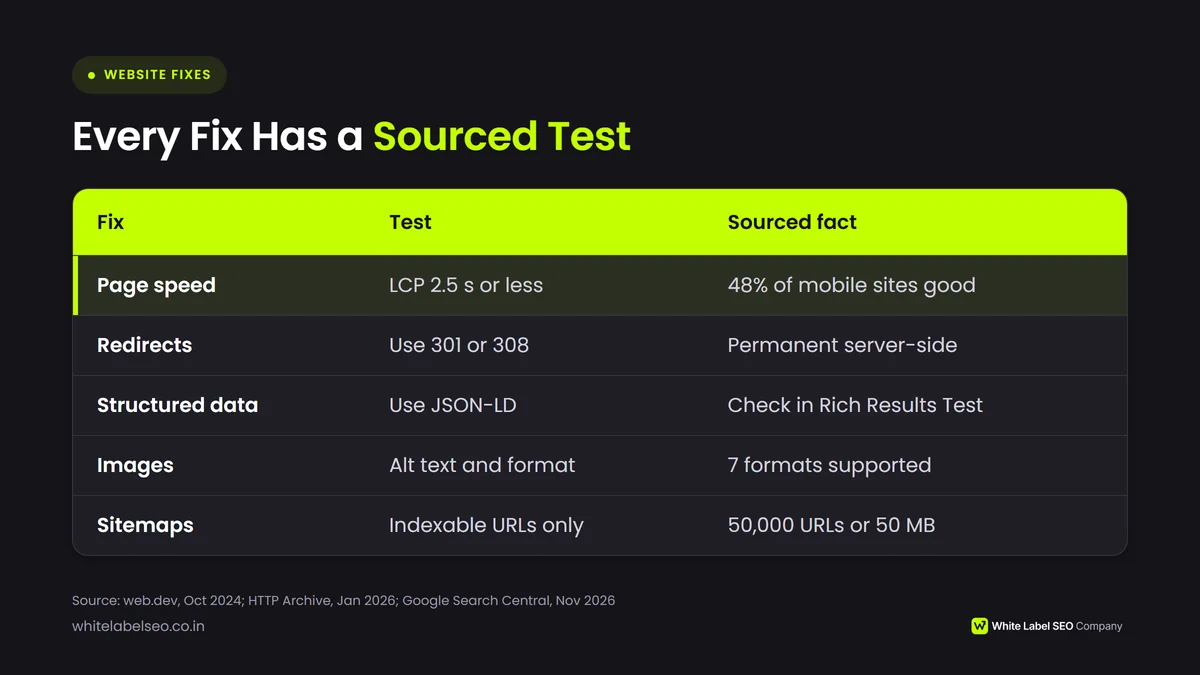
The table below lists the 8 website fixes in the order of this guide, with what changes and the sourced fact behind each.
| Website fix | What the partner changes | Sourced fact | Source |
|---|---|---|---|
| Title tags and H1s | Duplicate or vague titles become descriptive and distinct | No limit on title length; titles are cut to fit the device width | Google Search Central, title links |
| Page speed | Templates, images and scripts that slow LCP, INP and CLS | LCP 2.5 s or less; INP 200 ms or less; CLS 0.1 or less; good Core Web Vitals on 48% of mobile sites | web.dev, Oct 31, 2024; HTTP Archive, Jan 15, 2026 |
| Mobile content | Missing text, headings and markup on the mobile page | Same content, structured data, titles and descriptions on both versions | Google Search Central, mobile-first indexing |
| Redirects | Moved URLs point to new pages with server-side redirects | Permanent codes are 301 and 308 | Google Search Central, redirects |
| Internal links | Orphan pages get a crawlable link with descriptive anchor text | Every page you care about needs a link from at least 1 other page | Google Search Central, crawlable links |
| Structured data | JSON-LD added for visible content and validated | JSON-LD is recommended in most cases; 3 formats are supported | Google Search Central, structured data |
| Images | Alt text, file names and formats corrected | 7 image formats supported, from BMP to AVIF | Google Search Central, image SEO |
| Sitemaps and indexing | Only canonical, indexable URLs listed | Limit of 50,000 URLs or 50 MB per sitemap | Google Search Central, sitemaps |
The table shows that every fix has a pass or fail test you can show a client, so a result such as “LCP now 2.4 seconds” replaces a vague claim about better SEO.
What should a white label SEO partner hand back for each fix?
A white label SEO partner should hand back a change log, before and after proof, the affected URLs, a test result and a rollback note for every website fix. These five items let you report to the client in plain words and let you undo a change if something breaks.
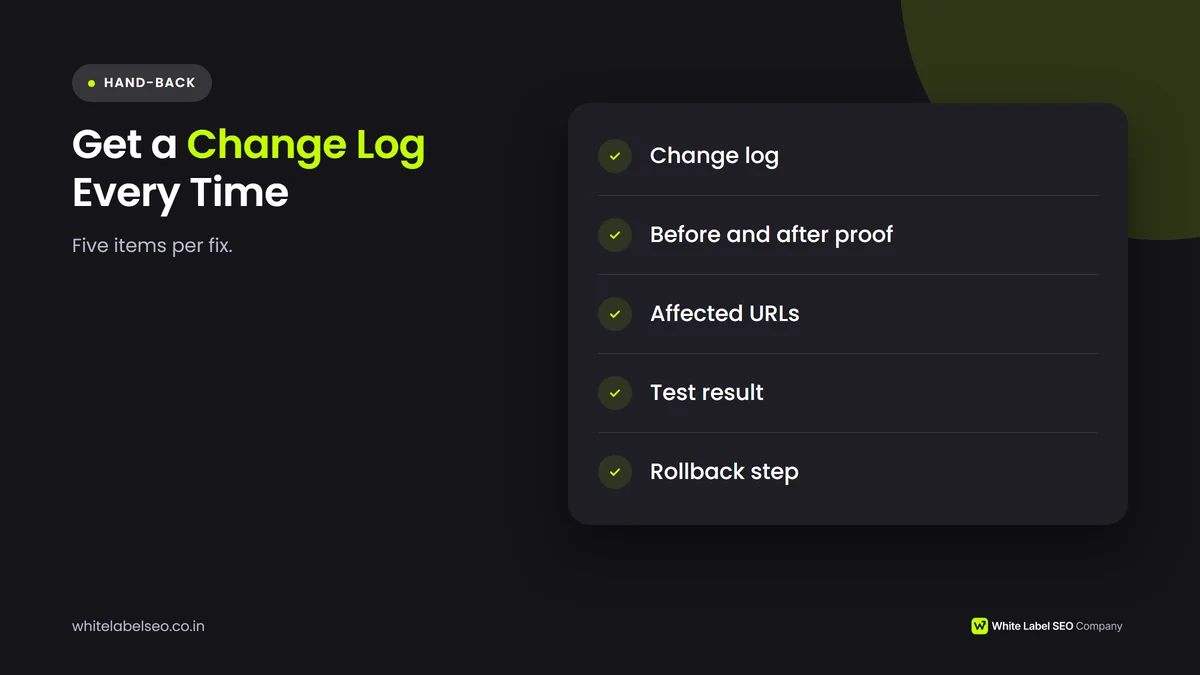
The 5 items a white label SEO partner should hand back after each website fix are listed below.
- Write a change log that names each page, the old value, the new value and the date, in words a client can read.
- Attach before and after proof such as a PageSpeed Insights result or a Rich Results Test screenshot.
- List the affected URLs so you know what was touched and can recheck it in Google Search Console.
- Record the test result for the fix, for example the redirect status code or the validated markup.
- State the rollback step so a change can be reversed if the client’s developer or plugin conflicts with it.
Ask for the same hand-back every month, and compare it with what a white label SEO partner does each month, so the fixes appear in the report next to the usual SEO work. Keep your own CMS admin account on the client’s site, and give the partner an editor-level user instead of the owner login.
Which website fixes belong in a white label SEO monthly retainer and which in a one-off project?
Fixes that keep recurring belong in a monthly retainer, and fixes that happen once belong in a one-off project. Title tags, internal links, structured data, image alt text and sitemap checks recur every time a client adds pages, while redirect maps and speed rebuilds are usually one-off project work.
The split protects your margin. A monthly retainer should cover the upkeep a partner does on every new page, such as titles, links, markup and sitemap entries. A one-off project suits larger jobs: a site-wide redirect map after a URL change, or a template change that raises mobile or speed scores. Price each project on its own and set the scope in writing.
Timing matters when you report. Google’s SEO Starter Guide says some changes take effect in a few hours and others take months, and suggests waiting a few weeks before judging a change. Report that the fix is done now, and report the ranking effect later.
When the job is a new build or a migration, not a fix to an existing site, it is a different service. We cover that border in how agencies white label website development alongside SEO.
Frequently asked questions
Can a white label SEO partner edit a client’s website directly?
Yes, a white label SEO partner can edit a client’s website directly if you give it an editor-level CMS user or a staging copy. Keep the admin and hosting logins in your agency’s or the client’s name, so the partner’s access can be removed at any time.
How long do website fixes take to show results?
Website fixes can show results in a few hours or take months, according to Google’s SEO Starter Guide, which suggests waiting a few weeks before judging a change. Report the finished fix first, then report traffic and ranking changes at the next monthly review.
Do these website fixes need a developer?
No, most of the 8 website fixes need no custom development: titles, alt text, internal links, sitemaps and JSON-LD can be changed in a CMS or a plugin. Redirect rules and speed work on a custom template can need server or theme access, so confirm that before you sell them.
Should you tell the client a partner made the fixes?
You do not need to name the white label SEO partner, but you should tell the client which pages changed and when. Present the work as your agency’s work, as with any white label delivery, and send the change log with the monthly report.
Which website fix should an agency sell first?
Title tags and headings are the best first website fix, because they are fast to make, easy to show in a before and after sheet and low risk. Add redirects and speed after that, once the client trusts the process.
What should you do next with these website fixes?
Pick 3 of the 8 website fixes for your next client proposal, write the change log and hand-back list into the scope, and decide which fixes sit in the monthly retainer and which are a one-off project. Then ask your partner to show a sample change log before you sell.
If you want a partner that makes these changes under your brand, see our white label SEO services at White Label SEO.
Want to add website fixes to your SEO packages?
At White Label SEO, we make the fixes in this list on your clients’ existing sites, under your brand, and send a change log for every change. Tell us which client site you want to start with, and we’ll scope the first fixes with you.
Sources
- web.dev (Google), “Web Vitals”, updated October 31, 2024. https://web.dev/articles/vitals
- HTTP Archive, “Web Almanac 2025: Performance”, published January 15, 2026. https://almanac.httparchive.org/en/2025/performance
- Google Search Central, “Redirects and Google Search”, accessed November 27, 2026. https://developers.google.com/search/docs/crawling-indexing/301-redirects
- Google Search Central, “Introduction to structured data markup in Google Search”, accessed November 27, 2026. https://developers.google.com/search/docs/appearance/structured-data/intro-structured-data
- Google Search Central, “Influence your title links in search results”, accessed November 27, 2026. https://developers.google.com/search/docs/appearance/title-link
- Google Search Central, “Making links crawlable”, accessed November 27, 2026. https://developers.google.com/search/docs/crawling-indexing/links-crawlable
- Google Search Central, “Mobile-first indexing best practices”, accessed November 27, 2026. https://developers.google.com/search/docs/crawling-indexing/mobile/mobile-sites-mobile-first-indexing
- Google Search Central, “Google Images SEO best practices”, accessed November 27, 2026. https://developers.google.com/search/docs/appearance/google-images
- Google Search Central, “Build and submit a sitemap”, accessed November 27, 2026. https://developers.google.com/search/docs/crawling-indexing/sitemaps/build-sitemap
- Google Search Central, “SEO Starter Guide”, accessed November 27, 2026. https://developers.google.com/search/docs/fundamentals/seo-starter-guide
- ZealousWeb, “From Audit to Action: How Agencies Deliver SEO Fixes at Scale With a White-Label Execution Partner”, June 18, 2026. https://www.zealousweb.com/resources/blog/technical-seo-execution-partner-for-agencies/
